Jörmungandr and the ouroboros through world mythology

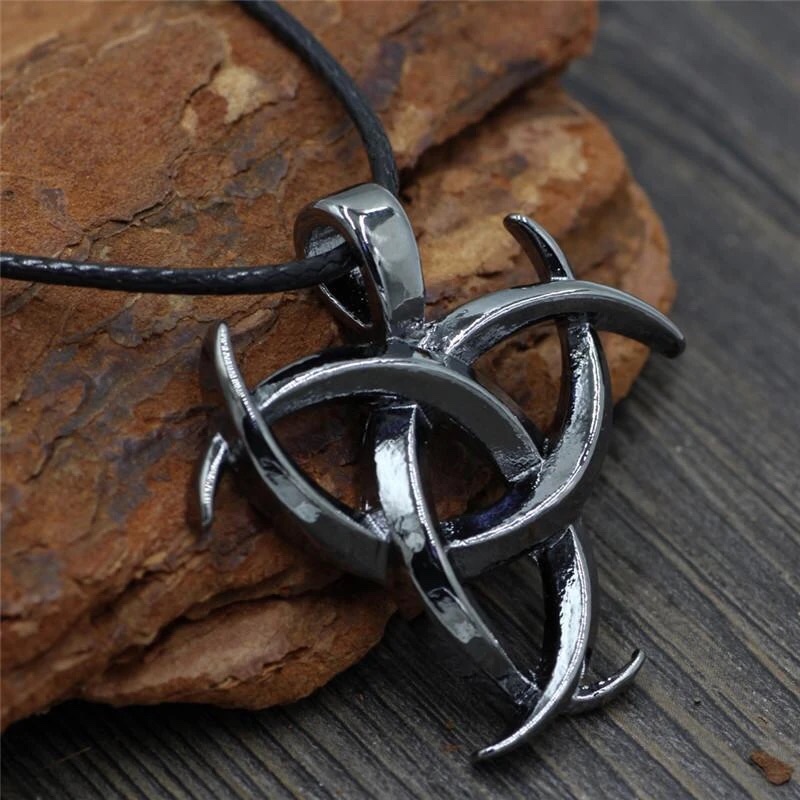
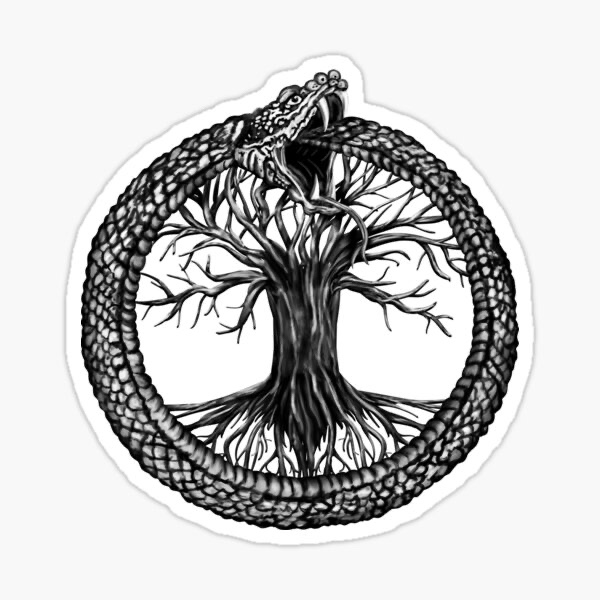
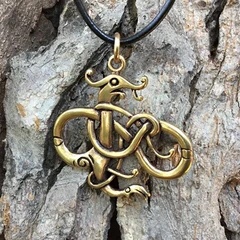
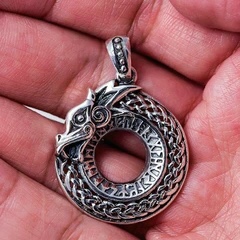
Of all the gods, giants, beasts, and spirits that stalked the Viking mental landscape, Jörmungandr – the world-coiling serpent – remains one of the most renowned. Jörmungandr is also known as the Midgard Serpent because he was a sea monster so large that he wrapped all the way around Midgard (the world of humans). When this gigantic beast stirs, storms, earthquakes, and tidal waves erupt. Jörmungandr lies in the depths of the sea, encircling the earth, holding his own tail in his mouth, waiting for the day of Ragnarok. It is said that when the serpent releases his tail and begins his attack, Ragnarok – the ‘final’ dark day for the gods – will begin.

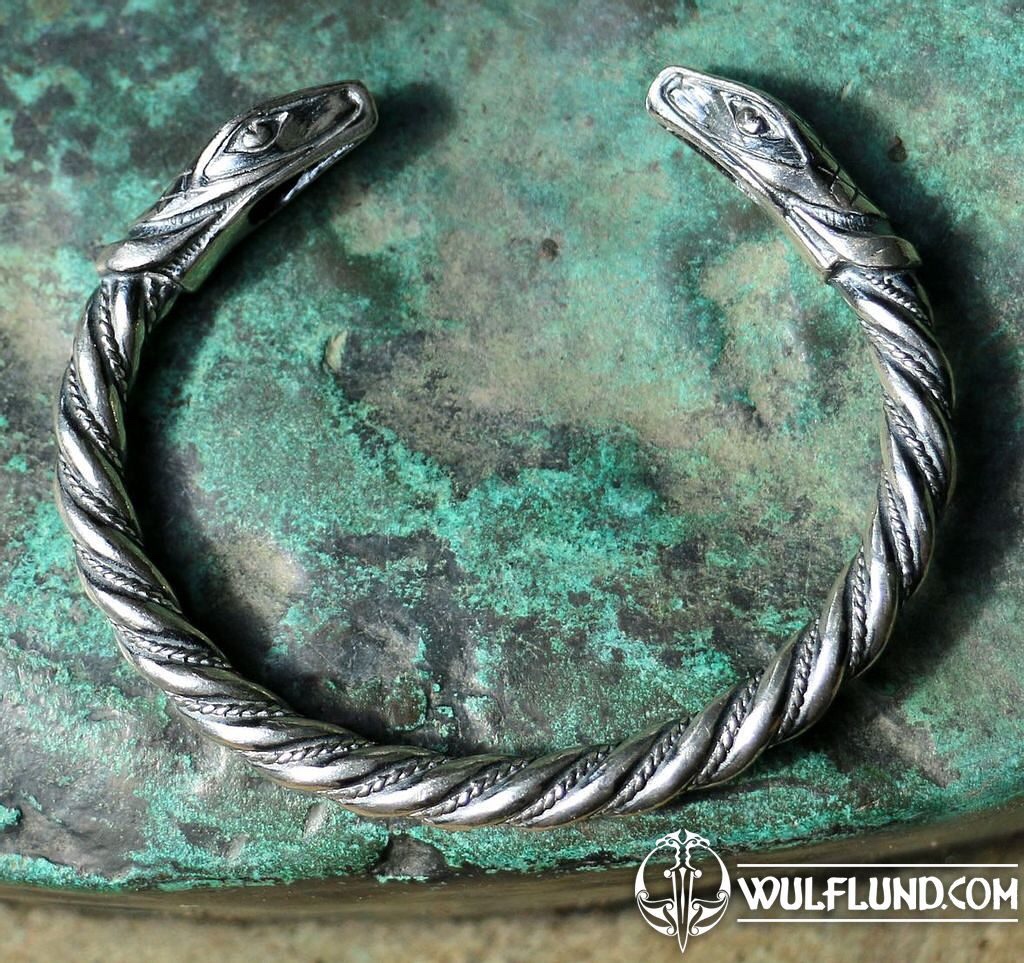
Jörmungandr is not the only world-coiling serpent across the thousands of years and hundreds of cultures that color the human imagination. In fact, the image of a tail-swallowing dragon can be found worldwide and throughout history. This symbol of the circular snake is called the ouroboros. The earliest known ouroboros depiction is from the grave of Pharaoh Tutankhamen from the 13th century B.C. Since that time, similar images have shown up in ancient Chinese, Persian, Hindu, Greek, and Mesoamerican sites and artifacts. The ouroboros was also prominently featured in the language of mysticism amongst the Gnostics, Hermetic, and alchemists throughout Late Antiquity and the Middle Ages.

In most of these settings, the ouroboros signifies time – depicting the living, breathing cycle of ages that have no real beginning and no real end. In Roman sources, the ouroboros symbolized the god Saturn (the Greek Kronos from where we get words like chronology and chronometer). Saturn/Kronos was a god of time. He was considered by the Greco-Romans to be especially savage and terrifying. He was lord of the Titans – spirits of elemental chaos that were something like the giants (Jötnar) of Viking lore. In all this imagery, the ouroboros represents the endless cycles of creation and destruction. In fact, many scholars believe that our mathematical symbol for eternity – the sideways figure eight (∞) – is a shorthand adaptation of the ouroboros symbol.

Source: Sons of Vikings
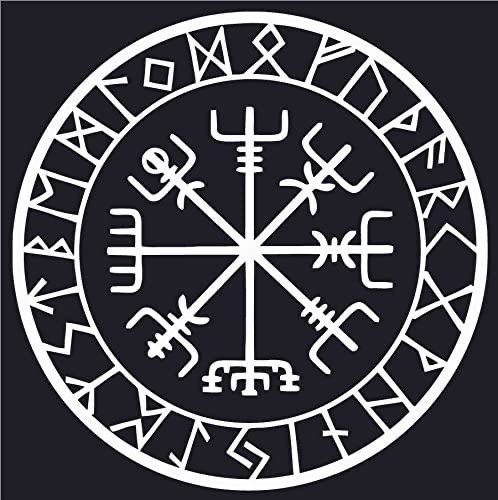
Time to take back Viking history and Symbolism from racists and white supremacists

“All manner of Viking symbols and misconceptions about a golden age of Nordic racial purity have been appropriated by racist extremists looking to justify their xenophobia and acts of violence, according to the University of Alberta researcher.

Van Deusen said the age of racial purity never existed and she is determined to debunk the corrosive myth at every turn, especially in the classroom.

Viking symbols are everywhere among the ultra-right. When the Unite the Right rally took place in Charlottesville in 2017, some protesters carried banners featuring the Norse god Thor’s hammer, popular among the Nazis and neo-Nazi groups.

The perpetrator of New Zealand’s Christchurch massacre last year wrote, “See you in Valhalla”-referring to the great hall where heroes of Norse mythology go after they die-at the end of his manifesto.

Closer to home, the Soldiers of Odin-a Finnish white supremacist movement named after another Norse god in 2015-have recently emerged in Alberta and throughout Canada.

“The precedent was set with the Nazis,” said Van Deusen. “National Socialism and Hitler idealized the Norse people-those who lived in the Nordic areas. Even the swastika is based in part on a symbol based on Viking artifacts.”

Source: https://www.ualberta.ca/folio/2020/07/white-supremacists-are-misappropriating-norse-mythology-says-expert.html

What does the word Viking even mean?

Viking in Old Norse

Viking in Old Norse is víkingr. The ‘r’ on the end is essentially a grammatical feature of Old Norse for denoting a masculine noun. It is often dropped in English transliteration (for example, people may write the name of the god Freyr as Frey). In Old Norse, víkingr was someone who was a seaborne raider/adventurer.

Noun or Verb

Víkingr and plural forms of the word, such as víkingum or víkingar, appear as nouns describing Scandinavian seaborne raiders in the sagas, Eddic poetry, and runestones.

We see literally carved in stone the term “Viking” being used as a noun and to denote people. From the context, it does not seem that “Viking” referred to everybody, though, but to some type of traveling warrior.

Viking’ also used as a Verb in Old Norse

Viking could also be a verb in Old Norse. This verb meant the act of seaborne raiding or adventuring. So, a víkingr would víking, or in other words, a seaborne raider would raid by sea. In many historical fiction books, this is rendered “to go viking.”

There is no evidence to suggest that the verb was more prevalent than the noun or adjective. However, it is fair to say that Vikings used the terms víkingr and víking differently than we use these terms.

What Vikings Called Themselves, and What Other People Called Them

It is essential to remember that in our ancestors’ times many of the current cultural values did not exist. ideals, concepts, and information we now take for granted had not developed yet. Today, one of the strongest ways people identify is by their nationality – we are Americans, Norwegians, etc. While many of Europe’s nations began to form and organize in the Viking Age, national identity was then only in its embryonic stages. 

As the Viking Age dawned, the Nordic peoples of Scandinavia shared a common language, culture, and faith. However, they did not share a strong sense of common identity, as evidenced by their constant wars, raiding, and competition – even within the geographical boundaries of their homeland. They were divided into numerous tribes or clans.

Their societies were arranged in small units united by kinship and their allegiance was to local chieftain. The first “King of All Norway,” Harald Fairhair, did not consolidate power until a century into the Viking Age, and the political boundaries of Denmark, Norway, and Sweden would not solidify for several centuries after that.

So, while Vikings used the term víkingr for a seaborne adventurer, early medieval Scandinavian peoples had no overarching name for themselves. They did not think that way. Instead, they identified themselves by family, clan, and tribal loyalties. During the Viking Age, these intimate groups formed larger and larger networks and affected greater and greater changes far from home. 

Vikings might not have had a common term for themselves, but their enemies had many. The English and the French tended to call them all Danes. Archeology is abundantly clear, though, that the “Great Heathen Army,” the “Army of the Seine,” and these other large forces were not just Danes but mixed companies from locations wherever Vikings roamed. 

English monks, writing in Latin, also adopted the word, Wiccinga/Wiccingi (the Old English form of ‘viking’ in Latinized singular and plural forms). This capitalization in the manuscripts strongly suggests the Vikings were known by that name, and that it is not just a generic descriptor.

There were other names in other places. In Ireland, the Vikings were called “the Foreigners.” In the east – Russia, Ukraine, Belarus, the Byzantine Empire, Bulgaria, and the Mediterranean – Vikings were called Varangians (“sworn companions”) and Rus’. To the Moors of Spain and the Arabs around the Caspian, they were called Majūs.

Source: Sons Of Vikings

Lavender Wands

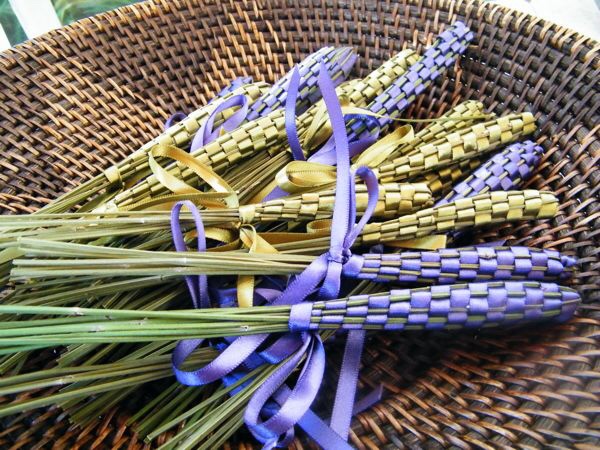
The wand is made by weaving a ribbon over and under adjacent stalks, so you must use an odd number of stalks. (I suggest using 13). Harvest only the most robust and straight flower stalks.

• 6 feet 1/4-inch satin ribbon
• 13 stalks fresh, straight, long-stemmed lavender
• Heavy thread
• Clippers
• Scissors

1. Align the flower heads and wrap the thread tightly below the flowers, including one end of the ribbon. Knot the thread and trim the ends; leave 1/4 inch tail of the ribbon.

2. Turn the wand so the flowers point downward. One at a time, bend the stalks over the thread. (Pressing your thumbnail into the stalk above the thread as you bend it prevents breakage if the stalks have dried out a little.) Space stalks evenly like the spines of an umbrella.

3. Bring the ribbon to the outside of the umbrella and begin to weave over and under adjacent stalks. As you weave, pull on the ribbon fairly hard and make sure the flowers inside are covered. As the pulling causes the stalks to twist, realign them after weaving three rounds so they are once again straight and evenly spaced. Repeat this step if necessary after the sixth round.

4. After weaving beyond the flower heads, form a handle by weaving the ribbon tightly for 4 to 5 inches. Tie it off in a bow. After the wand dries, reweave the ribbon on the now shrunken handle and retie the bow.

Source: Mother Earth Living

Who Were The Norse?

“The term ‘Norse’ is used to describe the various peoples of Scandinavia who spoke the Old Norse language between the eighth and thirteenth centuries AD. While it had eastern and western dialects it would have been generally mutually understood across the range of areas within which it was spoken. A third recognisable form was spoken on the island of Gotland.

The Old Norse language later developed into modern Danish, Faroese, Icelandic, Norwegian and Swedish. In addition, there once existed the so-called Norn languages of Orkney and Shetland that are now extinct. It was, essentially, the language of the Vikings.”

~ Martyn Whittock, from Tales of Valhalla

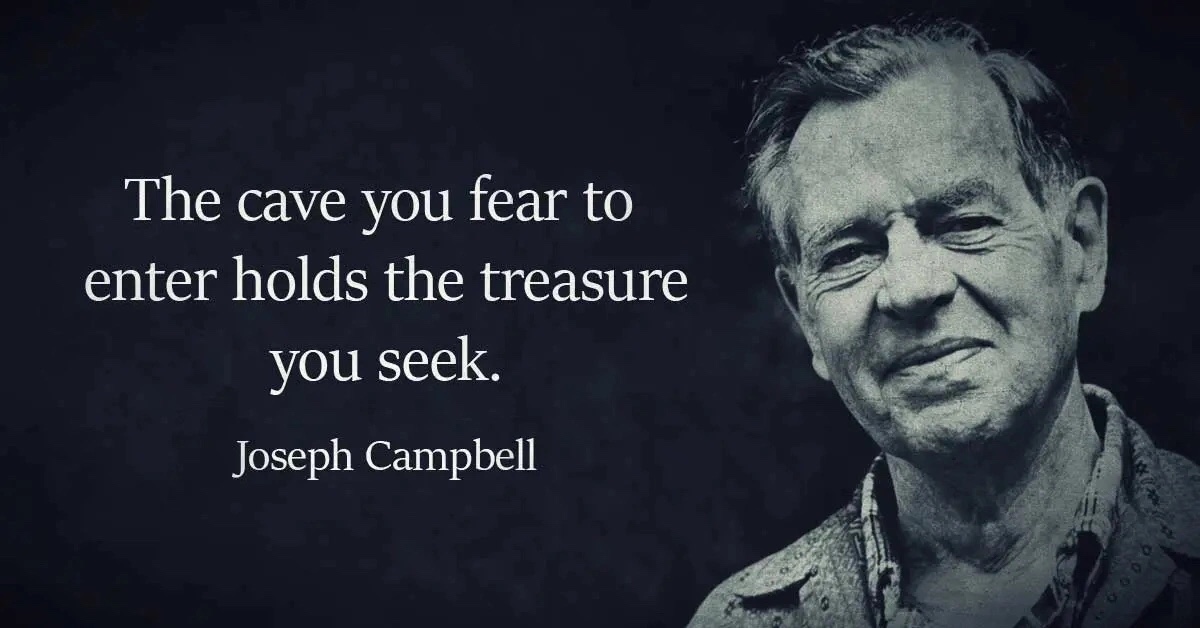
Joseph Campbell on “Society”

“You can tell what’s informing a society by what the tallest building is. When you approach a medieval town, the cathedral is the tallest thing in the place. When you approach an eighteenth-century town, it is the political palace that’s the tallest thing in the place. And when you approach a modern city, the tallest places are the office buildings, the center of economic life.”

~ Joseph Campbell

#FavoriteQuotes #JosephCampbell

Huldufólk

In Iceland and the Faroe Islands, elves are often called the Huldufólk (the hidden folk). They are mysterious and mischievous, at times acting helpful and at other times playing tricks. Tradition says they make their homes in the rocks that cover the island. For centuries, the wee folk lived in the dancing shadows of hearth fires as farmers entertained wide-eyed children with tales of shenanigans while warning them not to stray too far from home, lest they disappear into elfland, never to return.

In Iceland, elves, (‘alfar’ in Icelandic), are beings thought to be smaller than most humans. Elves are thought to live outdoors, and to rarely speak. While some Icelanders believe elves to be a very distinct group, many have come to see them as synonymous with another group of mythical beings known as the huldufólk, or Hidden People.

Like elves, huldufólk also live outdoors, making their homes in Iceland’s rocks and cliffs. According to a study done in 2006, 32% of Icelanders believe the existence of these beings to be possible, while 24% believe their existence is either likely or an outright certainty.

Celebrating elves and huldufólk is common in Iceland. For instance, it is customary for Icelanders to clean and leave food for elves as it’s believed they hold parties late at night. On New Year’s Eve, it is thought that huldufólk move to new locations. As a result, it’s traditional to leave candles out to help them find their way. Finally, Þrettándinn, or Thirteenth Night, is celebrated on January 6th and marks the last day of Christmas in Iceland. On this day, bonfires called álfabrennur, of Elf Fires, are commonly lit.

#Huldufólk #Elves #Iceland #FaroeIslands

Dorling Kindersley, From “The Mythology Book”

“Myths had a great influence on the societal fabric of history’s greatest civilizations. The rich and complex mythology of ancient Egypt emphasized the creation of order out of chaos. Such stories validated the governance of society and legitimized a status quo in which the pharaoh himself was viewed as divine and therefore worthy of being served. The Egyptians also saw time as cyclical; events that happened in their society were merely repeating what had happened before and had been recorded in their myths.”

~ Dorling Kindersley, From “The Mythology Book”