Ginnungagap

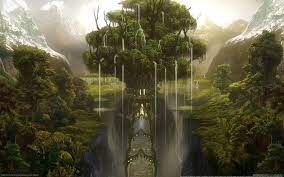
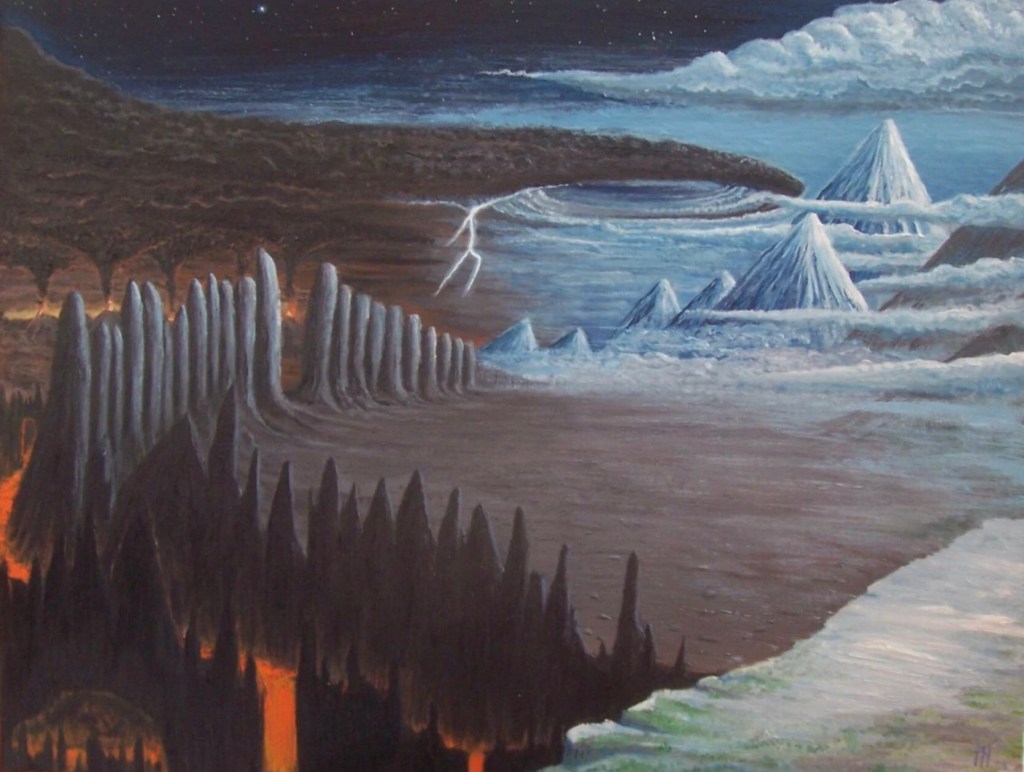
Ginnungagap (“seeming emptiness”), in the cosmology of Norse mythology, is the primordial void separating Niflheim and Muspell, the land of eternal ice and snow and the land of eternal heat and flame.In the beginning, before the world of men and gods existed, the spring Hvergelmir, deep in the frozen wastes of Niflheim, gave rise to eleven rivers known as the Elivagar. Over a long period of time, water of the Elivagar ran across Niflheim and poured into the northern part of Ginnungagap. The water froze, forming vast sheets of ice in the void. Hot air from Muspell melted some of the ice, creating a zone of meltwater amid the ice and snow. Here life began, and the first living thing was a frost giant.

The Younger Futhark

The runic alphabet that was used during the Viking Age is called Younger Futhark. These runes can be found on hundreds of runestones throughout Scandinavia. This alphabet does not consist of many runes, and that is because the Norse language evolved a lot during the Iron Age, which meant that the runic alphabet was reduced from 24 to 16 runes.

Each rune has its own name and sound. Some of the runes are used to spell the same letter, for instance, the Týr rune is used for the letters “t” and “d”, and kaun is used for “g” and “k”. 

The names on this list of the Younger Futhark runes have been taken from the website of The National Museum in Copenhagen. The names of the runes may vary slightly depending on the language and on which runologist has conducted the research.

Heka & Akhu: Ancient Egyptian Magic

Heka (magic) was already at the heart of Egyptian beliefs by 4000 BCE. Creator deities such as Nu (the watery abyss) were said to have used heka to bring the world into existence from primordial chaos. In doing so, they subdued the forces of chaos, but the forces constantly sought to return and could only be stopped by heka. For the ancient Egyptians, it was not just the gods that handled magic. Lesser supernatural beings, pharaohs, and the dead were thought to possess an element of heka, which they could channel through the use of spells to deflect the attention of malevolent spirits.

The ancient Egyptians also believed in another form of magic power called akhu, which was malign and closely associated with beings of the underworld. To protect against akhu magical practitioners such as priests, scribes in the “Houses of Life”—which held the manuscript collections of Egyptian temples—sunu (doctors), and sau (amulet-makers) employed heka spells, rituals, and magical objects. Indeed, faith in heka was so widespread that ancient Egyptians used it in all aspects of life from matters of state to the delivery of oracles and more mundane village affairs, such as love matches, protection during childbirth, and curing minor illnesses. As well as being an abstract force, there was a god called Heka who personified magic. Heka helped ensure the harmony of the cosmos and acted as a conduit through whom worshippers could seek divine favors. He had a female counterpart, Weret-hekau (Great of Magic), who was depicted in the form of a cobra. It is thought that the snake-headed staffs often used by ancient Egyptian magicians may have represented her.

Sources: A History of Magic, Witchcraft and the Occult

Fólkvangr

In Norse mythology, Fólkvangr (“field of the host” or “people-field” or “army-field”) is a meadow or field ruled over by the goddess Freyja where half of those that die in combat go upon death, whilst the other half go to the god Odin in Valhalla.

Others were also brought to Fólkvangr after their death; Egils Saga, for example, has a world-weary female character declare that she’ll never taste food again until she dines with Freya. Fólkvangr is attested in the Poetic Edda, compiled in the 13th century from earlier traditional sources, and the Prose Edda, written in the 13th century by Snorri Sturluson. According to the Prose Edda, within Fólkvangr is Freyja’s hall Sessrúmnir. Scholarly theories have been proposed about the implications of the location.

After each battle, Odin and Freyja would choose the einherjar who have proven themselves to be the most courageous fighters and divide them among themselves. The fallen Viking warriors will later be brought to either Folkvangr or Valhalla. The less fortunate ones, however, had no choice and would go to Hel. In the underworld, they would live eternally, but only merely continuing their ordinary lives on earth: eating, drinking, and sleeping.

There are not many differences when it comes to practicality and routine in these two dwelling places of the Gods. In fact, life in both of them equally would be an envy of any Viking warrior. In Folkvangr, as well as in Valhalla, warriors would fight amongst each other every day, making sure they will be prepared when the Ragnarok comes. Many of them would be injured, many of them slaughtered; however, in the evening, their wounds would heal, and they would be ready to feast.

Actually, the only real difference between Valhalla and Folkvangr lies in the way of entering them. Namely, those who die honorably are chosen between Odin and Freya to enter their respective realms. The ones chosen by Odin enter Valhalla, while those who are selected by Freya enter Folkvangr.

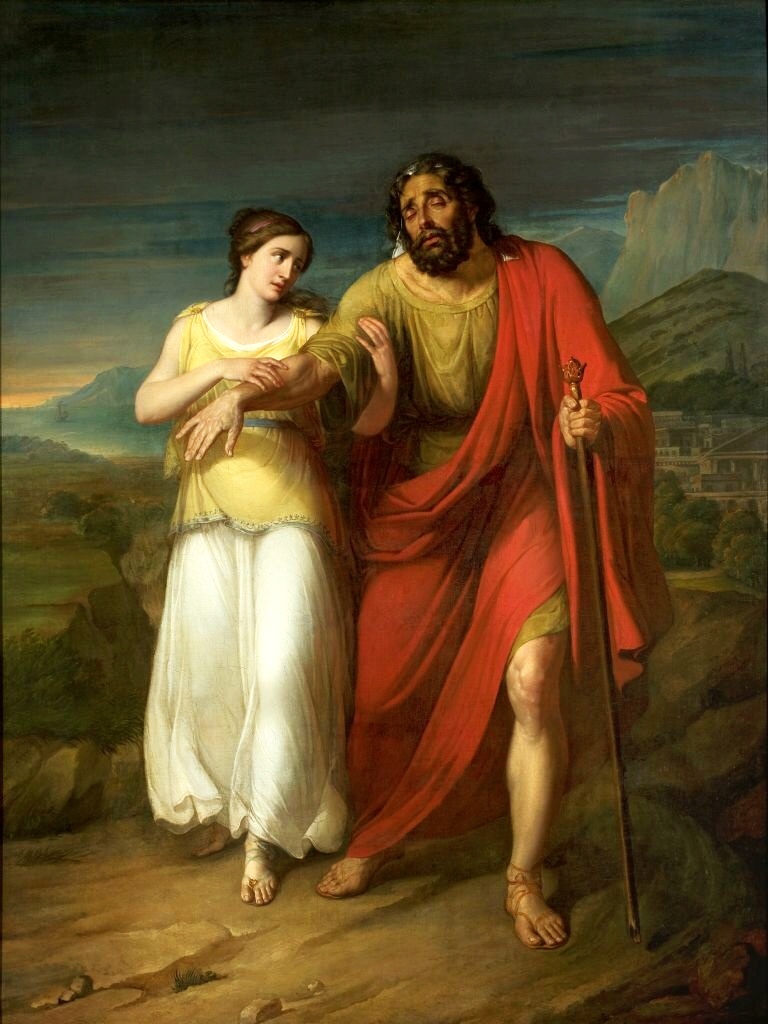
Oedipus and Antigone (1825) – Aleksander Kokular

In Greek mythology, Antigone was the daughter of Oedipus by his own mother, Jocasta, and the sister of Eteocles, Polyneices, and Ismene.

When her father went into exile she accompanied the blind man as his guide.

Two versions exist of Antigone’s fate after she defied King Creon. In the first, the subject of the tragedy Antigone by Sophocles, Creon ordered that she be immured as a punishment, but rather than face burial while alive she hanged herself; Haemon, the son of Creon to whom she was betrothed, committed suicide alongside her. In the second version, Creon turned Antigone over to Haemon for punishment, but he smuggled her away, and she later bore him a son. When Creon refused to forgive them, Haemon killed both himself and Antigone.

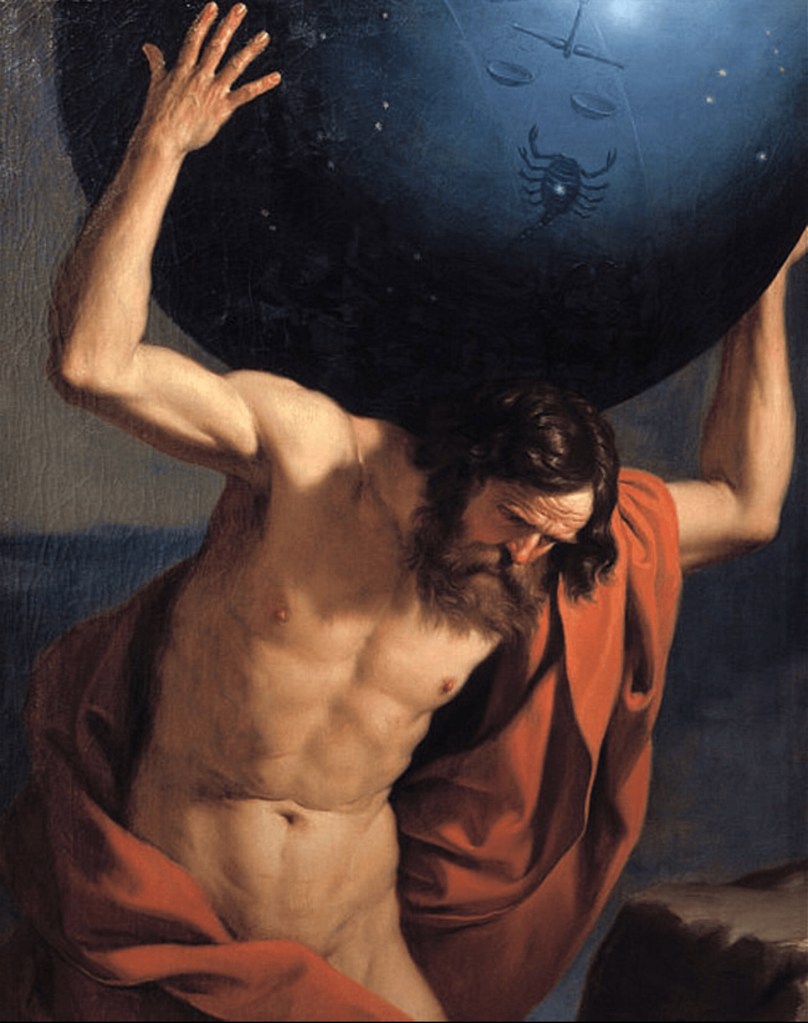
Atlas Holding Up the Celestial Globe (1646) – Guercino

Atlas was the son of Iapetus and Clymene. He was the leader of the Titans in their battle against the Olympian Gods. The Titans were defeated and all but Atlas were confined to Tartarus, a section of the Underworld. Atlas’s punishment was to carry the sky upon his shoulders throughout eternity. During one of his 12 famous labors, the great hero Heracles took the burden from the shoulders of Atlas so that the Titan could fetch for him the golden apples of the Hesperides. When Atlas returned, Heracles tricked him into taking back the weight of the heavens.

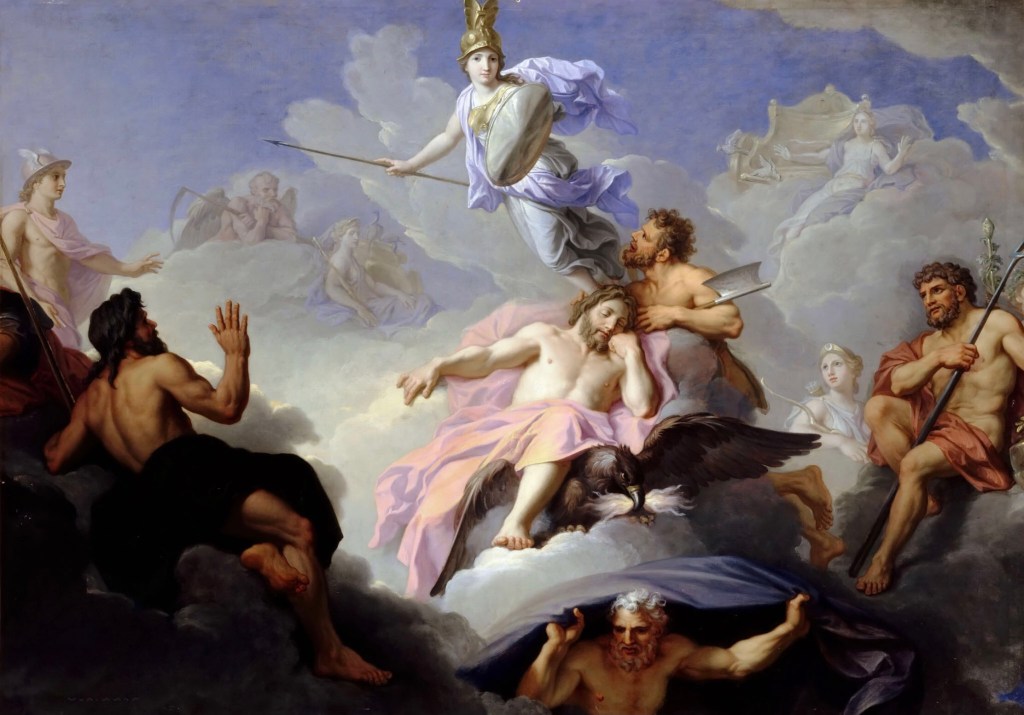
The Birth of Minerva [Athena] (1688) – René-Antoine Houasse

Athena, often given the epithet Pallas, is the goddess of wisdom, courage, inspiration, civilization, law and justice, strategic war, mathematics, strength, war strategy, the arts, crafts, and skill in ancient Greek religion and mythology. Minerva is the Roman goddess identified with Athena.

There are many different stories about the birth and parentage of Athena. In the most familiar story, she sprang fully armed from the head of Zeus when Hephaestus split it open with an ax. Zeus had previously swallowed his consort, Metis, on learning that she would soon bear a child who would rule the gods.

The 18 Levels of Hell in Chinese Mythology

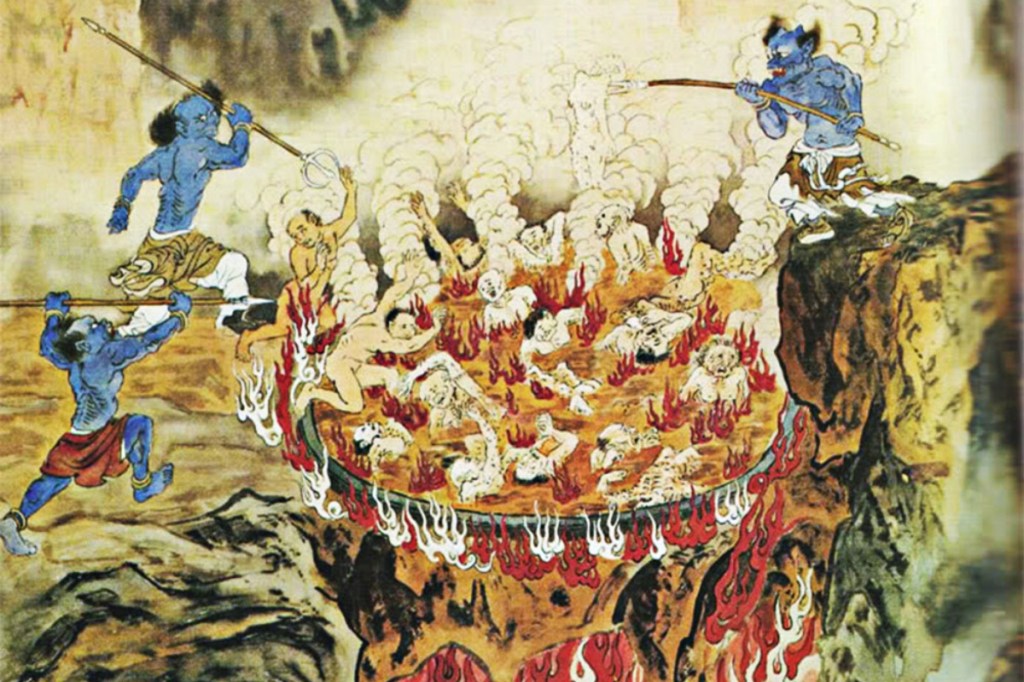
Buddhism and Taoism—the main religions of China—both have different interpretations of hell and how it is structured, but what they can both agree on is this: Sinners who accumulate bad karma during their lives have to atone for their sins after their death. Their souls are therefore taken into hell, a fiery place consisting of several layers, courts, or circles, each doling out a different punishment for specific sins.

A big difference between the Chinese hell and the concept of hell most known in Christianity is that in Chinese hell, souls are not necessarily condemned to eternal damnation. While broadly believed in Western culture that sinners have to suffer in hell until the second coming of Christ, the Chinese version of hell is more of a purgatory, where souls are able to eventually leave and be reincarnated back into the world once they have done their time.

  • Hell of Tongue-ripping, where those who gossip and spread trouble with their words will repeatedly have their tongues ripped out.
  • Hell of Scissors, where those who destroy someone else’s marriage will have their fingers repeatedly cut off.
  • Hell of Trees of Knives, where those who sow discord amongst family members will be repeatedly hung from trees made of sharp knives.
  • Hell of Mirrors of Retribution, where those who have managed to escape punishment for their crimes while alive will be repeatedly shown their true horrific selves.
  • Hell of Steamers, where hypocrites and troublemakers will repeatedly be steamed “alive.”
  • Hell of Copper Pillars, where arsonists will be repeatedly chained to red-hot pillars of copper.
  • Hell of the Mountain of Knives, where those who have killed for pleasure or without good reason will repeatedly be made to climb a mountain made of sharp blades sticking out of it.
  • Hell of the Mountain of Ice, where adulterers, deceivers of elders, and schemers will be repeatedly left out on a barren mountain of ice to freeze.
  • Hell of the Cauldrons of Oil, where rapists, thieves, abusers, and false accusers will be repeatedly fried in vats of boiling oil.
  • Hell of the Cattle Pit, where those who have abused animals will repeatedly be hurt by animals in turn.
  • Hell of the Crushing Boulder, where those who have abandoned or killed children will repeatedly be made to hold up heavy boulders, eventually being crushed by its weight.
  • Hell of Mortars and Pestles, where those who voluntarily waste food will repeatedly be force-fed hell fire by demons.
  • Hell of the Blood Pool, where those who disrespect others will be thrown in and submerged into a pool of blood.
  • Hell of the Wrongful Dead, where those who have commited suicide—considered deliberately going against the karmic course of the universe—will be force to repeatedly wander the realm without a way out, while being pelted constantly by the Winds of Sorrow and the Rains of Pain.
  • Hell of Dismemberment, where tomb raiders will have their bodies repeatedly be torn into pieces.
  • Hell of the Mountain of Fire, where thieves, robbers, and the corrupt will be repeatedly thrown into the fiery pits of an active volcano.
  • Hell of Mills, where those who have misused their power to oppress the weak will repeatedly be crushed in a stone mill.
  • Hell of Saws, where those who have engaged in unethical or unfair business practises, or exploited loopholes in the legal system, will be repeatedly sawn in half by demons with saws.