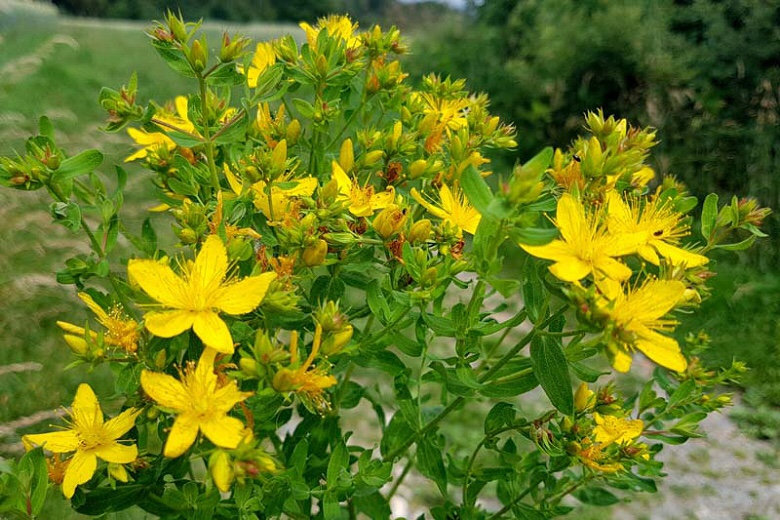
Saint John’s Wort (Hypericum perforatum)

Saint John’s wort (Hypericum perforatum): This true midsummer flower is strongly influenced by the midday sun. The countless gold-yellow filaments burst out of the calyx like sun rays. They make the flowers, which open only during dry weather, look like tiny suns. The flower petals look as if they might be small airplane propellers and are reminiscent of swirling beams of light and of the light chakras. As a medicinal herb, this plant of the Sunflower family has a soothing effect on the nerves, brings light into the soul, and chases away the darkness.

For centuries, St. John’s wort served as a talisman against evil. At the same time, it was prized for its medicinal power, both helping heal wounds and ease psychological stress. In ancient Rome and Greece, the herb was used to treat inflammation of all kinds, and was even put to use in compounds used on serious battle wounds.

Warning: St. John’s wort may interfere with some prescription medicines. If you take prescription drugs of any kind, be sure to talk with a naturopath or a health care professional familiar with Natural Standard, the top resource for drug-herb interactions, to determine a safe level before taking remedies containing the herb.
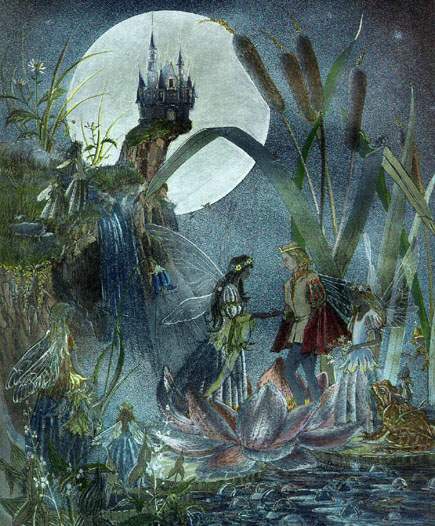
Faerie Flowers

Specific flowers, such as buddleia, attract butterflies and fairies alike. Wild flowers that are bell-shaped, such as foxgloves and bluebells, work in much the same way. Planting certain flowers will encourage fairies to come in their droves and bring an extra sparkle of magic to your back yard:

  • Bluebell: The indigo hue attracts fairies. They love to dance on bluebell-carpeted woodland.
  • Buttercup: The golden cup brings confidence and awareness of your own abilities.
  • Clover: Three- or four-leaved clover can be carried as a protective charm.
  • Cowslip: Thought to be a portal into the fairy dimension.
  • Daffodil: This yellow trumpet ushers in the spring and brings clarity and new beginnings.
  • Daisy: Holds both the strong male energy of the sun and the soft feminine energy of the moon.
  • Heather: Perfect for fairies to feed from.
  • Honeysuckle: Its potent fragrance evokes old memories and buried feelings.
  • Lavender: Its therapeutic fragrance soothes, cleanses and calms and induces sleep.
  • Marigold: Connected to the warmth of the sun, it has magical potency at noon.
  • Poppy: Bringer of dreams and visions, inspiration and creativity – when used carefully.
  • Primrose: Portal to the fairy realm. Protects the household from harm.
  • Rose: Bringer of love, healer of the heart and feminine energy.
  • Snapdragon: Repels negativity and reveals hidden truths.
  • Tulip: Shaped like a chalice, this ‘cup of love’ assists with feeling the blessings of nature.”

Sources: Connecting with the Fairies Made Easy

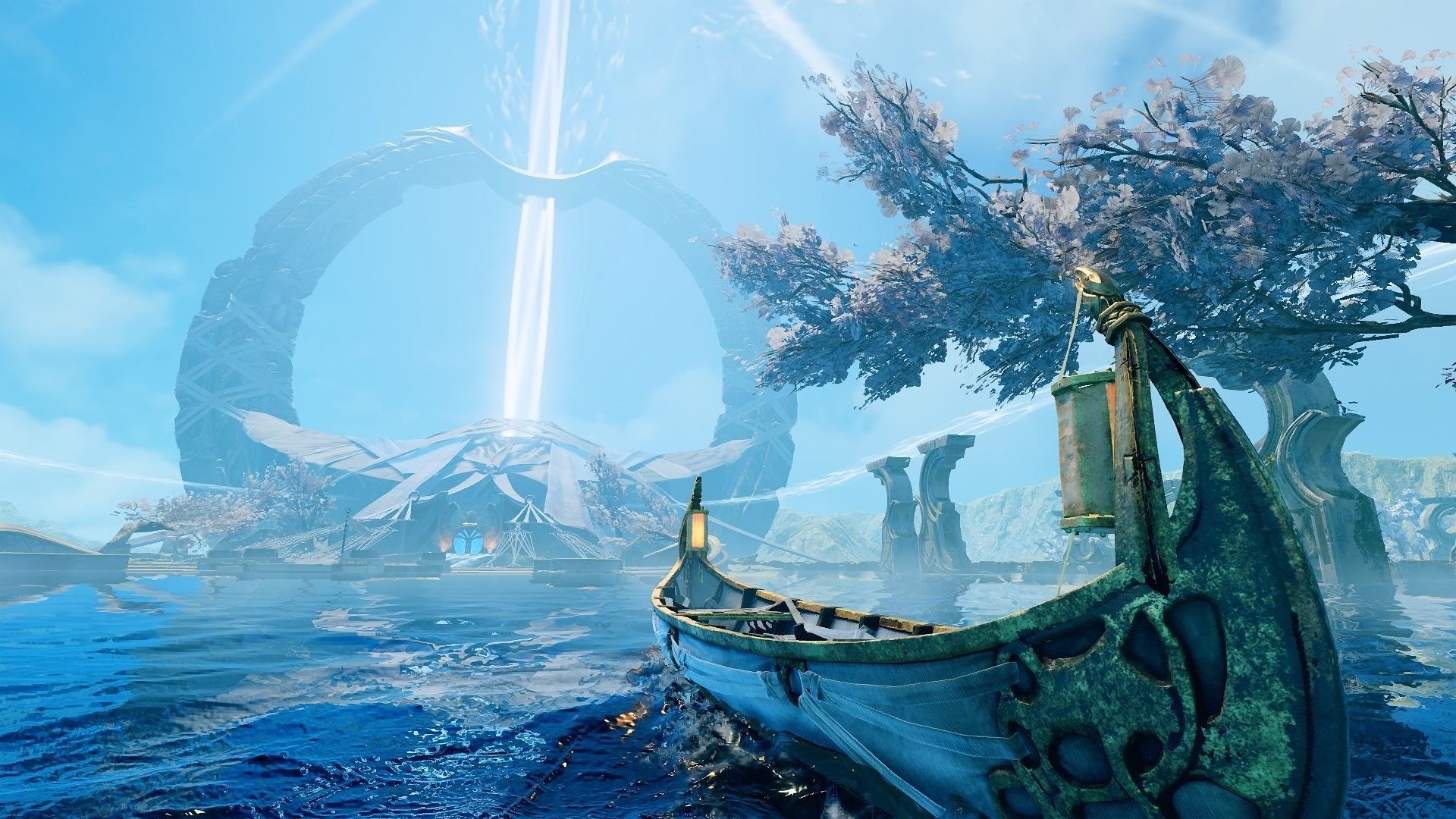
Alfheim

Alfheim (“elf home”), in Norse mythology, is one of the nine worlds. It is located on the highest level of the Norse universe. Also found on this level are the worlds of Asgard and Vanaheim. Alfheim is the palace of the god Freyr and the homeland of the elves of light. Neither the elves of light nor the elves of darkness, who live in Svartalfheim, participate in any of the events described in the Norse myths. Elves do, however, have active roles in the literature of quite a few of the other branches of Indo-European mythology.

Alfheim is never described in the sources that form the basis of our current knowledge of heathen Germanic religion, but is rather merely mentioned in passing in a few places. However, the elves are described as being luminous and “more beautiful than the sun,” so we may suppose that their homeland was a gracious realm of light and beauty. Although the realms that comprise the Nine Worlds of the Norse cosmology are never listed, it seems highly probable that, given the prominence of the elves in Germanic religion, Alfheim was one of them.

The Vanir god Freyr is said to be the ruler of Alfheim. Scholars have long puzzled over what to make of this, and no wholly satisfactory conclusions have been put forth. The relationship between the elves and the Vanir is highly ambiguous and involves considerable overlap between the two groups. Freyr’s position as lord of Alfheim, therefore, while hard to interpret with much precision, shouldn’t be entirely surprising.

Fenrir

Fenrir (or Fenris) is a gigantic and terrible monster in the shape of a wolf. He is the eldest child of Loki and the giantess Angrboda. The gods learned of a prophecy which stated that the wolf and his family would one day be responsible for the destruction of the world. They caught the wolf and locked him in a cage. Only the god of war, Tyr, dared to feed and take care of the wolf. When he was still a pup they had nothing to fear, but when the gods saw one day how he had grown, they decided to render him harmless. However, none of the gods had enough courage to face the gigantic wolf. Instead, they tried to trick him. They said the wolf was weak and could never break free when he was chained. Fenrir accepted the challenge and let the gods chain him. Unfortunately, he was so immensely strong that he managed to break the strongest fetters as if they were cobwebs.

After that, the gods saw only one alternative left: a magic chain. They ordered the dwarves to make something so strong that it could hold the wolf. The result was a soft, thin ribbon: Gleipnir. It was incredibly strong, despite what its size and appearance might suggest. The ribbon was fashioned of six strange elements: the footstep of a cat; the roots of a mountain; a woman’s beard; the breath of fishes; the sinews of a bear; and a bird’s spittle. The gods tried to trick the wolf again, only this time Fenrir was less eager to show his strength. He saw how thin the chain was, and said there was no pride in breaking such a weak chain. Eventually, though, he agreed, thinking that otherwise his strength and courage would be doubted. Suspecting treachery however, he in turn asked the gods for a token of good will: one of them had to put a hand between his jaws. The gods were not overly eager to do this, knowing what they could expect. Finally, only Tyr agreed, and the gods chained the wolf with Gleipnir. No matter how hard Fenrir struggled, he could not break free from this thin ribbon.

In revenge, he bit off Tyr’s hand.Being very pleased with themselves, the gods carried Fenrir off and chained him to a rock (called Gioll) a mile down into the earth. They put a sword between his jaws to prevent him from biting. On the day of Ragnarok, Fenrir will break his chains and join the giants in their battle against the gods. He will seek out Odin and devour him. Vidar, Odin’s son, will avenge his father by killing the wolf.

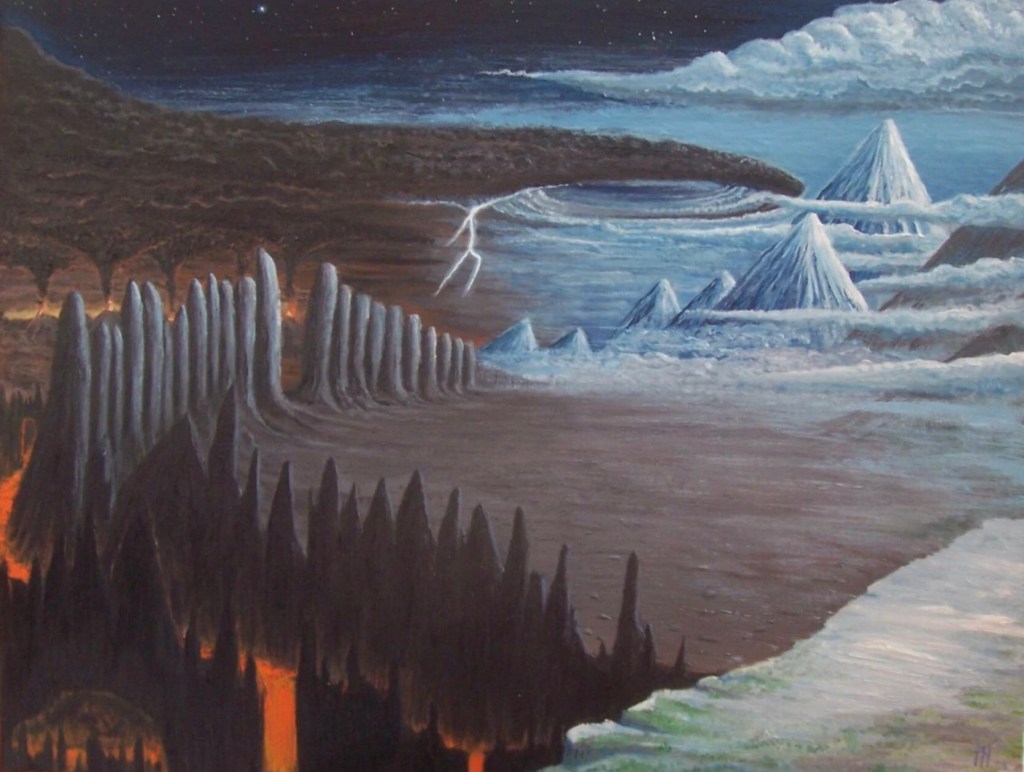
Ginnungagap

Ginnungagap (“seeming emptiness”), in the cosmology of Norse mythology, is the primordial void separating Niflheim and Muspell, the land of eternal ice and snow and the land of eternal heat and flame.In the beginning, before the world of men and gods existed, the spring Hvergelmir, deep in the frozen wastes of Niflheim, gave rise to eleven rivers known as the Elivagar. Over a long period of time, water of the Elivagar ran across Niflheim and poured into the northern part of Ginnungagap. The water froze, forming vast sheets of ice in the void. Hot air from Muspell melted some of the ice, creating a zone of meltwater amid the ice and snow. Here life began, and the first living thing was a frost giant.

The Younger Futhark

The runic alphabet that was used during the Viking Age is called Younger Futhark. These runes can be found on hundreds of runestones throughout Scandinavia. This alphabet does not consist of many runes, and that is because the Norse language evolved a lot during the Iron Age, which meant that the runic alphabet was reduced from 24 to 16 runes.

Each rune has its own name and sound. Some of the runes are used to spell the same letter, for instance, the Týr rune is used for the letters “t” and “d”, and kaun is used for “g” and “k”. 

The names on this list of the Younger Futhark runes have been taken from the website of The National Museum in Copenhagen. The names of the runes may vary slightly depending on the language and on which runologist has conducted the research.

Heka & Akhu: Ancient Egyptian Magic

Heka (magic) was already at the heart of Egyptian beliefs by 4000 BCE. Creator deities such as Nu (the watery abyss) were said to have used heka to bring the world into existence from primordial chaos. In doing so, they subdued the forces of chaos, but the forces constantly sought to return and could only be stopped by heka. For the ancient Egyptians, it was not just the gods that handled magic. Lesser supernatural beings, pharaohs, and the dead were thought to possess an element of heka, which they could channel through the use of spells to deflect the attention of malevolent spirits.

The ancient Egyptians also believed in another form of magic power called akhu, which was malign and closely associated with beings of the underworld. To protect against akhu magical practitioners such as priests, scribes in the “Houses of Life”—which held the manuscript collections of Egyptian temples—sunu (doctors), and sau (amulet-makers) employed heka spells, rituals, and magical objects. Indeed, faith in heka was so widespread that ancient Egyptians used it in all aspects of life from matters of state to the delivery of oracles and more mundane village affairs, such as love matches, protection during childbirth, and curing minor illnesses. As well as being an abstract force, there was a god called Heka who personified magic. Heka helped ensure the harmony of the cosmos and acted as a conduit through whom worshippers could seek divine favors. He had a female counterpart, Weret-hekau (Great of Magic), who was depicted in the form of a cobra. It is thought that the snake-headed staffs often used by ancient Egyptian magicians may have represented her.

Sources: A History of Magic, Witchcraft and the Occult

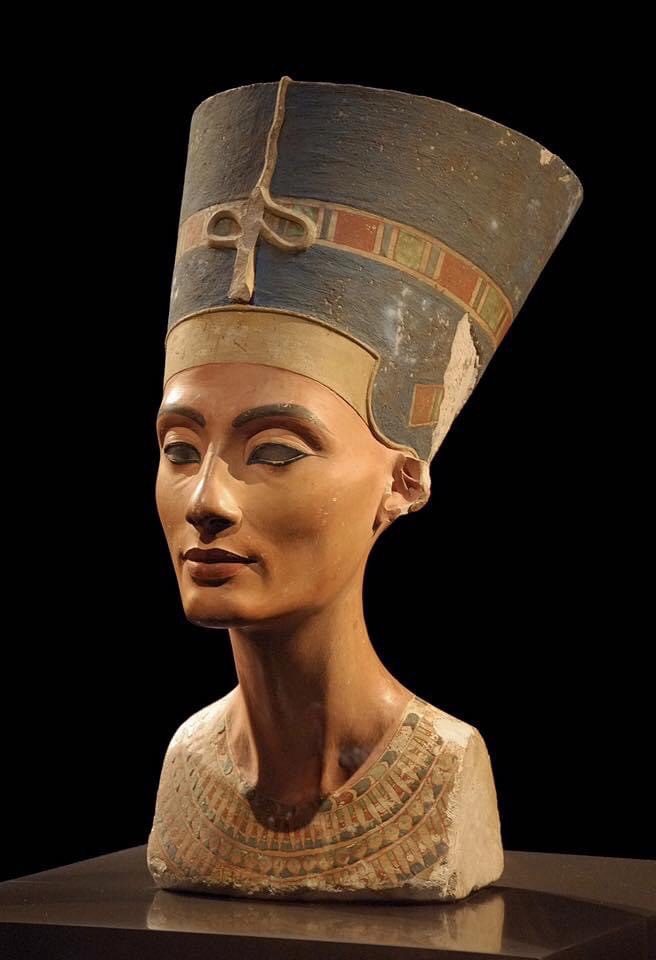
Neferneferuaten Nefertiti (1370 – 1330 BC)

Neferneferuaten Nefertiti (1370 – 1330 BC)

“Beautiful are the Beauties of Aten, the Beautiful one has come”

Egyptian queen and the Great Royal Wife (chief consort) of Akhenaten, an Egyptian Pharaoh. Nefertiti and her husband were known for a religious revolution, in which they worshiped one god only, Aten, or the sun disc. Akhenaten and Nefertiti were responsible for the creation of a whole new religion which changed the ways of religion within Egypt. With her husband, she reigned at what was arguably the wealthiest period of Ancient Egyptian history.

Some scholars believe that Nefertiti ruled briefly as Neferneferuaten after her husband’s death and before the accession of Tutankhamun, although this is still an ongoing debate.

Ecofeminism

French feminist Françoise d’Eaubonne coined the term “ecofeminism” in 1974 for a new branch of feminism that focused on ecology, the study of the interactions between organisms and their environment. It holds that the domination and degradation of nature and the exploitation and oppression of women have significant connections.

Several environmental disasters in the US—most notably the 1979 near meltdown at the Three Mile Island nuclear power plant in Pennsylvania—brought 600 women together in 1980 for “Women and Life on Earth,” the first ecofeminist conference. Held in Massachusetts during the spring equinox, the conference explored the links between feminism, militarization, healing, and ecology. Ecofeminism was defined as a “women-identified movement” that sees Earth’s devastation and the threat of nuclear annihilation as feminist concerns because they are underpinned by the same “masculinist mentality” that oppresses women. Ecofeminism holds that women have a special role to play in protecting the environment and campaigning against damage to the planet.

As ecofeminism developed, it began to splinter into different approaches, one of which is sometimes described as cultural ecofeminism. This strand is rooted in spirituality, goddess worship, and nature-based religions. Its adherents, including American writer and activist Starhawk (Miriam Simos), argue that women have an intrinsic kinship with the natural environment, and, as instinctive carers, should be at the forefront of its protection. Other feminists criticize this approach for reinforcing gender stereotypes, claiming women’s moral superiority, and taking little account of class, race, or the economic exploitation of resources.

Sources: The Feminism Book (DK)