I Stare Into the Darkness

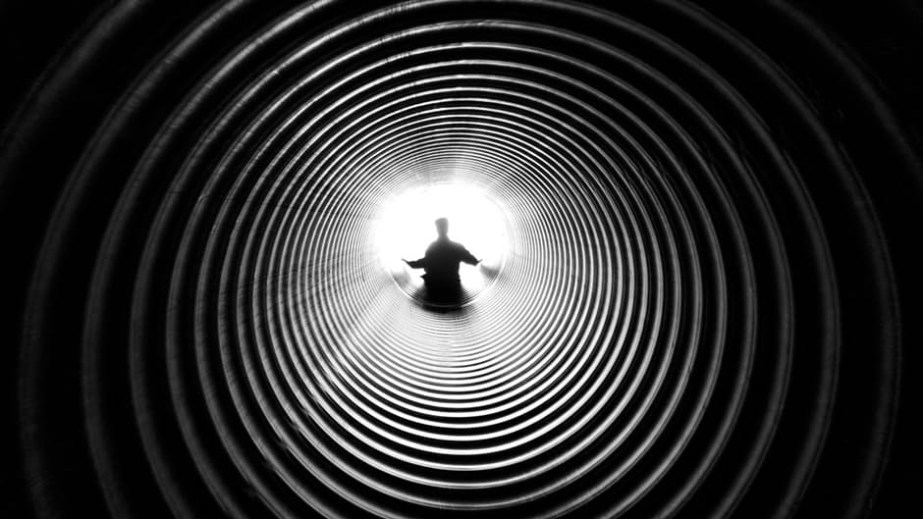
I stare into the darkness of my room,
of my mind.
Thoughts and images penetrate my consciousness,
moments, images, memories of the night I just lived.
My skin burns,
as my heart races buried within my chest.
What is this sensation, this feeling,
which consumes me?
Sleep, I must sleep,
things will make sense in the morning.
A scent, a whisper, a touch,
attempt to devour me.
My mind has become flooded,
drowning in moments from the past,
the present,
the possibilities that lie before me.
I hear the vehicles pass my house,
why are they so loud tonight?
The cat cries in the next room,
why can’t silence be mine, peace be mine.
I awake in a cold sweat,
my mind hasn’t been quieted.
I scratch for a semblance of sanity,
as I futilely attempt to sleep.
Enough, I cry out,
my eyes clenched shut.
The visions of his hands around my throat,
permeate my mind.
The tender touch of her cheek brushing mine,
supersedes my immortal nightmare.
A sigh in the darkness of my room,
and I am back.

Poetic Forms I Employ

There are a multitude of poetic forms that gave been used through the ages from a Shakespearian Sonnet to a Haiku to my favorite a Sestina. Definitions provided here adapted from poetryfoundation.org website. Here are a few of the ones I employ on a regular basis:

Ballad – A popular narrative song passed down orally. In the English tradition, it usually follows a form of rhymed (abcb) quatrains alternating four-stress and three-stress lines. Folk (or traditional) ballads are anonymous and recount tragic, comic, or heroic stories with emphasis on a central dramatic event; examples include “Barbara Allen” and “John Henry.” Beginning in the Renaissance, poets have adapted the conventions of the folk ballad for their own original compositions. Examples of this “literary” ballad form include John Keats’s “La Belle Dame sans Merci,” Thomas Hardy’s “During Wind and Rain,” and Edgar Allan Poe’s “Annabel Lee.”

Ballade – An Old French verse form that usually consists of three eight-line stanzas and a four-line envoy, with a rhyme scheme of ababbcbc bcbc. The last line of the first stanza is repeated at the end of subsequent stanzas and the envoy. An example is Hilaire Belloc’s “Ballade of Modest Confession”.

Free Verse – Nonmetrical, nonrhyming lines that closely follow the natural rhythms of speech. A regular pattern of sound or rhythm may emerge in free-verse lines, but the poet does not adhere to a metrical plan in their composition. Matthew Arnold and Walt Whitman explored the possibilities of nonmetrical poetry in the 19th century. Since the early 20th century, the majority of published lyric poetry has been written in free verse. Examples include the work of William Carlos Williams, T.S. Eliot, Ezra Pound, and H.D.

Haiku – A Japanese verse form of three unrhyming lines in five, seven, and five syllables. It creates a single, memorable image. The Imagist poets of the early 20th century, including Ezra Pound and H.D., showed appreciation for the form’s linguistic and sensory economy; Pound’s “In a Station of the Metro” embodies the spirit of haiku.

Limerick – A fixed light-verse form of five generally anapestic lines rhyming AABBA. Edward Lear, who popularized the form, fused the third and fourth lines into a single line with internal rhyme. Limericks are traditionally bawdy or just irreveren. Examples include “A Young Lady of Lynn” or Lear’s “There was an Old Man with a Beard.”

Sestina – A complex French verse form, usually unrhymed, consisting of six stanzas of six lines each and a three-line envoy. The end words of the first stanza are repeated in a different order as end words in each of the subsequent five stanzas; the closing envoy contains all six words, two per line, placed in the middle and at the end of the three lines. The patterns of word repetition are as follows, with each number representing the final word of a line, and each row of numbers representing a stanza:

1 2 3 4 5 6
6 1 5 2 4 3
3 6 4 1 2 5
5 3 2 6 1 4
4 5 1 3 6 2
2 4 6 5 3 1
(6 2) (1 4) (5 3)

Sonnet – A 14-line poem with a variable rhyme scheme originating in Italy and brought to England by Sir Thomas Wyatt and Henry Howard, earl of Surrey in the 16th century. Literally a “little song,” the sonnet traditionally reflects upon a single sentiment, with a clarification or “turn” of thought in its concluding lines.

Petrarchan sonnet, perfected by the Italian poet Petrarch, divides the 14 lines into two sections: an eight-line stanza (octave) rhyming ABBAABBA, and a six-line stanza (sestet) rhyming CDCDCD or CDEEDE. John Milton’s “When I Consider How my Light Is Spent” and Elizabeth Barrett Browning’s “How Do I Love Thee” employ this form.

Italian sonnet is an English variation on the traditional Petrarchan version. The octave’s rhyme scheme is preserved, but the sestet rhymes CDDCEE. Thomas Wyatt’s “Whoso List to Hunt, I Know Where Is an Hind” and John Donne’s “If Poisonous Minerals, and If That Tree.”

English (or Shakespearean) sonnet, which condenses the 14 lines into one stanza of three quatrains and a concluding couplet, with a rhyme scheme of ABABCDCDEFEFGG (though poets have frequently varied this scheme) George Herbert’s “Love (II),” Claude McKay’s “America,” and Molly Peacock’s “Altruism” are English sonnets.

Spenserian sonnet is a 14-line poem developed by Edmund Spenser in his Amoretti, that varies the English form by interlocking the three quatrains (ABAB BCBC CDCD EE).

Villanelle – A French verse form consisting of five three-line stanzas and a final quatrain, with the first and third lines of the first stanza repeating alternately in the following stanzas. These two refrain lines form the final couplet in the quatrain. Example “Do Not Go Gentle into That Good Night” by Dylan Thomas, Elizabeth Bishop’s “One Art,” and Edwin Arlington Robinson’s “The House on the Hill.”

Harvard Square

Alone in a crowded Harvard Square he once again is made flesh,
The fractures of my mind allowing this assault,
Frozen, trembling, submissive I stare into oblivion,
I choke, swallowing, sweating, gasping for breath,
Humanity rushes past me, around me, and over me in a mob,
No longer I stand in the present, but awoken into my nightmare,
Washed away twenty-three years past eroding my reality,
Grasping at the shreds of my sanity, it slips through my fingers,
The edge of the knife relentless, my focus, my reality,
“Throw yourself into it,” the voice screams in my mind,
The world before me melts, swirls and rises back up to greet me.

Time lapses, I rush into the oncoming traffic,
Clamoring for certainty I dive into the coffee bar,
Frantic my eyes dart back from the door to my hands,
Unable to breathe freely, all eyes burrow into me,
These unnamed souls know my every weakness, every secret,
Surrounded by strangers, overwhelmed by my passions,
The moments blur into minutes crawling ever forward,
My body violently tremors mixing with time and space,
I want to scream for it all to stop, for it all to end permanently,
Awash in the confusion of my eternal nightmares made flesh,
“Stop!” I sink into the unending cycles of my paranoia and psychosis.

Guilt, Pity and Envy

Guilt, Pity and Envy

I met Guilt, Pity and Envy in a black corridor,
They conceived a bastard love child,
He grows within my gut, tearing my belly asunder.

“Fuck off,” I screamed at the bastard buckling over,
His parents glared at me, surrounding me,
Their laugher echoes in my mind.

Guilt, Pity and Envy closed in on me,
I felt their breaths on the nape of my neck,
I smelled their foul air, the odor made me wretch.

I could feel the bastard consuming me from the inside,
Filling me up with a perverse version of his parent’s being,
Guilt, Pity, Envy and now Deceit.

“I will not succumb,” I cried, my eyes rolling into the back of my head,
I arched my back, contorting my body into a twisted mangle of flesh,
My body poured with sweat and tears, “You won’t take me without a fight.”

Their claws tore into my flesh,
Ripping my gut open,
Spilling my bowels across the floor.

“You can’t have me,” I snarled.
Their voices echoed in a gibberish I strained to comprehend,
Deep within my consciousness.

Guilt, Pity, and Envy swirled within me, whispering half-truths,
Deceit tears at me from inside, the bastard love child,
I see the straight razor glistening before me on the counter.

I hack open my throbbing wrists,
Spilling out all the Guilt,
All the Envy, All the Pity.

The bastard’s hands are around my throat,
Choking off my breaths, extinguishing my free will,
Deceit vanquishes my meager resistance.

I tear the bastard from me; he is not what I envisioned him to be,
The love child, Deceit, is a tall lustful shameless blond,
Dressed in a pristine glistening backless black latex gown.

“Stay out of my fucking head,” I scream, glaring at the bitch,
She smiles wryly, with a wink; she blows me a kiss,
I sigh deeply, Am I this pathetic?

Defiantly I raise the back of my hand to strike her,
Deceit’s talons burrow deeper into my flesh,
My hand drops submissively, pathetically, longingly.

Tears stream down my cheeks, my eyes smolder with an unfamiliar intensity,
“Enough whore,” I cry my eyes rolling back into my head,
I glare into her eyes, mine lowering to her neck, my fingers caress the razor.

Guilt, Pity and Envy, their laughter echoes in my mind,
Deceit steps forward grinding her body against my own,
I gasp as my body reacts to her touch, “Fucking bitch,” I mutter.

Her embrace is intense not quite tender; I feel her sucking my freewill.
“I despise you,” I whisper in desperation,
My eyes close to the clatter of the razor hitting the floor.

A silent sob,
The taste of blood on my lips,
She has won…

A Guilt That Consumes

The criss-crossing clash of tiny dishes echo in my mind,
The self-orchestrated visions of my past resurface,
Times of glory, times of disgust and hate,
I scream in the darkness of my mind,
As the ether mask is placed over my mouth, choking my protests.

A guilt that consumes,
A guilt that devours,
Reaches down wrenching out my soul,
I shudder, my legs tremor,
My back stiffens,
A gasp released from my lungs.

I stare in disbelief at my guilt,
As it actualizes before me,
It twists, it turns and swirls,
Taking a perverse form before me,
I drop to my knees, body rigid,
Offering myself in prayer to my guilt, to my soul.

Do I deserve what I desperately require,
Is it fair to ask this of the world,
My mind spins to the ringing chorus of answers,
To each of my pertinent questions,
I cringe straining to make out their replies,
Is this my personal hell?

I formed and molded my private hell,
Out of each decision along my road,
Stretching back as far as I can remember,
“No,” I don’t deserve what I seek,
The voice echoing in my mind,
Whispers with a mocking laugh.

A laugh I shall not be soon to forget,
Mockingly the voices swirl within my mind,
I stumble from question to question,
All the while the laughing echoes,
Into the recesses of my vacant soul,
Tears flow down my ashen face.

My jaws are pried wide open in horror,
The ceiling spins, the walls melt away into darkness,
My eyes blink as the needle impales my vein,
Insecurity washes over and through me,
Will I succumb to the voices, will it wash hope away.

Word Salad

Word Salad

Times lapses repeating always inside my mind,
Trauma assault voices always the same time lapses,
They’re coming implanting thoughts actions in my head,
Time lapses repeating inside outside assault voices,
Stop the noise overwhelming destroying screaming.
Past past future present moments in time shadow,
Darkness echoes whispers time forgotten realities,
Shadow people cloaked darkness, eyeless, faceless,
Across all time pursuing reality lapses inside out,
Clawing cutting scaring skin stretches too tight blood,
Trickling down releases screaming always the same.
Voices in my head chirping chirping scratching,
Whispers whispers in my head, images of a time only I see,
Time races time crawls time stops in moments of lucidity.

Cutting: A Love Story

I wrote this eight years ago in an attempt to explain the love/hate addiction to cutting. The impulse when I felt so numb that the pain of the razor blade slicing my arms and the blood trickling down to my open palm was preferred to feeling nothing at all:

Cutting: A Love Story

Long ago you made the choice, that first cut,

You found the pain incredible, the blood a release,

The cuts were shallow, hardly scratches really,

They healed quickly, not even a scar left behind.

A choice, a choice to isolate, a life in constant shame,

You lie to those closest and dearest to your heart,

Sometimes now they take months to heal,

Scars carved into your flesh for all to witness.

You’ll define your life as before and after cutting,

Terrified you’ll fear the touch of a friend,

Skin burning from the sweet release of your blood,

Wincing you’ll fear the tender touch of a friend.

The cuts spread, no longer constrained to your arms,

Deeper they grow week by precious week,

You’ll realize you’re losing all self-control,

Fear your next cut, love it, how deep will it be?

Your life revolving around the next chance to cut,

A razor blade hidden away in your wallet,

Will today be the day you cut too deep?

A day when the blood won’t stop, gasping, shaking.

Blood won’t stop flowing, ever down your arm,

Fearful, terrified a panic attack chokes your heart,

Alone, always alone, you’ll swear you’ll stop,

A sweet lie as the blood pools in your hand.

This is just the beginning of the romance,

You’ll learn to take care of your one true love,

Antibiotic cream, bandages, medical tape,

The cuts will grow wider, grow deeper.

Watching, hoping to find someone who understands,

Searching, the signs will be everywhere and nowhere,

Long sleeve shirts, bracelets, wristbands,

But their skin will be untouched, perfect, and flawless.

Isolating more and more, alone, always alone,

Your last cuts deeper, burning through the shame,

The relief doesn’t last nearly as long anymore,

You know you need to cut deeper, wider.

You dream of cutting, or just letting one person know,

You love, you hate the day you made the first cut,

Each time you pray for the strength to push harder,

Rolling up your sleeve, face-to-face with your one true love.

#MySchizLife #Cutting #SelfHarm