Today in Science —> Galilean Satellites

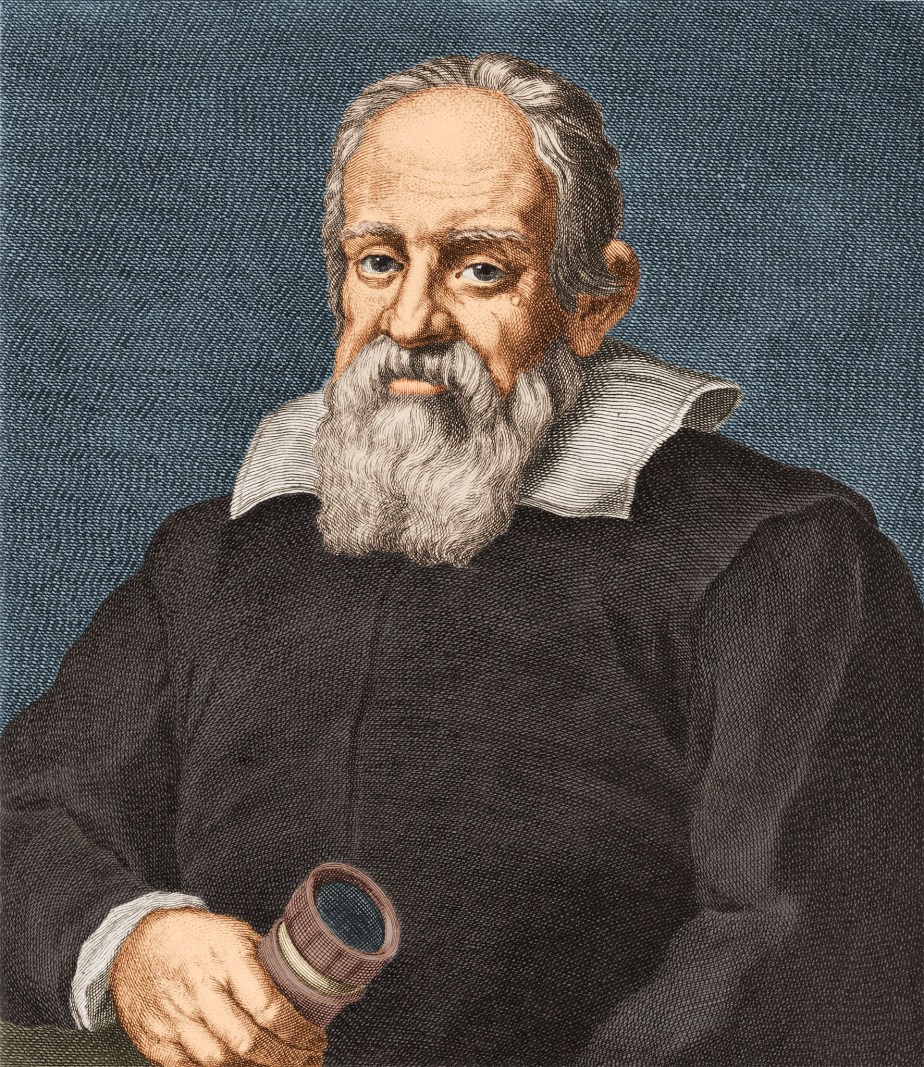
Today in Science—> On this date in 1610, Galileo observed three small “stars” in a line and very close to Jupiter. Over the next several days, he saw that the stars were changing position in relation to Jupiter and he concluded that they were orbiting the planet and also discovered a fourth such star as well. He originally called them the Medicean stars in honor of the de’ Medici family which ruled Tuscany, but they have since been renamed the Galilean satellites and are the four largest moons of Jupiter—Io, Europa, Ganymede, and Callisto. Galileo’s observations were the first that showed heavenly bodies orbiting each other and not Earth, leading to the overthrowing of the Aristotelian geocentric model of cosmology.

#Galileo #GalileanSatellites

Twin Jet Nebula

On December 17th, 1997, this Hubble Telescope image of the Twin Jet Nebula (or M2-9) shows gas being ejected, like exhaust from a pair of jet engines, at more than 200 miles per second in opposite directions from a star 2,100 light-years from Earth.

#TodayInAstronomy #HubbleTelescope #TwinJetNebula

Zhang Heng

Zhang Heng was born in 78 CE in the town of Xi’e, in what is now Henan Province, in Han Dynasty China. At 17, he left home to study literature and train to be a writer. By his late 20s, Zhang had become a skilled mathematician and was called to the court of Emperor An-ti, who, in 115 CE, made him Chief Astrologer.

Zhang lived at a time of rapid advances in science. In addition to his astronomical work, he devised a water-powered armillary sphere (a model of the celestial objects) and invented the world’s first seismometer, which was ridiculed until, in 138 CE, it successfully recorded an earthquake 250 miles (400 km) away. He also invented the first odometer to measure distances traveled in vehicles, and a nonmagnetic, south-pointing compass in the form of a chariot. Zhang was a distinguished poet, whose works give us vivid insights into the cultural life of his day.

First Image of A Black Hole

We have seen what we thought was unseeable.  We have seen and taken a picture of a black hole.”

~ Sheperd Doeleman, director of the Event Horizon Telescope Collaboration.

What are black holes? 

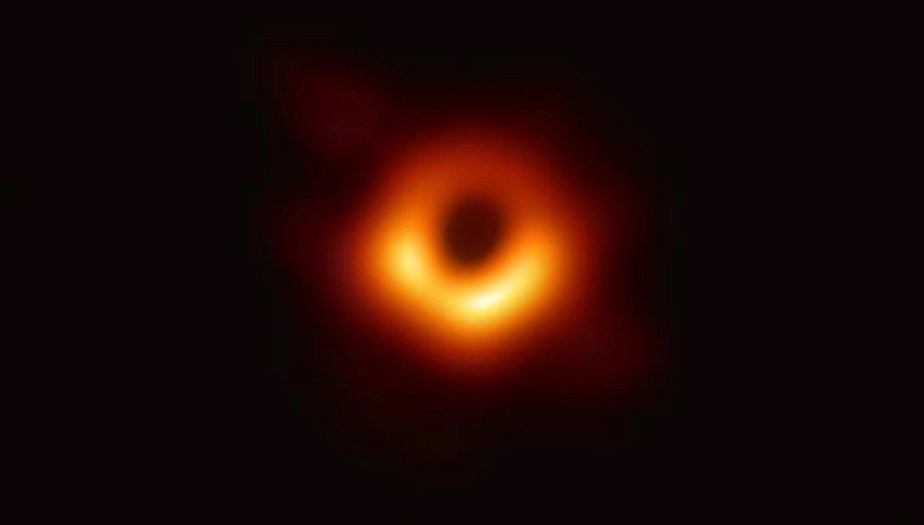
Black holes are made up of huge amounts of matter squeezed into a small area, according to NASA, creating a massive gravitational field which draws in everything around it, including light. They also have a way of super-heating the material around them and warping spacetime. Material accumulates around black holes, is heated to billions of degrees and reaches nearly the speed of light. Light bends around the gravity of the black hole, which creates the photon ring seen in the image.

In April 2017, scientists used a global network of telescopes to see and capture the first-ever picture of a black hole, according to an announcement by researchers at the National Science Foundation Wednesday morning. They captured an image of the supermassive black hole and its shadow at the center of a galaxy known as M87.

The Event Horizon Telescope Collaboration, called EHT, is a global network of telescopes that captured the first-ever photograph of a black hole. More than 200 researchers were involved in the project. They have worked for more than a decade to capture this. The project is named for the event horizon, the proposed boundary around a black hole that represents the point of no return where no light or radiation can escape.

A lot of people have heard the term “event horizon” That isn’t what we’re  seeing in this image. The bright ring is light bending around the intense gravity of the black hole. The event horizon is actually a long way inside the black circular shadow. 

The visual confirmation of black holes acts as confirmation of Albert Einstein’s theory of general relativity. In the theory, Einstein predicted that dense, compact regions of space would have such intense gravity that nothing could escape them. But if heated materials in the form of plasma surround the black hole and emit light, the event horizon could be visible.

Black holes have sparked imaginations for decades.  They have exotic properties and are mysterious to us. Yet with more observations like this one they are yielding their secrets. This is why NSF exists. We enable scientists and engineers to illuminate the unknown, to reveal the subtle and complex majesty of our universe.” 

~ France Córdova, National Science Foundation Director 

Source: CNN

Veil Nebula

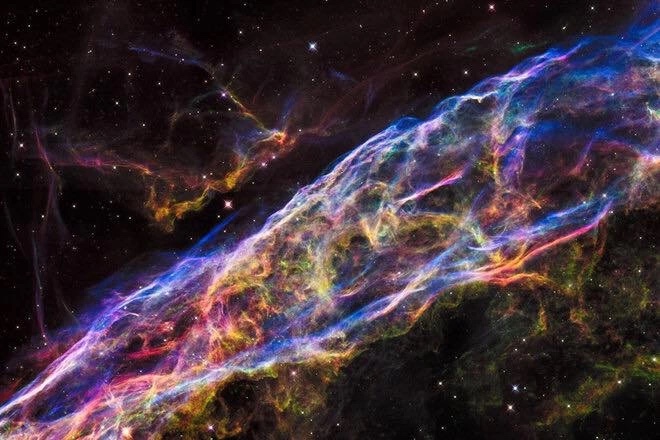
The Veil Nebula is a cloud of heated and ionized gas and dust in the constellation Cygnus. It constitutes the visible portions of the Cygnus Loop (radio source W78, or Sharpless 103), a large but relatively faint supernova remnant. The source supernova exploded circa 3,000 BC to 6,000 BC, and the remnants have since expanded to cover an area roughly 3 degrees in diameter (about 6 times the diameter, or 36 times the area, of the full moon). The distance to the nebula is not precisely known, but Far Ultraviolet Spectroscopic Explorer (FUSE) data supports a distance of about 1,470 light-years.

The Hubble Space Telescope captured several images of the nebula. The analysis of the emissions from the nebula indicate the presence of oxygen, sulfur, and hydrogen. This is also one of the largest, brightest features in the x-ray sky.

#VeilNebula #Astrophysics

Spaghetti Nebula

The Spaghetti Nebula is a Supernova Remnant (SNR) in the Milky Way. 3,000 light-years away from us straddling the border between the constellations Auriga and Taurus. Discovered in 1952 at the Crimean Astrophysical Observatory using a 25-inch Schmidt-Cassegrain telescope, it is difficult to observe due to its extremely low brightness.

The nebulous area is fairly large with an almost spherical shell and filamentary structure.  The remnant has an apparent diameter of approximately 3 degrees, an estimated distance of approximately 3000 (±350) light-years, and an age of approximately 40,000 years.

It is believed that after its stellar explosion a rapidly spinning neutron star known as pulsar PSR J0538+2817 was left behind in the nebula core, emitting a strong radio signal

Sculptor Galaxy

Breathtakingly Beautiful Galaxy With an Enormous Halo of Extreme Star Creation

The Sculptor Galaxy has an enormous halo of gas, dust and stars, which had not been observed before at frequencies below 300 MHz. The halo originates from galactic “fountains” caused by star formation in the disk and a super-wind coming from the galaxy’s core.

Astronomers have used a radio telescope in outback Western Australia to see the halo of a nearby starburst galaxy in unprecedented detail. A starburst galaxy is a galaxy experiencing a period of intense star formation and this one, known as NGC 253 or the Sculptor Galaxy, is approximately 11.5 million light-years from Earth…

The Rosette Nebula

The Rosette Nebula

The Rosette Nebula (also known as Caldwell 49) is a large, spherical (circular in appearance), H II region located near one end of a giant molecular cloud in the Monoceros region of the Milky Way Galaxy. The open cluster NGC 2244 (Caldwell 50) is closely associated with the nebulosity, the stars of the cluster having been formed from the nebula’s matter.

Photo Credits: Miguel Claro