Whenever I am in the Washington DC area I like to pay a “visit” to one of my favorite Chefs, Jose Andres. His empire of DC restaurants is impressive and exquisite. He won the James Beard award in 2004. He is one of my all-time favorite celebrity chefs. I own two of his cookbooks, Tapas : A Taste Of Spain In America, and Made In Spain. I have watched his TV series Made In Spain and numerous interviews as well as guest appearances on such shows as Anthony Bourdain : No Reservations. On this occasion I spent the morning at one of the many museums in DC and then took a walk over to the award winning
I was excited to go not just for the food but they had gone through an elaborate remodel since my last visit. Would it meet my expectations and be as fun an environment as I anticipated? Yes, the remodel is gorgeous. The remodel is bright and fun. The virtual palate of colors over the bar is impressive and the bathroom is a must see. For a confirmed germ-a-phobe that is a hard sentence to write, but nevertheless it is the truth. A cacophony of faces gazes up at you from the floor of the bathroom. It is simply fun.
In the past I’ve been to Jaleo in the evening and with friends. It has always been fun to order a medley of small dishes and share them. Today I am dining alone and at lunch. To my surprise they have an express lunch which allows you to choose from a select few options three courses for $25 – perfect. My first course is something simple, Pan con tomate y manchego (toasted slices of rustic bread brushed with fresh tomatoes and manchego cheese). It is simple and delicious and a nice start to my meal.
On this day I am in the mood for something a bit spicy and potatoes. So naturally my second course was Patatas Bravas (fried fingerling potatoes with spicy tomato sauce and aioli). It was just right for the mood I was in. The potatoes were fried crisp and the tomato sauce had just the right amount of bite to it. At this time a girl in hre thirties was seated next to me with her parents. They were fun to watch as her parents obviously didn’t understand the restaurant concept at the beginning, but by the end were ordering more tapas dishes without their daughter’s help. They obviously were very much enjoying their meal.
My third and final course was Tortilla de Patatas (traditional Spanish omelette). I told you I was in the mood for potatoes. It was a delightful end to a very traditional classic tapas meal. In the past I had certainly had more elegant and elaborate tapas meals at Jaleo, but today this was just right after my morning at the museum. Would I return to Jaleo? Absolutely next time I am in DC. I still haven’t tried the paella, which is on my culinary to do list.
The Macaron…cookie was born in Italy, introduced by the chef of Catherine de Medicis in 1533 at the time of her marriage to the Duc d’Orleans who became king of France in 1547 as Henry II. The term “macaron” has the same origin as that the word “macaroni” — both mean “fine dough”.
The first Macarons were simple cookies, made of almond powder, sugar and egg whites. Many towns throughout France have their own prized tale surrounding this delicacy. In Nancy, the granddaughter of Catherine de Medici was supposedly saved from starvation by eating Macarons. In Saint-Jean-de-Luz, the macaron of Chef Adam regaled Louis XIV and Marie-Therese at their wedding celebration in 1660.
Only at the beginning of the 20th century did the Macaron become a “double-decker” affair. Pierre Desfontaines, the grandson of Louis Ernest Laduree (Laduree pastry and salon de the, rue Royale in Paris) had the idea to fill them with a “chocolate panache” and to stick them together.
Since then, French Macaron cookies have been nationally acclaimed in France and remain the best-selling cookie in pastry retail stores.
Recently I stopped by for lunch after being out shooting some photos, my other passion. I was immediately greeted with a smile and an eager server. I was asked if I’d prefer to sit at the bar or a table. I don’t sit at the bar often these days after my liver transplant, as it brings back memories of a time in my life I have put into the past. I chose a booth with the sun nicely warming my side of the booth. I read down the daily specials board as my waitress went to get me my soda. My plan had been to order an appetizer as I didn’t feel I was starving. I was quickly drawn to the fried green tomatoes and maybe a side of their bacon butter beans which I love.
Fried Green Tomatoes Bacon Butter Beans
Ready to order the waitress returned with my soda and offered to explain the specials. I agreed even though I was certain I knew what I was going to have. I smiled and said, “I’ll have the cod special.” She had sold me on the roasted cod knowing I could have the fried green tomatoes and butter beans anytime. I realized this would be my first time here not having the bacon butter beans in nearly a year. I love them that much. I waited and watched the interactions of the staff as they took orders, filled drink orders, interacted with the cooks and delivered each meticulously designed plate.
Specials Board
Soon my meal arrived, roasted cod with black-eyed pea succotash, and squash puree all resting on a fried green tomato. I instantly knew I had ordered the right meal today. There was a voice in the back of my mind screaming out for a side of butter beans, but I ignored it on this occasion. It is rare when I am at Palm Valley Fish Camp that I will order anything that is not a local wild sustainable fish, but the cod was very fresh and flown in from the west coast. The cod was lightly roasted with just a bit of color and flaked off easily so you could see how moist it was. One of the things that keeps me returning over and over again is that they hardly ever overcook a piece of fish. It sounds easy, but I’ve lost count at how many seafood restaurants server a dry tasteless and thoroughly unsatisfying fish fillet.
Roasted Cod
The cod had a nice salt balance which was perfectly complemented by the sweetness of the fresh corn and black-eyed pea succotash. My first bite was of the fish alone. It was very pleasant, but did not blow me away. When eaten with the succotash the flavors melded into a delightful light tasting lunch. The squash puree was richly sweet and left me perfectly wanting more. Then there was the thick sliced fried green tomato upon which the cod rested. It was nicely crisp and hot inside with just the right amount of breading. The tang of the tomato was a nice counterbalance to the lightly roasted cod. After all the fried green tomatoes was what I had planned to order the whole time anyway. I was very pleased that my waitress had enticed me with her suggestion of the special today. I would go away with only a slight yearning for their bacon butter beans, but I’ll be back and quite soon I am sure. It was a great lunch for only $16.00 with the soda. As I left I made reservations for the Friday after Thanksgiving. I wonder if I’ll make it the two weeks between visits. I know those bacon butter beans will be calling me to return sooner…
I receive much of my information from living on the First Coast, so what and where exactly is the first coast?
Florida’s First Coast is a region of the U.S. located on the Atlantic coast of North Florida. The First Coast refers to the same general area as the region of Northeast Florida. It comprises the five counties surrounding Jacksonville: Duval, Baker, Clay, Nassau, and St. Johns, largely corresponding to the Jacksonville metropolitan area, and depending who you ask includes nearby areas Putnam and Flagler counties in Florida and Camden County in Georgia. As its name suggests, the First Coast was the first area of Florida colonized by Europeans. The name originated in a marketing campaign in the 1980’s.
The name refers both to the area’s status as the first coast that many visitors reach when entering Florida, as well as to the region’s history as the first place in the continental United States to see European contact and settlement. Juan Ponce de León may have landed in this region during his first expedition in 1513, and the early French colony of Fort Caroline was founded in present-day Jacksonville in 1564. Significantly, the First Coast includes St. Augustine, the oldest continuously inhabited European-established city in the continental U.S., founded by the Spanish in 1565.
The First Coast marketing campaign and identity has been very popular with its spread to other nearby areas, being found as far south as Flagler Beach in Flagler County, Palatka in Putnam County, and as far north as St. Mary’s, Georgia.
Colonial Williamsburg is a living-history museum and private foundation presenting part of an historic district in the city of Williamsburg, Virginia. Colonial Williamsburg’s 301-acre Historic Area includes buildings from the 18th century (during part of which the city was the capital of Colonial Virginia), as well as 17th-century, 19th-century, and Colonial Revival structures, as well as more recent reconstructions.
The Historic Area is an interpretation of a colonial American city, with exhibits of dozens of restored or re-created buildings related to its colonial and American Revolutionary War history. Colonial Williamsburg’s Historic Area’s combination of restoration and re-creation of parts of the colonial town’s three main thoroughfares and their connecting side streets attempts to suggest the atmosphere and the circumstances of 18th-century Americans. Colonial Williamsburg’s motto has been: “That the future may learn from the past”.
Savannah’s Forsyth Park was designed after the French ideal of having a central public garden, and the fountain is said to be the garden’s centerpiece (although it isn’t at the center of the park).
However beautiful, the fountain is not unique. It was ordered from a catalogue.
Other cities fancied the catalogue spread, too. Similar fountains exist in New York, Peru and France.
Cheese I am an advocate of the growing community of cheese aficionados that believe for you to truly appreciate cheese you must have at minimum a cursory understanding of the cheese making process, it’s steps, and where what you are consuming comes from. The three main types of animals cheese comes from, and the only ones we will be concerned with here, are cows, sheep, and goats. After all cheese is simply concentrated milk with salt added so where do these three species milk vary and why do I have preferences for one over the other. Cows by far produce the most milk, but it is also the thinnest as opposed to Sheep’s milk which is the most concentrated – it has a higher percentage of fat solid, and thus flavor. Of course sheep produce far less of it. Cow’s milk has a fat content of 3.25 percent by weight, whereas sheep’s milk is 7.4 percent milk fat by weight. For some perspective as far as cow’s milk and milk fat: skimmed milk is 0 to 0.5 percent milk fat, low fat milk 1 percent, reduced fat milk 2 percent, whole milk 3.25 percent, half-and-half 10.5 to 18 percent, light whipping cream 30 to 36 percent, and heavy cream 36 to 40 percent milk fat. There is an old adage that goat’s milk is best for drinking, cow’s for making butter, but sheep’s is the best for cheese. Generally speaking it take 6 to 12 units (either pounds or kilograms) of milk to make a unit of cheese.
Raw Milk vs. Pasteurized vs. Ultra-Pasteurized Raw milk is just that, milk which has not been processed in any manner. It possesses all of its natural bacteria and thus makes more flavorful cheese. Raw milk will separate and curdle if left at room temperature. In the United States it is advised that raw milk should either be pasteurized or used to make cheese aged over 60 days. In many states you are unable to obtain raw milk. It will spoil in about a week.
Pasteurized milk is the best option for most people in the United States that do not have access to raw milk. Pasteurization kills dangerous pathogens, but as a result also to a great extent destroys vitamins, beneficial bacteria, texture and flavor. It will curdle if left at room temperature. Homogenized milk has been processed to break up the fat globules and force them into suspension within the milk. In an effort to prevent the separation of the milk and the cream it changes the Molecular structure which prevents it from producing a culture at room temperature. Most milk available in the United States is both pasteurized and homogenized.
In the United States we also have ultra-pasteurized and ultra-high temperature (UHT) milk. These two groups are unable to produce cheese and should be avoided. Ultra-pasteurized milk is heated to 191 degrees and UHT to 280 degrees Fahrenheit. Unfortunately these processes are used on a lot of organic milks as they are more fragile and susceptible to slower retail sales.
Ripening the Milk You can pick up most any professional cheese making book, or visit a website, and they will all basically show you the same eight steps in making cheese outlined by professor Kosikowski, the first of these is ripening the milk. This first step involves two interrelated functions acidification and coagulation. Starting with the freshest milk possible, ideally from the most recent milking, a starter culture is added. Traditionally this was done by adding a bit of soured milk from the day before. It is of course still possible to make cheese according to the traditional method, however it is much more difficult and time consuming. It is much more common, nearly universal, that cheese makers use freeze-dried starter cultures containing the beneficial bacteria. These starter cultures offer the cheese maker predictability and consistency.
Coagulation is the process which turns milk into the solid which makes cheese possible. Traditionally animal Rennets are used which are extracted from the stomach of young ruminants. Today there is also a vegetarian option with the rennet coming from various plants, most commonly the cardoon thistle. Rennet induced coagulation takes from half an hour to an hour depending upon the cheese recipe, the temperature, and the kind of coagulant used.
Cutting the Curds Ince the curds have formed a regular mass they will begin to expel the whey, which is mostly water, as they contract. The greater the surface area of the curds, the more whey they will expel. This is precisely the logic behind cutting the curds. To produce a softer cheese with more moisture content the curds are cut larger, likewise for a harder cheese they are cut small. The curds should be cut to a consistent size so that they yield a consistent texture and moisture content. Many cheese makers use wires stretched in a metal frame called a harp. The cheese maker will pass the hard through the mass of curd in one direction and then again at the perpendicular.
Cooking and Holding This third step involves some amount of heating the curds, hence cooking them, and allowing them to rest while the effects of acidification, heating, and cutting runs its course. It is crucial to watch your curds carefully during this step as the smaller curds will get hotter. Due to this is one of several reasons consistent curd size is so important.
Heating the curds is done slowly to prevent them from developing a hard outer skin. Oftentimes they are carefully stirred to aid in whey expulsion and prevent them from sticking. Commercial cheese makers usually employ large stainless steel vats with hollow walls through which hot water circulates to gently warm the curds. The harder the cheese the more it is cooked at higher temperatures and more it is stirred. Sometimes washing the curds is employed. In which case some of the whey is drained and replaced with water. This procedure lowers the acidification of the bath while adding moisture to the curds.
Dipping and Draining Dipping is when you carefully scoop out the curds to transfer them to a draining vessel or mold. Another way of draining is to open a valve at the bottom edge of the cheese vat. Soft curds will take on the shape of the draining vessel in a mass.
Knitting The curds in this stage fuse together to form a uniform consistency. Knitting can happen in the vat, mold, cheese press, or draining vessel.
Pressing Over a few hours or a few days varying degrees of pressure are applied to the curds until the desired moisture content, density, and texture of the cheese is achieved. The softer the cheese the more gradually it is drained with little to no pressure. Sometimes this is referred to as being pressed under their own weight. Conversely harder cheeses will have weights placed on top of them or other pressing measures.
Salting Salt is the major ingredient added to cheese to control moisture content, bacteria growth as well as for taste. This may be applied in two ways: wet and dry. In dry salting the salt is applied directly to the curd mass, often before pressing. Wet salting, also known as brining, is when the cheese is placed in a saltwater solution for anytime from several hours to several days.
Curing Curing is a term used for a multitude of special procedures used for desired effects during aging. Some of these are: rubbing, brushing, spraying, wrapping in cloth or leaves, regular turning, etc. This is where the aging process is employed from immediately ready for consumption to several years. In general the harder cheeses are aged longer, for instance true Parmesans are aged 3 to 4 years.
Affinage Traditional cheese makers relied on special ripeners (affineurs) for their cheese which could be immediately ready, while some might need days or even months to reach their ideal ripeness. This relationship is still in effect in many old world instances for example with Roquefort. Affinage is about nurturing the cheese to bring about its ideal ripeness. There are numerous variables the affineur must control including: setup of the cheese cave, temperature, humidity, duration of aging, and the treatments employed. There is quite some debate over the validity of the craft. Opinions run from not screwing up the cheese to you can’t save a poorly made cheese but you could ruin a good one to you can make a good cheese great.
Cheese Types There are multiple ways to consider cheese types by fat content, by water content, by aging period. Americans have a multitude of categories which the American Cheese Society breaks them up into. There are some basic categories however as follows: Fresh – Unaged, unmolded, unpressed. What is commonly referred to as tub cheese. Chèvre – Goat’s milk soft-ripened Loire valley style cheeses. An example is Selles-sur-Cher. Bloomy Rind – Also known as soft ripened. Unpressed cheeses produced from the curds being gently ladled into a mold. An example is Brie or Camembert. Washed Rind – These are often slimy on the outside, melting on the inside, mild tasting and stinky. A prime example of this type is Epoisses. They can also be semi-hard with strong flavors. Natural Rind – Any cheese for which the rind is allowed to develop on its own without special treatments. Blues are actually a member of this group. Uncooked, Pressed – These are semi-hard and hard cheeses that feature pressing. Examples of these are Cantal, and Laguiole. Cooked, Pressed – These are hard aged alpine style cheeses. An example is Comte or Gruyere. Blue – A large class of cheeses who a categorized by their blue-green mold. Most of these molds run through the interior (the paste) while a few only bare the mold on the outside. A famous example is Roquefort.
Tasting Cheese The very first thing you should consider doing is to slow down and really taste it, smell it, touch the cheese. Be certain your palate is clear, your nose is ready. Americans in general shy away from funky smells. With great cheese expect some smells that you are used to shunning. Get a good smell of the cheese. hold the cut slice of cheese right up to your nose. Be sure your hands are clean and unscented, perfume or even scented soap or hand cleanser can effect your appreciation.
Look and examine the cheese closely. Look at the rind and take note of the color, the texture, any imperfections. Some cheeses that look bad taste great, so know what you are looking for. Touch the cheese and give it a poke. Take note of the consistency, how did the knife go through the cheese. Is it soft, meaty, brittle?
Finally taste the cheese, yes this is the moment you’ve been waiting for. Always start with a thin slice, how does it stimulate your tongue and get your juices flowing, take note of the evolution of flavors and finally the finish. Shutting your eyes when first tasting a new cheese really does shut out other distractions, so you can become one with the cheese. Take note of the flavor – sweet, salty, bitter, sour, but also the texture or mouthfeel. Is it buttery and smooth or is it dry and crumbling or gooey and runny?
When serving cheese there are some general guidelines you should follow, especially if it is for your cliché wine and cheese tasting party: • Cheese should always be cut fresh – the air begins the oxidation process be which the cheese loses its aromas, taste and not to mention begins drying it out. The longer you wait the more you lose. • Trim all leftovers carefully. • Always serve cheese at room temperature – the cold diminishes the cheeses flavor and aroma, this is the most common mistake people make. Remove cheese from the refrigerator at least one hour prior to tasting. • If possible use a separate knife for each cheese, if not possible at least use a different knife for each type of cheese we discussed earlier. If this is not possible clean the knife well between cheeses so as not to mingle flavors. • Small wedges with some of the rind is the objective when slicing cheese. This isn’t always possible with crumbly blues or with gooey cheeses.
The cheese plate or the progression needs to be considered. The traditional classic progression is from simpler to complex, young to older, light to heavy, mild to strong. I always recommend following this progression. What should I serve with my cheese? Keep it simple. The oldest and best accompaniment is bread. Bread is a useful palate cleanser between cheese while also being the ideal complement to fine cheeses. Some classic bread options include: • Classic baguette • Olive breads • Tuscan rounds • Focaccia, plain or with herbs • Flatbreads or crackers that are fairly neutral in flavor. Robust cheeses such as cheddar go with the more strongly flavored bread. Mild bread like the baguette are ideal for the subtler cheeses. Strong cheeses such as the blues can support a sweet but bread.
Fruit and vegetables also make great accompaniments. The sweet juiciness of many fruits make a fine contrast to the saltiness of your cheese. Consider using fresh figs, apples, grapes, as well as dried apricots, preserves and chutneys for starters. Select vegetables as well provide the contrast when putting together a cheese tasting. For a luncheon try fresh vegetables such as carrots, radishes, zucchini, bell peppers, etc. You can also consider pickled vegetables to go along with your cheese and bread. Make certain though not to overwhelm the lighter more mild cheeses.
With the rise in charcuterie in America there are more and more meats available to add to your cheese tasting. When in France stop in the neighborhood charcuterie and pick out some sauccion. Make certain again you don’t overwhelm the lighter cheeses. When home consider prosciutto, sopressata, capitols, or salami. For a touch more you can consider Spanish jamon serrano or chorizo, German speck, or Virginia country ham.
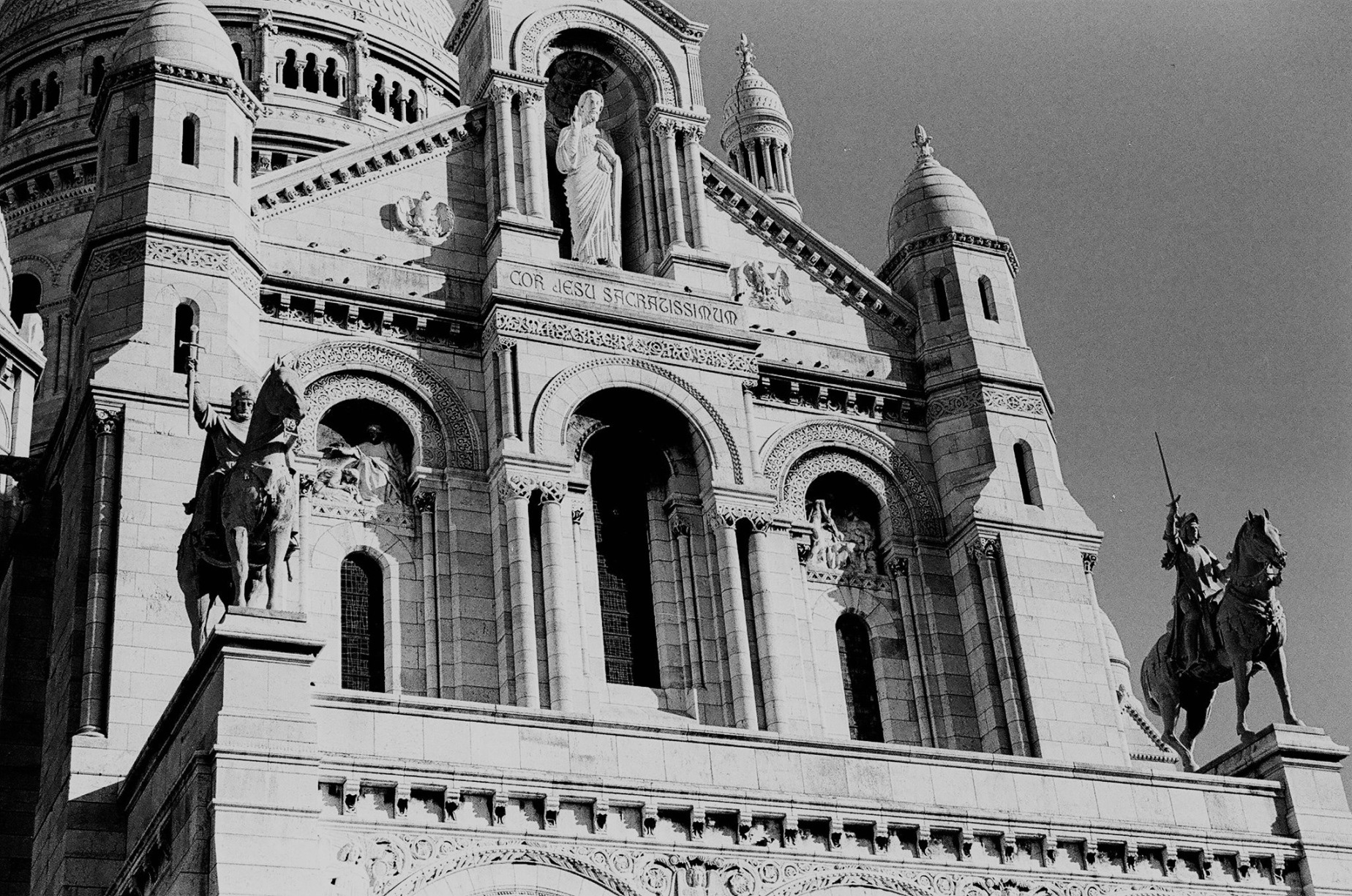
The Basilica of the Sacred Heart of Paris, commonly known as Sacré-Cœur Basilica and often simply Sacré-Cœur, is a Roman Catholic church and minor basilica, dedicated to the Sacred Heart of Jesus, in Paris, France. A popular landmark, the basilica is located at the summit of the butte Montmartre, the highest point in the city. Sacré-Cœur is a double monument, political and cultural, both a national penance for the defeat of France in the 1871 Franco-Prussian War and the socialist Paris Commune of 1871 crowning its most rebellious neighborhood, and an embodiment of conservative moral order, publicly dedicated to the Sacred Heart of Jesus, which was an increasingly popular vision of a loving and sympathetic Christ.
Every year 1.520 billion people ride the Paris metro. Daily, the metro covers over 600,000 miles with 600 conductors shuttling 2,553 cars to all 303 stations.
Thanks to the incredible design of the Chief Engineer, Fulgence Bienvenüe, there are never more than 550 yards between one station and another; which means Paris has the most comprehensive underground rail system in the world.
Around 3,500 workers began constructing the metro in 1898, which was finished on July 19th, 1900, just in time for the World’s Fair and Summer Olympic Games at the Bois de Vincennes. Parisians immediately loved the new means of transport and it was quickly adapted as an inescapable feature of the Paris daily life.
Architect Hector Guimard’s design of the metro station kiosks fostered the Art Nouveau architecture, which is widely known as “le style metro”. There are two main variations of the metro kiosk designs: with and without glass roofs. The first has a glass canopy feature in the form of a dragonfly. The second’s masts lean over the steps of the metro like graceful plants; giving Parisians a little taste of nature in the hustle and bustle of the city.
Initially the metro was called, “La Compagnie du Chemin de Fer Metropolitan de Paris”, which was a mouthful, so then it was shortened to “Le Metropolitan”, which was then abbreviated to what has now become the most common word used for all subway networks around the world, the “Metro”.
When WWII arrived in Paris, metro authorities were forced to abandon their projects. Many services became limited and some stations, such as Arsenal, Champ de Mars, Croix Rouge, closed down. Now know as “ghost stations”, they are used as sets for films like Amélie and architects are now thinking of ways to revamp them as nightclubs and swimming pools.
Metro stations were too shallow to be used as bomb shelters during WWII, so they became a meeting place for the French Resistance. The extensive tunnels allowed them to conduct swift assaults on the Germans throughout Paris.
The newest addition to the Paris Metro, line 14, opened in 1998 and was instantly deemed the future of railway technology. It is the only Paris metro line that has operated automatically without a conductor since its opening. There are plans for lines 15, 16, 17, and 18 to open at varying dates through 2030.
Even the names and décor of the stations have significance. Stations are named for war heroes, important battles, main streets, and people who have had a significant impact on French history. Each metro station also has a theme. For instance, at the platform of Richelieu-Drouot there is a touching war memorial carved into black marble by the sculptor Carlo Sarrabezolles which is dedicated to the metro railway agents who died in WWI. The walls of Concorde are covered in the writing of the Declaration of the Rights of Man from the French Revolution of 1789. In 1994, the Belgian comic book artist Francois Schuite redesigned Arts et Métiers to be reminiscent of Jules Verne’s science fiction novel.
If you find yourself impressed by the quality of musicianship echoing through the halls, that is because starting in 1997, the Espace Metro Accords (EMA) began holding auditions to decide which musicians could showcase their music in the metro. Each year around 100 artists are picked and are given permission to perform for the active travelers.
We met on the steps of the Opera Bastille you and I, I paused in admiration before you noticed me, You were dressed all in black – sleek and willowy, Our eyes met, a smile crossed your face with a blush, My eyes transfixed upon you I felt strikingly underdressed, I’d had a haircut, and my beard neatly trimmed, I’d shopped all afternoon, dressed just how you liked, I made my way up the stairs to meet your gazing eyes, “You’re lovely,” I whispered with a quick kiss of your cheek, You grow nervously flushed, nearly a dark Crimson, I take your hands in my own giving them a tight squeeze, Your lips part in silence as if you wish to say something, Longingly you gaze into my eyes pulling me closer to you, You wear the black leather choker I so adore, Matched with your Victorian black lace gloves, Your lips brush my own, I deeply inhale your breath, “Come my dear you’re all mine tonight,” you deviously grin, You take my right hand in yours’ leading me down the stairs, Your nervous squeezes of my hand echo your excitement, We wind through the crowds bustling outside the bars and clubs, You pull me into a tiny club and down into the basement, Winding your way to a reserved table in the corner, You motion to a waitress placing our order, I smile curious of the whole evening will be so orchestrated, I hardly notice the waitress return as I gaze into your eyes, “I’ve been planning this night all week,” you blush shyly, Our lips meet in a more intimate embrace, My heart races at the brush of your fingers over my knee.




 Mark Bere Peterson’s Counterculture, Urban Legends, Paganism & Witchcraft