Viking Era Jewelry

Most of our knowledge of Viking Age jewelry comes graves and hoards. Because accompanied burials ceased after the conversion to Christianity, we know more about earlier Viking Period jewelry than we do of the later Viking era.

Viking age jewelry tends to be dated according to the art style that is used for decoration.

Jewelry was worn by both men and women. It was a means of fastening cloaks, belts and dresses, And it was an adornment and a means of displaying visible wealth, even as a means of carrying wealth. It could be used as a means of exchange, and as a means of cementing an alliance.

Gold was used for the most prestigious jewelry, but gold was relatively scare in Scandinavia, so most jewelry was made of silver or gilded bronze. Gold and silver items would have been individually made, but bronze jewelry would have been mass produced, using clay moulds from a single master prototype.

In addition to brooches and buckles, silver neck and arm rings were common items of jewelry. Many were made from melted down silver Arabic coins, and were made to standard weights so that their value was easily assessed.

”Silver arm-rings were by far the commonest products of the Hiberno-Viking tradition…Over one hundred are known from silver hoards in Ireland, where they were sometimes cut into fragments which could later melted down and recycled. Several different types have been identified, the most important in terms of sheer numbers being the broad-band type. Like the neck-rings, they seem to have been manufactured for the storage and circulation of silver, and their target weight of 26.15 grams (0.92 ounces) is very close to the most important weight unit of the lead scale-weights from tenth-century Dublin. Their purity was obviously a matter of concern, because they sometimes display small nicks and pecks.”

Source: Netherton, R. and Owen Crocker, G. R. (eds) (2006), “Medieval Clothing and Textiles vol 2″
Lucia Buns (Swedish Lussekatter)

½ gram saffron

1 cup whole milk

1 tablespoon active dry yeast

⅓ cup sugar, plus a pinch for proofing the yeast

3½ cups flour

½ cup sour cream

1 teaspoon table salt

4 tablespoons butter, softened

1 egg

1 tablespoon water

36 dried, sweetened cranberries

Swedish pearl sugar (optional, but so good – available at King Arthur Flour or Sur La Table) for sprinkling

On a small plate, grind the saffron with the back of a spoon until it is powdered. If you have a mortar and pestle, that will work wonderfully.

In a small saucepan over medium-low heat, heat the milk until just beginning to simmer. Remove the pan from the heat, add the saffron, and stir. Allow the mixture to cool to the temperature of a warm bath. When the milk is warm but not hot, add the yeast and a pinch of the sugar. Allow the mixture to sit until it is bubbling and has grown in volume, about 5 minutes

While the yeast mixture is proofing, in a large bowl with a wooden spoon or in the bowl of a stand mixer fitted with the dough hook attachment, combine the sugar, flour, sour cream, and salt.

Add the yeast mixture, and knead until the dough is nice and smooth, and pulls away from the sides of the bowl.

Add the butter, 1 tablespoon at a time, and continue kneading the dough until it again pulls away from the sides of the bowl. It might seem like this is never going to happen, but all of a sudden, you’ll have a nice, smooth ball of dough.

Put the dough in a lightly oiled bowl, cover with plastic wrap, and allow it to rise until doubled in size.

Punch down the risen dough, knead it briefly on a lightly floured counter, and divide the dough into eighteen equal portions.

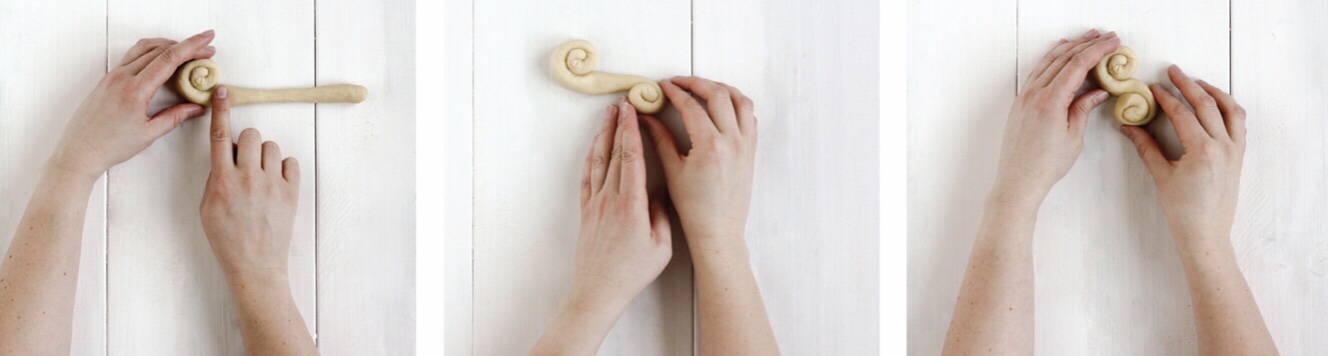
Roll each piece of dough into a long, skinny strip, about 12 inches long. Roll the left end of the dough up and clockwise until it reaches the middle, then roll the right end down and clockwise until it reaches the middle. Your dough should now look like a very tightly rolled S.

Place the Ss on a parchment-lined baking sheet, cover with plastic wrap, and allow them to rise for 30 minutes.

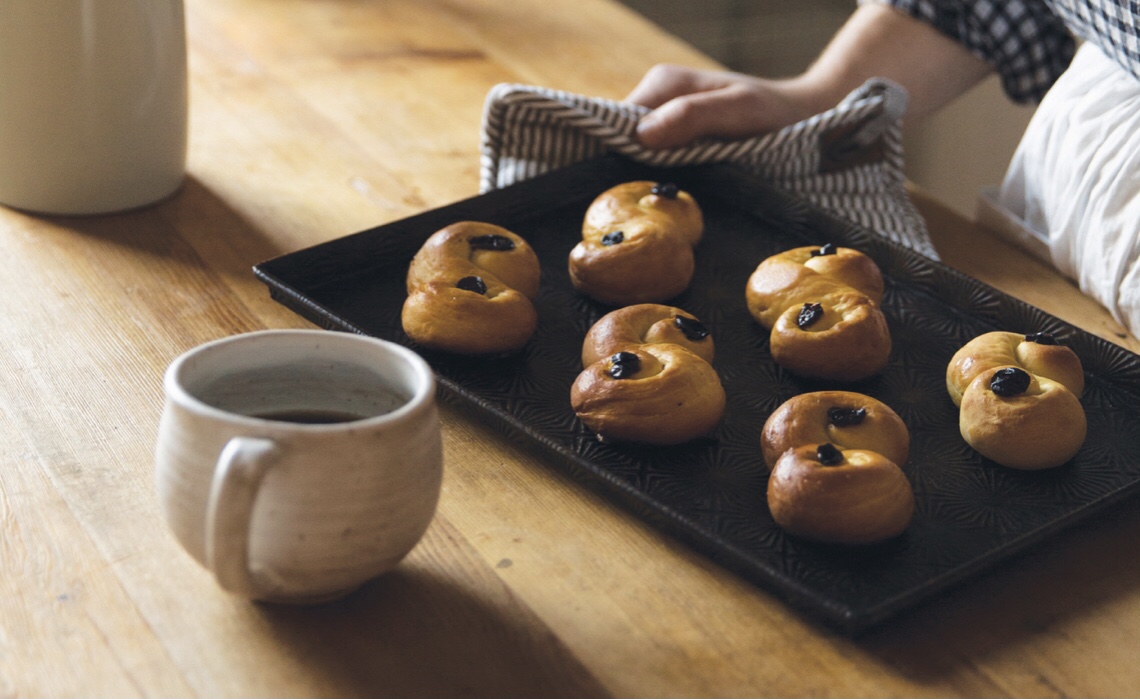
Preheat the oven to 400 degrees F. While the buns are rising, in a small bowl, whisk together the egg and water. Just before baking, lightly brush the tops and sides of each lucia bun with the egg wash, place a cranberry at the center of each swirl, and sprinkle the tops with pearl sugar.

Bake the lucia buns for 8 minutes, or until they are puffed and golden. Remove the baking sheet from the oven and allow the buns to cool. Store leftovers in an airtight container.

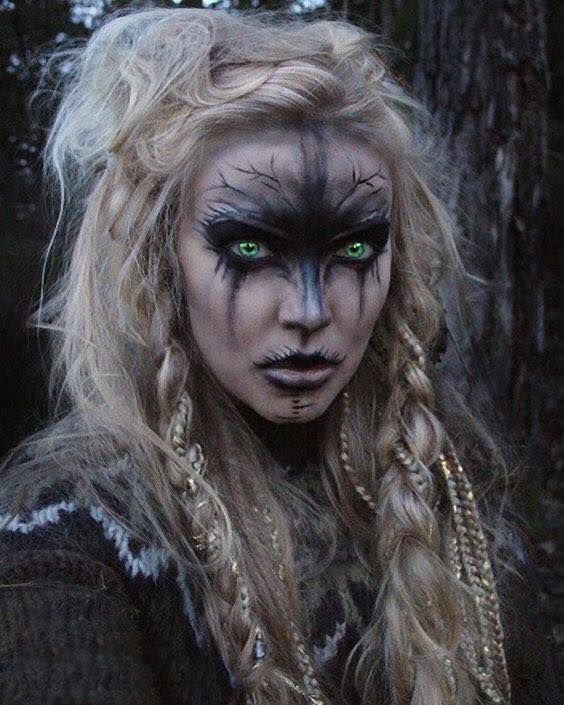
Witches of the Norse World

Witches

Belief in witches stretches across almost all cultures in history, and the Vikings definitely did not invent them. Vikings believed in magic and never took it lightly. There are about 40 different words for magic and magic users in their language of Old Norse, showing the range of understanding and the importance they placed on it. Freyja, the most venerated of the Norse goddesses, was a goddess of magic and taught her arcane arts to Odin. Freyja is sometimes called a witch in the Eddic poems and was much maligned for this by later Christians.  Freyja traveled in a chariot drawn by black or gray cats. These quiet, intelligent, ruthless creatures are her familiars or messenger spirits. A Viking who looked up to see a raven might see it as an omen from Odin, just as he might see a black cat as a sign that Freyja was watching.

Witches, sorcerers, and wizards were taken seriously and respected in the Viking world. This is further attested by the many Viking Age graves archaeologists have discovered that have grave goods (valuables deliberately interred with the body) associated with magic users. One tell-tale sign of a witch’s grave is an iron staff. It is thought that these iron staffs were used by Völva sorceresses in certain magic rituals, held between the thighs as the witch entered a shamanistic trance. At such times, it was thought that the witch’s layers of inner self left their outer body (what occultists now refer to as astral projection).

One passage referring to this is in the Havamal:

I know a tenth spell
If I see witches
at play in the air
I can cast this spell
So that they get lost
So they can’t find their skins
So they can’t find their minds

If the Viking Age, witches used their iron rod as a means of traveling across levels of consciousness, it is easy to see how later Medieval Christians would say that witches “flew through the air riding on brooms.”

So, the pagan Vikings respected (and feared) witches and often turned to them for help, but when the Vikings gradually became more Christian, witches were targeted as public enemies by the Church. Witchcraft never wholly died out, though. In Iceland, in particular, witchcraft survived in a well-documented line from early Viking times until the present – though it certainly changed and took on elements and influences from other cultures.

It is not just the Medieval Christian that shifted the perspective of the witch from medicine woman and soothsayer to evil, hexing hag, though. Viking lore is replete with frightening or “wicked” witches. There are at least three Eddic poems in which the speaker is a dead witch awoken by Odin or Freyja’s necromancy, and forced to lend her wisdom to the gods though she is full of spite for them. The worst of the evil witches were sometimes referred to as “Troll Wives” and were Jötnar rather than human. Like many fearsome beings in Norse lore, Troll Wives are seldom described in detail. However, the impression given fits the Halloween image of a lank-haired, green-skinned disfigured distortion of the elderly.

But it is clear that there is a broad range of witches. Only some of them could really be classified as good or evil – which is typical of the moral complexity and honesty that has made Norse lore so poignant and enduring.

Source: Sons of Vikings

What does the word Viking even mean?

Viking in Old Norse

Viking in Old Norse is víkingr. The ‘r’ on the end is essentially a grammatical feature of Old Norse for denoting a masculine noun. It is often dropped in English transliteration (for example, people may write the name of the god Freyr as Frey). In Old Norse, víkingr was someone who was a seaborne raider/adventurer.

Noun or Verb

Víkingr and plural forms of the word, such as víkingum or víkingar, appear as nouns describing Scandinavian seaborne raiders in the sagas, Eddic poetry, and runestones.

We see literally carved in stone the term “Viking” being used as a noun and to denote people. From the context, it does not seem that “Viking” referred to everybody, though, but to some type of traveling warrior.

Viking’ also used as a Verb in Old Norse

Viking could also be a verb in Old Norse. This verb meant the act of seaborne raiding or adventuring. So, a víkingr would víking, or in other words, a seaborne raider would raid by sea. In many historical fiction books, this is rendered “to go viking.”

There is no evidence to suggest that the verb was more prevalent than the noun or adjective. However, it is fair to say that Vikings used the terms víkingr and víking differently than we use these terms.

What Vikings Called Themselves, and What Other People Called Them

It is essential to remember that in our ancestors’ times many of the current cultural values did not exist. ideals, concepts, and information we now take for granted had not developed yet. Today, one of the strongest ways people identify is by their nationality – we are Americans, Norwegians, etc. While many of Europe’s nations began to form and organize in the Viking Age, national identity was then only in its embryonic stages. 

As the Viking Age dawned, the Nordic peoples of Scandinavia shared a common language, culture, and faith. However, they did not share a strong sense of common identity, as evidenced by their constant wars, raiding, and competition – even within the geographical boundaries of their homeland. They were divided into numerous tribes or clans.

Their societies were arranged in small units united by kinship and their allegiance was to local chieftain. The first “King of All Norway,” Harald Fairhair, did not consolidate power until a century into the Viking Age, and the political boundaries of Denmark, Norway, and Sweden would not solidify for several centuries after that.

So, while Vikings used the term víkingr for a seaborne adventurer, early medieval Scandinavian peoples had no overarching name for themselves. They did not think that way. Instead, they identified themselves by family, clan, and tribal loyalties. During the Viking Age, these intimate groups formed larger and larger networks and affected greater and greater changes far from home. 

Vikings might not have had a common term for themselves, but their enemies had many. The English and the French tended to call them all Danes. Archeology is abundantly clear, though, that the “Great Heathen Army,” the “Army of the Seine,” and these other large forces were not just Danes but mixed companies from locations wherever Vikings roamed. 

English monks, writing in Latin, also adopted the word, Wiccinga/Wiccingi (the Old English form of ‘viking’ in Latinized singular and plural forms). This capitalization in the manuscripts strongly suggests the Vikings were known by that name, and that it is not just a generic descriptor.

There were other names in other places. In Ireland, the Vikings were called “the Foreigners.” In the east – Russia, Ukraine, Belarus, the Byzantine Empire, Bulgaria, and the Mediterranean – Vikings were called Varangians (“sworn companions”) and Rus’. To the Moors of Spain and the Arabs around the Caspian, they were called Majūs.

Source: Sons Of Vikings

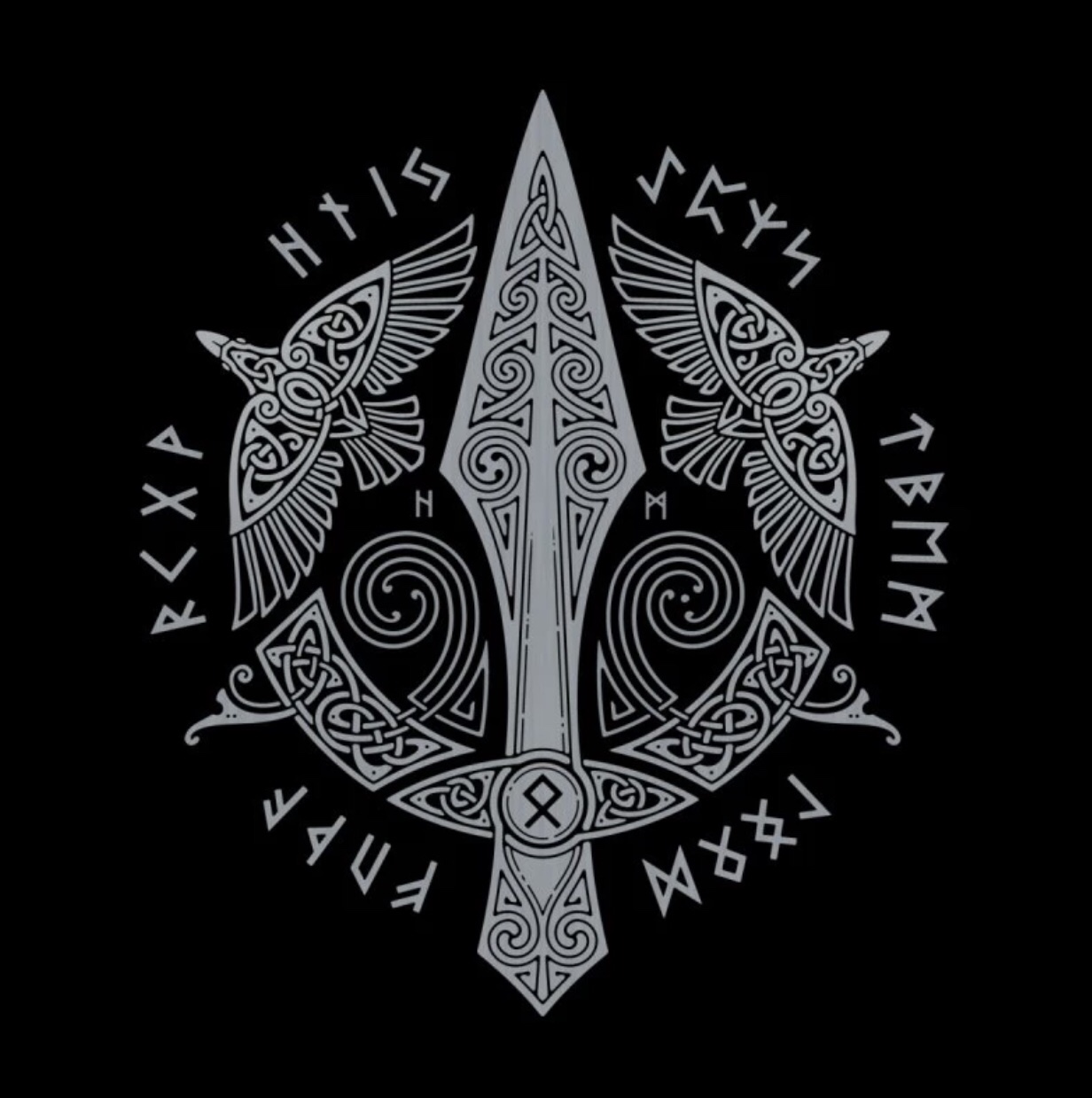
Viking Runes Introduction

By the beginning of the Viking Age, the Scandinavian rune-masters had developed an alphabet, or “futhark” (from the value of the first six characters), of sixteen characters that was quite distinct from the rest of the Germanic peoples. This alphabet was known as the “younger futhark”.

However, even within Scandinavia, there was no standard form for the characters and there are variations from inscription to inscription, but basically there were two main forms of futhark: the Common or Danish futhark (although it occurs outside of Denmark), and the Swedo-Norwegian futhark (although this also occurs outside of Sweden and Norway.

One can see that there are shortcomings with these alphabets. For example, there are characters for b, k and t, but there are none for p, g and d (this is because the futhark does not distinguish between these voiced and voiceless pairs. Therefore the rune-master had to use b for p, k for g and t for d.

There were other peculiarities: although there were two characters for the two different types of a, there were no symbols for e and o. This meant that the name “Svein” appears as in runes “suin” and the name “Gormr” appears as “kurmR”.

It becomes even more complicated, as the spelling practice allowed n to be omitted when it occurred before a consonant. Therefore the name Thormundr appears as thurmutR.

This of course means that many runic inscriptions can be very difficult to read and there can be a great deal of dispute about their true meaning.

Despite the difficulties in reading runic inscriptions, they can provide a good deal of useful information.

Source: Swedish National Museum Heritage Board’s website, but that page no longer exists.

Who Were The Norse?

“The term ‘Norse’ is used to describe the various peoples of Scandinavia who spoke the Old Norse language between the eighth and thirteenth centuries AD. While it had eastern and western dialects it would have been generally mutually understood across the range of areas within which it was spoken. A third recognisable form was spoken on the island of Gotland.

The Old Norse language later developed into modern Danish, Faroese, Icelandic, Norwegian and Swedish. In addition, there once existed the so-called Norn languages of Orkney and Shetland that are now extinct. It was, essentially, the language of the Vikings.”

~ Martyn Whittock, from Tales of Valhalla

The Wolf Song – Nordic Lullaby

This version of the lullaby from “Ronja Rövardotter / Ronia the robbers daugther” written by beloved Swedish writer, Astrid Lindgren, whose books have been read for children all over the world:

Lyrics in Swedish and English:

Vargen ylar i nattens skog
(The wolf is howling in the forest of the night)
Han vill men kan inte sova
(He wants to, but cannot sleep)
Hungern river i hans varga buk
(The hunger tears his wolven stomach)
Och det är kallt i hans stova
(And it’s cold in his burrow)

Du varg du varg, kom inte hit
(Wolf, wolf, don’t you come here)
Ungen min får du aldrig
( I will never let you take my child)

Vargen ylar i nattens skog
(The wolf is howling in the forest of the night)
Ylar av hunger o klagar
(Howling out of hunger and moaning)
Men jag ska ge’n en grisa svans
(But I will give him a pig tail)
Sånt passar i varga magar
(Which suits a wolven stomach)

Du varg du varg, kom inte hit
(Wolf, wolf, don’t you come here)
Ungen min får du aldrig
( I will never let you take my child)

…(First verse again)

Balancing Stones

“The very first time I tried balancing stones was back in 2010. I saw some stone sculptures in a park, when an old, wise man told me that it was a symbol for the balance of nature. I liked that idea, and after that I started making easy stone sculptures. After a while, I started experimenting with balance and I tried to make stone sculptures that had such small balance points so that it almost would look impossible. I really loved that. Both because it felt like a challenge, but also because it forced me to get really still and quiet, and focus on one thing only; to find the tiny, tiny balance point. It more and more turned into some kind of meditation.”

~ Jonna Jinton, Swedish artist, musician and filmmaker and I live in the beautiful woods in the North of Sweden