New Zealand Travel Ad

New Zealand has just opened up a bit for travel. Prime Minister Jacinda Ardern announced that both Australia and New Zealand are in a “bubble,” and people will be able to travel between the two countries without mandatory quarantining in hotels. (Both countries have very low infection rates.) The Kiwis, of course, are celebrating this with their typical wry humor: here’s a NZ travel ad.

#Travel #NewZealand

American Conservative Judaism

The Conservative movement is the second largest of the three main religious denominations within American Judaism, claiming 18 percent of American Jews, according to a 2013 study by the Pew Research Center. Historically it has occupied a sort of middle ground between Reform and Orthodox, maintaining (unlike Reform) that Jewish law remains binding on modern Jews, but affording far greater leeway than Orthodoxy in adapting those laws to reflect modern realities.

• The movement tolerates a range of religious practice in its commitment to halachic pluralism — the idea that multiple (and opposing) opinions concerning the requirements of Jewish law can be considered equally legitimate.

• Most (but not all) Conservative synagogues are egalitarian on gender issues, and the movement has endorsed religious rulings both in favor of and opposed to same-sex marriage.

• While its rabbis are not permitted to officiate at interfaith weddings, the movement has in recent years made a greater effort to welcome interfaith couples and families into its congregations. One of its mottos has been “Tradition and Change.”

• In the mid-20th century, the Conservative movement was the dominant stream of American Judaism. In some years in the 1950s, the movement was adding 100 new affiliate congregations annually. But by the end of the century, the movement was in serious decline, with some fretting openly that Conservative Judaism was on the road to oblivion.

The movement began as an effort to “conserve” traditional Judaism in the face of the liberalizing tendencies of Reform leaders in the late 19th century. One critical moment of division is often said to be the Reform movement’s famous 1883 “trefa banquet,” when non-kosher foods were served at a dinner honoring the first rabbis ordained through the Reform seminary Hebrew Union College. The Jewish Theological Seminary of America, which would become the flagship institution of the Conservative movement, was founded in 1886 — one year after Reform adopted its Pittsburgh Platform of 1885, which explicitly rejected Jewish practices it viewed as inconsistent with modern ideas.

The movement has been defined by its official commitment to Jewish law (halacha ), even as it has staked out positions that entail substantial departures from what was long considered normative Jewish practice. In 1983, the movement began ordaining women rabbis, which prompted some JTS faculty to quit the school in protest. In 1998, the movement’s updated prayer book, Sim Shalom, contained an alternative Amidah text that included the names of the matriarchs, Sarah, Rebecca, Rachel and Leah alongside the names of the patriarchs. Some of the God language in the book replaced gendered language such as “King” and “Father” with more gender-neutral terms, like Sovereign and Guardian.

One of the movement’s most significant — some would say fateful — innovations was the 1950 ruling permitting worshippers to drive to synagogue (but nowhere else) on Shabbat. Amid the rapid suburbanization of postwar America, this change enabled many to attend synagogue who would otherwise be unable to get there on the Jewish Sabbath, when driving is traditionally prohibited. However, some critics would later point to this shift as undermining the movement’s stated commitment to Jewish law.

In the 21st century, the movement’s long-term viability has continued to be drawn into question. The percentage of Jewish households that identified as Conservative dropped by 10 points — from 43 to 33 percent — between 1990 and 2000, according to surveys of the American Jewish population conducted in those years. By 2013, a Pew survey found only 18 percent of American Jews identified as Conservative, roughly half the number that called themselves Reform. The movement’s synagogue umbrella group, the United Synagogue for Conservative Judaism, also experienced a significant drop-off in affiliated congregations.

The decline is attributed to various factors, chief among them intermarriage. A majority of intermarried Jews who were raised Conservative no longer identify as such as adults, according to sociologist Steven M. Cohen. At least some of those Jews have gravitated toward the Reform movement, which has traditionally been more welcoming of intermarried couples. Others have pointed to the movement’s liberalization over the years, which has turned off more traditionally minded Jews, as well as to the rise of independent minyans, which have attracted many graduates of Conservative day schools and summer camps. Still others have fingered geographic mobility as the culprit — the relocation of American Jews from areas where the Conservative movement historically had a strong presence (the northeast and the Midwest), to areas where Reform congregations predominated (the South and the West).

05587F44-91BE-42E2-85A1-0622115EDEEF

But according to Cohen, there remain some encouraging signs for the movement in recent studies showing that among those who do identify as Conservative, metrics of Jewish engagement remain strong. “What Conservative institutions like camps and day schools have been doing is working to build a core group with relatively high levels of Jewish observance, engagement and literacy,” Cohen wrote in a 2015 op-ed for JTA. “If they keep doing so, the evidence suggests that while the overall number of Conservative Jews may still decline, this dedicated core will continue to sustain what was once America’s largest Jewish denomination.”

By 2017, a Pew survey found only 14 percent of American Jews identified as Conservative, roughly half the number (28 percent) that called themselves Reform. To understand that in a broader context thirty-seven percent identified as “just Jewish” with no formal affiliation with any of the big three denominations (big four if you consider reconstructionist).

Sources: Essential Judaism, myjewishlearning.com, Chabad.org

Tadpole Nebula

The Star Formation In The Tadpole Nebula:

IC410 is a dusty emission nebula located in the constellation of Auriga at about 12.000 ly from Earth. It is part of a larger star forming region that also contains the Flaming Star Nebula. The gas structures in this picture are lit by the radiation from the open star cluster NGC1893 that lies in the center of the nebula. This star cluster is about 4 million years old, but in astronomical terms it is still very young, with hot, massive stars. At the top-left of the star cluster two more dense structures are visible. These are similar to the famous Pillar of Creation and they are composed of dust and gas leftover from the formation of the star cluster and are very likely to give birth to more stars in the future. As can be seen in the picture, these structures point away from the center of the nebula. This is because of the stellar winds and radiation pressure from the stars in NGC 1893. Due to these structure’s shape, the nebula is also called the Tadpoles Nebula.

La Silla Observatory

Our magnificent Milky Way galaxy is radiant over La Silla Observatory. The ESO 3.6-metre telescope is shown to the right, now home to the world’s foremost extrasolar planet hunter: High Accuracy Radial velocity Planet Searcher (HARPS), a spectrograph with unrivalled precision.

Photo Credit: ESO/B. Tafreshi

The Beatles and Astrid Kirchherr

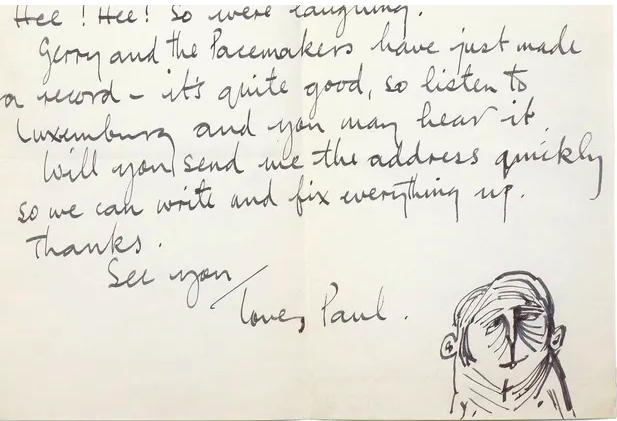
If you’re a Beatles fan, the Guardian has a good article on Astrid Kirchherr, once engaged to the ex-Beatle Stu Sutcliffe, and who photographed, mothered, and molded the style of the Beatles (i.e., suggesting their “mop top” haircuts) when they played in Hamburg before they were famous. She also received lots of letters from the Beatles, One is below, along with a photo of her with Ringo and John.

Kirchherr died in 2020, and the letters are up for auction.

Agnostic Atheism

Concept of the day:

Agnostic Atheism: as anyone fluent in the contemporary debate between atheists and theists knows, is common parlance among nonbelievers. Roughly, the idea here is that when one uses the term “atheist” they’re making reference to their belief, whereas when one uses the term “agnostic,” they’re making reference to their knowledge. In this way, so the argument goes, one can be an atheist in the sense that they don’t believe that God exists (or that they positively believe that God does not exist) but nevertheless be an agnostic in the sense that they don’t know, or claim to know, that God does not exist.

Further, there is an additional distinction that is made between soft (or weak) atheists and hard (or strong) atheists. On the one hand, soft atheists are those who claim only to lack belief in God. On the other hand, hard atheists are those who claim to know or believe that God does not exist.

Now, descriptively speaking, this taxonomy seems to correspond pretty closely to the way that many atheists now days construe their atheism. So, as far as semantics go, this seems correct. However, and I say this as an atheist, in terms of its philosophical rigor, this construal of atheism seems a bit lacking. To demonstrate this, try to imagine an atheist using the distinction between atheism and agnosticism, as well as the distinction between soft and hard atheism, with respect to any other conception of god apart from the standard, Western monotheistic conception. That would be peculiar, would it not? So, the question is why don’t we atheists bother to qualify our rejection of Zeus or Odin with the caveats of agnosticism and a mere lack of belief? And if we don’t need to do this, why, then, must we do this with respect to the god of Christianity?

Well, frankly, I don’t think we need to. The mere fact that I don’t know *for certain* that Zeus doesn’t exist does not mean that I have to be an agnostic with respect to his existence, any more than the fact that I can’t know for certain that I’m not just a brain in a vat means I have to be agnostic about whether or not I’m just a brain in a vat. In other words, the sort of certainty that agnostic atheists point to in order to distinguish between their atheism and their agnosticism is itself based on a rather sophomoric understanding of epistemology that is quickly done away with by the slightest of philosophical inquiry. I may not know for certain that God does not exist, but this is not at all to say that I’m not entirely rational in going ahead and affirming my belief in the nonexistence of God all the same. And I don’t have to call myself an agnostic while doing so.

Sources: Atheist Republic

#NotAttackingReligion #FreedomOfBelief #JustSomeClarification

The Pharaoh of Exodus: Evidence or No Evidence

Date: 1440 BC

Discovered: Elephantine, Egypt

Period: Exodus

Torah Passages: Exodus 2:11–5:1; 12:37-41; 14:4-30; Acts 7:20-30

Pharaoh and his servants had a change of heart toward the people… So he made his chariot ready and took his people with him… and he chased after the sons of Israel (Exodus 14:5-8).

Pharaoh Amenhotep II reigned over Egypt beginning in about 1450 BC during the powerful 18th Dynasty of the New Kingdom. His monuments and inscriptions indicate that he was one of the most boastful pharaohs of ancient Egypt, claiming such feats as being able to shoot arrows through a copper target a palm thick, rowing a ship by himself faster and farther than 200 Egyptian sailors, singlehandedly killing 7 prince warriors of Kadesh, having the kings of Babylon, the Hittites, and Mitanni all come to pay tribute to him, and supposedly conducting the largest slave raid in Egyptian history.

According to a match of chronological information from Egyptian king lists and the Bible, Amenhotep II was probably also the pharaoh of the Exodus, which occurred in approximately 1446 BC. One of the most significant artifacts relating to the circumstantial evidence for Amenhotep II being the pharaoh of the Exodus is a stele that he commissioned to commemorate one of his campaigns.

While earlier in the 18th Dynasty the Egyptians had a powerful military, especially during the reign of Thutmose III, who conducted 17 known military campaigns, after the beginning of the reign of Amenhotep II there is a steep decline.  In fact, Amenhotep II had only two confirmed campaigns during his reign—the first took place prior to the Exodus, while the second was primarily a slave raid that occurred soon after the Exodus and was recorded on the Elephantine Stele.

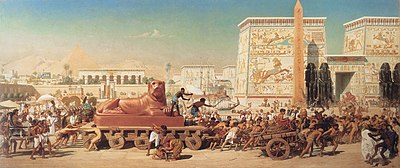
This monumental stone inscription with its accompanying artwork was originally erected at the southern city of Elephantine, and it records the campaign of Amenhotep II to Canaan in which he claims to have brought back over 101,128 captives to be used as slaves.31 In comparison, other Egyptian military campaigns of the period brought back nowhere near the amount of captives, with the largest total being only 5,903, and as a result most scholars consider the number of slaves captured by Amenhotep II in this text to be a massive exaggeration. Because this happened right after the Exodus, perhaps it is indicative of an urgent need to replace the lost slave population in Egypt, or purely as propaganda making it appear that the pharaoh had recovered or replenished the slaves lost during the Hebrew Exodus.

Additional indicators include that the pharaoh preceding the Exodus must have had a reign of over 40 years, since Moses killed an Egyptian and fled to Midian for 40 years until the pharaoh who knew him had died. Thutmose III, the father and predecessor of Amenhotep II, reigned for 54 years and is the only pharaoh in the dynasty with a reign of 40 or more years. The Exodus pharaoh must also have recently begun his reign, since Moses returned and confronted the Exodus pharaoh soon after the previous pharaoh died, and Amenhotep II took the throne only about four years or less prior to the Exodus.

The first campaign of Amenhotep II was launched in his third year, or approximately 1448 BC. The second campaign, to Canaan, occurred in his seventh year, approximately 1444 BC, which seems to have been only one or two years after the Exodus.

Sources: Essential Judaism, Unearthing the Bible, myjewishlearning.com, Chabad.org

Pine Island Glacier Reaching Tipping Point

Researchers have confirmed for the first time that Pine Island Glacier in West Antarctica could cross tipping points, leading to a rapid and irreversible retreat which would have significant consequences for global sea level.

Pine Island Glacier is a region of fast-flowing ice draining an area of West Antarctica approximately two thirds the size of the UK. The glacier is a particular cause for concern as it is losing more ice than any other glacier in Antarctica.

Currently, Pine Island Glacier together with its neighbouring Thwaites glacier are responsible for about 10% of the ongoing increase in global sea level.

Scientists have argued for some time that this region of Antarctica could reach a tipping point and undergo an irreversible retreat from which it could not recover. Such a retreat, once started, could lead to the collapse of the entire West Antarctic Ice Sheet, which contains enough ice to raise global sea level by over three metres.

While the general possibility of such a tipping point within ice sheets has been raised before, showing that Pine Island Glacier has the potential to enter unstable retreat is a very different question.

Now, researchers from Northumbria University have shown, for the first time, that this is indeed the case.

Their findings are published in leading journal, The Cryosphere.

Using a state-of-the-art ice flow model developed by Northumbria’s glaciology research group, the team have developed methods that allow tipping points within ice sheets to be identified.

For Pine Island Glacier, their study shows that the glacier has at least three distinct tipping points. The third and final event, triggered by ocean temperatures increasing by 1.2C, leads to an irreversible retreat of the entire glacier.

Sources: Phys.org

Gingerade Tea

If you love the toning effects of ginger on your immunity and digestion, this tea is for you. In addition to the ginger, Gingerade contains the nutritive sweet herbs milky oats, fennel, and honeybush, which create a delicious blend. Rosemary, known as the herb of remembrance, supports the mind and memory. Lemongrass, with its delicate citrus scent, brightens the mind and uplifts mood. Adding fresh or dried fruits provides a little sweetness and a touch of sour.

3 parts milky oats

2 parts ginger

2 parts honeybush (Cyclopia)

1 part lemongrass

1 part rose hips

1 part fennel

1 part dried berries (e.g., elderberry, blackberry, blueberry)

0.5 part rosemary

1 drop lemon essential oil, or fresh lemon zest to taste

Steeping

Hot Infusion: Pour 1.5 cups hot water over 2 tablespoons tea. Steep for 10 to 15 minutes.

Cold Infusion: Combine 2 cups cold water and 1 to 2 tablespoons tea in a lidded jar. Shake the jar to make sure all the tea is saturated. Place in the refrigerator or a cool place for at least 2 hours.

Taste: sweet, spicy, fruity

Herbal Actions: supports digestion, mineral rich

Systems Affected: digestive, general tonic

The Beatles Monopolize Top 5 Billboard Hits

Today in music history —> On this date in 1964, the Fab Four monopolized the top five on the Billboard Hot 100, marking the only act ever to lock up the region in a week.

On the Billboard Hot 100 dated April 4, 1964, the Beatles made history as the only act ever to occupy the chart’s top five positions in a week.

With a 27-1 second-week blast to the top for “Can’t Buy Me Love,” the Fab Four locked up the chart’s entire top five:

No. 1, “Can’t Buy Me Love”

No. 2, “Twist and Shout”

No. 3, “She Loves You”

No. 4, “I Want to Hold Your Hand”

No. 5, “Please Please Me”