Shiitake Mushroom Dashi

5 cups Vegetarian Konbu Dashi Stock
11/4 ounces dried shiitake mushrooms
1 teaspoon caster sugar
pinch of sea salt

Add Vegetarian Konbu Dashi Stock to a pan until hot but not boiling, then remove from the heat.

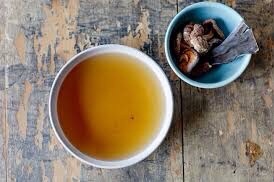
Add the shiitake mushrooms, sugar and salt to the hot konbu dashi and let them soak for 2–4 hours. Remove the mushrooms, reserving them for another recipe.

Strain the dashi into a bowl avoiding any sediment or grit from the bottom of the pan.

The dashi will keep in the fridge for a few days and in the freezer for up to 3 months.

Niboshi Dashi

This Dashi is a much stronger flavored version than the bonito and konbu dashi.  Excellent for Miso Soup and Ramen.

  • 11/4 ounces dried small sardines (niboshi)
  • 5 cups) cold water or Traditional Fish Based Dashi
  • 1/8 ounce konbu (if using water)

Pluck off and discard the fish heads, open up the fish stomachs and remove and discard the insides. Place the prepared fish in a pan with the measured water and konbu, or with the Traditional Fish Based Dashi, and leave to soak for one hour.

Bring the water quickly to a boil, skim off any scum that rises to the surface and simmer very gently for 6–10 minutes.

Remove from the heat and pass through a very fine muslin-lined sieve.

The dashi will keep in the fridge for a few days and in the freezer for up to 3 months.

Chicken Dashi

Meat dashi’s are pretty rare in Japanese Cuisine.  In the United States chef David Chang has made his bacon dashi infamous in culinary circles.

This Dashi can be made more luxurious by replacing the chicken bones with duck bones.

3 pounds 5 ounces chicken bones
1 tablespoon fine sea salt
2 scallions, white part only
3 1/2 ounces carrots
1 3/4 ounces of ginger
1 cup sake

14 3/4 cups cold water

Remove any bits of fat from the chicken bones. Rub the salt into the bones and set aside for 1 hour to allow salt to penetrate.

Preheat the oven to 350 degrees. Place the bones in a roasting pan and roast in the oven for 30 minutes.

Meanwhile, cut the scallion stalks in half and carefully char them over a gas flame on the stove or under the broiler. Wash and roughly slice the unpeeled carrots and ginger.

Transfer the hot roasted bones to a large stockpot and add the rest of the ingredients. Quickly bring to a boil, then simmer until the stock is reduced by half, skim off any scum that rises to the surface.

Remove the bones from the pot, and pass the stock through a fine sieve.

The dashi will keep in the fridge for a few days and in the freezer for up to 3 months.

Tarot: Temperance

Alternative Names: Art

Number: XIV

Astrological Sign or Planet: Sagittarius, the archer

Element: Fire

General Meaning: Patience

Chakra: Solar plexus, for personal power

Key Meanings: Moderation, reconciliation, healing, and angelic guidance

Key Message: You are guided to find peace.

Tarot: Death

Alternative Names: Mortality, Transformation, Thirteen

Number: XIII

Astrological Sign or Planet: Scorpio, the scorpion

Element: Water

General Meaning: Decline and rebirth

Chakra: Alta Major, for the past and past lives

Key Meanings: Transformation and change

Key Message: Swift change brings new beginnings.

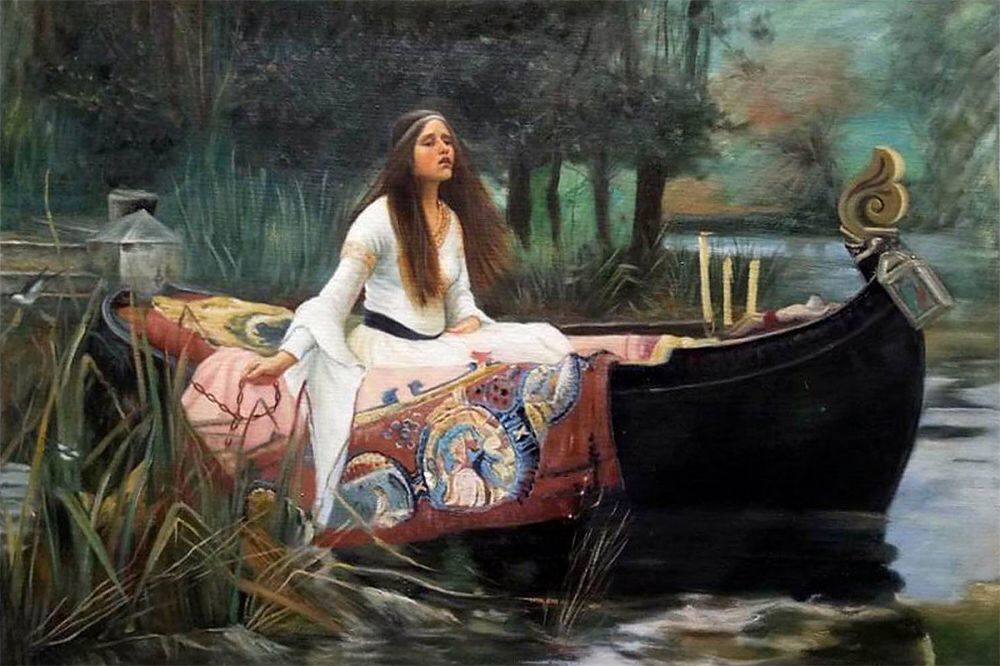
The Lady of Shalott

The Lady of Shalott (1832)

BY ALFRED, LORD TENNYSON

Part I 

On either side the river lie

Long fields of barley and of rye,

That clothe the wold and meet the sky; 

And thro’ the field the road runs by 

       To many-tower’d Camelot; 

The yellow-leaved waterlily 

The green-sheathed daffodilly 

Tremble in the water chilly 

Round about Shalott.

Willows whiten, aspens shiver. 

The sunbeam showers break and quiver 

In the stream that runneth ever 

By the island in the river 

       Flowing down to Camelot. 

Four gray walls, and four gray towers 

Overlook a space of flowers, 

And the silent isle imbowers 

The Lady of Shalott.

Underneath the bearded barley, 

The reaper, reaping late and early, 

Hears her ever chanting cheerly, 

Like an angel, singing clearly, 

       O’er the stream of Camelot. 

Piling the sheaves in furrows airy, 

Beneath the moon, the reaper weary 

Listening whispers, ‘ ‘Tis the fairy, 

Lady of Shalott.’

The little isle is all inrail’d 

With a rose-fence, and overtrail’d 

With roses: by the marge unhail’d 

The shallop flitteth silken sail’d, 

       Skimming down to Camelot. 

A pearl garland winds her head: 

She leaneth on a velvet bed, 

Full royally apparelled, 

The Lady of Shalott.

Part II 

No time hath she to sport and play: 

A charmed web she weaves alway. 

A curse is on her, if she stay 

Her weaving, either night or day, 

       To look down to Camelot. 

She knows not what the curse may be; 

Therefore she weaveth steadily, 

Therefore no other care hath she, 

The Lady of Shalott.

She lives with little joy or fear. 

Over the water, running near, 

The sheepbell tinkles in her ear. 

Before her hangs a mirror clear, 

       Reflecting tower’d Camelot. 

And as the mazy web she whirls, 

She sees the surly village churls, 

And the red cloaks of market girls 

Pass onward from Shalott.

Sometimes a troop of damsels glad, 

An abbot on an ambling pad, 

Sometimes a curly shepherd lad, 

Or long-hair’d page in crimson clad, 

       Goes by to tower’d Camelot: 

And sometimes thro’ the mirror blue 

The knights come riding two and two: 

She hath no loyal knight and true, 

The Lady of Shalott.

But in her web she still delights 

To weave the mirror’s magic sights, 

For often thro’ the silent nights 

A funeral, with plumes and lights 

       And music, came from Camelot: 

Or when the moon was overhead 

Came two young lovers lately wed; 

‘I am half sick of shadows,’ said 

The Lady of Shalott.

Part III 

A bow-shot from her bower-eaves, 

He rode between the barley-sheaves, 

The sun came dazzling thro’ the leaves, 

And flam’d upon the brazen greaves 

       Of bold Sir Lancelot. 

A red-cross knight for ever kneel’d 

To a lady in his shield, 

That sparkled on the yellow field, 

Beside remote Shalott.

The gemmy bridle glitter’d free, 

Like to some branch of stars we see 

Hung in the golden Galaxy. 

The bridle bells rang merrily 

       As he rode down from Camelot: 

And from his blazon’d baldric slung 

A mighty silver bugle hung, 

And as he rode his armour rung, 

Beside remote Shalott.

All in the blue unclouded weather 

Thick-jewell’d shone the saddle-leather, 

The helmet and the helmet-feather 

Burn’d like one burning flame together, 

       As he rode down from Camelot. 

As often thro’ the purple night, 

Below the starry clusters bright, 

Some bearded meteor, trailing light, 

Moves over green Shalott.

His broad clear brow in sunlight glow’d; 

On burnish’d hooves his war-horse trode; 

From underneath his helmet flow’d 

His coal-black curls as on he rode, 

       As he rode down from Camelot. 

From the bank and from the river 

He flash’d into the crystal mirror, 

‘Tirra lirra, tirra lirra:’ 

Sang Sir Lancelot.

She left the web, she left the loom 

She made three paces thro’ the room 

She saw the water-flower bloom, 

She saw the helmet and the plume, 

       She look’d down to Camelot. 

Out flew the web and floated wide; 

The mirror crack’d from side to side; 

‘The curse is come upon me,’ cried 

The Lady of Shalott.

Part IV 

In the stormy east-wind straining, 

The pale yellow woods were waning, 

The broad stream in his banks complaining, 

Heavily the low sky raining 

       Over tower’d Camelot; 

Outside the isle a shallow boat 

Beneath a willow lay afloat, 

Below the carven stern she wrote, 

The Lady of Shalott.

A cloudwhite crown of pearl she dight, 

All raimented in snowy white 

That loosely flew (her zone in sight 

Clasp’d with one blinding diamond bright) 

       Her wide eyes fix’d on Camelot, 

Though the squally east-wind keenly 

Blew, with folded arms serenely 

By the water stood the queenly 

Lady of Shalott.

With a steady stony glance— 

Like some bold seer in a trance, 

Beholding all his own mischance, 

Mute, with a glassy countenance— 

       She look’d down to Camelot. 

It was the closing of the day: 

She loos’d the chain, and down she lay; 

The broad stream bore her far away, 

The Lady of Shalott.

As when to sailors while they roam, 

By creeks and outfalls far from home, 

Rising and dropping with the foam, 

From dying swans wild warblings come, 

       Blown shoreward; so to Camelot 

Still as the boathead wound along 

The willowy hills and fields among, 

They heard her chanting her deathsong, 

The Lady of Shalott.

A longdrawn carol, mournful, holy, 

She chanted loudly, chanted lowly, 

Till her eyes were darken’d wholly, 

And her smooth face sharpen’d slowly, 

       Turn’d to tower’d Camelot: 

For ere she reach’d upon the tide 

The first house by the water-side, 

Singing in her song she died, 

The Lady of Shalott.

Under tower and balcony, 

By garden wall and gallery, 

A pale, pale corpse she floated by, 

Deadcold, between the houses high, 

       Dead into tower’d Camelot. 

Knight and burgher, lord and dame, 

To the planked wharfage came: 

Below the stern they read her name, 

The Lady of Shalott.

They cross’d themselves, their stars they blest, 

Knight, minstrel, abbot, squire, and guest. 

There lay a parchment on her breast, 

That puzzled more than all the rest, 

       The wellfed wits at Camelot. 

‘The web was woven curiously, 

The charm is broken utterly, 

Draw near and fear not,—this is I, 

       The Lady of Shalott.’

Hel

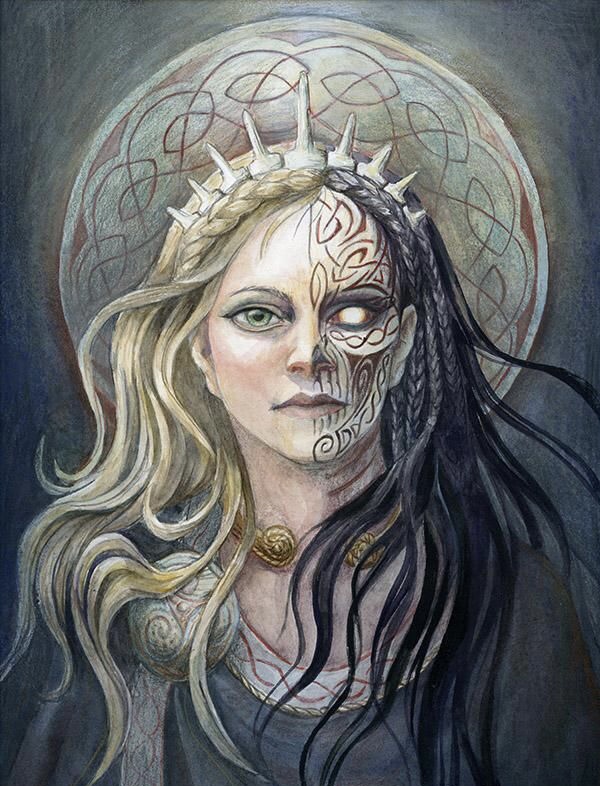
Hel (“Hidden” or “Concealer”) is a goddess who rules over the identically-named Hel, the underworld where many of the dead dwell. Her name’s meaning of “Hidden” surely has to do with the underworld and the dead being “hidden” or buried beneath the ground.

Hel is the daughter of Loki and the giantess Angrboda (“Anguish-boding”), and therefore the sister of the wolf Fenrir and the world serpent, Jormungand.  This makes her part of a highly dangerous and disreputable family.

Hel is generally presented as being rather greedy, harsh, and cruel, or at least indifferent to the concerns of both the living and the dead. However, her personality is little-developed in what survives of Old Norse literature. She’s mostly mentioned only in passing. She’s described as having the appearance as being half-black (or sometimes blue), half-white, and with a perpetually grim and fierce expression on her face.

The only surviving myth in which she features prominently is that of The Death of Baldur. The beloved god Baldur was slain by none other than Hel’s father, Loki, and the gods sent an emissary named Hermod to Hel in hopes of retrieving Baldur. Hermod pleaded with Hel, telling her how every living thing was in sorrow over the loss of Baldur. But Hel wouldn’t give up her prize so easily. She told Hermod that she would only consent to release Baldur if every last thing in the universe wept for him. Hermod and the other gods went around and got almost everything in the cosmos to weep for Baldur. Only one giantess, who was probably Loki in disguise, refused. But because of that one refusal, the terms of Hel’s offer weren’t met, and Hel kept Baldur in her cold clutches.

The realm of the dead has several names: Niðavellir (“Obscure Plains” or “Fields of Darkness”), Náströnd (“Corpse-shore”), or Násheimr (“Corpse-world”). It seems to consist of nine dwellings, the most terrible of which is Náströnd, in the southern reaches of Hel, where those who broke the moral laws, especially oath breakers, are cast. The dragon Níðhöggr gnaws on their corpses.

Because of how sparsely-defined her character is, many scholars view Hel as more of a late literary personification of the grave than a goddess who was actually worshiped or appeased in her own right. Due to the lack of conclusive evidence either way, this must remain an open question.

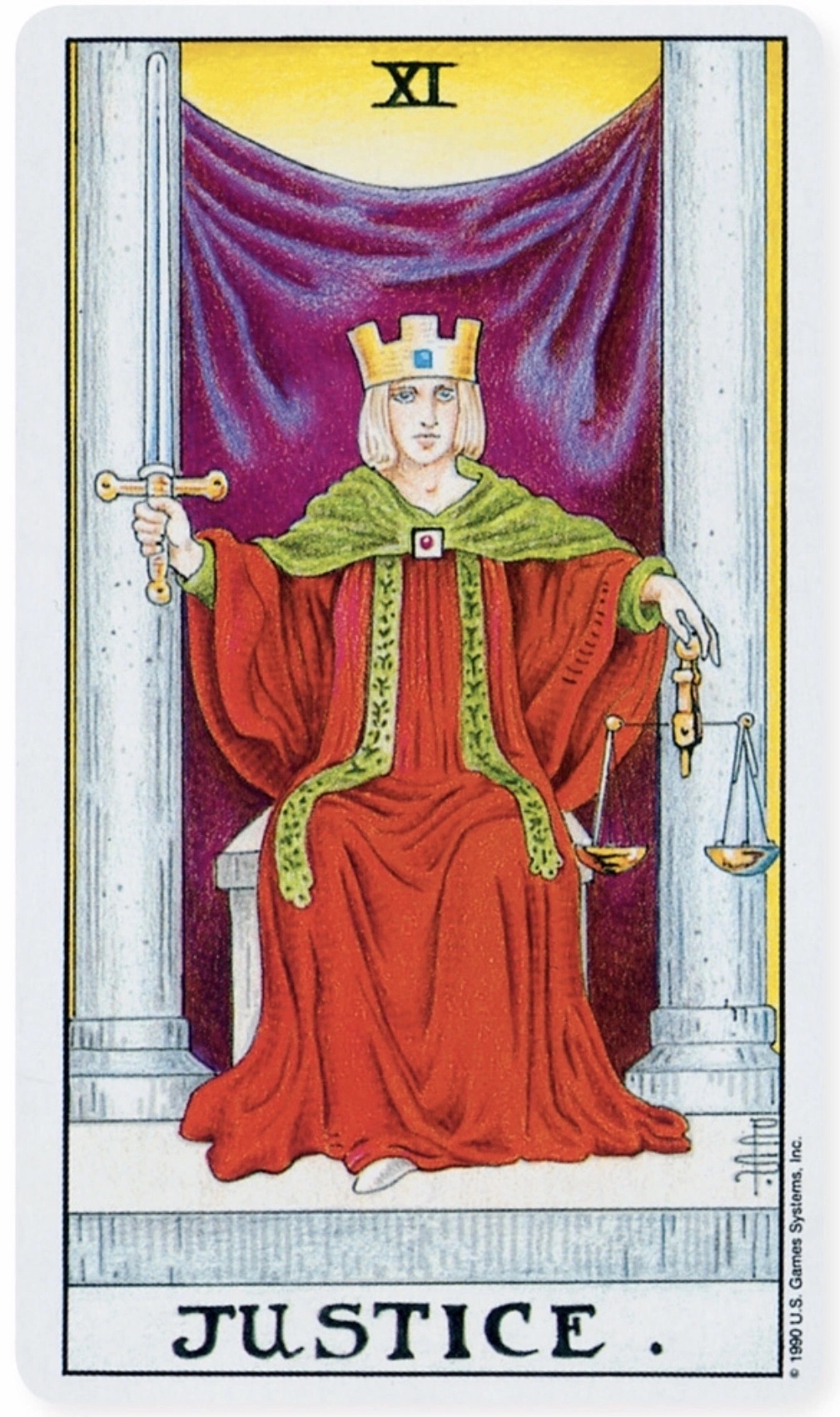
Tarot: Justice

Alternative Names: Adjustment

Number: XI (VIII in some decks)

Astrological Sign or Planet: Libra the scales

Element: Air

General Meaning: Fairness

Chakra: Earth Star, for spiritual grounding

Key Meanings: Balance, perception, and objectivity

Key Message: With the right values, reward comes.