The Five Classical French Mother Sauces: Tomate

The Five Classical French Mother Sauces: Tomate

The term “mother sauce” refers to any one of five basic sauces, which are the starting points for making various secondary sauces.  The five mother sauces:

  • Béchamel
  • Velouté
  • Espagnole
  • Hollandaise
  • Tomate

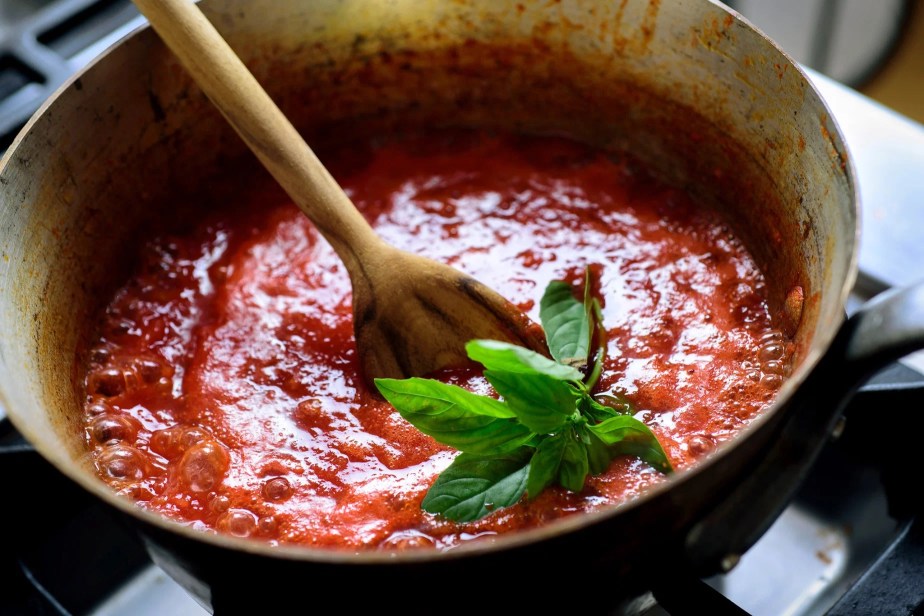
Tomate is a sublimely light sauce.  Its perfect tomato flavor dresses grilled fish or roasted chicken just as well as a bowl of spaghetti. There are countless variations on the theme, as well. Add the fresh basil at the very end, just before serving, to maximize flavor.

3 tablespoons extra virgin olive oil
1 large onion, finely chopped
1 medium carrot, peeled and finely chopped
4 garlic cloves, peeled and finely chopped
Pinch of sea salt
Freshly ground black pepper
6 medium tomatoes, peeled, seeded, and coarsely chopped
1/2 cup good-quality red wine
1-1/2 cups Chicken Stock
1 traditional bouquet garni ( seen here)
1 teaspoon sugar
Pinch of red chili pepper flakes
1/4 cup coarsely chopped fresh basil leaves

In a large pot, heat the olive oil over medium heat. Add the onion, carrot, garlic, and a pinch of salt and pepper. Stir and reduce heat to medium-low, and cook for 10 minutes, or until the vegetables are softened but not browned. Add the tomatoes. Increase heat to medium-high, stir, and cook another 3-5 minutes. Season with another pinch of salt and pepper. Add the red wine, chicken stock, bouquet garni, sugar, and chili pepper flakes. Bring to a boil over high heat, and then reduce to a simmer.

Cook over medium-low heat for 45 minutes, or until reduced by about one-third and thickened. Remove and discard bouquet garni. Puree tomato sauce lightly with a immersion blender or in a stand blender, until frothy and chunky-smooth. Taste and adjust seasonings as necessary. Add the basil just before serving.

Freezes well for about 3 months.
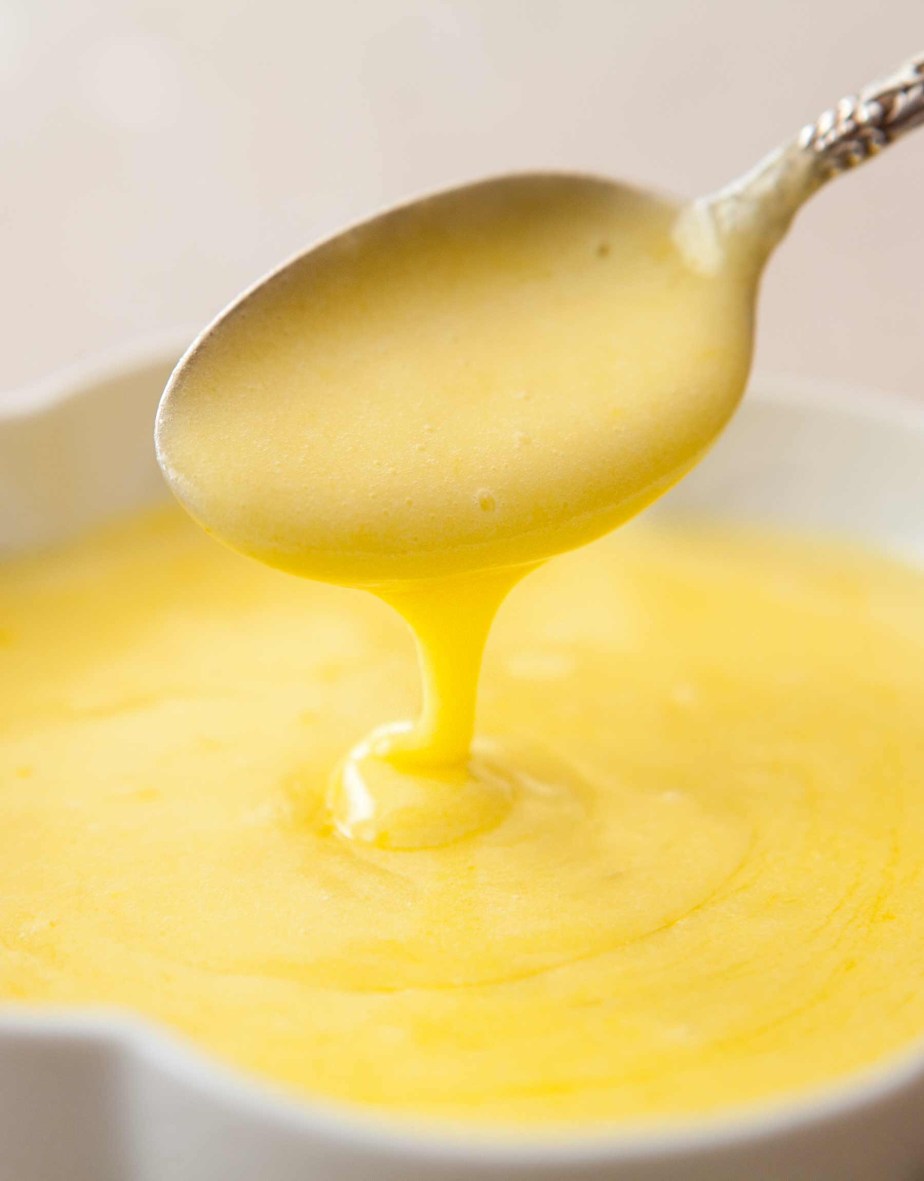
The Five Classical French Mother Sauces: Hollandaise

The Five Classical French Mother Sauces: Hollandaise

The term “mother sauce” refers to any one of five basic sauces, which are the starting points for making various secondary sauces.  The five mother sauces:

  • Béchamel
  • Velouté
  • Espagnole
  • Hollandaise
  • Tomate

Hollandaise is a mild, slightly lemony sauce that is the perfect accompaniment with many things, including eggs Benedict, seafood, shellfish, poultry, and raw or roasted vegetables.

3 egg yolks, room temperature
14 tablespoons cool, unsalted butter cut into 1/4-inch cubes, divided
1 tablespoon fresh lemon juice
Sea salt or kosher salt
Ground white pepper

Whisk the eggs together vigorously in a sloped saucepan over low heat until it starts to thicken, around 3 minutes. Remove from the heat and whisk in 2 tablespoons of the butter until melted. Whisk in the lemon juice and a pinch of salt. Return to the heat, and whisk in and melt the remaining butter in 2-tablespoon increments. Continue until the butter is gone. Season to taste with salt and pepper.

Many additional sauces can be made from this base such as Béarnaise, which is a Hollandaise finished with a reduction of White Wine and tarragon.

The Five Classical French Mother Sauces: Espagnole

The Five Classical French Mother Sauces: Espagnole

The term “mother sauce” refers to any one of five basic sauces, which are the starting points for making various secondary sauces.  The five mother sauces:

  • Béchamel
  • Velouté
  • Espagnole
  • Hollandaise
  • Tomate

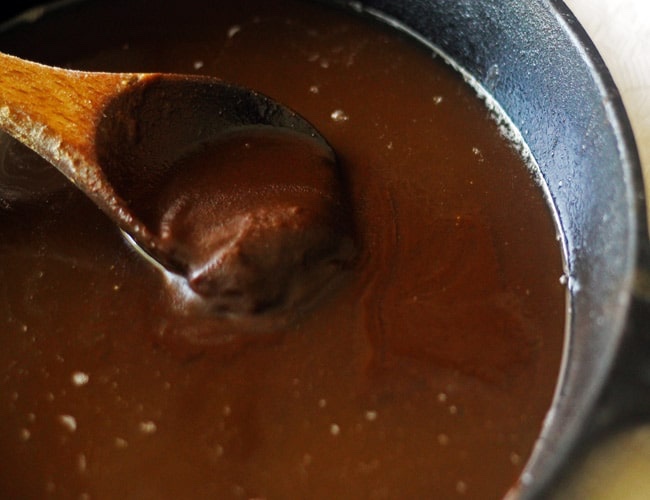
Espagnole Is a rich, beefy, slightly sweet sauce.  I’m presenting a simplified version of Escoffier’s original sauce which was much more time consuming.  Espagnole is also the basis of Demi-glacé which is a much reduced version of classical Espagnole.

3 tablespoons butter
1 large carrot, coarsely chopped
1 stalk celery, coarsely chopped
2 onions, coarsely chopped
1/4 cup flour
5 cups beef stock
2 garlic cloves, crushed
1 traditional bouquet garni (explained here)
1/2 cup tomato paste
1/3 cup Madeira wine
Kosher salt
Freshly ground black pepper

Melt the butter in a large saucepan over medium heat. Add carrot, celery, and onions and sauté until softened, about 5 minutes. Add the flour and reduce the heat to medium low. Stir in the flour and continue cooking until the vegetables and flour are nicely browned. Add the beef stock, garlic, bouquet garni, and tomato paste. Simmer for 1 hour, skimming, until the sauce is reduced by half. Strain through a chinois.

To finish, reduce the sauce by another third, or to about 1-1/2 cups total, in a medium saucepan over medium heat. Add the Madeira and cook through another 10 minutes. Taste to adjust seasonings.

For comparison sake I’ll list the ingredients in a traditional Escoffier espagnole sauce:

  • 13 pounds beef shin, with bones cut into 3-inch pieces
  • 13 pounds veal shank, with bones cut into 3-inch pieces
  • 8 tablespoons (1 stick) butter
  • 2 pounds carrots, peeled and sliced in rounds
  • 10 medium onions, peeled and sliced
  • 1 ½ pounds pork rind, cut into 3-inch squares
  • 1 fresh pig’s foot, split
  • 1 bunch parsley
  • 1 tablespoon plus 1 teaspoon fresh or 1¼ teaspoons dried thyme
  • 14 bay leaves
  • 1 clove garlic, finely chopped
  • 1 pound unsalted butter
  • 3 ¾ cups sifted all-purpose flour
  • ¼ pound salt pork, diced
  • 2 recipes Sauce Tomate
  • 1 cup Madeira

The Five Classical French Mother Sauces: Velouté

The term “mother sauce” refers to any one of five basic sauces, which are the starting points for making various secondary sauces.  The five mother sauces:

  • Béchamel
  • Velouté
  • Espagnole
  • Hollandaise
  • Tomate

Velouté is another simple mother sauce.  It is made by thickening white stock with roux and then simmering.  This sauce is then flavoured and the foundation for numerous sauces.  The two most important sauces derived from velouté are sauce allemande and sauce suprême.  Sauce allemande is finished with egg yolks and mushroom cooking liquid, while sauce suprême is finished with mushroom cooking liquid, heavy cream and butter.  These sauces are usually flavoured additionally to make different sauces.

Velouté

5 Cups White Stock (Chicken, Veal, or Fish)

2 Ounces Butter

¼ Cup Flour

Simmer stock in a 3 quart saucepan.  In a second saucepan melt the butter.  Add the flour.  Stir the butter and flour over medium heat for approximately two minutes or until the flour has a toasty scent.  Remove from heat and cool slightly.

Whisk the stock into the roux.  Return the stock to heat and bring back to simmer whisking continuously.  Once sauce return to a simmer lower heat, cook sauce gently for one hour skimming off the skin that forms on the surface.

Strain the velouté.  Stir until it cools.

Sauce Suprême

1 Quart Sauce Velouté

1 Quart White Stock (Chicken, Veal, or Fish)

1 Cup of Mushroom Cooking Liquid *

1 Cup of Heavy Cream or Crème Fraîche

3 Ounces Butter

Combine all ingredients and bring to a simmer.  Lower heat and reduce by 2/3, approximately one quart.  Skim off fat during reduction.  Finish sauce by stirring in 1 cup of heavy cream and 3 ounces of butter.

Sauce Allemande

5 Egg Yolks

2 Cups White Stock (Chicken, Veal, or Fish)

1 Cup of Mushroom Cooking Liquid *

1 Tablespoon Lemon Juice

1 Quart Hot Sauce Velouté

4 Ounces Butter

Whisk together egg yolks, white stock, mushroom cooking liquid, and lemon juice.  Add to hot Sauce Velouté and whisk returning to heat.  Reduce sauce by one-third, approximately one quart.  Whisk 4 ounces cold butter into the sauce.

* Mushroom Cooking Liquid

Is prepared by cooking mushroom for 15 minutes in a covered pot with an equal amount of water.  While cultivated button mushrooms work, as with all cooking adding more exotic wild mushroom will make a more flavorful broth.

The Five Classical French Mother Sauces : Béchamel

The Five Classical French Mother Sauces : Béchamel

The term “mother sauce” refers to any one of five basic sauces, which are the starting points for making various secondary sauces.  The five mother sauces:

  • Béchamel
  • Velouté
  • Espagnole
  • Hollandaise
  • Tomate

Béchamel is by far the easiest and simplest of the five mother sauces.  This is primarily because you do not have to start with a stock.  In its simplest form it is just Flour, Butter and Milk.  Béchamel is traditionally used in such dishes as lasagna, a gratin, soufflés, a soup base, etc.

The simplest form of the sauce requires thickening the milk with a white roux and heating long enough to cook out the flour taste.  More complex versions start with onion, or ham, or mirepoix (onion, carrots, and celery).  I have included a basic version upon which more complex sauces can be built and from which a number of derivative simple sauces are made.

The amount of roux used in the making of your sauce can greatly depend upon what the end use of the sauce will be.  A soufflé for instance would use a quite thick sauce, while a soup use a very thin sauce by comparison.  Here I have presented a sauce which falls squarely in the middle.  Many recipes do not call for heating the milk first, but I prefer this method.  If you do not wish to heat the milk whisk vigorously to prevent lumps as well as a skin.

Béchamel

1 Quart Milk

2 Ounces of Butter

¼ Cup Flour

Salt, Pepper and Nutmeg to taste

Heat the milk to a gentle simmer in a saucepan.  Whisk from time to time to prevent a skin forming on the milk.  In a second saucepan melt the butter and add the flour.  Stir the butter and flour for two minutes over medium heat.  It should have a slightly toasty smell.  Remove from heat and allow to cool slightly.

Whisk the milk into the roux.  Return to stove and whisk continuously while bringing it back to a simmer.  Once it returns to a slow simmer, reduce the heat.  Cook sauce for 30 minutes to an hour.  Occasionally rub around the bottom of saucepan to prevent from scalding.  A skin will form on the surface which you will need to skim off.

By this time the starchy taste should have cooked out of the sauce.  Taste it.  Season sauce and strain.  Stir Béchamel while it is cooling to prevent the formation of a skin.

Traditionally there are three primary sauces which are directly derived from Béchamel.  These three sauces are Sauce Mornay, Sauce Soubise, and Sauce Crème.

Sauce Mornay

Sauce Mornay (Cheese Sauce) is usually used for the base of a cheese soufflé or gratin.  Classic recipes use half Gruyère and Parmesean.  Today it is often used with many other cheeses.  A combination of two well-aged cheddars works amazingly.  Blue cheeses also work very well, but please choose genuine Roquefort, gorgonzola, stilton, etc.

For Sauce Mornay add four ounces of cheese per quart of Béchamel.  Stir the sauce just long enough for the cheese to melt.

Sauce Soubise

Sauce Soubise is a combination of Béchamel and an onion purée.  It is a wonderful sauce used in all types of gratins.

For Sauce Soubise sweat one pound of white onions.  Do NOT brown.  Combine with two cups of Béchamel.  Cover the sauce and cook it slowly for 30 minutes.  Purée and strain.

Sauce Crème (Cream Sauce)

Cream sauce in modern times has been all but replaced by lightly reduced cream.  Traditionally cream sauce is finished by taking 1 quart of Béchamel with 7 ounces of heavy cream.  Reduce the mixture to three-quarters.  Add an additional 5 ounces of heavy cream.  This should bring it to the right consistency.

Valhalla

Valhalla (“Hall of the Slain”; Old Norse Valhöll): Odin’s dwelling in Ásgarðr and the paradise of warriors. One cannot enter it if death came as a result of illness or old age. Armor lies strewn about on the benches. The roof is made of spears and shields. Atop it is where the goat Heiðrún stands; she chews on the leaves of Læraðr (Yggdrasill), and from her udders comes the mead that the valkyries serve to the einherjar.

Near her is the stag Eikþyrnir (“Oak-thorny”) who munches on the branches of the tree; moisture flows from his antlers. Valhalla has 540 doors. Each day the warriors emerge from them to fight each other in the courtyard for amusement, and they return to the hall when the signal for dinner has sounded. The cook, Andhrímnir, then serves them the meat of the boar Sæhrímnir. On the day of Ragnarök the warriors will leave Valhalla to confront the forces of chaos.

Freyja

Freyja (“Lady,” “Mistress”): She is the primary goddess of the family of the Vanir, daughter of Njörðr and the sister of Freyr. She was married to Óðr, with whom she had a daughter, Hnoss, also called Gersimi. When her husband went away on his travels, she wept gold tears. She lives in Fólkvangr, one of the heavenly dwellings, and her hall is called Sessrumnir. She shares half of the dead with Odin. She is fond of love poetry and is famous for her promiscuity. The worship addressed to her was erotic, which likens her to several Eastern deities, Cybele in particular. Freyja travels in a chariot drawn by cats.

Her field of activity is vast: life (birth) and death, love and battle, fertility and black magic. It is Freyja who taught the Æsir the magic rites most honored by the Vanir.

She is beautiful and lascivious, which inspired the giants with an urge to wed her, and the historiographical texts tell us that she was good to invoke for matters concerning love.

In skaldic poetry she was called Vanadís (“Dise of the Vanir”), Sýr (“Sow”), Gefn (“The Giving One”), Hörn (“Spirit of Flax”?), and Mardöll (“Sea-brightener”). She was quite renowned because of her necklace, Brísingamen. She obtained this piece of jewelry by sleeping with the dwarves who had forged it. The strength of the worship dedicated to Freyja is well attested by Norwegian and Swedish place-names, but the texts remain silent on this point.

Liaisons: The Binding Agents

Liaisons thicken a liquid in order to add body and thickness.

Basic Stock + Binding Agent = Basic Sauce

Roux: Made by cooking together flour and fat (typically butter) usually in equal portions.

  • Fat is melted
  • Flour is added and cooked
  • Roux Blanc —> 3-5 minutes, pale sauce
  • Roux Blond —> 6-7 minutes, golden sauce
  • Roux Brun —> 8-12 minutes, rich brown sauce

Beurre Manié: Softened Butter kneaded into flour

  • Pea size amounts whisked into sauce
  • Mixture is never brought to a boil
  • Only a small amount is used

Singer: Dry flour is sprinkled into a sauce

Slurry: Whisking Potato starch, cornstarch, arrowroot, or Rice flour into a cold liquid to be dissolved.

  • Poured into boiling liquid in a slow stream.
  • Whisk constantly until thickened.

Double Cream: 

  • Simmered and reduced by half
  • Do not reduce further or it will break.
  • Whish into a hot liquid.

Mustard:

  • French Dijon has a slight thickening effect.
  • Beaten into the sauce off heat.
  • Sauce must not be boiled again or it will break.

Egg Yolks:

  • Temper egg yolk —> whisk a small amount of hot liquid into yolks to prevent from scrambling when added to sauce.
  • Whisk vigorously as you add to hot sauce.

Tapioca:

  • Pearl tapioca will add consistency to a sauce.
  • If left to sit the thickening will continue.

Butter:

  • Used to finish a sauce and create a silky velvet like thickness.
  • Not a primary thickener.

Brown Stocks (Fonds Bruns)

Brown Stocks (Fonds Bruns)

  • Preheat oven.
  • Clean and, if necessary, break bones.
  • Brown bones in roasting pan in oven.
  • Add mirepoix.
  • Transfer bones and mirepoix to stockpot.
  • Remove fat from roasting pan.
  • Deglaze sucs.
  • Cover browned ingredients with cold water.
  • Simmer and skim.
  • Add bouquet garni and tomatoes.
  • Simmer, skim and defat frequently
    • Chicken stock: 4 hours
    • Veal & game Stock: 6-8 hours.
    • Beef Stock: 8-12 hours.
  • Drain through fine chinois.
  • Discard solids.

Brown Veal Stock (Fond de Veau Brun)

  • Roasted Veal bones.
  • Carrots.
  • Celery.
  • Onions.
  • Tomatoes.
  • Tomato paste.
  • Garlic
  • Bouquet garni.

Brown Beef and Veal Stock (Braisiere)

  • Roasted Beef and Veal bones.
  • Carrots.
  • Onions.
  • Celery.
  • Tomatoes.
  • Tomato paste.
  • Garlic.
  • Bouquet garni.

Brown Game Stock (Fond de Gibier)

  • Roasted game bones.
  • Carrots.
  • Celery.
  • Onions.
  • Tomatoes.
  • Tomato paste.
  • Garlic.
  • Bouquet garni.