Baruch Spinoza: The God Of Spinoza

Baruch Spinoza (1632-1677) born Benedito de Espinosa was a Jewish-Dutch philosopher of Portuguese Sephardi origin. By laying the groundwork for the Enlightenmentand modern biblical criticism,including modern conceptions of the self and the universe, he came to be considered one of the great rationalists of 17th-century philosophy. Along with René Descartes, Spinoza was a leading philosophical figure of the Dutch Golden Age. Spinoza’s given name, which means “Blessed”, varies among different languages. In Hebrew, it is written ברוך שפינוזה. His Portuguese name is Benedito “Bento” de Espinosa or d’Espinosa. In his Latin works, he used Latin: Benedictus de Spinoza.

“As to the view of certain people that I identify god with nature (taken as a kind of mass or corporeal matter), they are quite mistaken”

~ Baruch Spinoza

When Spinoza wrote “Deus sive Natura” (“God or Nature”) Spinoza meant God was Natura naturans not Natura naturata, that is, “a dynamic nature in action, growing and changing, not a passive or static thing.”  One might best understand Spinoza by examining Bertrand Russell’s commentary of his beliefs from 1910:

“Spinoza, more than any other modern philosopher, writes always with a strong sense of the importance of philosophy in the conduct of life, and with a firm belief in the power of reason to improve men’s conduct and purify their desires. Like many men of great independence of mind, he feels the need of something great enough to justify him in submitting to its authority. Like all who contemplate human life without sharing its baser passions, he is oppressed by the endless strife produced by conflicting aims and unrestrained ambitions. Believing, as he does, that self-preservation is the very essence of everything that exists, he sees no end to strife except by persuading men to choose as their ends things which all may enjoy in common. Contempt and moral condemnation stand in the way of toleration; he therefore sets out to prove that what men do they do from a necessity of their nature. As well might one condemn a triangle for not having made the effort to increase its angles beyond two right angles as condemn men for being what their nature makes them. His theory of the emotions, in which, by his geometrical method, he demonstrates that men must act in ways which it is common to condemn, contains much admirable psychology; but it was not this that made him value his theory: what he valued was the conclusion that moral condemnation is foolish. It is for this reason partly that Spinoza inveighs against free-will and finds pleasure in showing the necessity of everything. But there is also another reason: what is transitory, though it may be tolerated, cannot be worshipped; but the proof of its necessity connects it with the Divine nature, and thereby removes its pitifulness. To a certain type of mind there is something sublime about necessity: it seems that in the knowledge of what is necessary we place ourselves in harmony with what is greatest in the universe. This constitutes, to those who feel it, a great part of the value of mathematical demonstration; even Spinoza’s geometrical method, which has been almost universally condemned, will be held appropriate by those who know the “intellectual love of God.”

“He who loves God,” Spinoza says, “cannot strive that God should love him in return.” Goethe, in a passage of characteristic sentimentality, misquotes this proposition in singling it out for special praise; he quotes it as, “Who loves God truly must not expect God to love him in return,” and regards it as an example of “Entsagen sollst du, sollst entsagen.” If Goethe had understood Spinoza’s religion, he would not have made this mistake. Spinoza, here and elsewhere, is not inculcating resignation; he himself loved what he judged to be best, and lived, so far as one can discover, without effort in the way which he held to be conformable to reason. There seems to have been in him, what his philosophy was intended to produce in others, an absence of bad desires; hence, his nature is harmonious and gentle, free from the cruelty of asceticism, or the monkishness of the cloister, or the moralistic priggery of Goethe’s praises. “He who clearly and distinctly understands himself and his emotions,” Spinoza says, “loves God, and loves Him better the better he understands himself and his emotions.” It is through the love of God that we are freed from bondage to the passions, and that our minds become in some degree eternal. “God loves Himself with an infinite, intellectual love,” and “the intellectual love of the mind towards God is the very love with which He loves Himself.” Hence, though immortality in the ordinary sense is an error, the mind is nevertheless eternal in so far as it consists in the intellectual love of God. To represent such a philosophy as one of renunciation is surely to miss the whole of the mystic joy which it is intended to produce, and to misunderstand the reconciliation of the individual with the whole, which is the purpose of so much elaborate argument.

Spinoza’s ethical views are inextricably intertwined with his metaphysics, and it may be doubted whether his metaphysics is as good as is supposed by followers of Hegel. But the general attitude towards life and the world which he inculcates does not depend for its validity upon a system of metaphysics. He believes that all human ills are to be cured by knowledge and understanding; that only ignorance of what is best makes men think their interests conflicting, since the highest good is knowledge, which can be shared by all. But knowledge, as he conceives it, is not mere knowledge as it comes to most people; it is “intellectual love,” something coloured by emotion through and through. This conception is the key to all his valuations.”

~ Bertrand Russell

The concept of a personal relationship with God comes from the position that one is a part of an infinite interdependent “organism.” Spinoza argued that everything is a derivative of God, interconnected with all of existence. Although humans experience only thought and extension, what happens to one aspect of existence will affect others. Thus, Spinozism teaches a form of determinism and ecology, and uses these as a basis for morality.

A core doctrine of Spinozism is that the universe is essentially deterministic. All that happens or will happen could not have unfolded in any other way. Spinoza claimed that the third kind of knowledge, intuition, is the highest kind. More specifically, he defined intuition as the ability of the human intellect to intuit knowledge based upon its accumulated understanding of the world.  Spinoza’s metaphysics consists of one thing, Substance, and its modifications (modes). Early in The Ethics Spinoza argues that there is only one Substance, which is absolutely infinite, self-caused, and eternal. Substance causes an infinite number of attributes and modes.  He calls this Substance “God”, or “Nature”. In fact, he takes these two terms to be synonymous (in the Latin the phrase he uses is “Deus sive Natura”), but readers often disregard his neutral monism. During his time, this statement was seen as literally equating the existing world with God – for which he was accused of atheism. Spinoza asserted that the whole of the natural universe is made of one Substance – God or Nature – and its modifications.

Spinoza’s doctrine was considered radical at the time he published, and he was widely seen as the most infamous atheist-heretic of Europe. His philosophy was part of the philosophic debate in Europe during the Enlightenment, along with Cartesianism. Specifically, Spinoza disagreed with Descartes on substance duality, Descartes’ views on the will and the intellect, and the subject of free will.

“It cannot be overemphasized how the rest of Spinoza’s philosophy, his philosophy of mind, epistemology, psychology, moral philosophy, political philosophy, and philosophy of religion – flows more or less directly from the metaphysical underpinnings in Part I of the Ethics.”

~  Michael Della Rocca

Sources: Wikipedia.org. Della Rocca, Michael. (2008). “Spinoza”Russell, Bertrand. “Spinoza,” The Nation (London), 8 (Nov 12 1910).  “Essential Judaism” Robinson, George. 2016. Myjewishlearning.com. Chabad.org. jewfaq.org.

The Rosetta Stone

The Rosetta Stone:

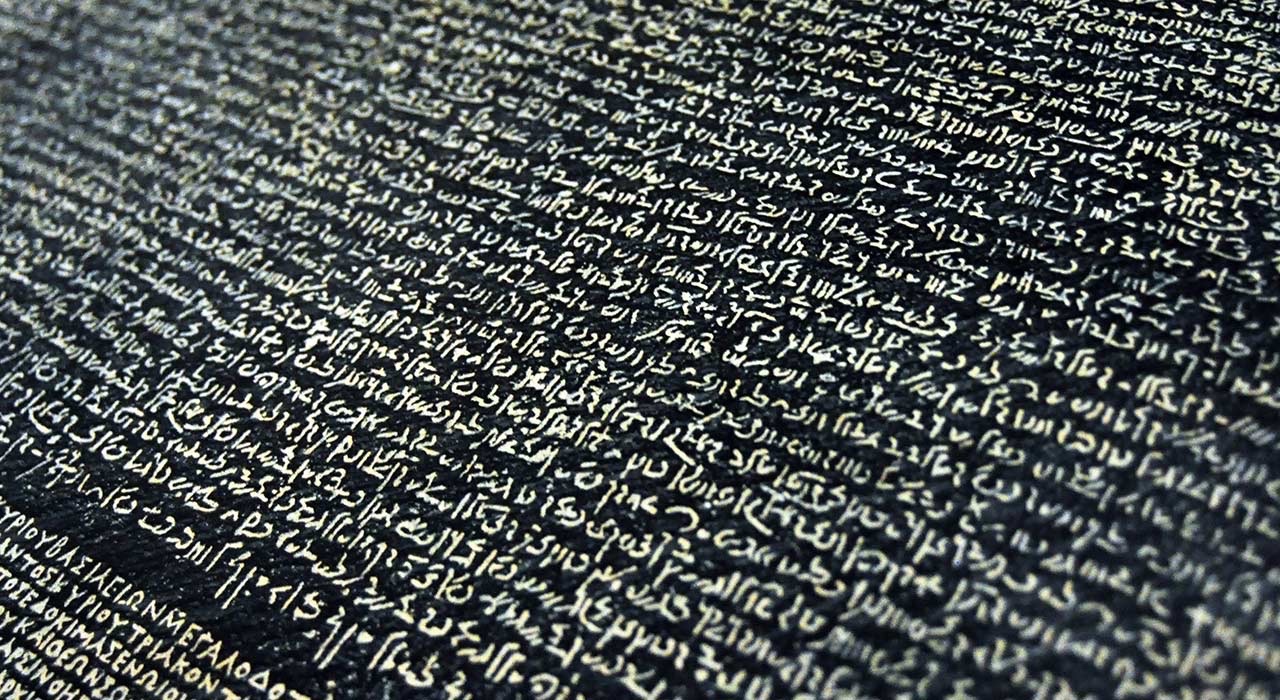
The 1.12m (3ft 6in) high Rosetta Stone in the British Museum is originally from Egypt and is made out of granodiorite stele, which is a coarse-grained rock.

It is a broken part of a bigger slab with text carved on to it that has helped researchers learn how to read Egyptian hieroglyphs – a form of writing that used pictures as signs.

It features three columns of the same inscription in three languages: Greek, hieroglyphs and demotic Egyptian – and is the text of a decree written by priests in 196 BC, during the reign of pharaoh Ptolemy V.

It is unclear how the stone was discovered in July 1799, but there’s a general belief that it was found by soldiers fighting with the French military leader Napoleon Bonaparte as they were building an extension to a fort near the town of Rashid – also known as Rosetta – in the Nile Delta.

When Napoleon was defeated, the British took possession of the stone under the terms of the Treaty of Alexandria in 1801.

It was then transported to England, arriving in Portsmouth in February 1802. George III offered it to the British Museum a few months later.

#RosettaStone

Overcoming Stigma

Stigma is when someone views you in a negative way because you have a distinguishing characteristic or personal trait that’s thought to be, or actually is, a disadvantage (a negative stereotype). Unfortunately, negative attitudes and beliefs toward people who have a mental health condition are common.

Stigma can lead to discrimination. Discrimination may be obvious and direct, such as someone making a negative remark about your mental illness or your treatment. Or it may be unintentional or subtle, such as someone avoiding you because the person assumes you could be unstable, violent or dangerous due to your mental illness. You may even judge yourself.

Some of the harmful effects of stigma can include:

• Reluctance to seek help or treatment

• Lack of understanding by family, friends, co-workers or others

• Fewer opportunities for work, school or social activities or trouble finding housing

• Bullying, physical violence or harassment

• Health insurance that doesn’t adequately cover your mental illness treatment

• The belief that you’ll never succeed at certain challenges or that you can’t improve your situation

Steps to cope with stigma

Here are some ways you can deal with stigma:

Get treatment. You may be reluctant to admit you need treatment. Don’t let the fear of being labeled with a mental illness prevent you from seeking help. Treatment can provide relief by identifying what’s wrong and reducing symptoms that interfere with your work and personal life.

Don’t let stigma create self-doubt and shame. Stigma doesn’t just come from others. You may mistakenly believe that your condition is a sign of personal weakness or that you should be able to control it without help. Seeking counseling, educating yourself about your condition and connecting with others who have mental illness can help you gain self-esteem and overcome destructive self-judgment.

Don’t isolate yourself. If you have a mental illness, you may be reluctant to tell anyone about it. Your family, friends, clergy or members of your community can offer you support if they know about your mental illness. Reach out to people you trust for the compassion, support and understanding you need.

Don’t equate yourself with your illness. You are not an illness. So instead of saying “I’m bipolar,” say “I have bipolar disorder.” Instead of calling yourself “a schizophrenic,” say “I have schizophrenia.”

Join a support group. Some local and national groups, such as the National Alliance on Mental Illness (NAMI), offer local programs and internet resources that help reduce stigma by educating people who have mental illness, their families and the general public. Some state and federal agencies and programs, such as those that focus on vocational rehabilitation and the Department of Veterans Affairs (VA), offer support for people with mental illness.

Get help at school. If you or your child has a mental illness that affects learning, find out what plans and programs might help. Discrimination against students because of a mental illness is against the law, and educators at primary, secondary and college levels are required to accommodate students as best they can. Talk to teachers, professors or administrators about the best approach and resources. If a teacher doesn’t know about a student’s disability, it can lead to discrimination, barriers to learning and poor grades.

Speak out against stigma. Consider expressing your opinions at events, in letters to the editor or on the internet. It can help instill courage in others facing similar challenges and educate the public about mental illness.

Others’ judgments almost always stem from a lack of understanding rather than information based on facts. Learning to accept your condition and recognize what you need to do to treat it, seeking support, and helping educate others can make a big difference.

Sources: The Mayo Clinic, NAMI, NIH, To Write Love on Her Arms

Mental Illness: Symptoms

Mental illness, also called mental health disorders, refers to a wide range of mental health conditions — disorders that affect your mood, thinking and behavior. Examples of mental illness include depression, anxiety disorders, schizophrenia, eating disorders and addictive behaviors.

Many people have mental health concerns from time to time. But a mental health concern becomes a mental illness when ongoing signs and symptoms cause frequent stress and affect your ability to function.

A mental illness can make you miserable and can cause problems in your daily life, such as at school or work or in relationships. In most cases, symptoms can be managed with a combination of medications and talk therapy (psychotherapy).

Symptoms

Signs and symptoms of mental illness can vary, depending on the disorder, circumstances and other factors. Mental illness symptoms can affect emotions, thoughts and behaviors.

Examples of signs and symptoms include:

• Feeling sad or down

• Confused thinking or reduced ability to concentrate

• Excessive fears or worries, or extreme feelings of guilt

• Extreme mood changes of highs and lows

• Withdrawal from friends and activities

• Significant tiredness, low energy or problems sleeping

• Detachment from reality (delusions), paranoia or hallucinations

• Inability to cope with daily problems or stress

• Trouble understanding and relating to situations and to people

• Problems with alcohol or drug use

• Major changes in eating habits

• Sex drive changes

• Excessive anger, hostility or violence

• Suicidal thinking

Sometimes symptoms of a mental health disorder appear as physical problems, such as stomach pain, back pain, headaches, or other unexplained aches and pains.

If you have suicidal thoughts

Suicidal thoughts and behavior are common with some mental illnesses. If you think you may hurt yourself or attempt suicide, get help right away:

• Call 911 or your local emergency number immediately.

• Call your mental health specialist.

• Call a suicide hotline number. In the U.S., call the National Suicide Prevention Lifeline at 1-800-273-TALK (1-800-273-8255) or use its webchat on suicidepreventionlifeline.org/chat.

• Seek help from your primary care provider.

• Reach out to a close friend or loved one.

• Contact a minister, spiritual leader or someone else in your faith community.

Suicidal thinking doesn’t get better on its own — so get help.

Helping a loved one

If your loved one shows signs of mental illness, have an open and honest discussion with him or her about your concerns. You may not be able to force someone to get professional care, but you can offer encouragement and support. You can also help your loved one find a qualified mental health professional and make an appointment. You may even be able to go along to the appointment.

If your loved one has done self-harm or is considering doing so, take the person to the hospital or call for emergency help.

Causes

Mental illnesses, in general, are thought to be caused by a variety of genetic and environmental factors:

Inherited traits. Mental illness is more common in people whose blood relatives also have a mental illness. Certain genes may increase your risk of developing a mental illness, and your life situation may trigger it.

Environmental exposures before birth. Exposure to environmental stressors, inflammatory conditions, toxins, alcohol or drugs while in the womb can sometimes be linked to mental illness.

• Brain chemistry. Neurotransmitters are naturally occurring brain chemicals that carry signals to other parts of your brain and body. When the neural networks involving these chemicals are impaired, the function of nerve receptors and nerve systems change, leading to depression and other emotional disorders.

Risk factors

Certain factors may increase your risk of developing a mental illness, including:

• A history of mental illness in a blood relative, such as a parent or sibling

• Stressful life situations, such as financial problems, a loved one’s death or a divorce

• An ongoing (chronic) medical condition, such as diabetes

• Brain damage as a result of a serious injury (traumatic brain injury), such as a violent blow to the head

• Traumatic experiences, such as military combat or assault

• Use of alcohol or recreational drugs

• A childhood history of abuse or neglect

• Few friends or few healthy relationships

• A previous mental illness

Mental illness is common. About 1 in 5 adults has a mental illness in any given year. Mental illness can begin at any age, from childhood through later adult years, but most cases begin earlier in life.

The effects of mental illness can be temporary or long lasting. You also can have more than one mental health disorder at the same time. For example, you may have depression and a substance use disorder.

Complications

Mental illness is a leading cause of disability. Untreated mental illness can cause severe emotional, behavioral and physical health problems. Complications sometimes linked to mental illness include:

• Unhappiness and decreased enjoyment of life

• Family conflicts

• Relationship difficulties

• Social isolation

• Problems with tobacco, alcohol and other drugs

• Missed work or school, or other problems related to work or school

• Legal and financial problems

• Poverty and homelessness

• Self-harm and harm to others, including suicide or homicide

• Weakened immune system, so your body has a hard time resisting infections

• Heart disease and other medical conditions

Prevention

There’s no sure way to prevent mental illness. However, if you have a mental illness, taking steps to control stress, to increase your resilience and to boost low self-esteem may help keep your symptoms under control. Follow these steps:

• Pay attention to warning signs. Work with your doctor or therapist to learn what might trigger your symptoms. Make a plan so that you know what to do if symptoms return. Contact your doctor or therapist if you notice any changes in symptoms or how you feel. Consider involving family members or friends to watch for warning signs.

• Get routine medical care. Don’t neglect checkups or skip visits to your primary care provider, especially if you aren’t feeling well. You may have a new health problem that needs to be treated, or you may be experiencing side effects of medication.

• Get help when you need it. Mental health conditions can be harder to treat if you wait until symptoms get bad. Long-term maintenance treatment also may help prevent a relapse of symptoms.

• Take good care of yourself. Sufficient sleep, healthy eating and regular physical activity are important. Try to maintain a regular schedule. Talk to your primary care provider if you have trouble sleeping or if you have questions about diet and physical activity.

Sources: The Mayo Clinic, NAMI, NIH

Hieroglyphics and Cartouches Simplified

Hieroglyphics and Cartouches

Hieroglyphics was a system, an alphabet, which Ancient Egyptians used to express their thoughts in written form. Composed of over 1000 distinct and illustrious characters, cursive hieroglyphics were used for religious and historic literature – recorded on papyrus which was resourceful in Ancient Egypt. Hieroglyphics can be found at many locations – from pyramids to catacombs to Pharaoh’s tomb writings (which helped identifying them).

The major discovery, which lead to the deciphering of hieroglyphics, was made by Napoleon’s army in 1799 – the Rosetta Stone! It took over 20 years, after the discovery, to fully comprehend Ancient Egyptian scripture. The Rosetta Stone involved the same text written in 3 different languages: Ancient Egyptian hieroglyphics, Demotic, and Ancient Greek.

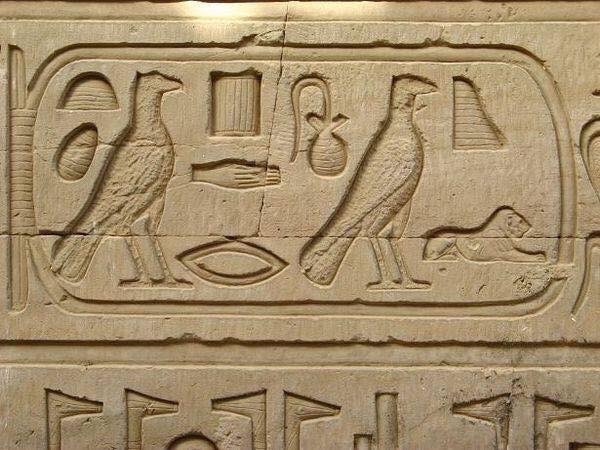
Cartouches were carved tablets, mostly made of stone, which contained a message written in Hieroglyphic script. Cartouches were sometimes used as ornaments and, at other times, as titles for pharaohs and priests. the ancient Egyptians called them “shenu”.

The deciphering of hieroglyphics and discoveries of cartouches have, together, lead us to a much better understanding of the Ancient Egypt civilization. Ancient Egypt carries a rich history and it will take much more time – a year, a decade, a century, before we can have a complete and clear vision of its society… #AncientEgypt #Hieroglyphics

An Introduction To Egyptian Hieroglyphs

BAE89F7A-1D2E-4753-97FC-A1E67F7CAC64

“The main purpose of writing was not decorative, and it was not originally intended for literary or commercial use. Its most important function was to provide a means by which certain concepts or events could be brought into existence. The Egyptians believed that if something were committed to writing it could be repeatedly “made to happen” by means of magic.”

~ Egyptologist Ann Rosalie David (1946 – present)

The best known Ancient Egyptian writing is known as hieroglyphics “sacred carvings” and developed at some point prior to the Early Dynastic Period (c. 3150 -2613 BCE). The designation “hieroglyphics” is a Greek word; the Egyptians referred to their writing as medu-netjer, “the god’s words,” as they believed writing had been given to them by the great god Thoth. Thoth has been depicted in many ways depending on the era and on the aspect the artist wished to convey. Usually, he is depicted in his human form with the head of an ibis. Thoth was born with an immense knowledge and most importantly the knowledge of the power of words. He was also considered to have been the scribe of the underworld. Thoth was universally worshipped by ancient Egyptian scribes. Many scribes had a painting or a picture of Thoth in their “office”. Likewise, one of the symbols for scribes was that of the ibis. Thoth has played a prominent role in many of the Egyptian myths. Displaying his role as arbitrator, he had overseen the three epic battles between good and evil making sure neither had a decisive victory over the other.

BA1E6DFB-29A6-4740-9627-CF97F64C7AA2

The ancient Egyptians regarded Thoth as One, self-begotten, and self-produced. He was the master of both physical and moral (i.e. divine) law. He is said to direct the motions of the heavenly bodies. Without his words, the Egyptians believed, the gods would not exist. His power was unlimited in the Underworld and rivaled that of Ra and Osiris. The Egyptians credited him as the author of all works of science, religion, philosophy, and magic. The Greeks further declared him the inventor of astronomy, astrology, the science of numbers, mathematics, geometry, surveying, medicine, botany, theology, civilized government, the alphabet, reading, writing, and oratory. They further claimed he was the true author of every work of every branch of knowledge, human and divine.

Thoth gave human beings this knowledge freely, but it was a responsibility he expected them to take seriously. Words could hurt, heal, elevate, destroy, condemn, and even raise someone from death to life. Sometime in the Predynastic Period in Egypt (c. 6000 – c. 3150 BCE), they began to use symbols to represent basic concepts. Egyptologist Miriam Lichtheim writes, “[the script] was limited to the briefest notations designed to identify a person or a place, an event or a possession.” The earliest writings purpose was most likely in trade, to convey information about goods, prices, and purchases. However the first actual extant evidence of Egyptian writing comes from tombs in the form of offering lists in the Early Dynastic Period.

F28587CE-7E7F-449F-B890-06BC81EB391D

Death was not the end of life for the ancient Egyptians; it was only a transition from one state to another. An Offering List was an inventory of the gifts due to a particular person and inscribed on the wall of their tomb. Someone who had performed great deeds, held a high position of authority, or led troops to victory in battle were due greater offerings than another who had done relatively little with their lives. The autobiography and the prayer became the first forms of literature in Egypt and were created using the hieroglyphic script.

“The Offering List grew to enormous length till the day on which an inventive mind realized that a short Prayer for Offerings would be an effective substitute for the unwieldy list. Once the prayer, which may already have existed in spoken form, was put into writing, it became the basic element around which tomb-texts and representations were organized. Similarly, the ever lengthening lists of an official’s ranks and titles were infused with life when the imagination began to flesh them out with narration, and the Autobiography was born.”

~ Egyptologist Miriam Lichtheim (1914 – 2004)

Hieroglyphics developed out of the early pictographs. People used symbols, pictures to represent concepts such as a person or event.

“A modern-day example of how hieroglyphics were written would be a text message in which an emoji of an angry face is placed after an image of a school. Without having to use any words one could convey the concept of “I hate school” or “I am angry about school.” If one wanted to make one’s problem clearer, one could place an image of a teacher or fellow student before the angry-face-ideogram or a series of pictures telling a story of a problem one had with a teacher. Determinatives were important in the script, especially because hieroglyphics could be written left-to-right or right-to-left or down-to-up or up-to-down. Inscriptions over temple doors, palace gates, and tombs go in whatever direction was best served for that message. The beauty of the final work was the only consideration in which direction the script was to be read.”

~ Joshua J. Mark, Professor of Philosophy at Marist College

“The placement of hieroglyphs in relation to one another was governed by aesthetic rules. The Egyptians always tried to group signs in balanced rectangles. For example, the word for “health” was written with the three consonants s-n-b. These would not be written [in a linear fashion] by an Egyptian because the group would look ugly, it would be considered “incorrect”. The “correct” writing would be the grouping of the signs into a rectangle…The labor of construction was lightened somewhat by the fact that individual hieroglyphs could be enlarged or shrunk as the grouping required and that some signs could be placed either horizontally or vertically. Scribes would even reverse the order of signs if it seemed that a more balanced rectangle could be obtained by writing them in the wrong order.”

~ Egyptologist Karl-Theodor Zauzich

85FBE9BF-97FE-40CE-AABF-F28B57491EB1

Hieroglyphics were comprised of an ‘alphabet’ of 24 basic consonants which would convey meaning but over 800 different symbols to express that meaning precisely which all had to be memorized and used correctly.

“It may well be asked why the Egyptians developed a complicated writing system that used several hundred signs when they could have used their alphabet of some thirty signs and made their language much easier to read and write. This puzzling fact probably has a historical explanation: the one-consonant signs were not “discovered” until after the other signs were in use. Since by that time the entire writing system was established, it could not be discarded, for specific religious reasons. Hieroglyphics were regarded as a precious gift of Thoth, the god of wisdom. To stop using many of these signs and to change the entire system of writing would have been considered both a sacrilege and an immense loss, not to mention the fact that such a change would make all the older texts meaningless at a single blow.”

~ Egyptologist Karl-Theodor Zauzich

Hieroglyphics were obviously quite labor-intensive for a scribe and so another faster script was developed shortly after known as hieratic (‘sacred writing’). Hieratic script used characters which were simplified versions of hieroglyphic symbols. Hieratic appeared in the Early Dynastic Period in Egypt after hieroglyphic writing was already firmly developed.

9D99F31B-BC65-4FF9-BAAA-996634676B4D

Ancient World Reading List

Norse Mythology/Religion

Old Norse-speaking poets have left us countless valuable clues regarding their religious perspective, but the collection of poems known today as the “Poetic Edda” or “Elder Edda” contains the most mythologically rich and thorough of these. Two of these poems, Völuspá(“The Insight of the Seeress”) and Grímnismál (“The Song of the Hooded One”) are the closest things we have to systematic accounts of the pre-Christian Norse cosmology and mythology.

Among the prose Old Norse sources, the Prose Edda, or simply the “Edda,” contains the greatest quantity of information concerning our topic. This treatise on Norse poetics was written in the thirteenth century by the Icelandic scholar and politician Snorri Sturluson, long after Christianity had become the official religion of Iceland and the old perception of the world and its attendant practices had long been fading into ever more distant memory. The etymology and meaning of the title “Edda” have puzzled scholars, and none of the explanations offered so far have gained any particularly widespread acceptance.

Even though their definition of “history,” or at least what constitutes a reliable piece of historical information, might diverge considerably from our present understanding, the Icelanders of the Middle Ages have left us with numerous historical texts that add mightily to our knowledge of pre-Christian Norse religious traditions. While many of these, such as the priest Ari Thorgilsson’s Íslendingabók (“Book of Icelanders”) and the anonymous Landnámabók (“Book of Settlements”), don’t fit into the saga genre, the majority of these historical works are Icelandic sagas.

Egyptian Mythology/Religion

The Egyptian Book of the Dead is a collection of spells which enable the soul of the deceased to navigate the afterlife. The famous title was given the work by western scholars; the actual title would translate as The Book of Coming Forth by Day or Spells for Going Forth by Day and a more apt translation to English would be The Egyptian Book of Life.  Although the work is often referred to as “the Ancient Egyptian Bible” it is no such thing although the two works share the similarity of being ancient compilations of texts written at different times eventually gathered together in book form. The Book of the Dead was never codified and no two copies of the work are exactly the same. They were created specifically for each individual who could afford to purchase one as a kind of manual to help them after death.

The Book of Gates (sometimes also known as the “Book of Pylons”) is an ancient Egyptian religious text dating from the New Kingdom describing the journey of a deceased soul though the underworld with reference to the journey of the sun god Ra during the hours of the night.  In order to pass safely through each gate the deceased must name the guardians correctly. This tradition dates back to the Book of the Two Ways(part of the Coffin Texts), which recorded seven gates each with three guardians. Although other netherworld books refer to the existence of gates in the underworld, they are nowhere depicted in such detail as the Book of Gates.

Primary Classical Texts

The oldest epic tale in the world was written 1500 years before Homer wrote the Illiad. “The Epic of Gilgamesh” tells of the Sumerian Gilgamesh, the hero king of Uruk, and his adventures. This epic story was discovered in the ruins of the library of Ashurbanipal in Nineveh by Hormuzd Rassam in 1853. Written in cuneiform on 12 clay tablets, this Akkadian version dates from around 1300 to 1000 B.C.

“The Epic of Gilgamesh” was one of the most beloved stories of Mesopotamia. According to the tale, Gilgamesh is a handsome, athletic young king of Uruk city. His mother was the goddess Ninsun and his father the priest-king Lugalbanda, making Gilgamesh semi-divine. Gilgamesh is rambunctious and energetic, but also cruel and arrogant. He challenges all other young men to physical contests and combat. He also proclaims his right to have sexual intercourse with all new brides. Gilgamesh’s behavior upsets Uruk’s citizens and they cry out to the great god of heaven Anu for help with their young king.

Lysistrata is a comedy by Aristophanes. Originally performed in classical Athens in 411 BCE, it is a comic account of a woman’s extraordinary mission to end the Peloponnesian War by denying all the men of the land any sex, which was the only thing they truly and deeply desired. Lysistrata persuades the women of Greece to withhold sexual privileges from their husbands and lovers as a means of forcing the men to negotiate peace—a strategy, however, that inflames the battle between the sexes.

The Poetics (circa 335 BC) is the earliest surviving work of dramatic theory and first extant philosophical treatise to focus on literary theory in the West. This has been the traditional view for centuries. However, recent work is now challenging whether Aristotle focuses on literary theory per se (given that not one poem exists in the treatise) or whether he focuses instead on dramatic musical theory that only has language as one of the elements. In it, Aristotle offers an account of what he calls “poetry” (a term which in Greek literally means “making” and in this context includes verse drama – comedy, tragedy, and the satyr play – as well as lyric poetry and epic poetry).

Meditations is a series of personal writings by Marcus Aurelius, Roman Emperor from 161 to 180 AD, recording his private notes to himself and ideas on Stoic philosophy.

  • Medea” – Euripides

Medea is an ancient Greek tragedy written by Euripides, based upon the myth of Jason and Medea and first produced in 431 BC. The plot centers on the actions of Medea, a former princess of the “barbarian” kingdom of Colchis, and the wife of Jason; she finds her position in the Greek world threatened as Jason leaves her for a Greek princess of Corinth. Medea takes vengeance on Jason by murdering Jason’s new wife as well as her own children, after which she escapes to Athens to start a new life.

Hippolytus is an Ancient Greek tragedy by Euripides, based on the myth of Hippolytus, son of Theseus. The play was first produced for the City Dionysia of Athens in 428 BC and won first prize as part of a trilogy.

The Histories of Herodotus is considered the founding work of history in Western literature. Written in 440 BC in the Ionic dialect of classical Greek, The Histories serves as a record of the ancient traditions, politics, geography, and clashes of various cultures that were known in Western Asia, Northern Africa and Greece at that time. Although not a fully impartial record, it remains one of the West’s most important sources regarding these affairs. Moreover, it established the genre and study of history in the Western world

The Illiad is an ancient Greek epic poem in dactylic hexameter, traditionally attributed to Homer. Set during the Trojan War, the ten-year siege of the city of Troy (Ilium) by a coalition of Greek states, it tells of the battles and events during the weeks of a quarrel between King Agamemnon and the warrior Achilles.

The Odyssey is one of two major ancient Greek epic poems attributed to Homer. It is, in part, a sequel to the Iliad, the other work ascribed to Homer. The Odyssey is fundamental to the modern Western canon; it is the second-oldest extant work of Western literature, while the Iliad is the oldest. Scholars believe the Odyssey was composed near the end of the 8th century BC, somewhere in Ionia, the Greek coastal region of Anatolia.

The Metamorphoses is a Latin narrative poem by the Roman poet Ovid, considered his magnum opus. Comprising 11,995 lines, 15 books and over 250 myths, the poem chronicles the history of the world from its creation to the deification of Julius Caesar within a loose mythico-historical framework. Although meeting the criteria for an epic, the poem defies simple genre classification by its use of varying themes and tones. Ovid took inspiration from the genre of metamorphosis poetry, and some of the Metamorphoses derives from earlier treatment of the same myths; however, he diverged significantly from all of his models.

The Satyricon, or Satyricon liber (The Book of Satyrlike Adventures), is a Latin work of fiction believed to have been written by Gaius Petronius, though the manuscript tradition identifies the author as Titus Petronius. The Satyricon is an example of Menippean satire, which is different from the formal verse satire of Juvenal or Horace. The work contains a mixture of prose and verse (commonly known as prosimetrum); serious and comic elements; and erotic and decadent passages. As with the Metamorphoses (also called The Golden Ass) of Apuleius, classical scholars often describe it as a “Roman novel”, without necessarily implying continuity with the modern literary form.

The Symposium is a philosophical text by Plato dated c. 385–370 BC. It depicts a friendly contest of extemporaneous speeches given by a group of notable men attending a banquet. The men include the philosopher Socrates, the general and political figure Alcibiades, and the comic playwright Aristophanes. The speeches are to be given in praise of Eros, who is the god of love and desire, and the son of Aphrodite. In the Symposium, Eros is recognized both as erotic love, and as a phenomenon that is capable of inspiring courage, valor, great deeds and works, and vanquishing man’s natural fear of death. It is seen as transcending its earthly origins, and attaining spiritual heights. This extraordinary elevation of the concept of love raises a question of whether some of the most extreme extents of meaning might be intended as humor or farce. Eros is almost always translated as “love”, and the English word has its own varieties and ambiguities that provide additional challenges to the effort to understand the Eros of ancient Athens.

The Republic  is a Socratic dialogue, written by Plato around 380 BC, concerning justice, the order and character of the just city-state, and the just man. It is Plato’s best-known work, and has proven to be one of the world’s most influential works of philosophy and political theory, both intellectually and historically.

In the dialogue, Socrates discusses with various Athenians and foreigners about the meaning of justice and whether the just man is happier than the unjust man. They consider the natures of existing regimes and then propose a series of different, hypothetical cities in comparison, culminating in Kallipolis, a city-state ruled by a philosopher king. They also discuss the theory of forms, the immortality of the soul, and the role of the philosopher and of poetry in society. The dialog’s setting seems to be during the Peloponnesian War.

Lives of the Noble Greeks and Romans, commonly called Parallel Lives or Plutarch’s Lives, is a series of biographies of famous men, arranged in tandem to illuminate their common moral virtues or failings, probably written at the beginning of the second century AD. The surviving Parallel Lives comprises 23 pairs of biographies, each pair consisting of one Greek and one Roman, as well as four unpaired, single lives. It is a work of considerable importance, not only as a source of information about the individuals described, but also about the times in which they lived.

Oedipus Rex, also known by its Greek title, Oedipus Tyrannus! or Oedipus the King, is an Athenian tragedy by Sophocles that was first performed around 429 BC. Originally, to the ancient Greeks, the title was simply Oedipus, as it is referred to by Aristotle in the Poetics. It is thought to have been renamed Oedipus Tyrannus to distinguish it from another of Sophocles’ plays, Oedipus at Colonus. In antiquity, the term “tyrant” referred to a ruler, but it did not necessarily have a negative connotation.

Oedipus at Colonus (also Oedipus Coloneus) is one of the three Theban plays of the Athenian tragedian Sophocles. It was written shortly before Sophocles’ death in 406 BC and produced by his grandson (also called Sophocles) at the Festival of Dionysus in 401 BC.

In the timeline of the plays, the events of Oedipus at Colonus occur after Oedipus Rex and before Antigone; however, it was the last of Sophocles’ three Theban plays to be written. The play describes the end of Oedipus’ tragic life. Legends differ as to the site of Oedipus’ death; Sophocles set the place at Colonus, a village near Athens and also Sophocles’ own birthplace, where the blinded Oedipus has come with his daughters Antigone and Ismene as suppliants Of the Erinyes and of Theseus, the king of Athens.

Antigone is a tragedy by Sophocles written in or before 441 BC.  Of the three Theban plays Antigone is the third in order of the events depicted in the plays, but it is the first that was written. The play expands on the Theban legend that predates it, and it picks up where Aeschylus’ Seven Against Thebes ends.

The Aenid is a Latinepic poem, written by Virgil between 29 and 19 BC, that tells the legendary story of Aeneas, a Trojan who travelled to Italy, where he became the ancestor of the Romans. It comprises 9,896 lines in dactylic hexameter. The first six of the poem’s twelve books tell the story of Aeneas’s wanderings from Troy to Italy, and the poem’s second half tells of the Trojans’ ultimately victorious war upon the Latins, under whose name Aeneas and his Trojan followers are destined to be subsumed.

Secondary Texts

Dozens of maps provide a clear geography of great events, while timelines give the reader an ongoing sense of the passage of years and cultural interconnection. This old-fashioned narrative history employs the methods of “history from beneath”—literature, epic traditions, private letters and accounts—to connect kings and leaders with the lives of those they ruled. The result is an engrossing tapestry of human behavior from which we may draw conclusions about the direction of world events and the causes behind them.

In SPQR, an instant classic, Mary Beard examines not just how we think of ancient Rome but challenges the comfortable historical perspectives that have existed for centuries. With its nuanced attention to class, democratic struggles, and the lives of entire groups of people omitted from the historical narrative for centuries.

The scholarship that went into his Decline and Fall still stands, like a timeless Roman ruin: majestic, elegant and even sublime. An object of awe, Gibbon’s history unfolds its narrative from the height of the Roman empire to the fall of Byzantium. The six volumes (published between 1776 and 1788) fall into three parts: from the age of Trajan to “the subversion of the western empire” in 395 AD; from the reign of Justinian in the east to the second, Germanic empire, under Charlemagne, in the west; and from the revival of this western empire to the fall of Constantinople in 1453. In so doing, Gibbon traces the intimate and profound connection of the ancient world to his own, more modern time, linking more or less explicitly the age of the Enlightenment to the age of Rome.

With great spirit and diligence, Hughes is able to piece together a surprisingly vivid portrait of the hairy, slovenly son of a stonemason and midwife, who spends a lot of time at the gymnasium and holds philosophical discourses at shoe shops. By necessity, the book has a lot of speculation, with phrases like “there is every possibility that he sailed from Piraeus” and “Socrates would certainly have participated in such communal activity.” Academic purists may chafe that Hughes makes such imaginative leaps. But by doing so, she helps us imagine Socrates as a body of flesh rather than a bust of marble.

Amazons—fierce warrior women dwelling on the fringes of the known world—were the mythic archenemies of the ancient Greeks. Heracles and Achilles displayed their valor in duels with Amazon queens, and the Athenians reveled in their victory over a powerful Amazon army. In historical times, Cyrus of Persia, Alexander the Great, and the Roman general Pompey tangled with Amazons.

But just who were these bold barbarian archers on horseback who gloried in fighting, hunting, and sexual freedom? Were Amazons real? In this deeply researched, wide-ranging, and lavishly illustrated book, National Book Award finalist Adrienne Mayor presents the Amazons as they have never been seen before. This is the first comprehensive account of warrior women in myth and history across the ancient world, from the Mediterranean Sea to the Great Wall of China.

Cambridge Egyptologist, offers a comprehensive history of ancient Egypt, from prehistoric climate change to the death of Cleopatra, in 30 B.C. Most modern historians, he argues, have romanticized the grandeur of ancient Egypt, and, as a corrective, he focusses on the brutal subjugation in the Old Kingdom (2575-2125 B.C.) that allowed the Pharaohs to rule as divine authorities for three millennia. So absolute was the monarchy that it wasn’t until the Middle Kingdom (2010-1630 B.C.) that average Egyptians even dared to hope for the promise of an afterlife; they were spurred by the lower-ranking nobility, who had sought the privilege for themselves. While the wealth of detail may be hard for the general reader to absorb, Wilkinson successfully combines decades of scholarship with an accessible and personable narrative.

Children’s Books

MY FAVORITE BOOK, AT ONE moment in my childhood, was theD’Aulaires’ Book of Greek Myths, a big book, with a cover in the bright colors of the sun and lush illustrations inside. Uranus left stars in Gaea’s eyes as they fell in love, Iris ran down a rainbow, trailing her “gown of iridescent drops,” and the gods of Olympus sat arrayed on their thrones, Artemis with her bow, Demeter with Persephone on her lap, Zeus with lightning bolts in hand.

First published in 1962, the Book of Greek Myths is one of the most popular children’s books ever—it’s still a best-seller. It is the most famous of the books by the D’Aulaires, a husband and wife team of European artists who immigrated to America in the 1920s. But it’s also one of their last.

The Caldecott medal-winning d’Aulaires once again captivate their young audience with this beautifully illustrated introduction to Norse legends, telling stories of Odin the All-father, Thor the Thunder-god and the theft of his hammer, Loki the mischievous god of the Jotun Race, and Ragnarokk, the destiny of the gods. Children meet Bragi, the god of poetry, and the famous Valkyrie maidens, among other gods, goddesses, heroes, and giants. Illustrations throughout depict the wondrous other world of Norse folklore and its fantastical Northern landscape.

Neil Gaiman putting his own fingerprints on the Norse myths? Cue the hyperventilation of delighted readers. That reaction is genuinely earned in this tight retelling, as Gaiman darts between a Tolkienesque tone in the epic origin stories and his own bright wit in the tales centering on the adventures of Thor, Loki, and Odin. Those new to Norse mythology might be astonished by how bizarre some details are. (For example, the ship made of the fingernails and toenails of the dead might make you wonder how much the Vikings genuinely enjoying sailing.) The doomsday of Ragnarok will cause a jolt of disquiet among those who are used to Hollywood endings, and Thor himself will be a surprise for those who are familiar with Hollywood Thor—but those surprises are often where the fun lies.

Red Comet by Heather Clark

I’ve been waiting more than two months for this book to come out. It was released on Sylvia Plath’s birthday (Oct. 27th). I picked it up yesterday and it is amazing so far, but it’s long at 937 pages. Instead of the focus being on her suicide it is on the amazing art of the written form she composed during her lifetime.

The author spent eight years researching, given access to previously unseen journals, letters, stories and poetry. Highly recommend for anyone who wants to see through the mythology of Sylvia Plath and see the real woman and artist.

Here’s the NYT review:

https://www.nytimes.com/2020/10/27/books/review/red-comet-heather-clark-sylvia-plath.html

Book Review: The Eight Gates Of Zen

This volume has had a profound influence upon my life as I keep returning to it over and over again.  After my illness (liver transplant) I had lost a lot of my faith in Zen and was only practicing once in a while.  A received this gift from a friend who had lived at Zen Mountain Monastery for a time.  I placed in my queue of books to read and there it sat for a few month, but I kept having this nagging feeling that reading this volume would have an immediate impact on my life.

I finally read it through in a couple of days and I have never regretted that decision, as a matter of fact it was one of the best decisions I have made.  The book presents an, “accessible introduction to the philosophy and practice of Zen Buddhism includes a program of study that encompasses practically every aspect of life.”  Soon after I finished reading it I found myself seeking a teacher.  Living in Jacksonville, Florida that task proved difficult as I could not find someone that met my requirements.  I ended up turning to the internet and listening to the dharma talks of Thich Nhat Hanh, John Daido Loori, and others.  This in no way is  a substitute for having a teacher, but it was the best solution available for me.

This small volume has taught me much and when I find my faith wandering I pick it up and read either excerpts or the whole book again.  I recently was going through one of these spells and decided to read the book.  Since completing it I have found myself a sangha, started this website and am rededicated to walking the path.  I have never felt stronger about my beliefs and I owe a debt of gratitude to John Daido Loori and his book.

The program of study developed by John Daido Loori at Zen Mountain Monastery, from their website:

Zazen

Zazen is the cornerstone of Zen training. Za means “sitting.” Zen—which derives from the Sanskritdhyana—means meditation. In its beginning stages, zazen is a practice of concentration, with a focus on following or counting the breath. More than just meditation, however, zazen is a powerful tool of self-inquiry, boundless in its ability to reveal the true basis of reality. Through zazen, we realize the unity of the self with the ten thousand things, which has the potential to transform our lives and those of others.

Study with a Teacher

Zen is an ancestral lineage that traces itself back to Shakyamuni Buddha. Because it relies on the mind-to-mind transmission of its teachings, personal study with an authentic teacher is pivotal to training. Although fundamentally, teachers have nothing to give, they are indispensable in helping students navigate the difficulties we encounter along the way, directly pointing to our original perfection. In dokusan, private interview, students deal with the questions and insights that emerge out of zazen.

Buddhist Study

The founder of Zen, Bodhidharma, said that Zen does not rely on words and letters. However, most western Buddhist practitioners are not familiar with the historical, philosophical and psychological underpinnings of the tradition, so Buddhist Study is critical to establishing a sound religious practice. Though words are not the same as the reality they describe, when used skillfully, they can act as a medium for direct realization.

Liturgy

Liturgy makes visible the invisible, bringing into awareness the shared experience of a group. In theistic religions, liturgy reaffirms our relationship with God. Zen, by contrast, is nontheistic, so its emphasis is on realizing our Buddha nature, or the nature of the self. All of Zen’s rituals point to the intimacy between the self and the ten thousand things. For an introduction to Zen liturgy, see Celebrating Everyday Life by Daido Roshi.

Right Action

Right Action is the study and practice of the Buddhist Precepts, the moral and ethical teachings of the Buddha. Though the Precepts are based on the experience of no-self, they are designed to function in the world of differences. Thus they define how a Buddha lives in the world. See Daido Roshi’s book on the moral and ethical teachings of Zen Buddhism, The Heart of Being.

Art Practice

From its inception, training at Zen Mountain Monastery has taken up both the traditional Zen arts as well as contemporary arts to deeply study the self. Art practice encompasses the entire creative process: artist and tools, the relationships between artist and subject, artist and object, and object and audience. Together, these interactions show us that creativity is an inherent human process. See Daido Roshi’s book The Zen of Creativity.

Body Practice

Our physical body is our vehicle of self-realization, an experience that encompasses our whole being. The search for self-knowledge is often reduced to a purely mental pursuit. Body practice helps us to unify body, breath and mind through activities ranging from refined practices like Tai Chi to mundane activities like washing our face or eating breakfast.

Work Practice

Work Practice is a reminder that our spiritual practice must move off the cushion and translate into the sacred activity of living and working in the world. A daily caretaking period and formal work practice give us the opportunity to explore labor that is nourishing to ourselves and others. Starting with simple, repetitive tasks, and gradually increasing their complexity, we learn to see how our minds respond to the task at hand.

Book Review: Buddha & The Borderline

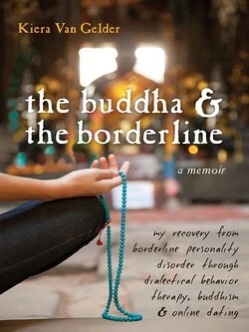
This book is atypical of the type I will normally review or discuss, but it is a phenomenal book that tangentially discusses Buddhism.  The book is really about a woman who suffers from borderline personality disorder and her journey through the depths of the disease and into recovery.  Buddhism plays a fundamental role in her recovery, but if you are looking for a deep discussion of Buddhist thought look elsewhere.  What you will find here is an inspiring story that will make you laugh out loud for real, cringe and possibly cry in spots.  There are parts of the true story that are just plain ugly and scary.  This is one of my favorite quick reads which gives you a sense of the importance of Buddhism in the life of a pained individual as she struggle to redefine herself.

The Buddha and the Borderline is a cross between Girl, Interrupted and Bridget Jones’s Diary.While reading it, I found myself admiring Kiera’s talent for vividly describing borderline hopelessness and pain while keeping me laughing with her tales of life as a ‘lonely and increasingly horny receptionist.’ While this book has something for everyone, Kiera’s detailed account of how she recovered from this deadly disorder will be enormously inspiring to people with borderline personality disorder and their family members.” (Randi Kreger)

“Kiera’s book is destind to become a classic in the growing literature on borderline personality disorder. I expected to get a somber account of a transformation from suffering to enlightenment,but the book I read was not only entirely entertaining and revealing, but also had me up way past my bedtime in stitches. The Buddha and the Borderline is seriously funny, authentic, and sublime in its wisdom. The book embodies the Four Noble Truths of Buddhism and integrates the world of core unrelenting suffering with the world of freedom from suffering. Transcendent stuff.” (Blaise Aguirre,MD, medical director of the Adolescent Dialectical Behavior Therapy Residential Program at McLean Hospital in Belmont, MA)