Book Review: A Dog’s Head by Jean Dutourd

“Jean Dutourd’s A Dog’s Head is a wonderful piece of magical realism, reminiscent of Voltaire, Borges and Kafka. With biting wit, Dutourd presents the story of Edmund Du Chaillu, a boy born, to his bourgeois parents’s horror, with the head of a spaniel. Edmund must endure his school-mate’s teasing as well as an urge to carry a newspaper in his mouth. This is the story of his life, trials, and joys as he searches for a normal life of worth and love.”

~From The Back Cover

Seasonal affective disorder (SAD): Symptoms

Seasonal affective disorder (SAD) is a type of depression that’s related to changes in seasons — SAD begins and ends at about the same times every year. If you’re like most people with SAD, your symptoms start in the fall and continue into the winter months, sapping your energy and making you feel moody. Less often, SAD causes depression in the spring or early summer.

Treatment for SAD may include light therapy (phototherapy), medications and psychotherapy.

Don’t brush off that yearly feeling as simply a case of the “winter blues” or a seasonal funk that you have to tough out on your own. Take steps to keep your mood and motivation steady throughout the year.

Symptoms

In most cases, seasonal affective disorder symptoms appear during late fall or early winter and go away during the sunnier days of spring and summer. Less commonly, people with the opposite pattern have symptoms that begin in spring or summer. In either case, symptoms may start out mild and become more severe as the season progresses.

Signs and symptoms of SAD may include:

• Feeling depressed most of the day, nearly every day

• Losing interest in activities you once enjoyed

• Having low energy

• Having problems with sleeping

• Experiencing changes in your appetite or weight

• Feeling sluggish or agitated

• Having difficulty concentrating

• Feeling hopeless, worthless or guilty

• Having frequent thoughts of death or suicide

Fall and winter SAD

Symptoms specific to winter-onset SAD, sometimes called winter depression, may include:

• Oversleeping

• Appetite changes, especially a craving for foods high in carbohydrates

• Weight gain

• Tiredness or low energy

Spring and summer SAD

Symptoms specific to summer-onset seasonal affective disorder, sometimes called summer depression, may include:

• Trouble sleeping (insomnia)

• Poor appetite

• Weight loss

• Agitation or anxiety

Seasonal changes in bipolar disorder

In some people with bipolar disorder, spring and summer can bring on symptoms of mania or a less intense form of mania (hypomania), and fall and winter can be a time of depression.

Causes

The specific cause of seasonal affective disorder remains unknown. Some factors that may come into play include:

• Your biological clock (circadian rhythm). The reduced level of sunlight in fall and winter may cause winter-onset SAD. This decrease in sunlight may disrupt your body’s internal clock and lead to feelings of depression.

• Serotonin levels. A drop in serotonin, a brain chemical (neurotransmitter) that affects mood, might play a role in SAD. Reduced sunlight can cause a drop in serotonin that may trigger depression.

• Melatonin levels. The change in season can disrupt the balance of the body’s level of melatonin, which plays a role in sleep patterns and mood.

Risk factors

Seasonal affective disorder is diagnosed more often in women than in men. And SAD occurs more frequently in younger adults than in older adults.

Factors that may increase your risk of seasonal affective disorder include:

• Family history. People with SAD may be more likely to have blood relatives with SAD or another form of depression.

• Having major depression or bipolar disorder. Symptoms of depression may worsen seasonally if you have one of these conditions.

• Living far from the equator. SAD appears to be more common among people who live far north or south of the equator. This may be due to decreased sunlight during the winter and longer days during the summer months.

Complications

Take signs and symptoms of seasonal affective disorder seriously. As with other types of depression, SAD can get worse and lead to problems if it’s not treated. These can include:

• Social withdrawal

• School or work problems

• Substance abuse

• Other mental health disorders such as anxiety or eating disorders

• Suicidal thoughts or behavior

Treatment can help prevent complications, especially if SAD is diagnosed and treated before symptoms get bad.

Sources: The Mayo Clinic

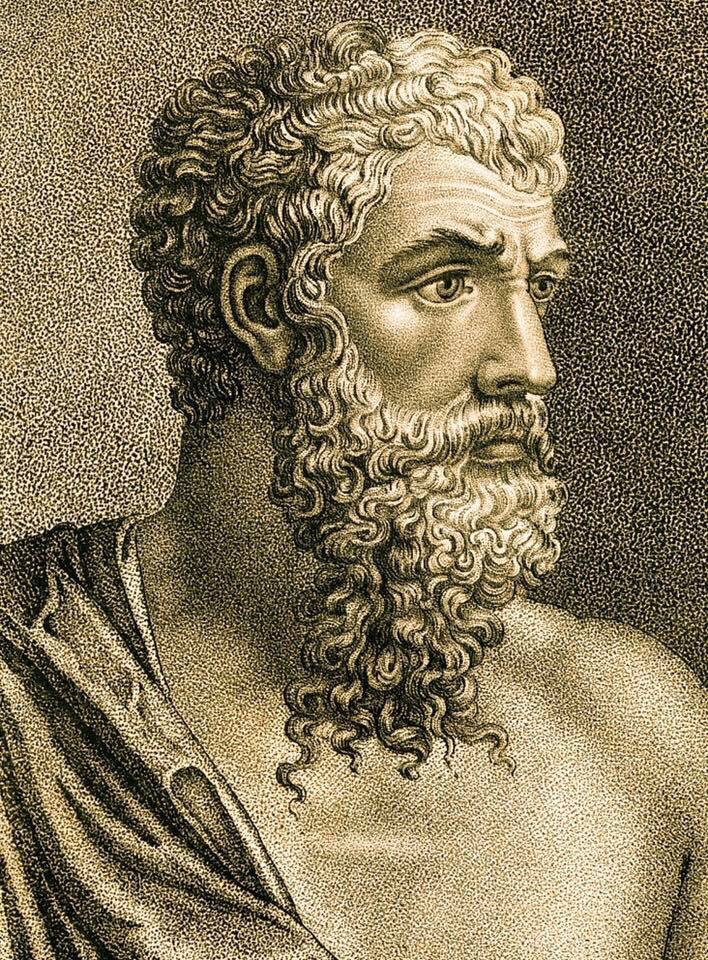
Aristophanes (c. 448-385 B.C.)

Aristophanes

Aristophanes (c. 448-385 B.C.) is the only representative of Old Comedy whose work we have in complete form. Aristophanes wrote political satire and his humor is often coarse. His sex-strike and anti-war comedy, Lysistrata, continues to be performed today in connection with war protests. Aristophanes presents a contemporary picture of Socrates, as a sophist in the Clouds, that is at odds with Plato’s Socrates.

Eleven of his forty plays survive virtually complete. These, together with fragments of some of his other plays, provide the only real examples of a genre of comic drama known as Old Comedy, and are used to define it.

Also known as “the Father of Comedy” and “the Prince of Ancient Comedy”, Aristophanes has been said to recreate the life of ancient Athens more convincingly than any other author. His powers of ridicule were feared and acknowledged by influential contemporaries; Plato singled out Aristophanes’ play The Clouds as slander that contributed to the trial and subsequent condemning to death of Socrates, although other satirical playwrights had also caricatured the philosopher.

His plays include: The Acharnians, Assemblywomen, The Birds, The Clouds, The Frogs, The Knights, Lysistrata, Peace, Plutus, Thesmophoriazusae, The Wasps

#ClassicalWisdom #ClassicalComedy #AncientGreece #Aristophanes

Aeschylus (c.525 – 456 B.C.)

Aeschylus

Aeschylus (c.525 – 456 B.C.) was the first great tragic poet. He introduced dialogue, the characteristic tragic boot (cothurnus) and mask. He established other conventions, like the performance of violent acts offstage. Before he became a tragic poet, Aeschylus, who wrote a tragedy about the Persians, fought in the Persian War in the battles of Marathon, Salamis, and Plataea.

Only seven of his estimated seventy to ninety plays have survived, and there is a long standing debate regarding his authorship of one of these plays, “Prometheus Bound”, which some believe his son Euphorion actually wrote.

Only seven tragedies have survived intact: The Persians, Seven against Thebes, The Suppliants, the trilogy known as The Oresteia, consisting of the three tragedies Agamemnon, The Libation Bearers and The Eumenides, together with Prometheus Bound.

The only complete trilogy of Greek plays by any playwright still extant (save a few missing lines in several spots) is the Oresteia (458 BC), although the satyr play that originally followed it, Proteus, is lost except for some fragments. The trilogy consists of Agamemnon, The Libation Bearers (Choephoroi), and The Eumenides. Together, these plays tell the bloody story of the family of Agamemnon, King of Argos.

#ClassicalWisdom #ClassicalTragedy #AncientGreece #Aeschylus

Plato’s The Allegory of the Cave

E6B23110-FD67-49CF-BA74-A55501E69029.jpeg

Plato’s The Allegory of the Cave

The Allegory of the Cave, or Plato’s Cave, was presented by the Greek philosopher Plato in his work Republic (514a–520a) to compare “the effect of educationand the lack of it on our nature”. It is written as a dialogue between Plato’s brother Glaucon and his mentor Socrates, narrated by the latter.

~ Plato realizes that the general run of humankind can think, and speak, etc., without (so far as they acknowledge) any awareness of his realm of Forms.

~ The allegory of the cave is supposed to explain this.

~ In the allegory, Plato likens people untutored in the Theory of Forms to prisoners chained in a cave, unable to turn their heads. All they can see is the wall of the cave. Behind them burns a fire.  Between the fire and the prisoners there is a parapet, along which puppeteers can walk. The puppeteers, who are behind the prisoners, hold up puppets that cast shadows on the wall of the cave. The prisoners are unable to see these puppets, the real objects, that pass behind them. What the prisoners see and hear are shadows and echoes cast by objects that they do not see. Here is an illustration of Plato’s Cave:

B9559BBB-E879-40B5-B5B4-11FBE8F8D82F

~ Such prisoners would mistake appearance for reality. They would think the things they see on the wall (the shadows) were real; they would know nothing of the real causes of the shadows.

~ So when the prisoners talk, what are they talking about? If an object (a book, let us say) is carried past behind them, and it casts a shadow on the wall, and a prisoner says “I see a book,” what is he talking about?

He thinks he is talking about a book, but he is really talking about a shadow. But he uses the word “book.” What does that refer to?

~ Plato gives his answer at line (515b2). The text here has puzzled many editors, and it has been frequently emended. The translation in Grube/Reeve gets the point correctly:

And if they could talk to one another, don’t you think they’d suppose that the names they used applied to the things they see passing before them?”

~ Plato’s point is that the prisoners would be mistaken. For they would be taking the terms in their language to refer to the shadows that pass before their eyes, rather than (as is correct, in Plato’s view) to the real things that cast the shadows.

~ If a prisoner says “That’s a book” he thinks that the word “book” refers to the very thing he is looking at. But he would be wrong. He’s only looking at a shadow. The real referent of the word “book” he cannot see. To see it, he would have to turn his head around.

~ Plato’s point: the general terms of our language are not “names” of the physical objects that we can see. They are actually names of things that we cannot see, things that we can only grasp with the mind.

D9AC059C-EF45-420D-85BD-0D9746E79EB2.jpeg

~ When the prisoners are released, they can turn their heads and see the real objects. Then they realize their error. What can we do that is analogous to turning our heads and seeing the causes of the shadows? We can come to grasp the Forms with our minds.

~ Plato’s aim in the Republic is to describe what is necessary for us to achieve this reflective understanding. But even without it, it remains true that our very ability to think and to speak depends on the Forms. For the terms of the language we use get their meaning by “naming” the Forms that the objects we perceive participate in.

~ The prisoners may learn what a book is by their experience with shadows of books. But they would be mistaken if they thought that the word “book” refers to something that any of them has ever seen.

Likewise, we may acquire concepts by our perceptual experience of physical objects. But we would be mistaken if we thought that the concepts that we grasp were on the same level as the things we perceive.

Sources: Philosophy 320: History of Philosophy (University of Washington)

The Republic by Plato

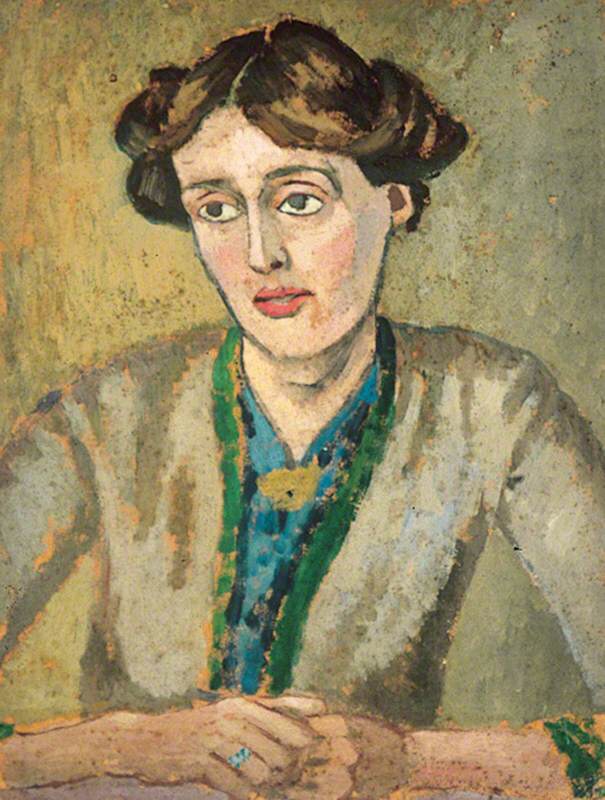
Virginia Woolf

Virginia Woolf (1882-1941)

Adeline Virginia Woolf is well known as one of the major literary figures of the twentieth century. The English author, novelist, essayist, biographer, feminist, publisher and writer of short stories is best known for her novels “Mrs. Dalloway,” “To The Lighthouse,” “Orlando,” and her book length essay, “A Room Of One’s Own.” From this essay she is often quoted, “A woman must have money and a room of her own if she is to write fiction.”

She began writing professionally in 1900 with an article about Haworth, the home of the Bronte family for the Times Literary Supplement. Her first novel “The Voyage Out” was published in 1915 by her half-brother. She would go on to publish novels and essays as an intellectual to both critical and popular success. Much of her work was self-published through the Hogarth Press. Her work was often criticized for its narrow portrayal of the upper middle class intellectuals and lacked anything of ethical or emotional relevance for the common reader. She is often criticized as well for being perceived as an anti-Semite despite the fact she was happily married to a Jewish man and condemned Christianity as self-righteous egotism and in a letter to her friend Ethel Smyth, “my Jew has more religion in one toe nail—more human love, in one hair.” Additionally her distaste for fascism and its ties to anti-Semitism is quite plainly spelled out in her book, “Three Guineas.” Her final work, “Between the Acts,” aptly expresses some of her main themes : transformation of life through art, sexual ambivalence, and the flux of time throughout one’s life at the same time being a deterioration and renewal.

Throughout her life Virginia suffered from several “breakdowns” as a result of having symptoms that conform to bipolar disorder, the first occurring by the sudden death of her mother when she was thirteen. Her most significant episode occurred after the death of her father in 1904 and was in turn briefly institutionalized after her first suicide attempt. Modern scholars have suggested her recurring depressive periods were a result of sexual abuse both her and her sister were subjected to by her half-brothers. She vividly recounts this in an autobiographical essay, “A Sketch of the Past,” which can be now read in “Moments of Being” a collection of posthumously-published autobiographical essays. She wrote of the event, “I can remember the feel of his hands going under my clothes; going firmly and steadily lower and lower, I remember how I hoped that he would stop; how I stiffened and wriggled as his hand approached my private parts. But he did not stop.”

Throughout her life she struggled with periodic mood swings and associated illnesses. Though this often affected her social life, her literary career and productivity continued with very few breaks. After the completion of “Between the Acts” she fell into a deep depression. The onset of World War II and the destruction of her London home in the bombing only deepened it. On March 28th, 1941 she filled the pockets of her overcoat with stones and drowned herself in the River Ouse which runs through the counties of West and East Sussex near her home. In her last note to her husband she wrote :

“Dearest, I feel certain that I am going mad again. I feel we can’t go through another of those terrible times. And I shan’t recover this time. I begin to hear voices, and I can’t concentrate. So I am doing what seems the best thing to do. You have given me the greatest possible happiness. You have been in every way all that anyone could be. I don’t think two people could have been happier ’til this terrible disease came. I can’t fight any longer. I know that I am spoiling your life, that without me you could work. And you will I know. You see I can’t even write this properly. I can’t read. What I want to say is I owe all the happiness of my life to you. You have been entirely patient with me and incredibly good. I want to say that – everybody knows it. If anybody could have saved me it would have been you. Everything has gone from me but the certainty of your goodness. I can’t go on spoiling your life any longer. I don’t think two people could have been happier than we have been.”
~ Virginia Woolf

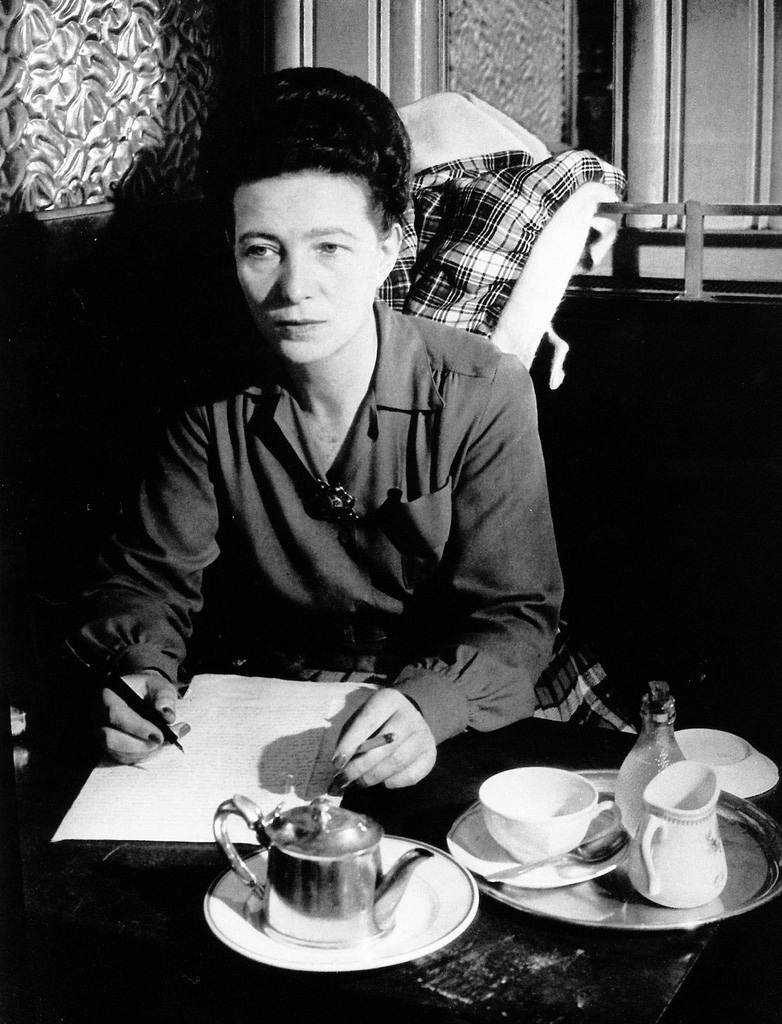
Simone de Beauvoir

Simone de Beauvoir (1908-1986)

Simone-Ernestine-Lucie-Marie Bertrand de Beauvoir was a French existentialist philosopher, intellectual, feminist and social theorist. She did not consider herself a philosopher, however her contributions to existential feminist thought firmly enshrines her legacy as one. In her lifetime she wrote novels, essays, biographies, a multi-volume autobiography, including articles/essays on philosophy, politics, and social issues. She is best remembered for her treatise “The Second Sex,” a highly detailed analysis of women’s oppression and as it relates and influences contemporary feminism. She is also known for her two metaphysical novels “She Came to Stay” and “The Mandarins,” but by far best known or renown for “The Second Sex.”

Simone de Beauvoir was born in Paris and studied mathematics and philosophy at the Institut Catholique and literature/languages at the Institut Sainte-Marie. She then went on to study philosophy at the Sorbonne. Afterwards while completing her practice teaching requirements she first met Maurice Merleau-Ponty and Claude Lévi-Strauss. While studying for her agrégation in philosophy (a highly competitive postgraduate civil service examination which serves as a national ranking of students for some position in the public education system) she met fellow students Jean-Paul Sartre, Paul Nizan, and René Maheu. The jury narrowly awarded Sartre first place over Beauvoir. She was twenty-one at the time and the youngest ever to pass the exam.

In June 1949 “The Second Sex” was published in France. She argues that men made women the “Other” in society by putting a false and constructed mystery around them. Therefore men used this as their excuse not to understand women, their problems and most importantly not to help them. She went on to argue that men stereotyped women and used it to organize society into a patriarchy. As an existentialist she believed, “l’existence précède l’essence” (existence precedes essence), there by one is not born a woman, but becomes one. It is the social construction of woman that she identifies as fundamental to woman oppression. She went on to argue that even Mary Wollstonecraft considered men to be the ideal to which women should aspire and that this belief limited women’s success by maintaining that perception. She vigorously argued that for feminism to move forward this assumption must be set aside. Thus Beauvoir aseerted that women are as capable of choice as man, and therefore can ellect to elevate themselves and move beyond the position which they have been resigned and reach a position in which they take responsibility for oneself and the world, where one can choose one’s freedom.

A long quote and a few short quotes :

“Art, literature, and philosophy are attempts to found the world anew on a human freedom: that of the creator; to foster such an aim, one must first unequivocally posit oneself as a freedom. The restrictions that education and custom impose on a woman limit her grasp of the universe…Indeed, for one to become a creator, it is not enough to be cultivated, that is, to make going to shows and meeting people part of one’s life; culture must be apprehended through the free movement of a transcendence; the spirit with all its riches must project itself in an empty sky that is its to fill; but if a thousand fine bonds tie it to the earth, its surge is broken. The girl today can certainly go out alone, stroll in the Tuileries; but I have already said how hostile the street is: eyes everywhere, hands waiting: if she wanders absentmindedly, her thoughts elsewhere, if she lights a cigarette in a cafe, if she goes to the cinema alone, an unpleasant incident can quickly occur; she must inspire respect by the way she dresses and behaves: this concern rivets her to the ground and self. “Her wings are clipped.” At eighteen, T.E. Lawrence went on a grand tour through France by bicycle; a young girl would never be permitted to take on such an adventure…Yet such experiences have an inestimable impact: this is how an individual in the headiness of freedom and discovery learns to look at the entire world as his fief…[The girl] may feel alone within the world: she never stands up in front of it, unique and sovereign.”

“One’s life has value so long as one attributes value to the life of others, by means of love, friendship, and compassion”

“A man attaches himself to woman — not to enjoy her, but to enjoy himself.”

“Man is defined as a human being and a woman as a female – whenever she behaves as a human being she is said to imitate the male.”

“Society, being codified by man, decrees that woman is inferior; she can do away with this inferiority only by destroying the male’s superiority.”

“The word love has by no means the same sense for both sexes, and this is one cause of the serious misunderstandings that divide them.”

“Representation of the world, like the world itself, is the work of men; they describe it from their own point of view, which they confuse with absolute truth.”

“One is not born a genius, one becomes a genius; and the feminine situation has up to the present rendered this becoming practically impossible.”
~ Simone de Beauvoir

Crisis Intervention Teams (CIT)

The lack of mental health crisis services across the U.S. has resulted in law enforcement officers serving as first responders to most crises. A Crisis Intervention Team (CIT) program is an innovative, community-based approach to improve the outcomes of these encounters.

In over 2,700 communities nationwide, CIT programs create connections between law enforcement, mental health providers, hospital emergency services and individuals with mental illness and their families. Through collaborative community partnerships and intensive training, CIT improves communication, identifies mental health resources for those in crisis and ensures officer and community safety.

Core Components of CIT Programs

Community Collaboration: Vitally important to successful CIT programs is building relationships. Community ownership should occur in all phases of CIT programs–initial planning, curriculum development, policies and procedures, and ongoing problem solving. This broad-based, grassroots community collaboration is what makes CIT programs sustainable over time, especially during challenging fiscal and political times.

A Vibrant and Accessible Crisis System: An outcome of productive community collaboration is the transformation of a crisis response system that is vibrant, responsive and easily accessible. Communities should work to provide a 24/7 crisis response, a “no wrong door” philosophy, and a 15 minute or under turnaround time to get first responders back on the streets. Depending on your community (urban, suburban, rural, frontier), these crisis system models may need to be creatively adapted to meet your needs.

Training for law enforcement and other first responders: The training curriculum is designed to be taught by local specialists from the law enforcement, behavioral health and consumer/advocate field. Upon completion of the course,

officers/first responders are better equipped to:

  • Understand common signs and symptoms of mental illnesses and co-occurring disorders;
  • Recognize when those signs and symptoms represent a crisis situation.
  • Safely de-escalate individuals experiencing behavioral health crises;
  • Utilize community resources and diversion strategies to provide assistance.

At the heart of effective CIT programs is officers who volunteer to be identified as a CIT officer and who are skilled and passionate about responding to these calls. Ongoing continuing education and advanced CIT training should be incorporated into the model.

Behavioral Health Staff Training: It is imperative that behavioral health staff develop an understanding of the role of law enforcement/first responders, and why they are trained to respond in ways that they do. This deeper understanding helps to provide insight and gain appreciation for what can otherwise be a culture divide. It is often beneficial for behavioral health staff to do ride- alongs with officers, and vice versa, for law enforcement to do home visits with case managers/therapists. It is also beneficial for law enforcement to provide training to front-line behavioral health workers on law enforcement culture. The goal is a deeper understanding and appreciation of one another’s roles, leading to improved collaboration.

Family/Consumer/Advocate Participation: People with lived experience provide invaluable insight in the training, and consumers and family members are key resources in advocating for CIT programs and improved crisis services. Consumer and family involvement in CIT programs also helps to inform understanding of how law enforcement is trained, building reasonable expectations of what to anticipate when law enforcement is called. Families and advocates also provide important feedback about the overall crisis response system, contributing to continuous quality improvement initiatives.

Police & First Responders Benefits

Not only can CIT programs bring community leaders together, they can also help keep people with mental illness out of jail and in treatment, on the road to recovery. That’s because diversion programs like CIT reduce arrests of people with mental illness while simultaneously increasing the likelihood that individuals will receive mental health services. CIT programs also:

• Give police officers more tools to do their job safely and effectively. Research shows that CIT is associated with improved officer attitude and knowledge about mental illness. In Memphis, for example, CIT resulted in an 80% reduction of officer injuries during mental health crisis calls.

• Keep law enforcement’s focus on crime. Some communities have found that CIT has reduced the time officers spend responding to a mental health call. This puts officers back into the community more quickly.

• Produce cost savings. It’s difficult to estimate exactly how much diversion programs can save communities. But incarceration is costly compared to community-based treatment. For example in Detroit an inmate with mental illness in jail costs $31,000 a year, while community-based mental health treatment costs only $10,000 a year.

Overall Benefits of CIT Programs

• Positive community relationships

• Improved crisis response system

• Trained response to behavioral health crisis calls

• Reduced unnecessary arrests or use of force

• Reduced officer/citizen injuries

• Increased officer confidence in skills

• Reduced liability

• More efficient use of criminal justice resources, including increased jail diversion

Sources: NAMI, CIT International

Mary Wollstonecraft

Mary Wollstonecraft (1759-1797)

Mary Wollstonecraft was an eighteenth century English writer, philosopher and advocate of women’s rights. She wrote novels, treatises, a travel narrative, a history of the French Revolution, a conduct book, and a children’s book. She is best known for her 1792 book, “A Vindication of the Rights of Women.” Through it she argues that women are not naturally inferior to men, but appear so simply because they lack the education. She posits both men and women should be treated as rational beings and bring about a social order founded on reason. Today she is regarded as one of the founding feminist philosophers and her unconventional life is also cited as a fundamental influence among certain feminists.
A few of her quotes summarize some of her beliefs much more adequately than I could ever attempt :

“I do not wish them [women] to have power over men; but over themselves.”

“If we revert to history, we shall find that the women who have distinguished themselves have neither been the most beautiful nor the most gentle of their sex.”

“It is vain to expect virtue from women till they are in some degree independent of men.”

“My own sex, I hope, will excuse me, if I treat them like rational creatures, instead of flattering their fascinating graces, and viewing them as if they were in a state of perpetual childhood, unable to stand alone.”
“Taught from their infancy that beauty is woman’s sceptre, the mind shapes itself to the body, and roaming round its gilt cage, only seeks to adorn its prison.”

“It is time to effect a revolution in female manners – time to restore to them their lost dignity – and make them, as a part of the human species, labour by reforming themselves to reform the world. It is time to separate unchangeable morals from local manners.”

“Love from its very nature must be transitory. To seek for a secret that would render it constant would be as wild a search as for the philosopher’s stone or the grand panacea: and the discovery would be equally useless, or rather pernicious to mankind. The most holy band of society is friendship.”
~ Mary Wollstonecraft

Marie de France

Marie de France (12th Century)

Very little is actually known of Marie de France as both her given name and where she lived is only known through her manuscripts. She was a medieval poet who probably was born in France and lived in England in the late 12th century. She lived and wrote at an unknown or undisclosed court, but was at least known of in the royal court of King Henry II of England. Some have suggested that she was perhaps a half-sister of Henry II.

She wrote a form of Anglo-Norman French and was proficient in Latin and English as well. She translated “Aesop’s Fables” into Anglo-Norman French from Middle English, and the “Legend of the Purgatory of St. Patrick” from Latin. She is best known as the writer of “The Lais Of Marie de France” which are still quite widely read and were a great influence on the romance genre (heroic literature) such as Chaucer’s “Canterbury Tales.”

“The Lais of Marie de France” are a series of twelve short (a few hundred lines each) Breton Lais. They are rhymed stanzas of 6-16 lines with 4-8 syllables per line which focus on glorifying the concept of courtly love through the adventure of the main character. The series of lais presents a contrast of the positive and negative actions that can result from love through magical situations, themes and imagery. Romantic themes include lovers in a hostile world, oppressive marriages and dichotomy social conventions, conflicts between love, chivalry and marriage, freedom of desire, love as an escape, and the psychological issues of love manifested in treachery and selfishness. They are also considered to have an ambiguous moral message especially for the time.

“Love is an invisible wound within the body, and, since it has its source in nature, it is a long-lasting ill.”

“Anyone who intends to present a new story must approach the problem in a new way and speak so persuasively that the tale brings pleasure to people.”

“It would be less dangerous for a man to court every lady in an entire land than for a lady to remove a single besotted lover from her skirts, for he will immediately attempt to strike back.”

~ Marie de France