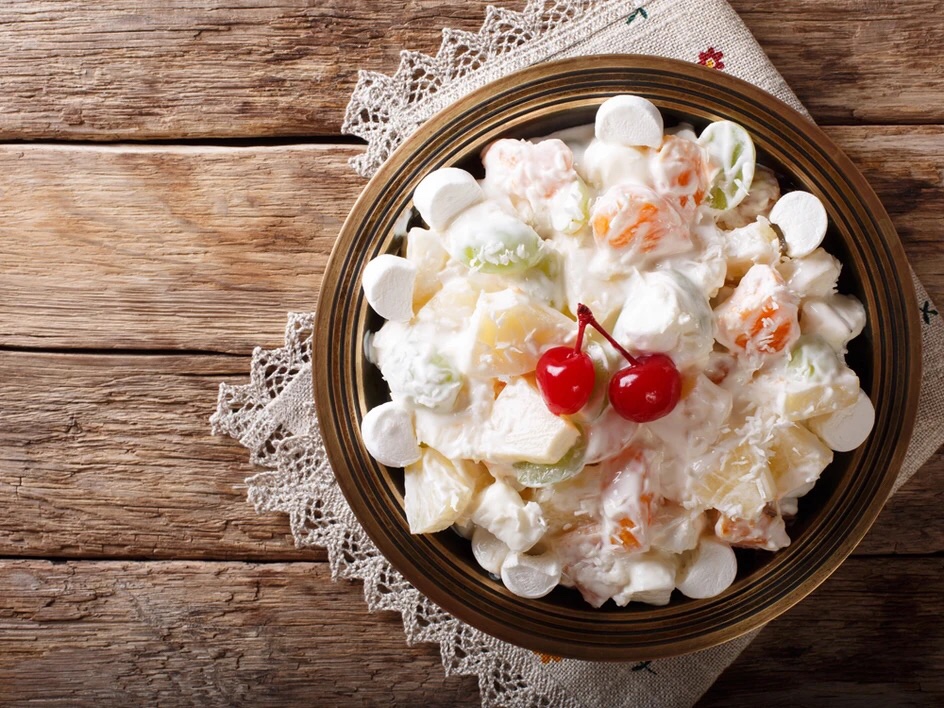
Food Through Culture: Ambrosia Salad

The dish features a daring combination of jet-puffed marshmallows, shredded coconut, pineapple and mandarin oranges. It’s most commonly finished with a smattering of cool whip (originally sour cream) and chilled in the fridge overnight, encouraging the ingredients to congeal into a dense, syrupy mass. More gourmet renditions have been known to include homemade marshmallows, crushed pecans, maraschino cherries and other fresh fruit. But beyond the various recipes, each ambrosia salad offers the same feeling: The quiet thrill of knowing you’re about to do something you shouldn’t, followed by pure, sticky bliss as you place that first goopy spoonful into your mouth.

A fruit salad without morals, nothing about ambrosia indicates that it should be served as a main course. Nevertheless, this is where it’s most likely to appear. I have never seen ambrosia on a dessert table. But have bared witness to it resting amongst mashed potatoes, Brussels sprouts and stuffing at countless potlucks and celebrations.

The mixture of refrigerated coconut and sour cream is rumoured to have begun in the southern U.S. in the 1800s, with the earliest written reference of the salad published in a cookbook from 1867, Dixie Cookery by Maria Massey Barringer. Thanks to newly built railroads that linked the west coast with the east, imported ingredients like coconut became easier to access. By the 1870s, the proliferation of imported ingredients meant ambrosia recipes were common.

The Originals (2013-2018)

The Originals is the first spin-off from the supernatural drama The Vampire Diaries, and it further expands the universe by providing a rich background story to many of the characters first met in the parent series.

In particular, we learn more about Klaus Mikaelson and his family, the first vampires to ever exist.

Their story unfolds in the French Quarter of New Orleans, a neighborhood they built and once ruled over but has since been taken over by Klaus’ own protege, Marcel.

Klaus is determined to regain control, but must also fight to keep his daughter safe from external threats against his family and the entire supernatural world.

American Horror Story: Coven (2013-2014)

In a city with a culture rich with ties to the occult, it’s no surprise that there’s a TV series about witches.

From Ryan Murphy’s renowned American Horror Story franchise is its third season subtitled Coven, which follows a secret institution of young witches who are descendants of those persecuted during the Salem witch trials in the late 1600s.

The girls are learning to harness and strengthen their powers at a boarding school run by witch Cordelia Foxx.

However, that also means they’re all contending to become the next Supreme, the most powerful witch, while battling external threats from voodoo practitioners as well as interior threats.

Treme (2010-2013)

Hurricane Katrina was identified as a Category 3 hurricane by the time it made landfall in Louisiana on August 29, 2005. The resulting damage on the state was devastating, particularly in New Orleans where floods swept the entire city.

HBO’s drama series Treme takes place in the aftermath of the disaster, in a neighborhood called Treme (based on the real-life neighborhood of the same name).

Having suffered their own tragedies brought on by Katrina, the residents of Treme strive to rebuild not just their homes but their entire lives.

As survivors, it seems more important now than ever to uphold the music and culture that gives their community its unique identity.

Hoodoo in Savannah

The Geechee culture is a remnant from what was once a society of black slaves. The area they call home stretches from Savannah southward to an area just below the Ogeechee River, from which they draw their name. Often times this culture is mistakenly called ‘Gullah’, but in actuality the Gullah people exist in an area to the north of Savannah, between Daufuskie Island and Charleston, South Carolina. The two peoples are similar, but not interchangeable: both are rooted in slavery, but the Geechee people have a history and tradition all their own.

Freed after the Civil War, these Island people would often group near the coast where both fishing and farming was plentiful. The community developed their own dialect. In addition to what amounted to their own language (also called ‘Geechee’), this culture also had an elaborate belief system through their African descent. These beliefs are centered on a deep spirituality, believing in both ghosts and in a type of magic cast by charms, potions and amulets.

This magical ability to cast spells is called ‘conjuring’, or ‘casting roots’. A magic spell itself is called a ‘conjure’. The spell is often cast by burying a bag or bundle on the property of the unsuspecting victim. There are also ways of conjuring involving secret potions to drink, powders, nail clippings, and that most powerful of talismans—graveyard dirt. Someone skilled in the art of casting spells is called a root doctor, or a witch doctor. They can be employed if you feel that magic is being used against you.

A witch doctor is very different from a witch, which is often called a ‘boo-hag’. Not to be confused with the Hollywood version, witches in this tradition look no different from regular people. Witches are more akin to vampires, because the belief is that they steal the breath and life-force or essence of the victim. To have your essence stolen by a witch is known as ‘being rid’ or ‘ridden’. If someone looks poor or sickly, the assumption is that a boo-hag stole that person’s energy in the middle of the night; they are being “rid by a witch.”

Mami Wata

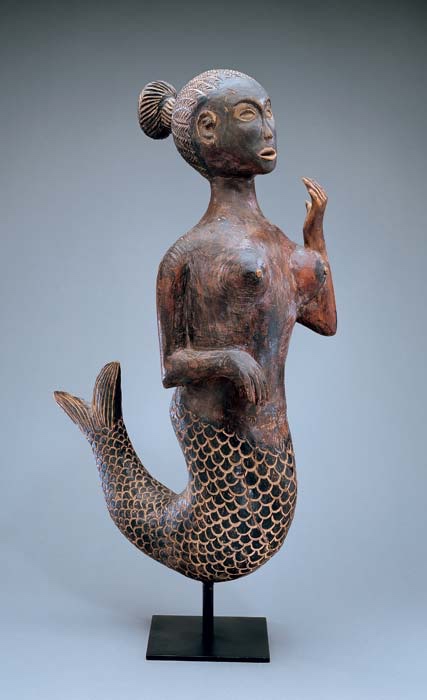
Mami Wata is a water-spirit, sometimes described as a mermaid figure, who can found throughout the western coastal regions and into central Africa. Mami Wata is described as having long dark hair, very fair skin and compelling eyes. Although she may appear to her devotees (in dreams and visions) as a beautiful mermaid, complete with tail, she is also said to walk the streets of modern African cities in the guise of a gorgeous but elusive woman. She is interested in all things contemporary: some of her favorite offerings include sweet, imported perfumes, sunglasses and Coca-Cola. Nonetheless, the spirit appears to be related to other water spirits who have a much longer history on the continent. Mami Wata’s colors are red and white. Those she afflicts with visions and temptations, and who experience her as an obsession or an illness, may wear the red of sickness and dangerous heat. Others who have a more positive orientation towards the spirit may show their blessings by wearing white. Most devotees wear a combination of red and white clothing.

Mami Wata is also said to have a number of avatars on earth–mortal women who have the same look as the deity and who act as her “daughters.” Mami Wata may give wealth to her devotees, her “daughters” or to her (male) spouses, but she is never known to give fertility. Some Igbo stories suggest that the fish under the waters are her children, and that she uses them as firewood. Mami Wata is sometimes seen as a metaphor for modern African conditions — having the knowledge of global wealth and the desire for large-scale consumption, but lacking the actual wealth or access to the world’s wealth that would enable Africans to participate in that system. A number of Africanist art historians have written about Mami Wata, notably Henry Drewal, as have anthropologists like myself. She is the subject of local poetry, song, paintings, carvings and now film.

Mami Wata is depicted as a mermaid, with a woman’s torso and the legs of either a fish or serpent. Sometimes Mami Wata is depicted as a whole woman carrying a large snake or snakes wrapped around her body. While she is often depicted as a mermaid or half woman–half snake, Mami Wata actually represents a whole pantheon of spirits and deities in West Africa. Mami Wata is the African ambassador to all the spirits of the waters: La Sirene, the Haitian Vodou loa who is similarly depicted as a mermaid; Yemoja, the Yoruban Mother of the Seven Seas; and Yemayá in Santeria and Ifá. Mami Wata remains an important spirit in the New Orleans Voudou pantheon.

Papa Legba

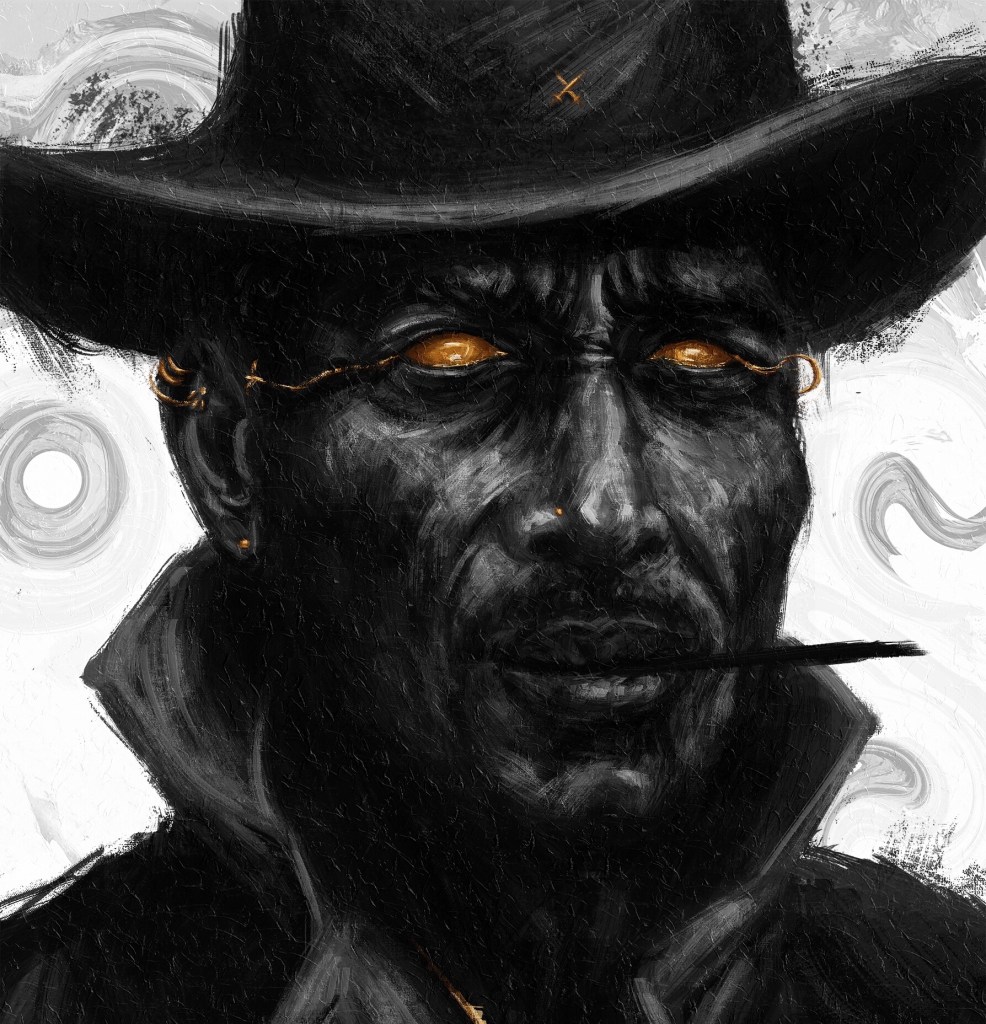
Legba, a god of West Africa and Voodooism, is the child of the Sky Pantheon. He is allied with destiny, but has no particular domain. Legba is very intelligent and cunning, despite the fact that he is a trickster. Although Legba appears as a weak poorly dressed old man, he is really very strong. He understands all languages of humans and of the gods. In Voodoo ceremonies, Legba is always the first to be invoked. No Loa, a spirit of the dead, is allowed to enter into the worshippers unless he has Legba’s permission. This is because he holds the key to the gate separating the humans’ world and the world of the gods.

Papa Limba, or Labas, is who we refer to as Papa Legba today; and St. Peter is the Catholic saint syncretized with him. Papa Legba is the gatekeeper to the spirit world and is represented by keys, among other things, while St. Peter holds the keys to the gates of heaven. Beyond this similarity, however, the two have little in common.

In New Orleans Voudou, syncretism manifests as Catholic icons representing African deities. The introduction of Catholic saints is a direct result of the implementation of the Louisiana Black Code, which made the practice of any religion other than Catholicism illegal. Substituting images of Catholic saints that shared similar characteristics as the Voudou spirits allowed slaves to continue with their religions in a veiled manner. Over time, the saints became incorporated into New Orleans Voudou as separate entities unto themselves, not substitutions. In Louisiana, it was easy to blend Voudou and Catholicism because of the many similarities between the two traditions. Both believe in a supreme being, include symbolic or actual rituals of sacrifice, and both use altars as focal points of devotion.

Source: The Magic of Marie Laveau

Aegir and Ran

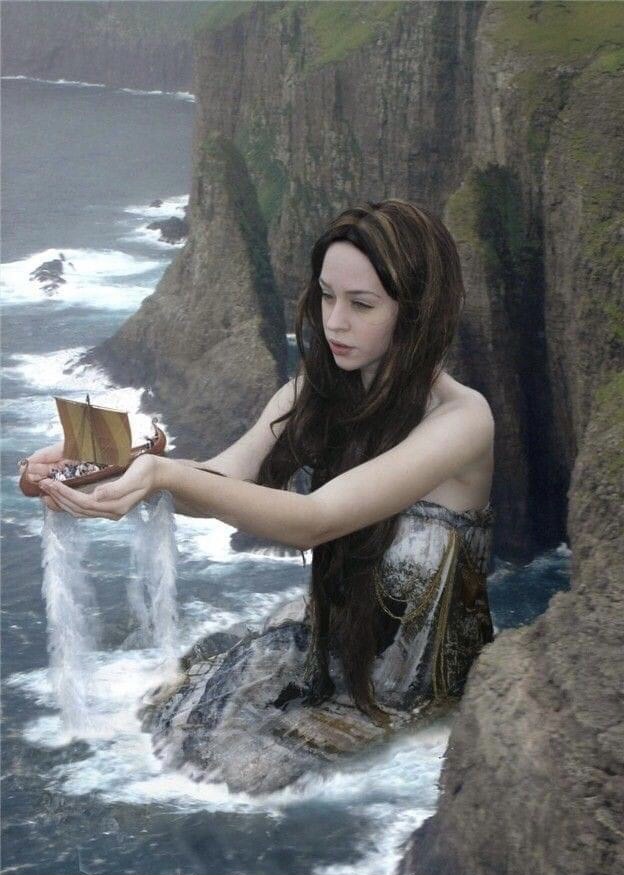
In Norse mythology, Aegir and Ran are a married couple that lives under the sea. Ran is a sea goddess, and her husband Aegir is a jotünn, and together they have nine daughters who all are named after the waves of the sea.

Their names are bloody-hair (Blóðughadda), wave (Bylgja), foaming sea (Dröfn), pitching wave (Dúfa), the lifting one (Hefring), transparent wave (Himinglæva), welling wave (Hronn), cold wave (Kolga) and frothing wave (Uðr). They are sometimes referred to as the spirits of the waves or the nine billow maidens.

Ran whose name means robbery, loves to spend her day catching and dragging drowning sailors with her huge fishing net down into her realm on the bottom of the sea.

This is the same fishing net as the trickster Loki once borrowed because he wanted to capture the dwarf Andvari who had turned himself into a pike.

Aegir means “sea” in Old Norse, is not a sea god, but he is a jötunn. Even Though Aegir is a jötunn (giant) the couple has befriended the Aesir, they are actually very well-liked among them, and they are often invited to the feasts in Asgard.

Aegir and Ran are often the hosts of the feasts themselves, and they send out invitations to the Aesir to visit them in their great hall in their underwater realm. The Norse gods never decline an invitation, they love to come and visit and drink the beer that Aegir brews.

For you see, Aegir is very well-known for his astonishing beer throughout the nine realms. He might be using his magic as his secret ingredient when he is brewing the beer in his huge cauldron.

His immense knowledge in the art of magic is known among the Aesir, probably one of the reasons why Odin wants to be around him. Odin does not come to the feasts for the beer, he only likes wine, but he probably comes to learn some of Aegir’s magic.

Li Grande Zombi

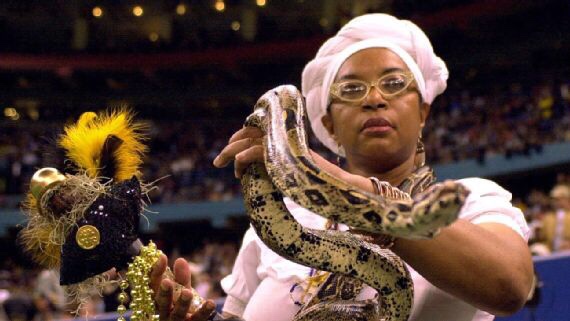
Li Grande Zombi is the major serpent spirit of worship among New Orleans Voodooists. In New Orleans Voodoo, snakes are not seen as symbols of evil as in the story of Adam and Eve. Snakes are considered to be the holders of intuitive knowledge—knowing that which cannot be spoken. Women often dance with serpents to represent the spiritual balance between the genders. Voodoo rituals in New Orleans almost always include a snake dance to celebrate the link to the ancient knowledge. The origin of Li Grande Zombi can be traced to the serpent deity Nzambi from Whydah in Africa. According to the Bantu Creation story, Nzambi is the Creator God:

Nzambi exists in everything and controls the universe through his appointed Spirits. In the beginning only Nzambi existed. When he was ready to create, millions and millions of pieces of matter swirled around him counterclockwise until Ngombe was born. Ngombe is the universe, the planets, the stars and all physical matter. Nzambi then created movement, and the matter that he had created began to change and drift apart. So, he decided to create a being that could traverse the universe and mediate between matter and space. Nzambi focused on a fixed point and gave life to a being who was simultaneously man and woman, a manifestation of the nature of Nzambi, called Exú-Aluvaiá.

Sources: The Voodoo Hoodoo Spellbook

Mummy Brown

Until relatively recently, Egyptian mummies, believe it or not, were used to produce a type of paint, which was called Mummy Brown, Mommia, or Momie. The main ingredient of this paint was, as you may have already guessed, ground up Egyptian mummies. This powder was mixed with white pitch and myrrh to produce a rich brown pigment. It was first made in the 16th century, and became a popular color amongst the Pre-Raphaelite painters of the mid-19th century.

For instance, it has been recorded that the British portraitist, Sir William Beechey, kept stocks of Mummy Brown. The French artist Martin Drölling also reputedly used Mummy Brown made with the remains of French kings disinterred from the royal abbey of St. Denis in Paris. It has been suggested that his L’interieur d’une cuisine is an example of extensive use of the pigment, while the mesmerizing painting by Edward Burne-Jones, entitled The Last Sleep of Arthur in Avalon, is also believed to have been painted using Mummy Brown.

Apothecary: Using Ground Mummies to Cure Disease

Art supplies were not the only things that ground bones of mummies were used for. More surprisingly, perhaps, is their use for medicinal purposes. This was due to the belief that mummies contained bitumen, which was used by the ancient Greeks to cure a variety of diseases. Apparently, in the absence of real bitumen, the so-called bitumen from a mummy would do just as well. Keep in mind that the word mummy itself is derived from the Persian word for bitumen, mum or mumiya.

As a result of this belief in the medicinal properties of Mummy powder, Egyptian mummies were exported to Europe, ground down, and sold in apothecaries throughout the continent. Part of the craze for Mummy powder was due to the claim that mummies had a mysterious life force that was transferrable to whoever ingested it. Hence, ground mummies were consumed by Europeans well into the 18th century.

Sources: Ancient Origins, “The Gruesome History of Eating Corpses as Medicine” in Smithsonian Magazine, “Ground Up Mummies Were Once an Ingredient in Paint” in Smithsonian Magazine.