Château De Montségur (“Satan’s Synagogue”)

Château De Montségur (“Satan’s Synagogue”)

Before turning their thoughts to the intriguing legends associated with these ruins, any person who strays off the marked footpaths and loses his or her footing on the edge of the precipices that drop away on every side of this aptly nicknamed “citadel in the sky.” And let us not forget that early in 1244 it was a feat of rock climbing that sealed the fate of the Cathars when they were besieged here by the army of King Louis IX. After seven months, during which traditional military strategies had brought nothing but failure, Hugues des Arcis, the commander of the forces encamped at the foot of this eagle’s nest, finally decided to send a small group of particularly agile soldiers up the cliff face. Under cover of darkness, this detachment reached the summit, captured a watchtower, and installed a trebuchet, with which it proceeded to bombard the interior of the castle without respite, making life impossible for the besieged, who were forced to surrender after a few weeks.

The fate of this community, the last bastion of the Cathar faith in France, is well known. One Sunday in March 1244, the day of the equinox, the believers—more than two hundred men and women—were led down to a pyre that had been set up at the foot of the hill, steadfastly refusing to renounce their faith. What else could they do, these pacifists who had taken a vow to show courage in the face of suffering and death? The name Cathar—from the Greek katharos, meaning “pure”—was given them by their contemporaries on account of their asceticism and refusal to compromise in any way. For the same reason, those who had undergone the rite of ordination called the consolamentum were known as perfecti, although among one another they preferred the terms “good man” and “good woman.” The band of sympathizers protecting the pacifist Cathars were allowed to go free provided they pledged to stop supporting heresy and swore allegiance to the king of France.

The Château de Montségur that stands today is not the same fortress that existed at the time of these dreadful events. Historians, archeologists, and local storytellers cannot agree on all the details. For example, was the Cathars’ place of martyrdom the prats dels cremats (“field of the burned”), as indicated today by a stele, or was it a neighboring hill? At this magnificent site, so many questions remain unanswered. There’s the legendary Cathar treasure, said to have been held in safekeeping at Montségur before being smuggled out to an unknown destination. And then there are the four men deputed by the community to slip away under the utmost secrecy prior to the ultimate surrender, carrying with them who knows what. Items of treasure? Precious documents? Mysterious keys enabling the Cathar tradition to be revived elsewhere? At Montségur nothing seems impossible. In the last century a team of German researchers came, with the blessing of the Nazi regime, to investigate, convinced that the castle housed the Holy Grail, the famous cup believed to have been used to catch Christ’s blood.

What should we make of the site’s architecture, of the spectacular alignment of the sun’s rays at solstice time, as if its architects had wanted the castle to function as a kind of astronomical calendar? And doesn’t its floor plan reflect the constellation of Boötes, with the donjon representing the star Arcturus? Is it also mere chance that “Cant del Boièr” (Song of the Herdsman) remains one of the most popular folk songs in the Occitanian canon, with some people reading into its words a coded message addressed to future generations?

“After seven hundred years the bay tree will flower again”—and with it, no doubt, the Cathar faith. Thus were the words of the troubadour in the Occitania of old. Or was it the last of the perfecti to be burned at the stake? Or even a poet born generations later? Basically, nobody knows. It is even possible that the bay tree could be an olive tree, and that the date is regularly adjusted so that it never loses its relevance. No matter. The legend remains perplexing enough for visitors to be drawn in by its verses while contemplating the ruins of what the inquisitors called “Satan’s synagogue” – but never quite managed to utterly destroy.

Sources: Atlas of Cursed Places
Nidhogg

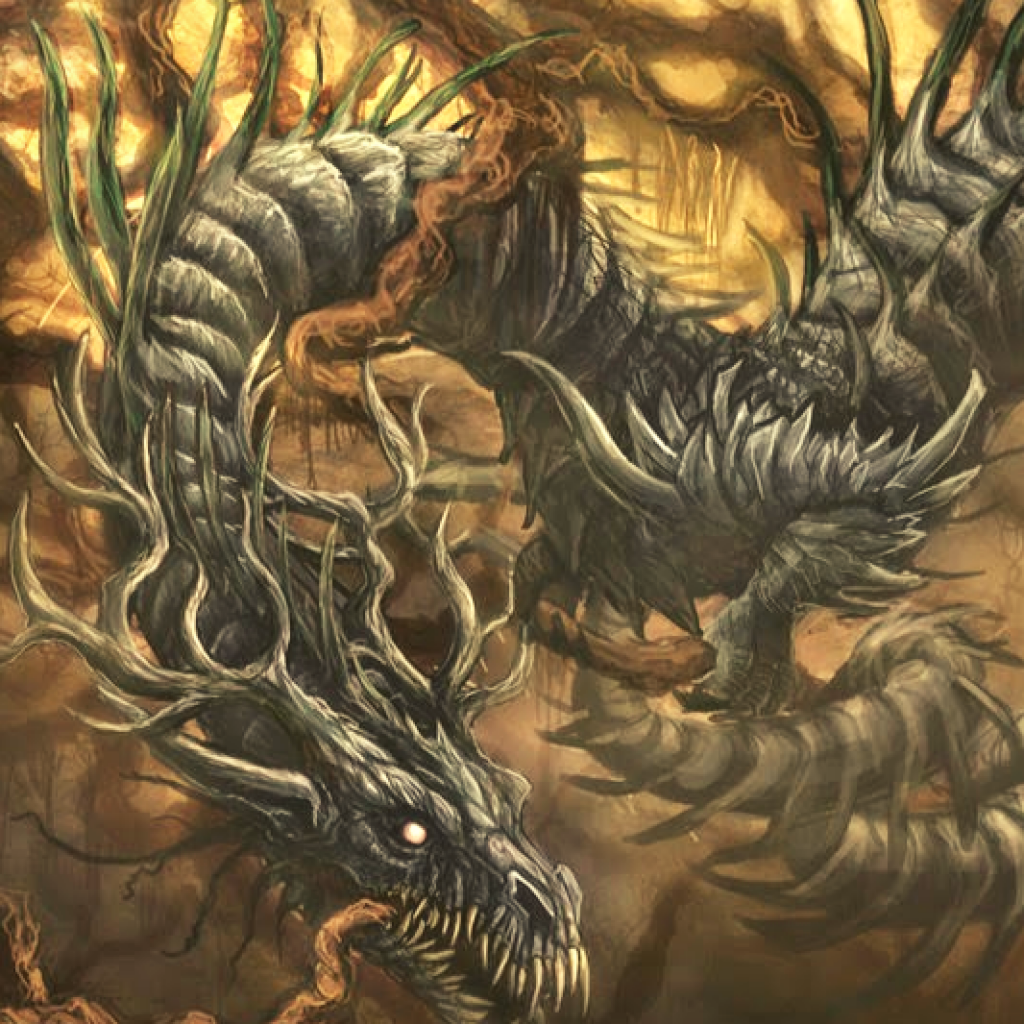
Nidhogg (Norse Níðhöggr) is a ferocious dragon who gnaws at the roots of Yggdrasil, the tree which supports the nine worlds of Norse mythology. This power-hungry monster is sometimes referred to as “the Malice Striker,” an appropriate name given that he rules over dark criminals and is bent on destroying peace and virtue.

Nidhogg is a tremendous dragon. His body is covered in bright scales, and horns erupt from his head. A pair of forelegs, complete with massive claws, help him to rip at the roots of Yggdrasil, but he has no back legs, only a serpentine tail. Beneath his bat-like wings, he carries the corpses of criminals.

His mammoth body can be found twisting through the roots of Yggdrasil, especially around Niflheimr, the cold world from which all the rivers of Midgard spring. Occasionally, he might slither into Hel to visit the dark goddess who some people consider his master.

Balance is extremely important in Norse mythology, and while Nidhogg does represent a ghastly force, he is still important to supporting the balance of Yggdrasil. A great eagle, who represents wisdom and virtue, perches in the uppermost branches of the tree, while Nidhogg, representing chaos and evil, lurks in its roots. The constant tension between the eagle and the dragon is fueled by Ratatoskr, a squirrel who runs up and down the tree ferrying insults between the two enemies. This tension may seem undesirable, but it actually promotes a cycle of growth in the tree of life. After the eagle and the dragon spend the day destroying Yggdrasil in their frenzy to attack each other, the tree is bathed in water from the wells of Urd, which promotes healing and new growth.

In addition to bringing balance to Yggdrasil, the monster also figures in the punishment of criminals. He rules over the dark shores of Nadastrond, to which the corpses of murderers, adulterers, and oath-breakers are banished. A terrifying hall, with walls woven from serpents and a ceiling that drips venom, waits for these criminals, and inside the hall, the dragon chews on their bodies.

Finally, the dreaded dragon has a role to play in Ragnarok, the day when the giants will attack the gods and destroy most of their world. Ragnarok will begin when the dragon finally manages to chew through the roots of Yggdrasil, causing the tree to yellow and the worlds it supports to plunge into a three-year winter. At the end of this frigid and chaotic period, he will fly up from the underworld, carrying dead criminals and leading the giants on an attack against the gods. Ultimately, the he will survive this battle and become the force of evil which balances good in the post-Ragnarok world.

Sources: mythology.net, Sons of Vikings

Fairy Path

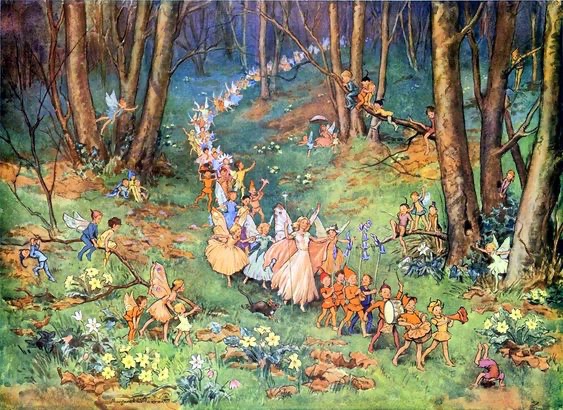
A Fairy Path or Fairy Road is the route by which the fairies regularly travel between any two locations. These paths can be found in many places and are invisible to anyone without the Second Sight, unless they happen to catch the Fairy folk unaware. Fairy Paths are often said to stretch between known fairy hills or locations but may also be found in more obscure locations.

It is considered very bad luck to build on a fairy path and those who do so always suffer for it one way or another. In the most benign cases the building will suffer from disturbances, often at night, as the fairies pass through the building following their accustomed route. As one source says:

When the house happens to have been built in a fairy track, the doors on the front and back, or the windows if they are in the line of the track, cannot be kept closed at night, for the fairies must march through.

In other instances attempts at building would be destroyed as soon as they were begun by being knocked down and a noted method of testing for a fairy path by those who “could not see them was to put up posts where the building was meant to go and see if they remained standing the next day. In extreme cases the person attempting to build might be killed or suffer extreme misfortune.

The Welsh Tylwyth Teg (“Fair Family”) have fairy paths as the Irish and Scottish fairies do, although their reputation is more dangerous. As one anecdotal source says:

“…the Tylwyth Teg have paths (precisely like those reserved for the Irish good people or for the Breton dead), and that it is death to a mortal while walking in one of these paths to meet the Tylwyth Teg.”

The fairies were known to move their homes at certain times of year, notably on the quarter days, and when they did so they would travel along these fairy paths to get from one hill to another. At any time of year, however, a Fairy Path could be perilous.

The Dagda

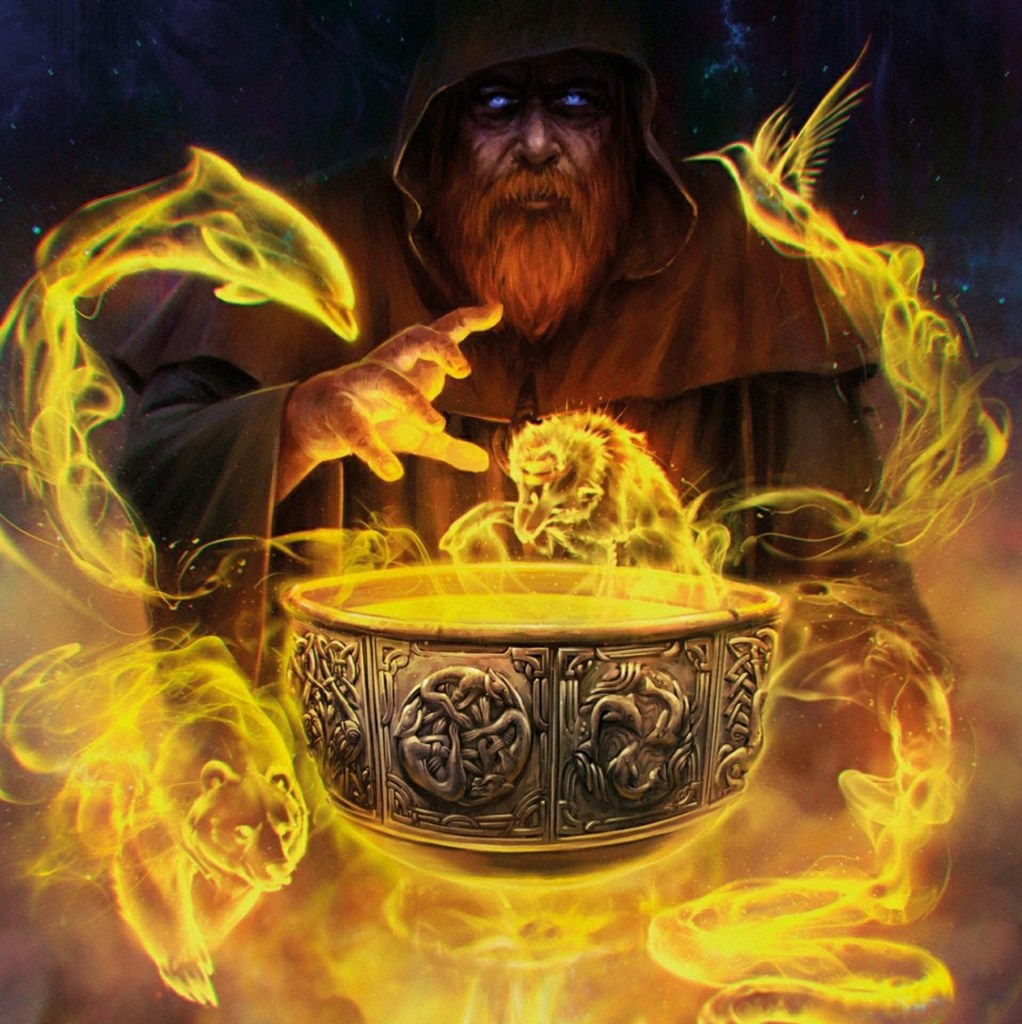
The Dagda was chief of the Tuatha dé Danann, the foremost of the Irish ancestral gods or faeries. Highly skilled and wise beyond measure, he was not only the god of life and death, but of seasons, agriculture, fertility, magic, and druidry as well. He wielded three sacred treasures: a cauldron of plenty, a club of life and death, and a harp that controlled men and seasons alike.

His children were plentiful, as were his lovers. His dwelling place was Brú na Bóinne.

The Dagda often carried three sacred relics with him that defined several of his many talents:

The coire ansic, a cauldron that could produce a bountiful feast; one could never be found wanting in the company of the Dagda. This particular relic was one of the Four Treasures of the Tuatha dé Danann, which were crafted in Murias.

The lorg mór, a mighty club (or staff) that possessed two distinct powers; its head had the power to slay nine men in a single swing while its handle could revive the slain with but a touch.

The uaithne, an ornate harp carved of oak. This harp could place the seasons in the proper order and command the wills and emotions of men. With these potent abilities, the Dagda was often seen as a god of order putting everything in its place, every time in its season, and every man to their rightful action.

In additions to these items, the Dagda owned two pigs—one always growing, the other always roasting—and an orchard that bore perennial sweet fruit.

The Dagda’s primary dwelling was at Brú na Bóinne, a series of Neolithic mounds on the banks of the River Boyne in County Meath. These ancient mounds were constructed around 3200 BCE, and as such are older than famous landmarks such as Stonehenge and the Great Pyramids. A mound called Newgrange aligned with the rising sun during winter solstice, representing the Dagda’s significance as lord of seasons and his mastery over day and night.

The Lebor Gabála Érenn laid out the coming of the Tuatha dé Danann, the fifth group of settlers to arrive in mythical Ireland. This group hailed from four cities north of the Emerald Isle, where they had learned the arts and sciences of their time, including magic. At this time, the Dagda was their chief. Though he did not hold the title of king, he was consulted and respected by many as if he was one.

The Dagda was also compared to the Germanic Odin and the Roman Dis Pater, as they bore certain similarities to him.


Days of the Week & Phases of the Moon for Botanical Magic

Days of the Week & Phases of the Moon for Magic

Here are the best days of the week to perform each type of magic:

Sunday—personal empowerment, success, generosity, luck

Monday—spirituality, virtue, emotional security and well-being

Tuesday—drive, confidence, ambition, victory, vitality

Wednesday—knowledge, change, charm, communication

Thursday—luck, power, protected growth, accomplishment, money, honor

Friday—beauty, grace, the arts, love, fertility, bonding, sex appeal

Saturday—the law, loss, endings, transforming, banishings, interrupting”

To give your magic a boost, try timing it with the phase of the moon. For things that won’t wait, go with the day of the week that works best:

Waxing moon—growing toward full. Do magic for increase, prosperity, health, wellness, love.

Full moon—alignment of moon, earth, and sun (sometime resulting in an eclipse), all purpose, use the extra boost for the metaphysical heavy lifting, court cases, protection.

Waning moon—shrinking toward the new moon. Practice magic of decrease; bringing things to a close; removing bad habits, negative people, debt, illness.

New moon—first light. New growth, beginning projects, set ideas in motion. Set goals for the month.

Dark moon—the absence of light. Do magic surrounding intuition, turning inward, cleansing, banishing or binding both people and addictions.

Blue moon—the second full moon in a calendar month. Do magic for wishes.

Black moon—the second new moon in a calendar month. Do magic for serious binding, banishing, stalkers, serious illness, addiction. Heavy lifting.

Moon Phases:

You may have seen a triple moon symbol; it looks like this )0(. It’s not just a clever design; this is the waxing, full, and waning moon depicted. So, if you look up into the sky and the moon is pointing to the left, it is waxing. If it is pointing to the right, it is waning.

Sources: Blackthorn’s Botanical Magic, The Homemade Apothecary


Cleansing Smoke

Regular use of cleansing smoke with a variety of materials is beneficial to an energetically healthy home. Too many folks rely solely on one cleaning method and one protection method. For example, many people enjoy the way white sage (Salvia apiana) smells, and though it is a good ally for clearing and cleansing space, it should not be your only ally.

Smoke Tools Hierarchy:

  • The weakest of the smoke tools is floral smoke. Lavender buds, for example, are very pleasant smelling. Flowers are well suited to brightening a space.
  • Leaves are slightly stronger and are good for refreshing the energy of a space. White sage is a common example. Since white sage (Salvia apiana) is largely wildcrafted (harvested in the wild) and used by native peoples, the increasing use of herbal cleansing smoke has led to skyrocketing prices and difficulty in sourcing the materials for the native peoples to whom white sage is sacred. The Salvia genus has many allies that can be farmed and don’t infringe on the beliefs and practices of First Nations and Native American people. 
  • The roots of a plant are stronger magically than its leaves. Roots will remove energies and entities that were not bothered by leaf smoke. Consider the strength of plant allies like ginger root, calamus root, and galangal root (Low John).
  • Even stronger than the root allies are wood allies. Palo santo is a popular wood-based smoke tool. This tree, native to Peru and the Yucatán Peninsula, has become increasingly popular in the last few years. Because of the popularity of this wood, the trees that take decades to reach maturity are over-harvested.
  • The strongest smoke tool of the plant ally families is the resin group. Tree resins are hardened sap structures like dragon’s blood (Dracaena draco), frankincense (Boswellia carteri), copal (Protium copal), and myrrh (Commiphora myrrha). If there is a problem that has not been affected by the lower energy signatures of the plant allies, a resin should do the trick.
    • Dragon’s Blood: This popular incense resin, resembling red chalk, commonly comes from two species, Dracaena draco and Dracaena cinnabari. Though there are more than the two varieties of Dracaena that produce this fragrant resin, many assume that all dragon’s blood is Dracaena draco. Both produce a similarly colored sap, with musky, warm notes with a hint of floral, though D. cinnabari has a touch more of the floral note than its cousin D. draco. D. cinnabari is the slower growing of the two varieties, though both trees take over ten years to produce their signature red sap. Due to over-harvesting and habitat loss, both species of Dracaena are on the threatened list.
    • Note: While no essential oil of dragon’s blood exists at this time, high-quality dragon’s blood oils can be sourced.

Sources: Blackthorn’s Botanical Magic, The Homemade Apothecary

Aches & Bruises Balm

Aches & Bruises Balm

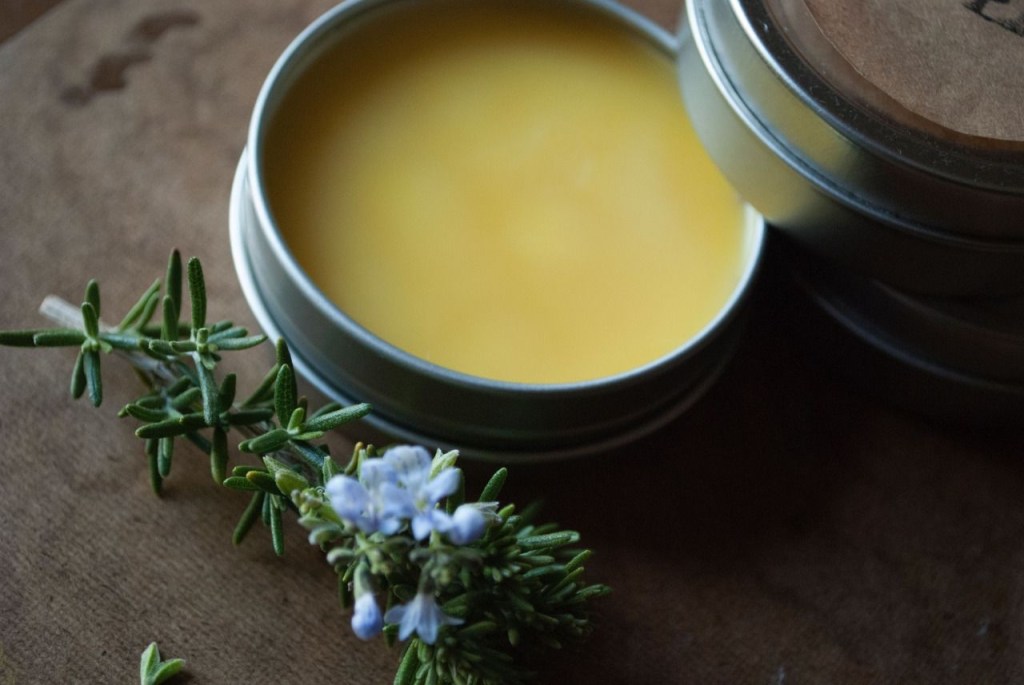
A healing balm for aches, sprains and bruises.

3 tablespoons beeswax

5 fluid ounces comfrey-infused oil

5 fluid ounces elder leaf-infused oil

20 drops of wintergreen essential oil

10 drops of marjoram essential oil

10 drops of lavender essential oil

Melt the beeswax in a bain-marie, then add the infused oils and mix well until fully combined. Remove from the heat and leave to cool for 5 minutes, then add the essential oils and stir well. Pour into jars, seal, label and date.

To use, massage into the affected area up to three times a day for a maximum of 2 months at a time.

Shelf Life: Up to 1 year in a cool, dark place.

Herbal Muscle Bath Salt

Herbal Muscle Bath Salt

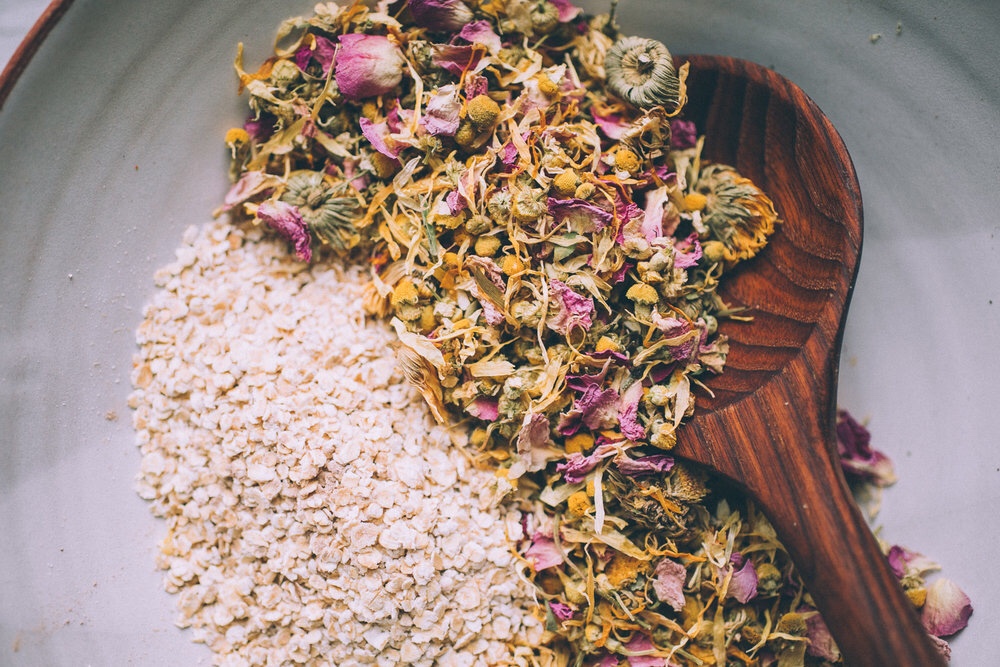
The salt and herbs in this bath salt work together to relax tired muscles, improve circulation and ease aches and pains.

4 ounces of salts of your choice, e.g. Epsom salts, Dead Sea salts, pink Himalayan salt

2 teaspoons chopped fresh or dried pine needles

2 teaspoons chopped fresh or dried eucalyptus leaf

2 teaspoons fresh or dried lavender flower heads

2 teaspoons dried daisy heads

10 drops of essential oil of your choice, e.g. rosemary, lavender, mint, eucalyptus

Put the salts and herbs into a blender and pulverize them together. This allows the cell walls of the herbs to be broken down so medicinal properties can be extracted into the bath water. Transfer the mixture to a glass or ceramic bowl, add the essential oil and mix well.

To use, add the mixture to a square of muslin cloth. Tie into a bundle at the top with string and then tie this to your hot water bath tap, allowing it to sit just below the tap. Run the hot water directly over and through the bundle, allowing the salt to dissolve and the herbs to be retained inside the muslin (so preventing drain blockage).

Add cold water to the bath to the desired temperature. Soak and relax in the bath for at least 30 minutes.

Tip: This mix can be made in bulk (with dried herbs) and stored in a sealed jar in a cool, dark place for up to 1 year.

Immune System Tonic Tincture

Immune System Tonic Tincture

Echinacea and elderberry are two herbs used to boost the immune system for prevention and treatment of infection. Combine the health-enhancing effects of mushrooms and anti-microbial properties of eucalyptus and you have an all-round infection-busting tonic.

7 ounces fresh elderberries (or 3.5 ounces dried)

2 ounces dried echinacea root

10 eucalyptus leaves, shredded

5 ounces fresh shiitake mushrooms, chopped

Vodka

Place all the ingredients, except the vodka, loosely in a large, sterilised preserving jar to about two-thirds full. Fill the jar with vodka. Seal the jar, then store in a cool, dark place, shaking the jar every couple of days for a month.

Strain, discarding the plant material and keeping the liquid. Pour the liquid into a sterilised bottle, seal, label and date.

Take 1 teaspoon in a little water, up to three times a day, as needed.

Shelf Life Up to 2 years in a cool, dark place.

Icelandic Elf School (Reykjavík, Iceland)

Icelandic Elf School (Reykjavík, Iceland)

When Icelandic member of parliament Árni Johnsen escaped unharmed from a car crash in 2010, he knew whom to credit for his survival: elves. After rolling five times, the politician’s SUV came to rest beside a 30-ton boulder. Johnsen, believing that multiple generations of elves called that boulder home, concluded that they used their magic to save him. When roadwork later required the removal of the boulder, he claimed it for himself, transporting it to his home to ensure the elves would continue to watch over him.

Johnsen’s beliefs are not unusual. According to Icelandic folklore, thousands of elves, fairies, dwarves, and gnomes—collectively known as “hidden people”—live in rocks and trees throughout the country. It is no wonder, then, that the world’s only elf school is located in Reykjavík.

Historian Magnús Skarphéðinsson, who has spent decades documenting people’s encounters with elves, established the school in 1991. Classes focus on the distinguishing characteristics of Iceland’s 13 varieties of hidden people. The school also offers five-hour classes for travelers, which include a tour of Reykjavík’s elf habitats. Students receive a diploma in “hidden people research.”

Skarphéðinsson has never seen an elf. His knowledge of their appearance and behavior comes from the hundreds of testimonies he has collected from people who claim to have made contact with hidden people.

Though Skarphéðinsson has devoted 30 years to the subject and considers himself the foremost authority on elves, he maintains a sense of humor about it all. At the end of class, he serves homemade coffee and pancakes and tells stories about the people who come up to him to say, “I swear I’m not on drugs, but I saw the strangest thing . . .”

Source: Atlas Obscura