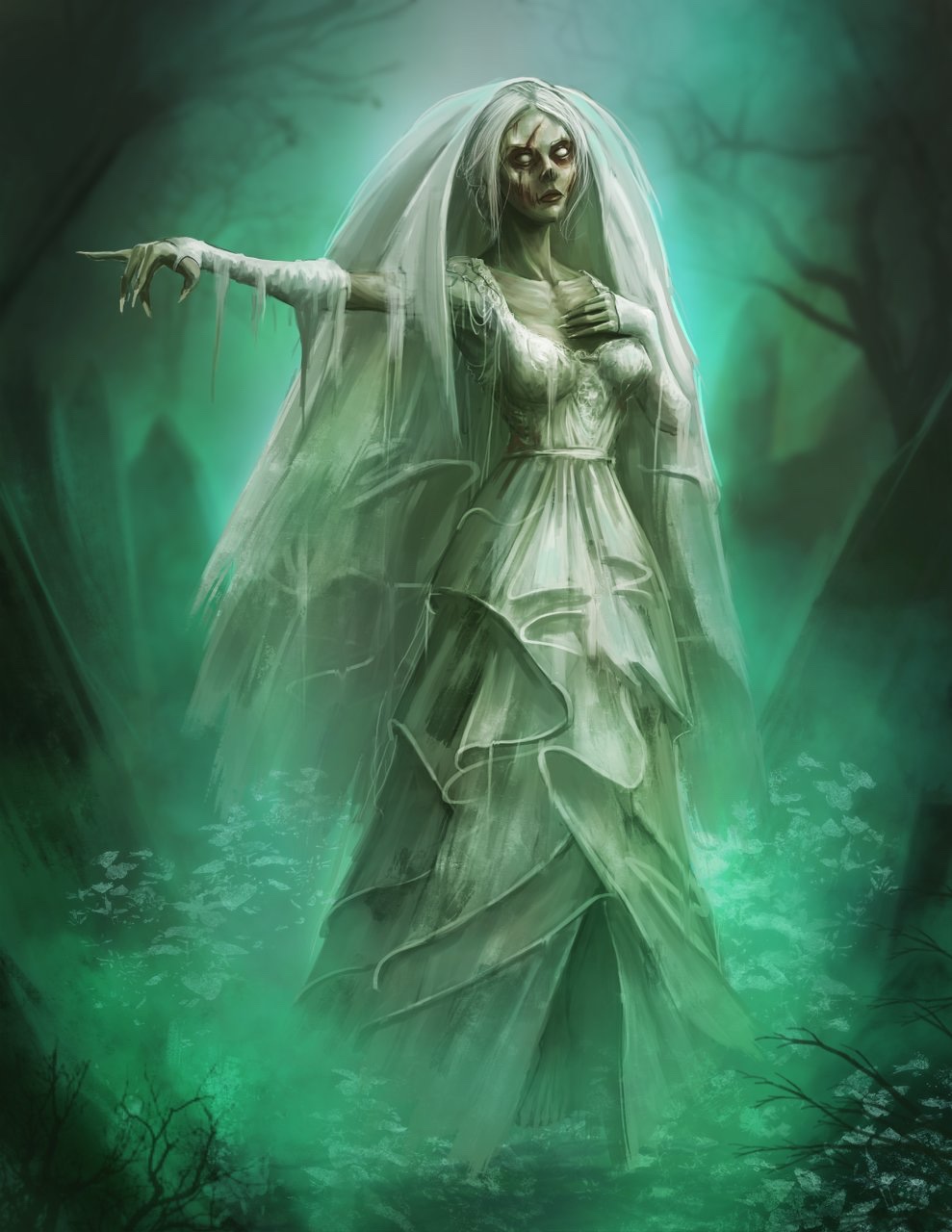
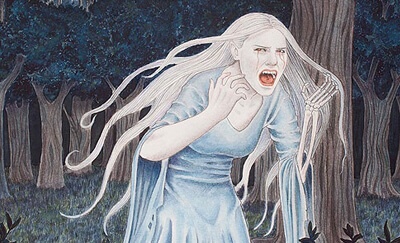
Banshee – actually should be spelled Bean Sidhe. She’s an Irish death spirit. Their keening fortells a death. They have very long, flowing hair and wear green dresses with grey cloaks. Their eyes are bright red because of their continuous weeping; or Benshee – an Irish faery attached to a house. Common name for the Irish Bean Sidhe. In Scotland the banshee is known as caoineag (wailing woman) also Bean-Nighe and, although seldom seen, she often heard in the hills and glens, by lakes or running water.
Bean Sidhe – In Irish folklore, the Bean Sidhe (woman of the hills) is a spirit or fairy who presage a death by wailing. She is popularly known as the Banshee. She visits a household and by wailing she warns them that a member of their family is about to die. When a Banshee is caught, she is obliged to tell the name of the doomed. The antiquity of this concept is vouched for by the fact that the Morrigan, in a poem from the 8th century, is described as washing spoils and entrails. It was believed in County Clare that Richard the Clare, the Norman leader of the 12th century, had met a horrible beldame, washing armor and rich robes “until the red gore churned in her hands”, who warned him of the destruction of his host. The Bean Sidhe has long streaming hair and is dressed in a gray cloak over a green dress. Her eyes are fiery red from the constant weeping. When multiple Banshees wail together, it will herald the death of someone very great or holy. The Scottish version of the Banshee is the Bean Nighe. Aiobhill is the banshee of the Dalcassians of North Munster, and Cliodna is the banshee of the MacCarthys and other families of South Munster.
Bean-Nighe – pronounced “ben-neeyah”; type of Banshee around streams in Scotland and Ireland. She washed bloodstained clothing of people who will soon die. They are rumored to be the ghosts of women who died in childbirth and will continue to wash until the day they should have died. The Washer at the Ford.
In March 1662, John and Bethia Kelly grieved over the body of their 8-year-old daughter inside their home. Little Elizabeth had been fine just days before when she returned home with a neighbor, Goodwife Ayres. The distraught parents, grasping at any explanation for their loss, saw the hand of the devil at work.
The parents were convinced that Elizabeth had been fatally possessed by Goody Ayres. The Kellys testified that their daughter first took ill the night after she returned home with her neighbor, and that she exclaimed, “Father! Father! Help me, help me! Goodwife Ayres is upon me. She chokes me. She kneels on my belly. She will break my bowels. She pinches me. She will make me black and blue.”
After Elizabeth’s death, accusations of bewitchment flew, and fingers were pointed at numerous townspeople. Hysteria gripped Hartford, a town that a generation before had witnessed the first execution of a suspected witch in the American colonies. Alse Young of Windsor, Connecticut, was sent to the gallows erected in Hartford’s Meeting House Square on May 26, 1647.
Witchcraft was one of 12 capital crimes decreed by Connecticut’s colonial government in 1642. The legal precedent cited by the devoutly Puritan colonists was of a divinely higher order: biblical passages such as Exodus 22:18 (“Thou shalt not suffer a witch to live”) and Leviticus 20:27 (“A man also or woman that hath a familiar spirit, or that is a wizard, shall surely be put to death”).
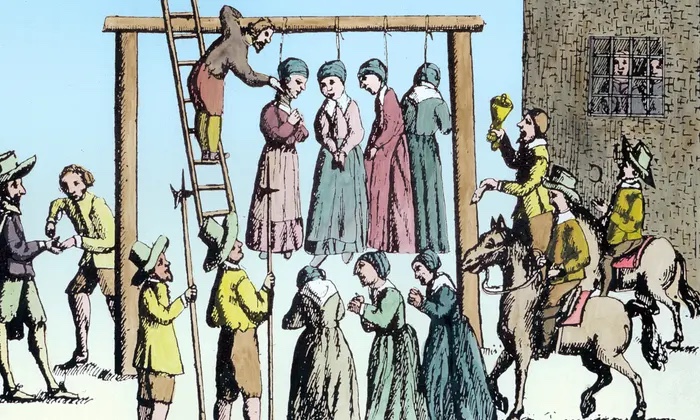
After Young’s public hanging, at least five other Connecticut residents met a similar fate. However, it was in Hartford in 1662, 30 years before the infamous Salem witch trials, that a witch hunt hysteria took hold, resulting in seven trials and four executions.
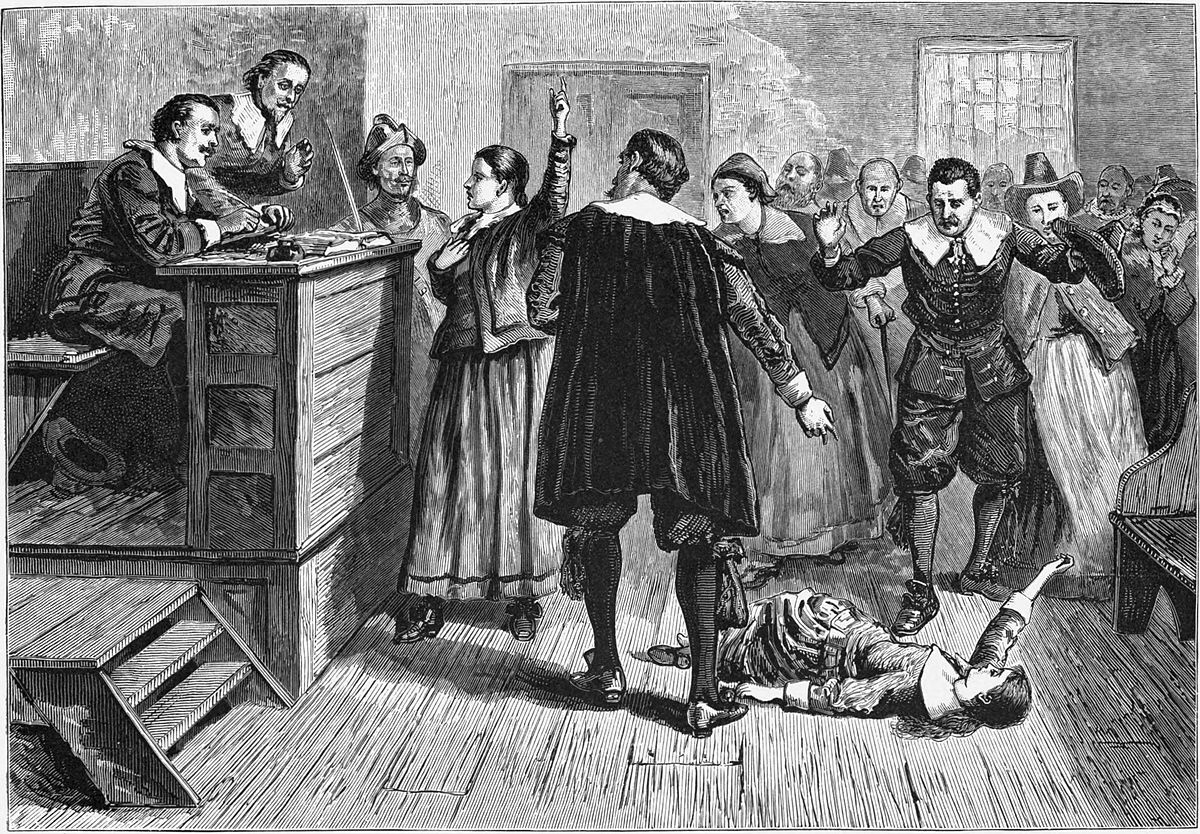
Shortly after Elizabeth Kelly’s death, the pious Ann Cole suddenly became “afflicted,” shaking violently and spouting blasphemy. According to one account, Cole was “taken with strange fits, wherein she held a discourse for a considerable time.” Cole blamed her bewitchment on neighbor Rebecca Greensmith, described by one townsperson as “a lewd, ignorant, considerably aged woman,” and others already suspected of witchcraft in the Kelly case. The accused began to accuse others, and even their spouses, of being the true witches. In what became a vicious circle, neighbors began testifying against neighbors. Goody Ayres’ husband, perhaps in an attempt to save his wife, joined in the chorus of Greensmith’s accusers.
The most damning testimony supposedly came from Greensmith herself, who reportedly admitted to having “familiarity with the devil” and said that “at Christmas they would have a merry meeting” to form a covenant. Greensmith implicated her husband and said she had met in the woods with seven other witches, including Goody Ayres, Mary Sanford and Elizabeth Seager. Neighbors testified that they saw Seager dancing with other women in the woods and cooking mysterious concoctions in black kettles.
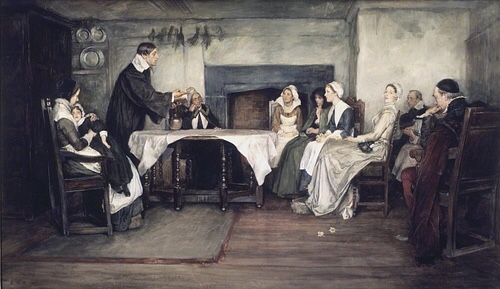
Two of the suspects, likely the Greensmiths, were subjected to the swimming test in which their hands and feet were bound and they were cast into the water to test the theory that witches are unable to sink. After they were tried, the Greensmiths were indicted “for not having the fear of God before thine eyes; thou hast entertained familiarity with Satan the grand enemy of God and mankind and by his help hast acted things in a preternatural way.” The court’s verdict: “According to the law of God and the established law of this commonwealth, thou deserves to die.”
Rebecca Greensmith had confessed in open court. Nathaniel Greensmith had protested his innocence. But they both met the same fate: the noose. Sanford was also sent to the gallows. After their executions, Cole reportedly was “restored to health.” Ayres fled Hartford, while Seager was finally convicted of witchcraft in 1665, although the governor reversed the verdict the following year. Mary Barnes of Farmington, Connecticut, was also swept up in the region’s witch hunt and executed alongside the Greensmiths.
The four executions of suspected witches in Hartford were to be Connecticut’s last. Another hysteria broke out in Fairfield, Connecticut, in 1692, but none of those convicted met death. Connecticut held its final witch trial in 1697, a half century after Alse Young’s execution. During that period, there were 46 prosecutions and at least 11 executions.
Aeval was a Celtic faerie queen of northern Munster. She was part of the Tuatha Dé Danann tribe and associated with the O’ Brien Clan. She Became the Banshee of the O’Brien Family and began her lament whenever one of the family members died. Her name means beautiful. She made Craig Liath her home which mean Gray Rock. She held a midnight court to determine if Husbands were satisfying their wives sexual needs. When found to be remiss the husband would to ordered to over come there prudishness and give their wives what they need.
Aeval had a lover once who was a servant of Murchadh named Dudhlaing Ua Artigan. Murchadh was the eldest son of Brian Boru. Aeval placed a druid mist around her lover to ensure that he would not go into battle in the Battle of Clontarf and be killed. Aeval went to Brian Boru’s tent to tell him that he would be victorious in battle but that he would loose his own life and the first son to visit him in his tent would become king. Brian sent for his eldest son Murcahd, but Murchadh decided to delay to change clothing. So instead his other son Donnchadh was the first to enter the tent. Murchadh went into battle with Dudhlaing, and they struck their enemies a mighty blow on either side. Murchadh said they he heard the sound of Dudhlaing’s blows but could not see him. It seems that Dudhlaing did not want to keep the magick mist about him when Muchadh could not see him, so he withdrew from the druid cloack. They went to the plain where Aeval was because they thought she could give them news of the battle. Aeval pleaded with the two men to stop and stay away from the battle. Murchadh refused and said that fear of his mortality would not keep him from going into battle, and that if he fell, he would bring the enemy down with him. She pleaded with Dudhlaing that if he stayed with her he would know 200 years of happiness to which he replied that he will not soil his good name for gold or silver. Aeval told the two men that they would fall in battle and that by tomorrow your blood will be spilt on the plains.
Aeval had a harp whose music was sweet and beautiful, but deadly to mortals. It is said that whoever heard the music of the harp would die shortly afterwards. The harp did not have to be strummed or plucked by her. It would play whatever it was told to play by her. The victims of her harp were usually young men. It is said that she gifted her harp to the son of Meardha when he was learning at the school of the Sidhe at Connacht. He learned that his father had been killed by the King of Lochlann. The son of Meardha went to where the three sons of the King of Lochlann were, and played his harp. The three sons died shortly afterward.
The Varacolaci vampire is from Romania. This is one of the most powerful of the undead creatures. It’s said that the Varacolaci has the ability to cause lunar and solar eclipses.
The Varacolaci, a vampire revenant in Romania, is said to be created when an unbaptized baby died or if a person committed suicide. But there are also some instances that being a varacolaci becomes inherited or passed down from generation to generation.
If a varacolaci was created after his death, the person who turned into a varacolaci would look exactly the same, though would tend to look pale and with dried out skin. The varacolaci hunts its prey all year round but it is particularly active during St. Andrew’s Day and St. George’s Day. This creature is also said to be one of the most dangerous types of vampire since it was considered as the strongest type of vampire in the folklore of Romania.
A varacolaci like any vampire drains the blood of its victim, but it does not leave any bite marks. It can shape shift into any animals, but it usually takes the form of a flea, cat, spider, frog and dog. It is also said to be responsible for causing lunar eclipse and solar eclipse by putting itself into a trance.
The varacolaci also has the ability of “midnight spinning”, a sort of astral projection that allows them to travel safely at night anywhere they wish to go. While they were on astral projection, the creature seems to look like a dragon or a creature with several mouths. However if one manages to find a varacolaci in this state, the creature would be unable to return to its body causing it to sleep forever and leaving its soul to wander around eternally.
Traditionally, those corpses that are suspected of becoming a varacolaci, can be prevented on rising from its grave by planting a thorny plant on its grave. If in an instance that a person dies by committing suicide the only way to prevent him from being a varacolaci is to throw his body into a river immediately.
An intricate ritual needs to be performed in order to completely vanquish the vampire being, first the vampire must rise from its grave and must be captured. In the case of a male varacolaci, their heart must be ripped off and cut in half. A nail must be punctured into its forehead and whole cloves of garlic must be placed inside its mouth. The corpse is then filled with a pig fat that comes from a pig that was slaughtered on St. Ignatius Day. A burial shroud is then dipped into a holy water and wrapped on the corpse. The body was then reburied into an isolated area far from the community. In the case of a female varacolaci an iron fork must be driven into its eyes and heart and the body was buried into a very deep grave.
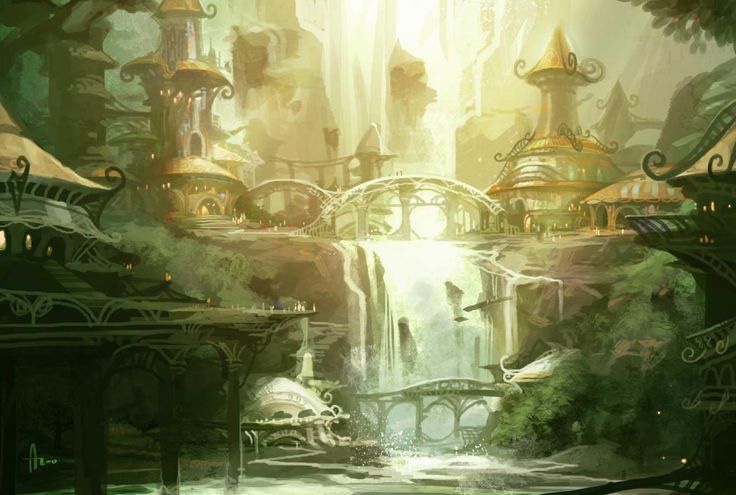
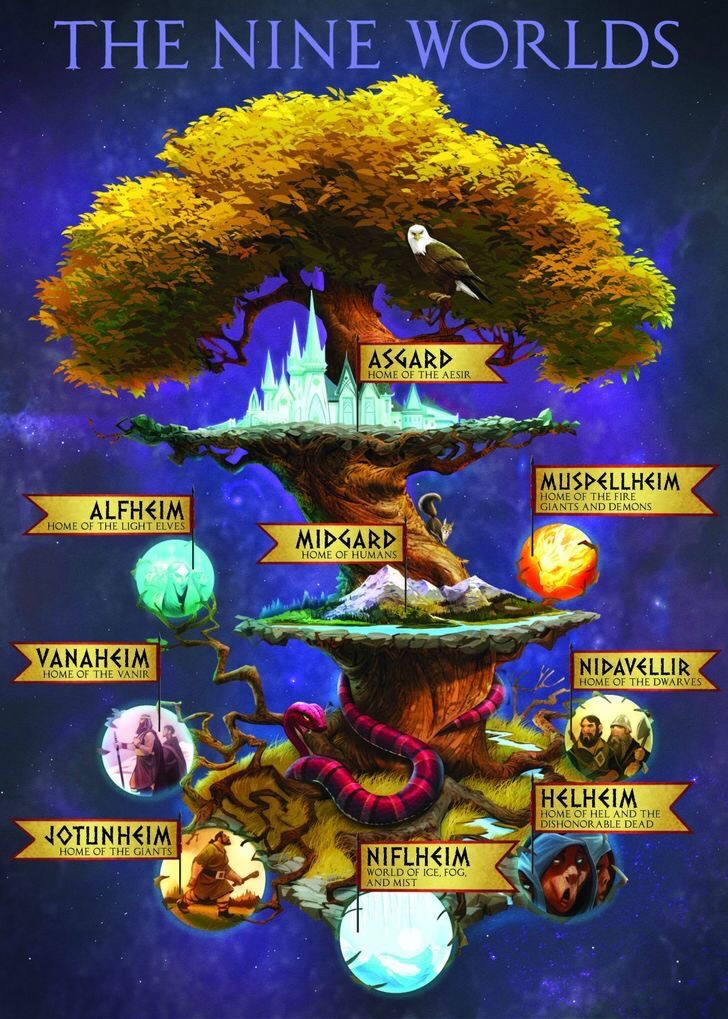
Vanaheim (Old Norse Vanaheimr, “Homeland of the Vanir“) is one of the Nine Worlds that are situated around the world-tree Yggdrasil. As the name implies, it’s the home of the Vanir tribe of deities, who tend to be somewhat more associated with fertility and what we today would call “nature” than the other tribe of Norse deities, the Aesir, who have their home in Asgard.
The surviving sources for our information on Norse mythology and religion, as fragmentary as they are, don’t contain any explicit mention of where exactly Vanaheim is located. The sole clue we have comes from the Lokasenna (“The Taunting of Loki“), one of the poems in the Poetic Edda, which states that the Vanir god Njord went eastward when he went to Asgard as a hostage at the conclusion of the Aesir-Vanir War. Presumably, then, Vanaheim lies somewhere to the west of Asgard.
Some scholars have gone so far as to claim that Vanaheim was invented by the thirteenth-century Icelandic Christian historian and poet Snorri Sturluson. However, there is one authentic and reliable Old Norse poem that mentions Vanaheim by name,so we can be reasonably certain that it was a genuine element of pre-Christian Norse religion.
It should come as no surprise, then, that the sources are completely silent as to what kind of world Vanaheim is. However, its name may contain an indication of the place’s character. One of the primary ways the pre-Christian Norse and other Germanic peoples classified geographical spaces (as well as psychological states) was with reference to their concept of the distinction between the innangard and utangard. That which is innangard (“inside the fence”) is orderly, law-abiding, and civilized, while that which is utangard (“beyond the fence”) is chaotic, anarchic, and wild. This psychogeography found its natural expression in agrarian land-use patterns, where the fence separated pastures and fields of crops from the wilderness beyond them. Of the Nine Worlds, two are innangard spaces: Asgard and Midgard, the world of human civilization. Both of these contain -gard in their names and are depicted as having a fence or fortification surrounding them. The rest of the Nine Worlds’ names end in -heim, and there’s no reference to their being enclosed in any way, which seems to indicate that they’re essentially utangard places. Such a designation is certainly in keeping with the way these places are described in Old Norse literature. Thus, we can infer that Vanaheim, like the Vanir themselves, is somewhat more wild or “natural,” and less “cultural,” than the world of the Vanir’s Aesir counterparts, or even that of humanity.
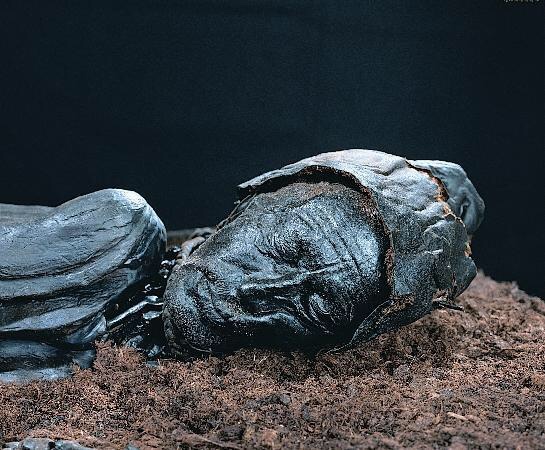
Walking around the Bjældskovdal bog in 1950, brothers Emil and Viggo Højgaard (along with Grethe, Viggo’s wife) stumbled upon a body. Believing the man to be the victim of a recent killing, they called the police. Further investigations revealed that he had indeed been murdered—some 2,300 years earlier.
The Tollund Man was found curled in the fetal position with his eyes closed and a serene expression frozen on his face. The cold, acidic, oxygen-starved conditions of the peat bog had kept him remarkably well preserved. His hair, beard stubble, eyelashes, and toenails were all intact, and he was nude, but for a sheepskin cap and wide belt around his waist. A rope was wound tightly around his neck. The Iron Age man had been hanged, likely during a ritual sacrifice.
In 1950, it was not yet known how best to preserve discoveries like Tollund Man. Accordingly, only the head of the original specimen was kept intact. The rest of the body was subjected to various tests to determine his probable age (probably around 40, due to the presence of wisdom teeth and wrinkles) and the conditions surrounding his life and death. Among the details found: Tollund Man was 5 feet 3 inches (1.6 m) tall, his final meal was a gruel made from barley and flaxseed, and his “sacrificers” (read: killers) took the time to close his mouth and eyes after death.
Thousands of “bog bodies” have been discovered in sphagnum swamps across Northern Europe, but the Tollund Man remains the best preserved. His original head and reconstructed body now reside at the Silkeborg Museum. The rope used to end his life is still wrapped around his throat.
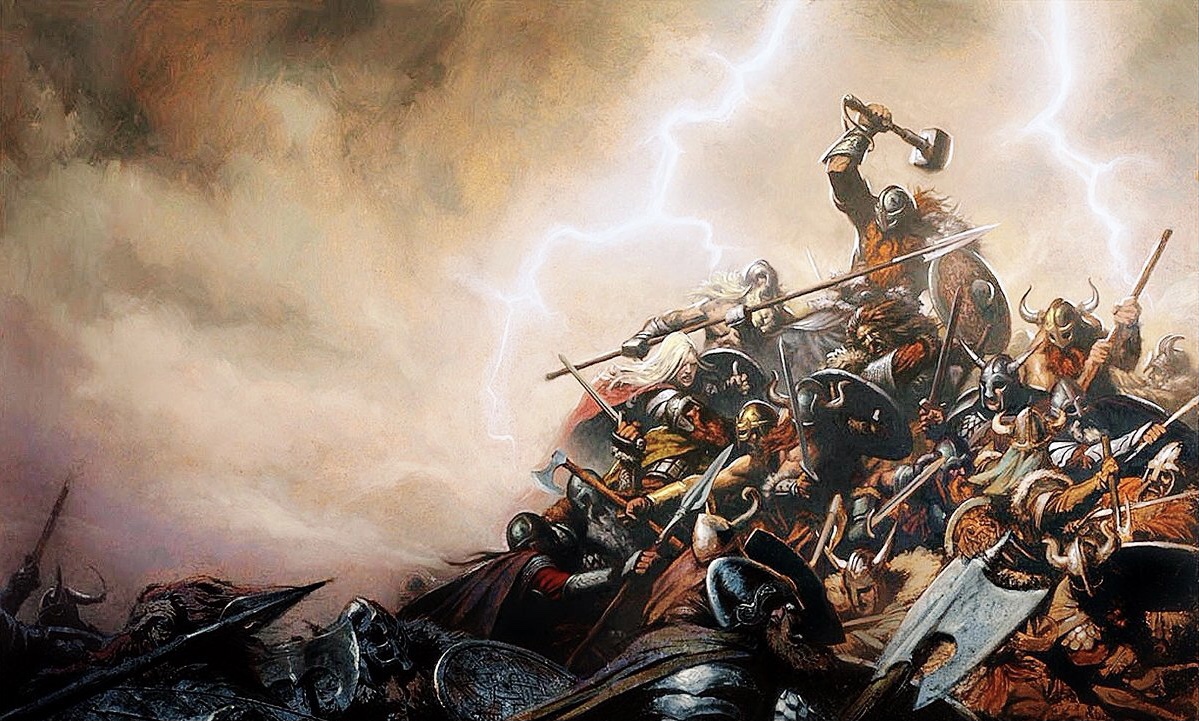
In Norse mythology, gods and goddesses usually belong to one of two tribes: the Aesir and the Vanir. Throughout most of the Norse tales, deities from the two tribes get along fairly easily, and it’s hard to pin down firm distinctions between the two groups. But there was a time when that wasn’t the case.
The Vanir goddess Freya was always the foremost practitioner of the art of seidr, the most terribly powerful kind of magic. Like historical seidr practitioners, she wandered from town to town plying her craft for hire.
Under the name Heiðr (“Bright”), she eventually came to Asgard, the home of the Aesir. The Aesir were quite taken by her powers and zealously sought her services. But soon they realized that their values of honor, kin loyalty, and obedience to the law were being pushed aside by the selfish desires they sought to fulfill with the witch’s magic. Blaming Freya for their own shortcomings, the Aesir called her “Gullveig” (“Gold-greed”) and attempted to murder her. Three times they tried to burn her, and three times she was reborn from the ashes.
Because of this, the Aesir and Vanir came to hate and fear one another, and these hostilities erupted into war. The Aesir fought by the rules of plain combat, with weapons and brute force, while the Vanir used the subtler means of magic. The war went on for some time, with both sides gaining the upper hand by turns.
Eventually the two tribes of divinities became weary of fighting and decided to call a truce. As was customary among the ancient Norse and other Germanic peoples, the two sides agreed to pay tribute to each other by sending hostages to live among the other tribe. Freya, Freyr, and Njord of the Vanir went to the Aesir, and Hoenir (pronounced roughly “HIGH-neer”) and Mimir went to the Vanir.
Njord and his children seem to have lived more or less in peace in Asgard. Unfortunately, the same can’t be said of Hoenir and Mimir in Vanaheim. The Vanir immediately saw that Hoenir was seemingly able to deliver incomparably wise advice on any problem, but they failed to notice that this was only when he had Mimir in his company. Hoenir was actually a rather slow-witted simpleton who was at a loss for words when Mimir wasn’t available to counsel him. After Hoenir responded to the Vanir’s entreaties with the unhelpful “Let others decide” one too many times, the Vanir thought they had been cheated in the hostage exchange. They beheaded Mimir and sent the severed head back to Asgard, where the distraught Odin chanted magic poems over the head and embalmed it in herbs. Thus preserved, Mimir’s head continued to give indispensable advice to Odin in times of need.
The two tribes were still weary of fighting a war that was so evenly-matched, however. Rather than renewing their hostilities over this tragic misunderstanding, each of the Aesir and Vanir came together and spat into a cauldron. From their saliva they created Kvasir, the wisest of all beings, as a way of pledging sustained harmony.
Sources: norse-mythology.org, Sons of Vikings, Children of Ash and Elm
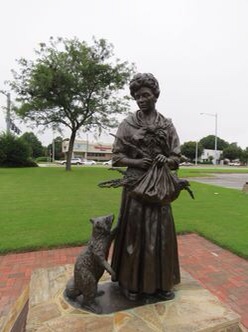
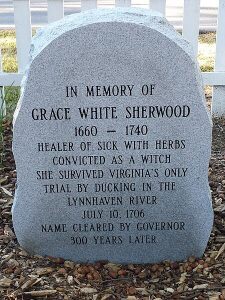
One of the most famous witches in Virginia’s history is Grace Sherwood, whose neighbors alleged she killed their pigs and hexed their cotton. A farmer, healer, and midwife, she was accused by her neighbors of transforming herself into a cat, damaging crops, and causing the death of livestock. She was charged with witchcraft several times. Sherwood was accused of bewitching her neighbor, Elizabeth Hill, causing Hill to miscarry. Other accusations followed and Sherwood was brought to trial in 1706.
The court decided to use a controversial water test to determine her guilt or innocence. Sherwood’s arms and legs were bound and she was thrown into a body of water. It was thought if she sank, she was innocent; if she floated, she was guilty. Sherwood didn’t sink and was convicted of being a witch. She wasn’t killed but put in prison and for eight years.
A satirical article (supposedly written by Benjamin Franklin) about a witch trial in New Jersey was published in 1730 in the Pennsylvania Gazette. It brought to light the ridiculousness of some witchcraft accusations. It wasn’t long before witch mania died down in the New World and laws were passed to help protect people from being wrongly accused and convicted.
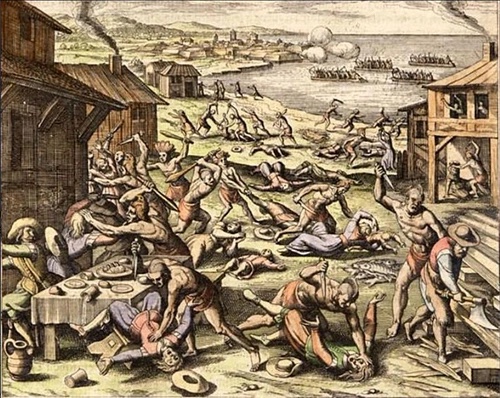
The power of the “Indian Curse” – whether in New England or in Virginia, as in the case of the equally famous Curse of Chief Cornstalk – was considered an irrefutable truth by the colonists because of their belief in the Native Americans as diabolical servants of Satan. This belief was strengthened early on by the Indian Massacre of 1622 in Virginia when, on the morning of 22 March 1622, the chief of the Powhatan Confederacy, Opchanacanough (l. 1554-1646) launched a surprise attack on the settlements, killing 347 people. Prior to the attack, the natives had appeared friendly (purposefully so, on Opchanacanough’s orders, to lower the colonists’ defenses), and this, to the colonists, was proof that no native could be trusted and all posed a potential threat.
The belief in natives wielding supernatural powers continued, however, as they became more marginalized, and it was understood that they had grounds for holding a grudge. Other minorities were equally apt to be suspect though, whether African slaves – who were thought to be able to cast spells through their own associations with Satan – or Catholics whose religious beliefs were considered diabolic by the majority of Protestants.
Witchcraft, thought to be practiced by all three of these groups, was understood as an intimate relationship between a person or people with Satan himself, God’s adversary, who continually plotted against those whom the Bible claimed God had made in his own image. Although the Salem Witch Trials are easily the most famous expression of the fear and hysteria generated by a belief in witchcraft, marginalized people – most often women – were charged, convicted, and hanged or otherwise dispatched in colonies from Massachusetts down to Florida.
Source: World History Encyclopedia Online, ancient.eu
Archaeologists have announced the discovery of a 3500 years old Ancient Egyptian city near Luxor in Egypt.
The Egyptian Expedition under Dr Zahi Hawass made the discovery whilst excavating an area between Rameses III’s temple at Medinet Habu, and Amenhotep III’s temple at Memnon in search of Tutankhamun’s Mortuary Temple.
The city dates from the period of Amenhotep III (also known as Amenhotep the Magnificent – the ninth pharaoh of the Eighteenth Dynasty) based on a large number of archaeological finds, such as rings, scarabs, coloured pottery vessels, and mud bricks bearing seals of King Amenhotep III’s cartouche.
Excavations which first started in September 2020 have revealed several streets flanked by houses that extend all the way to Deir el-Medina, the village of artisans who worked on the tombs in the Valley of the Kings. Many of the houses have relatively intact walls, whilst the interior contains everyday tools and domestic items.
Several districts have been identified, with a southern area being used for the storage and production of food items, a residential and administrative district, and an industrial district for the manufacturing of mud bricks and decorative jewelry.
One notable find is a storage vessel containing 10kg of dried meat that has the inscription: “Year 37, dressed meat for the third Heb Sed festival from the slaughterhouse of the stockyard of Kha made by the butcher luwy.”
Another discovery is a mud seal inscription that reads: “gm pa Aton” – meaning “the domain of the dazzling Aten”, the name of a temple built by King Akhenaten at Karnak.
Betsy Brian, Professor of Egyptology at John Hopkins University in Baltimore USA, said ‘The discovery of this lost city is the second most important archaeological discovery since the tomb of Tutankhamun”.
“The discovery of the Lost City not only gives us a rare glimpse into the life of the Ancient Egyptians at the time when the Empire was at his wealthiest, but it will help us shed light on one of history’s greatest mystery: why did Akhenaten & Nefertiti decide to move to Amarna,” Brian added.
Sources: Heritage Daily, Egyptian Ministry of Tourism and Antiquities











 Mark Bere Peterson’s Counterculture, Urban Legends, Paganism & Witchcraft