Norse Mythology and Days of the Week

Although worship of the Scandinavian gods for the most part ended a thousand years ago, and the myths are now exotic and foreign to most people in the English-speaking world, we make implicit reference to the gods and myths almost every day of our lives. That is because the names of the weekdays Tuesday, Wednesday, Thursday, and Friday all contain the names of old Scandinavian gods (Týr, Odin, Thor, and Frigg; the Old English forms were Tiw, Wodæn, Thunor, and Friija), and the choice of the gods for each of these days was based on myths about them.

Furthermore, when we read about or travel in places like Odense, Denmark (probably best known outside Denmark as the birthplace of Hans Christian Andersen), we see a place-name that once bore the name of the god Odin. There are hundreds of these in Scandinavia, but they are seldom obvious, except in Iceland, where there are places with names like Þórsmörk (Thor’s forest), a favorite place for hiking and camping. And if you are acquainted with or have heard of anyone called Freyja, Thor, Baldur (a not uncommon name in Iceland), or any Scandinavian name beginning with Tor, you know of the persistence of the names of the gods in personal naming systems.

Sources: Norse Mythology By John Lindow

Alfheim

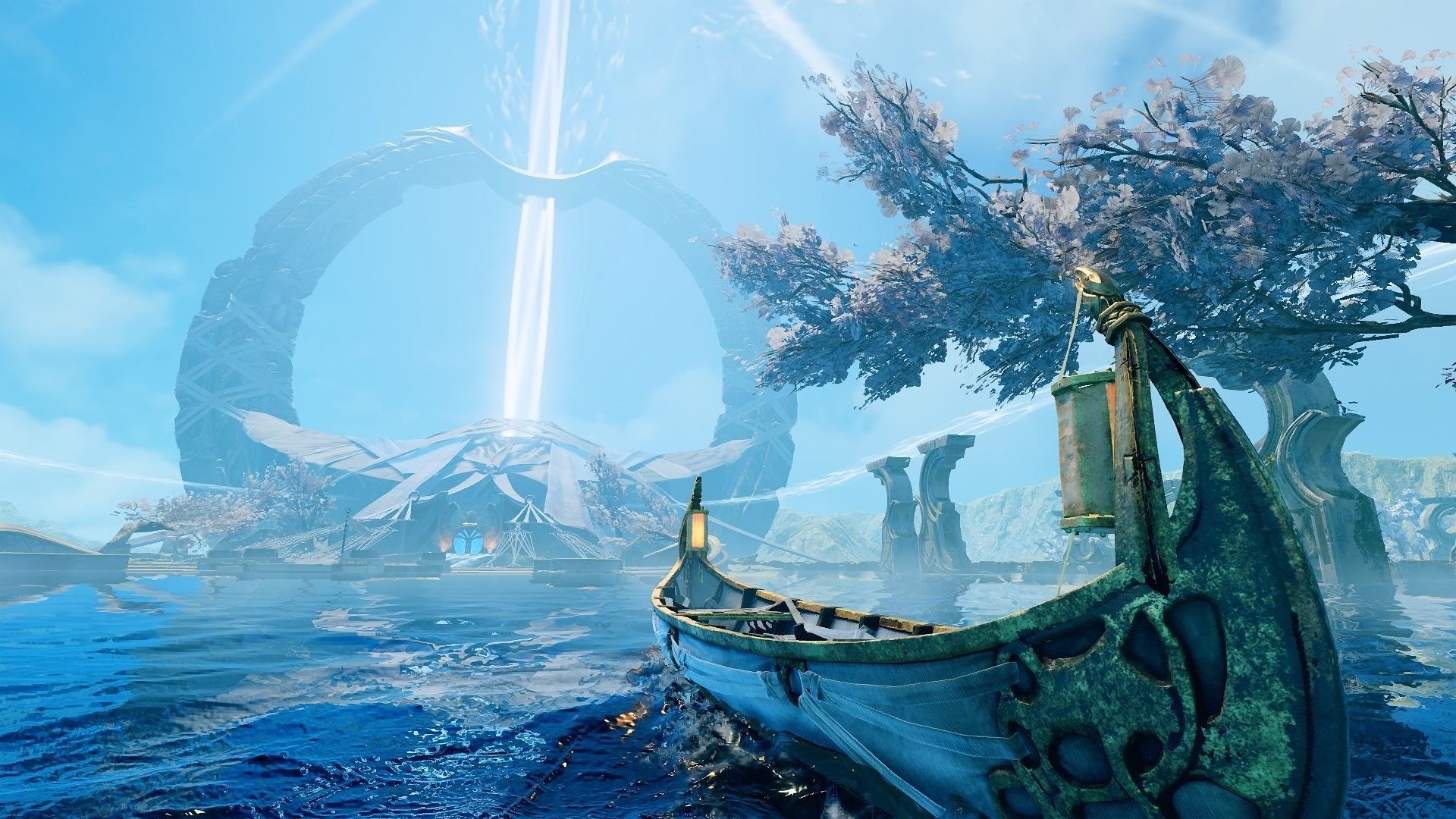
Alfheim (“elf home”), in Norse mythology, is one of the nine worlds. It is located on the highest level of the Norse universe. Also found on this level are the worlds of Asgard and Vanaheim. Alfheim is the palace of the god Freyr and the homeland of the elves of light. Neither the elves of light nor the elves of darkness, who live in Svartalfheim, participate in any of the events described in the Norse myths. Elves do, however, have active roles in the literature of quite a few of the other branches of Indo-European mythology.

Alfheim is never described in the sources that form the basis of our current knowledge of heathen Germanic religion, but is rather merely mentioned in passing in a few places. However, the elves are described as being luminous and “more beautiful than the sun,” so we may suppose that their homeland was a gracious realm of light and beauty. Although the realms that comprise the Nine Worlds of the Norse cosmology are never listed, it seems highly probable that, given the prominence of the elves in Germanic religion, Alfheim was one of them.

The Vanir god Freyr is said to be the ruler of Alfheim. Scholars have long puzzled over what to make of this, and no wholly satisfactory conclusions have been put forth. The relationship between the elves and the Vanir is highly ambiguous and involves considerable overlap between the two groups. Freyr’s position as lord of Alfheim, therefore, while hard to interpret with much precision, shouldn’t be entirely surprising.

Fenrir

Fenrir (or Fenris) is a gigantic and terrible monster in the shape of a wolf. He is the eldest child of Loki and the giantess Angrboda. The gods learned of a prophecy which stated that the wolf and his family would one day be responsible for the destruction of the world. They caught the wolf and locked him in a cage. Only the god of war, Tyr, dared to feed and take care of the wolf. When he was still a pup they had nothing to fear, but when the gods saw one day how he had grown, they decided to render him harmless. However, none of the gods had enough courage to face the gigantic wolf. Instead, they tried to trick him. They said the wolf was weak and could never break free when he was chained. Fenrir accepted the challenge and let the gods chain him. Unfortunately, he was so immensely strong that he managed to break the strongest fetters as if they were cobwebs.

After that, the gods saw only one alternative left: a magic chain. They ordered the dwarves to make something so strong that it could hold the wolf. The result was a soft, thin ribbon: Gleipnir. It was incredibly strong, despite what its size and appearance might suggest. The ribbon was fashioned of six strange elements: the footstep of a cat; the roots of a mountain; a woman’s beard; the breath of fishes; the sinews of a bear; and a bird’s spittle. The gods tried to trick the wolf again, only this time Fenrir was less eager to show his strength. He saw how thin the chain was, and said there was no pride in breaking such a weak chain. Eventually, though, he agreed, thinking that otherwise his strength and courage would be doubted. Suspecting treachery however, he in turn asked the gods for a token of good will: one of them had to put a hand between his jaws. The gods were not overly eager to do this, knowing what they could expect. Finally, only Tyr agreed, and the gods chained the wolf with Gleipnir. No matter how hard Fenrir struggled, he could not break free from this thin ribbon.

In revenge, he bit off Tyr’s hand.Being very pleased with themselves, the gods carried Fenrir off and chained him to a rock (called Gioll) a mile down into the earth. They put a sword between his jaws to prevent him from biting. On the day of Ragnarok, Fenrir will break his chains and join the giants in their battle against the gods. He will seek out Odin and devour him. Vidar, Odin’s son, will avenge his father by killing the wolf.

Ginnungagap

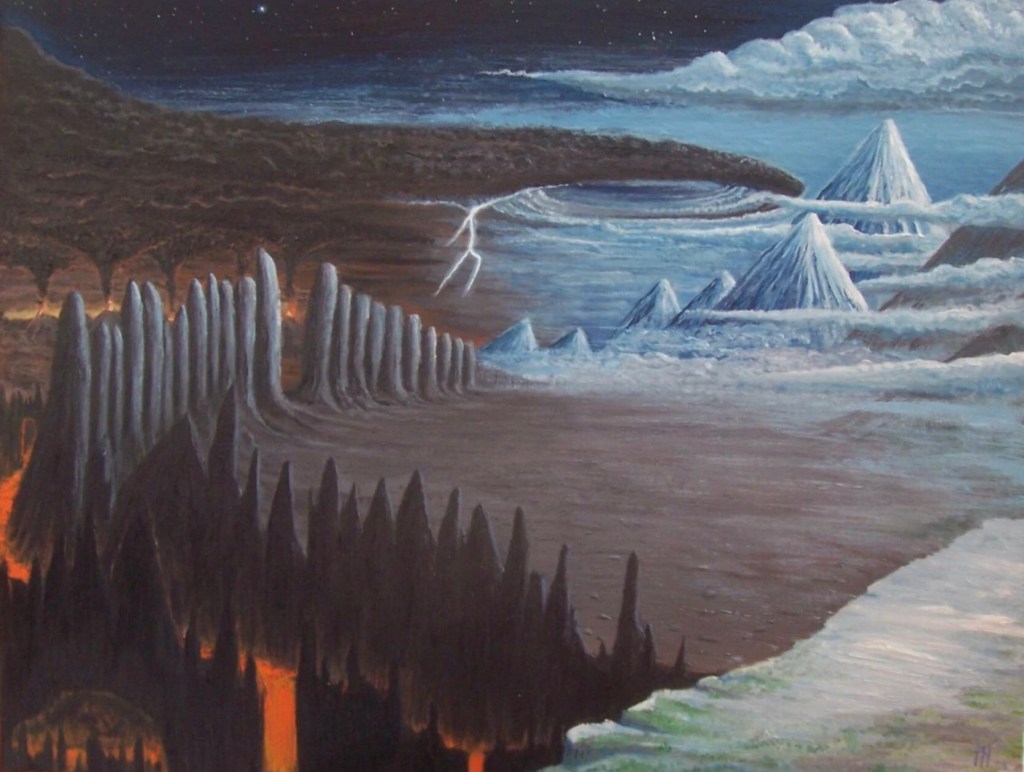
Ginnungagap (“seeming emptiness”), in the cosmology of Norse mythology, is the primordial void separating Niflheim and Muspell, the land of eternal ice and snow and the land of eternal heat and flame.In the beginning, before the world of men and gods existed, the spring Hvergelmir, deep in the frozen wastes of Niflheim, gave rise to eleven rivers known as the Elivagar. Over a long period of time, water of the Elivagar ran across Niflheim and poured into the northern part of Ginnungagap. The water froze, forming vast sheets of ice in the void. Hot air from Muspell melted some of the ice, creating a zone of meltwater amid the ice and snow. Here life began, and the first living thing was a frost giant.

The Younger Futhark

The runic alphabet that was used during the Viking Age is called Younger Futhark. These runes can be found on hundreds of runestones throughout Scandinavia. This alphabet does not consist of many runes, and that is because the Norse language evolved a lot during the Iron Age, which meant that the runic alphabet was reduced from 24 to 16 runes.

Each rune has its own name and sound. Some of the runes are used to spell the same letter, for instance, the Týr rune is used for the letters “t” and “d”, and kaun is used for “g” and “k”. 

The names on this list of the Younger Futhark runes have been taken from the website of The National Museum in Copenhagen. The names of the runes may vary slightly depending on the language and on which runologist has conducted the research.

Heka & Akhu: Ancient Egyptian Magic

Heka (magic) was already at the heart of Egyptian beliefs by 4000 BCE. Creator deities such as Nu (the watery abyss) were said to have used heka to bring the world into existence from primordial chaos. In doing so, they subdued the forces of chaos, but the forces constantly sought to return and could only be stopped by heka. For the ancient Egyptians, it was not just the gods that handled magic. Lesser supernatural beings, pharaohs, and the dead were thought to possess an element of heka, which they could channel through the use of spells to deflect the attention of malevolent spirits.

The ancient Egyptians also believed in another form of magic power called akhu, which was malign and closely associated with beings of the underworld. To protect against akhu magical practitioners such as priests, scribes in the “Houses of Life”—which held the manuscript collections of Egyptian temples—sunu (doctors), and sau (amulet-makers) employed heka spells, rituals, and magical objects. Indeed, faith in heka was so widespread that ancient Egyptians used it in all aspects of life from matters of state to the delivery of oracles and more mundane village affairs, such as love matches, protection during childbirth, and curing minor illnesses. As well as being an abstract force, there was a god called Heka who personified magic. Heka helped ensure the harmony of the cosmos and acted as a conduit through whom worshippers could seek divine favors. He had a female counterpart, Weret-hekau (Great of Magic), who was depicted in the form of a cobra. It is thought that the snake-headed staffs often used by ancient Egyptian magicians may have represented her.

Sources: A History of Magic, Witchcraft and the Occult

Fólkvangr

In Norse mythology, Fólkvangr (“field of the host” or “people-field” or “army-field”) is a meadow or field ruled over by the goddess Freyja where half of those that die in combat go upon death, whilst the other half go to the god Odin in Valhalla.

Others were also brought to Fólkvangr after their death; Egils Saga, for example, has a world-weary female character declare that she’ll never taste food again until she dines with Freya. Fólkvangr is attested in the Poetic Edda, compiled in the 13th century from earlier traditional sources, and the Prose Edda, written in the 13th century by Snorri Sturluson. According to the Prose Edda, within Fólkvangr is Freyja’s hall Sessrúmnir. Scholarly theories have been proposed about the implications of the location.

After each battle, Odin and Freyja would choose the einherjar who have proven themselves to be the most courageous fighters and divide them among themselves. The fallen Viking warriors will later be brought to either Folkvangr or Valhalla. The less fortunate ones, however, had no choice and would go to Hel. In the underworld, they would live eternally, but only merely continuing their ordinary lives on earth: eating, drinking, and sleeping.

There are not many differences when it comes to practicality and routine in these two dwelling places of the Gods. In fact, life in both of them equally would be an envy of any Viking warrior. In Folkvangr, as well as in Valhalla, warriors would fight amongst each other every day, making sure they will be prepared when the Ragnarok comes. Many of them would be injured, many of them slaughtered; however, in the evening, their wounds would heal, and they would be ready to feast.

Actually, the only real difference between Valhalla and Folkvangr lies in the way of entering them. Namely, those who die honorably are chosen between Odin and Freya to enter their respective realms. The ones chosen by Odin enter Valhalla, while those who are selected by Freya enter Folkvangr.

Hebrew Alphabet

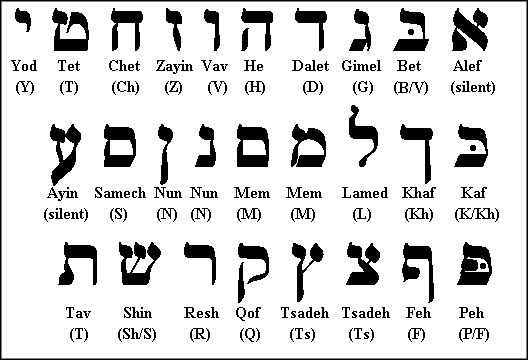
Hebrew uses a different alphabet than English. The picture above illustrates the Hebrew alphabet, in Hebrew alphabetical order. Note that Hebrew is written from right to left, rather than left to right as in English, so Alef is the first letter of the Hebrew alphabet and Tav is the last. The Hebrew alphabet is often called the “alef-bet,” because of its first two letters.

There are two versions of some letters. Kaf, Mem, Nun, Peh and Tzadeh all are written differently when they appear at the end of a word than when they appear in the beginning or middle of the word. The version used at the end of a word is referred to as Final Kaf, Final Mem, etc. The version of the letter on the left is the final version. In all cases except Final Mem, the final version has a long tail.

א Aleph

Aleph is one of two letters in the Hebrew alphabet that are silent. When pronounced, it takes the sound of whatever vowel its accompanied by. 

בּ Bet

Bet is pronounced “b”, just like the letter B in English. 

ב Vet

Vet is just bet without the dot inside, which is called a dagesh. Vet is pronounced “v” like the letter V in English.

ג Gimmel

Gimmel makes a hard G sound, as in “goat”. It may have a dagesh inside like this גּ but it makes the same sound with or without the dagesh.

ד Dalet

Dalet is pronounced “d”, like the letter D in English. It can also carry a dagesh, which doesn’t change its sound like this דּ.

ה Hay

Hay is pronounced “h” like the letter H in English. When it appears at the end of a word, it’s silent. It sometimes has a dot inside of it (הּ), called a mappiq instead of a dagesh that appears in other letters. It indicates that the hay should be pronounced as a consonant, even though it may appear in a place in a word where it would normally be silent.

ו Vav

Vav makes the “v” sound, exactly like the letter vet above. The thing that makes vav interesting is that it can also function as two different vowel sounds as well. When it appears as וֹ (called holem vav), it’s pronounced “oh”, like the sound at the end of “mow” and when you see וּ (called shurek), you’d pronounce it “ooo” like the sound at the end of “blue”.

ז Zayin

Zayin is pronounced “zzz” like the letter Z in English. It can carry a dagesh (זּ), which doesn’t change the pronunciation. 

ח Chet

Chet is one of the guttural letters in Hebrew and, as I said above, is pronounced in the back of your throat and sounds like the “ch” in the name “Bach”.

ט Tet

Tet is pronounced “t” like the letter T in English. It will sometimes appear with a dagesh (טּ), which doesn’t change its pronunciation. 

י Yod

The tiny letter yod sounds like the English letter “y”, as in “yellow”. Like others, it can carry a dagesh (יּ), which doesn’t change its pronunciation. 

כּ Kaf

Kaf is pronounced “k” like the English letter K. It’s always pronounced this way when the dot (dagesh) is present. Without the dagesh, it makes the sound of the next letter on this list, Chaf.

כ Chaf

The “ch” in the name of the letter chaf is pronounced as a guttural, similar to the “ch” in “Bach” like the letter chet above. It makes the same sound as chet also, the “ch” sound. When this letter has a dagesh, it makes the sound “k”, as described above. 

What’s unique about Chaf that I haven’t discussed yet is that it looks different when it appears at the end of a word. Five Hebrew letters do this and this end form of a letter is called the final (or sofit) form. When at the end of a word, chaf will look like this: ך.

ל Lamed

Lamed makes the same “l” sound as the letter L in English. Lamed may have a dagesh and look like this (לּ) but is pronounced the same. 

מ Mem

Mem is pronounced “mmm” like the letter M in English. When it appears with a dagesh (מּ), its sound is not changed. Mem also has a final form, ם, which is almost always found only when a mem is at the end of a word.

נ Nun

Nun (Pronounced both noon and nun), is pronounced “n” like the English letter N. It can have a dagesh, which would look like this (נּ) but the pronunciation remains the same. Nun has a final form for when it’s found at the end of a word, which looks like this: ן.

ס Samech

Samech is pronounced like the English letter S and is pronounced “s”. It can also have a dagesh (סּ) and is pronounced the same if it does.

ע Ayin

Like aleph, ayin is a silent letter. It only makes the sound of the vowel that accompanies it.

פּ Pey

Pey is pronounced “p” like the letter P in the English alphabet. If it has a dagesh, it’s pronounced “p” and if it doesn’t, it’s pronounced “f”, further explained below.

פ Fey

Fey is, like the English letter F, pronounced “f”. This is only when it doesn’t have a dagesh because if it does, it’s pronounced “p”. Fey also has a final form, ף, for when it appears at the end of a word.

צ Tsade

This letter’s name is pronounced tsa-dee, with the “ts” being a consonant blend sound like the sound at the end of the word “nuts”. This is also the way the letter is pronounced. It’s said the same when it contains a dagesh and has a final form (ץ) when it’s at the end of a word.

ק Qof

Qof makes the “q” sound like the English letter Q. It can also appear with a dagesh and it’s pronounced the same then.

ר Resh

Resh is pronounced “rrr” like the English letter R. It’s a guttural so it’s said from the back of your throat and is also rolled like a letter R in Spanish.

שׁ Shin 

Shin is pronounced “sh” like the commonly-used consonant blend in English. It sounds the same when it has a dagesh. Which side the dot on top is on indicates whether it’s pronounced “sh” or “s”.

שׂ Sin 

The name of this letter is pronounced sin or seen. It makes the same sound as the letter S in English, “sss”. This is the same sound as the letter samech and sin makes the same sound when it has a dagesh. Pay careful attention to which side the dot is on, as this is what differentiates between shin and sin. 

ת Tav

Tav, the last letter in the Hebrew alphabet, is pronounced “t” just like the English letter T. It sounds the same when it has a dagesh in it, like this: תּ.

Climate Dynamics and the Decline of Elephants and Their Precursors

Elephants and their forebears were pushed into wipeout by waves of extreme global environmental change, rather than overhunting by early humans, according to new research.

The study, published in Nature Ecology & Evolution, challenges claims that early human hunters slaughtered prehistoric elephants, mammoths and mastodonts to extinction over millennia. Instead, its findings indicate the extinction of the last mammoths and mastodonts at the end of the last Ice Age marked the end of progressive climate-driven global decline among elephants over millions of years.

Although elephants today are restricted to just three endangered species in the African and Asian tropics, these are survivors of a once far more diverse and widespread group of giant herbivores, known as the proboscideans, which also include the now completely extinct mastodonts, stegodonts and deinotheres. Only 700,000 years ago, England was home to three types of elephants: two giant species of mammoths and the equally prodigious straight-tusked elephant.

An international group of palaeontologists from the universities of Alcalá, Bristol, and Helsinki, piloted the most detailed analysis to date on the rise and fall of elephants and their predecessors, which examined how 185 different species adapted, spanning 60 million years of evolution that began in North Africa. To probe into this rich evolutionary history, the team surveyed museum fossil collections across the globe, from London’s Natural History Museum to Moscow’s Paleontological Institute. By investigating traits such as body size, skull shape and the chewing surface of their teeth, the team discovered that all proboscideans fell within one of eight sets of adaptive strategies.

“Remarkably for 30 million years, the entire first half of proboscidean evolution, only two of the eight groups evolved,” said Dr Zhang Hanwen, study coauthor and Honorary Research Associate at the University of Bristol’s School of Earth Sciences.

“Most proboscideans over this time were nondescript herbivores ranging from the size of a pug to that of a boar. A few species got as big as a hippo, yet these lineages were evolutionary dead-ends. They all bore little resemblance to elephants.”

The course of proboscidean evolution changed dramatically some 20 million years ago, as the Afro-Arabian plate collided into the Eurasian continent. Arabia provided crucial migration corridor for the diversifying mastodont-grade species to explore new habitats in Eurasia, and then into North America via the Bering Land Bridge.

“The immediate impact of proboscidean dispersals beyond Africa was quantified for the very first time in our study,” said lead author Dr Juan Cantalapiedra, Senior Research Fellow at the University of Alcalá in Spain.

“Those archaic North African species were slow-evolving with little diversification, yet we calculated that once out of Africa proboscideans evolved 25 times faster, giving rise to a myriad of disparate forms, whose specialisations permitted niche partition between several proboscidean species in the same habitats. One case in point being the massive, flattened lower tusks of the ‘shovel-tuskers’. Such coexistence of giant herbivores was unlike anything in today’s ecosystems.”

By 3 million years ago the elephants and stegodonts of Africa and eastern Asia seemingly emerged victorious in this unremitting evolutionary ratchet. However, environmental disruption connected to the coming Ice Ages hit them hard, with surviving species forced to adapt to the new, more austere habitats. The most extreme example was the woolly mammoth, with thick, shaggy hair and big tusks for retrieving vegetation covered under thick snow.

The team’s analyses identified final proboscidean extinction peaks starting at around 2.4 million years ago, 160,000 and 75,000 years ago for Africa, Eurasia and the Americas, respectively.

“It is important to note that these ages do not demarcate the precise timing of extinctions, but rather indicate the points in time at which proboscideans on the respective continents became subject to higher extinction risk,” said Dr Cantalapiedra.

Unexpectedly, the results do not correlate with the expansion of early humans and their enhanced capabilities to hunt down megaherbivores.

Sources: University of Bristol

The Djed

The djed is an ancient Egyptian symbol for stability which features prominently in Egyptian art and architecture throughout the country’s history. `Stability’ should be understood to mean not only a firm footing but immutability and permanance. The symbol is a column with a broad base which narrows as it rises to a capital and is crossed by four parallel lines. The column and the lines are sometimes brightly painted and other times monochrome. The djed first appears in the Predynastic Period in Egypt (c. 6000-3150 BCE) and continues through the Ptolemaic Dynasty (323-30 BCE), the last dynasty to rule Egypt before it became a province of the Roman Empire.

The djed is often overlooked in Egyptian art, and especially in architecture, simply because it is so ubiquitous; the djed is featured on pillars, tomb walls, architraves (the main beam which rests on pillars), palace walls, sheets of painted papyrus, and especially sarcophagi. Once one is aware of the djed and its importance to ancient Egyptian culture it is impossible to miss. It is a potent symbol associated with the god Osiris and his return from the dead. The symbol has been interpreted to represent different objects such as the god Osiris’ backbone, the tamarisk tree which enclosed the god, four pillars rising one behind another, and a fertility pole raised at festivals. `Stability’, however, seems to have been its prime meaning and the one which the ancient Egyptians attached the greatest importance to.

The precise origin of the djed is unknown but it was associated with the god Ptah, an early creator god in the Predynastic Period whose attributes were later assumed by the deities Atum and Osiris. According to historian Clare Gibson, the djed was an early phonogram which could also act as a pictogram or ideogram. A phonogram is a symbol representing a sound and a pictogram a symbol for a specific word or phrase while an ideogram is a symbol of a thing itself without reference to words or sounds (such as numerals where one recognizes the symbol 10 as representing a certain quantity). The djed symbolized the spoken word-concept for stability, was the written word for stability, and stood for the concept itself.

Sources: World History Encyclopedia