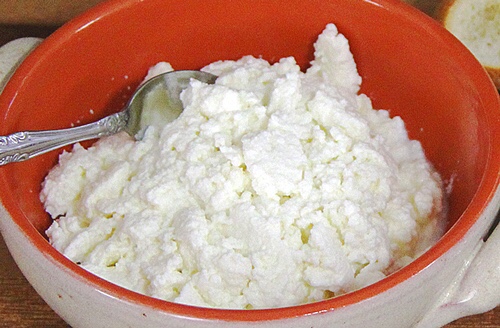
Ricotta Cheese

1 gallon whole milk, not ultra pasteurized
1 teaspoon citric acid dissolved in 1 cup cool, nonchlorinated water
1 teaspoon cheese salt dissolved in 1⁄2 cup cool, nonchlorinated water
1–2 tablespoons heavy cream

Pour in the milk, the citric acid and the salt solutions, and mix well without touching the bottom of a chilled pot.

Heat the milk to 185–195 degrees, do not boil. At 180 degrees stir occasionally to prevent a skim coat from forming on top of the milk.

When the curds and whey separate, turn off the heat. If the whey is still milky at 195 degrees, increase the heat another 10–20 degrees.  If the whey remains milky, add more citric acid solution a little at a time, stirring gently until you see a clear separation. Allow to set for 10 minutes.

Ladle the curds with a slotted spoon into a colander lined with butter muslin. Tie the corners of the muslin into a knot and hang the bag to drain at 72–86 degrees for 30 minutes, or until the cheese reaches your desired consistency.

Remove the cheese from the bag and place in a covered container. For a creamier consistency, add the cream at the end and mix thoroughly.

Store in the refrigerator for up to 2 weeks.

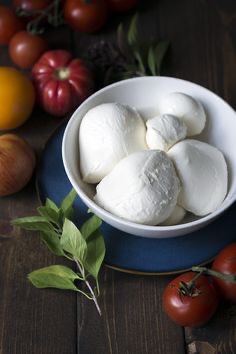
“Mary Karlin” Inspired Junket Mozzarella

1 gallon pasteurized but not homogenized whole cow’s milk
7 tablespoons distilled vinegar
4 tablets junket rennet dissolved in ½ cup cool nonchlorinated water
1½ teaspoons plus ¼ cup kosher salt or cheese salt

In a 6-quart stockpot, slowly heat the milk to 88°F over low heat; about 20 minutes. Stir in the vinegar using a whisk in an up-and-down motion to incorporate thoroughly. Add the dissolved rennet and gently whisk in for 1 minute.

Slowly raise the temperature to 90°F about 8 minutes. Remove from the heat, cover, and let rest, maintaining the temperature for 1 hour, until the curds form a solid mass of bonded small curds the consistency of soft tofu. Check for a clean break (see note), and if there isn’t a clean break, check again in 15 minutes.

Cut the curds into ½-inch pieces and let sit undisturbed for 10 minutes, maintaining them at 90°F. Over low heat, raise the temperature to 108°F over 15 minutes, gently stirring every 5 minutes or so and frequently checking the temperature and adjusting the heat as needed. Once 108°F is reached, remove from the heat and, using a rubber spatula, gently stir for about 10 minutes around the edges of the pot and under the curds to move them around and expel more whey.

Let the curds rest for another 15 minutes. At this point the curds will be slightly below the surface of the whey. Gently press one of the curds between two fingers. It should feel springy and stretchable; if it doesn’t, leave the curds for 10 minutes and then test again.

Line a colander with damp butter muslin, set it over another pot, and scoop the curds into it with a slotted spoon. Let drain for 15 minutes, or until the whey has stopped dripping and the curds are compacted together. Reserve the whey.

Add the 1½ teaspoons of salt to the whey and stir to dissolve. Slowly heat the whey over medium-low heat to 175°F to 180°F; this should take about 30 minutes.

Meanwhile, wrap the muslin over the curds and place the packet on a cutting board. Flatten the curds and allow to sit for 20 minutes. Open the muslin and cut the slab of curds into ½-inch strips or chunks.

Place a handful of curd chunks in a slotted spoon and, wearing heat-resistant gloves, dip the utensil into the hot whey for several seconds, melting the curds until stretchable. Using your fingers and working quickly, knead the melted curds in the utensil, dipping it back into the hot whey as needed to keep the curds pliable.

When the curds are kneaded into a firm ball, pull and stretch them into a small rope and fold them over onto themselves, repeating a few times until the ball of curds is smooth, pliable, and shiny. Don’t overwork the curds, or you’ll toughen the cheese. Shape the curds into a ball and place it in a bowl of ice water for 10 minutes to chill and firm up. Repeat.

Make a light brine by dissolving the ¼ cup of kosher salt in the hot whey, then chill.  Place the chilled cheese in the brine for 2 hours. Use immediately for best flavor, or store in the salted whey, covered and refrigerated, for up to 1 week.

Note: Using a sanitized long-blade curd cutting knife (or whatever you have on hand, perhaps a chef knife), make a short test cut at a 45-degree angle to observe the firmness of the curds. If the cut edge is clean the curds are ready to be cut into their proper size.

Easy Cream Cheese

2 Quarts  light cream
1⁄4 teaspoon calcium chloride diluted in 1⁄4 cup cool, nonchlorinated water
1 packet direct-set mesophilic starter culture
Cheese salt
Herbs

Heat the cream to 86 degrees. Add the calcium chloride solution and stir well to combine. Sprinkle the starter over the surface of the milk, wait 2 minutes for the powder to rehydrate, then stir.

Cover and let set at 86 degrees for 8–12 hours, until a solid curd forms.

Gently ladle the curds into a colander lined with butter muslin. Tie the ­corners of the muslin into a knot and hang the bag to drain at 72–86 degrees for 8–12 hours, or until the cheese reaches your desired consistency.

Place the cheese in a bowl and add the salt and herbs to taste, if using.

Pack the cheese into small molds and place in the refrigerator until firm, usually a few hours. Store in the refrigerator wrapped for up to 2 weeks.

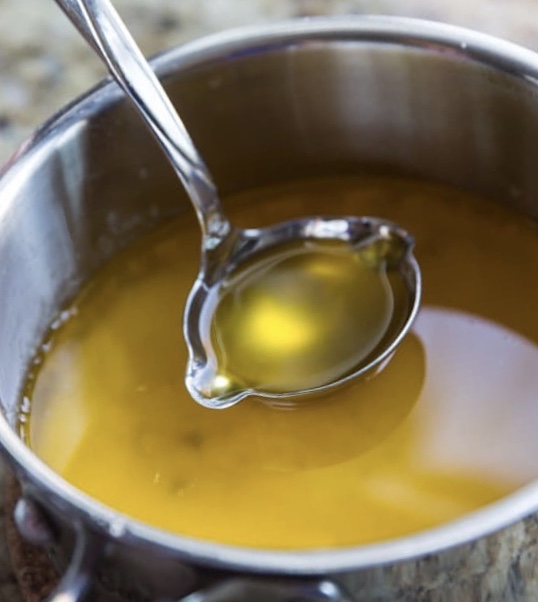
What is Clarified Butter?

Most simply clarified butter is butter with the milk-solid proteins taken out.  These proteins are what cause the butter to burn at low temperatures. If you’re sautéing with high heat or for prolonged periods and don’t want the butter to burn you’ll need to use clarified butter.  It’s truly a simple procedure.

To Clarify Butter:

Melt the butter in a heavy-bottom pot and let it sit for 15 minutes.

With a ladle, skim off the froth that has formed on top of the butter and discard.

Lift off the melted clear butterfat, the clarified butter, with a ladle, leaving the water contained in the butter, now useless, in the bottom of the pot.

Or Simpler yet:

Cook unsalted butter in a heavy-bottom saucepan over medium heat until it froths, and the froth begins to settle.

As the froth settles, you’ll see white specks in the butter.  When they turn to brown and adhere to the bottom and sides of the pan  strain the butter through a paper towel, coffee filter, or fine mesh strainer into a bowl.

Cheese Making 101

Cheese
I am an advocate of the growing community of cheese aficionados that believe for you to truly appreciate cheese you must have at minimum a cursory understanding of the cheese making process, it’s steps, and where what you are consuming comes from. The three main types of animals cheese comes from, and the only ones we will be concerned with here, are cows, sheep, and goats. After all cheese is simply concentrated milk with salt added so where do these three species milk vary and why do I have preferences for one over the other. Cows by far produce the most milk, but it is also the thinnest as opposed to Sheep’s milk which is the most concentrated – it has a higher percentage of fat solid, and thus flavor. Of course sheep produce far less of it. Cow’s milk has a fat content of 3.25 percent by weight, whereas sheep’s milk is 7.4 percent milk fat by weight. For some perspective as far as cow’s milk and milk fat: skimmed milk is 0 to 0.5 percent milk fat, low fat milk 1 percent, reduced fat milk 2 percent, whole milk 3.25 percent, half-and-half 10.5 to 18 percent, light whipping cream 30 to 36 percent, and heavy cream 36 to 40 percent milk fat. There is an old adage that goat’s milk is best for drinking, cow’s for making butter, but sheep’s is the best for cheese. Generally speaking it take 6 to 12 units (either pounds or kilograms) of milk to make a unit of cheese.

Raw Milk vs. Pasteurized vs. Ultra-Pasteurized
Raw milk is just that, milk which has not been processed in any manner. It possesses all of its natural bacteria and thus makes more flavorful cheese. Raw milk will separate and curdle if left at room temperature. In the United States it is advised that raw milk should either be pasteurized or used to make cheese aged over 60 days. In many states you are unable to obtain raw milk. It will spoil in about a week.

Pasteurized milk is the best option for most people in the United States that do not have access to raw milk. Pasteurization kills dangerous pathogens, but as a result also to a great extent destroys vitamins, beneficial bacteria, texture and flavor. It will curdle if left at room temperature. Homogenized milk has been processed to break up the fat globules and force them into suspension within the milk. In an effort to prevent the separation of the milk and the cream it changes the Molecular structure which prevents it from producing a culture at room temperature. Most milk available in the United States is both pasteurized and homogenized.

In the United States we also have ultra-pasteurized and ultra-high temperature (UHT) milk. These two groups are unable to produce cheese and should be avoided. Ultra-pasteurized milk is heated to 191 degrees and UHT to 280 degrees Fahrenheit. Unfortunately these processes are used on a lot of organic milks as they are more fragile and susceptible to slower retail sales.

Ripening the Milk
You can pick up most any professional cheese making book, or visit a website, and they will all basically show you the same eight steps in making cheese outlined by professor Kosikowski, the first of these is ripening the milk. This first step involves two interrelated functions acidification and coagulation. Starting with the freshest milk possible, ideally from the most recent milking, a starter culture is added. Traditionally this was done by adding a bit of soured milk from the day before. It is of course still possible to make cheese according to the traditional method, however it is much more difficult and time consuming. It is much more common, nearly universal, that cheese makers use freeze-dried starter cultures containing the beneficial bacteria. These starter cultures offer the cheese maker predictability and consistency.

Coagulation is the process which turns milk into the solid which makes cheese possible. Traditionally animal Rennets are used which are extracted from the stomach of young ruminants. Today there is also a vegetarian option with the rennet coming from various plants, most commonly the cardoon thistle. Rennet induced coagulation takes from half an hour to an hour depending upon the cheese recipe, the temperature, and the kind of coagulant used.

Cutting the Curds
Ince the curds have formed a regular mass they will begin to expel the whey, which is mostly water, as they contract. The greater the surface area of the curds, the more whey they will expel. This is precisely the logic behind cutting the curds. To produce a softer cheese with more moisture content the curds are cut larger, likewise for a harder cheese they are cut small.
The curds should be cut to a consistent size so that they yield a consistent texture and moisture content. Many cheese makers use wires stretched in a metal frame called a harp. The cheese maker will pass the hard through the mass of curd in one direction and then again at the perpendicular.

Cooking and Holding
This third step involves some amount of heating the curds, hence cooking them, and allowing them to rest while the effects of acidification, heating, and cutting runs its course. It is crucial to watch your curds carefully during this step as the smaller curds will get hotter. Due to this is one of several reasons consistent curd size is so important.

Heating the curds is done slowly to prevent them from developing a hard outer skin. Oftentimes they are carefully stirred to aid in whey expulsion and prevent them from sticking. Commercial cheese makers usually employ large stainless steel vats with hollow walls through which hot water circulates to gently warm the curds. The harder the cheese the more it is cooked at higher temperatures and more it is stirred. Sometimes washing the curds is employed. In which case some of the whey is drained and replaced with water. This procedure lowers the acidification of the bath while adding moisture to the curds.

Dipping and Draining
Dipping is when you carefully scoop out the curds to transfer them to a draining vessel or mold. Another way of draining is to open a valve at the bottom edge of the cheese vat. Soft curds will take on the shape of the draining vessel in a mass.

Knitting
The curds in this stage fuse together to form a uniform consistency. Knitting can happen in the vat, mold, cheese press, or draining vessel.

Pressing
Over a few hours or a few days varying degrees of pressure are applied to the curds until the desired moisture content, density, and texture of the cheese is achieved. The softer the cheese the more gradually it is drained with little to no pressure. Sometimes this is referred to as being pressed under their own weight. Conversely harder cheeses will have weights placed on top of them or other pressing measures.

Salting
Salt is the major ingredient added to cheese to control moisture content, bacteria growth as well as for taste. This may be applied in two ways: wet and dry. In dry salting the salt is applied directly to the curd mass, often before pressing. Wet salting, also known as brining, is when the cheese is placed in a saltwater solution for anytime from several hours to several days.

Curing
Curing is a term used for a multitude of special procedures used for desired effects during aging. Some of these are: rubbing, brushing, spraying, wrapping in cloth or leaves, regular turning, etc. This is where the aging process is employed from immediately ready for consumption to several years. In general the harder cheeses are aged longer, for instance true Parmesans are aged 3 to 4 years.

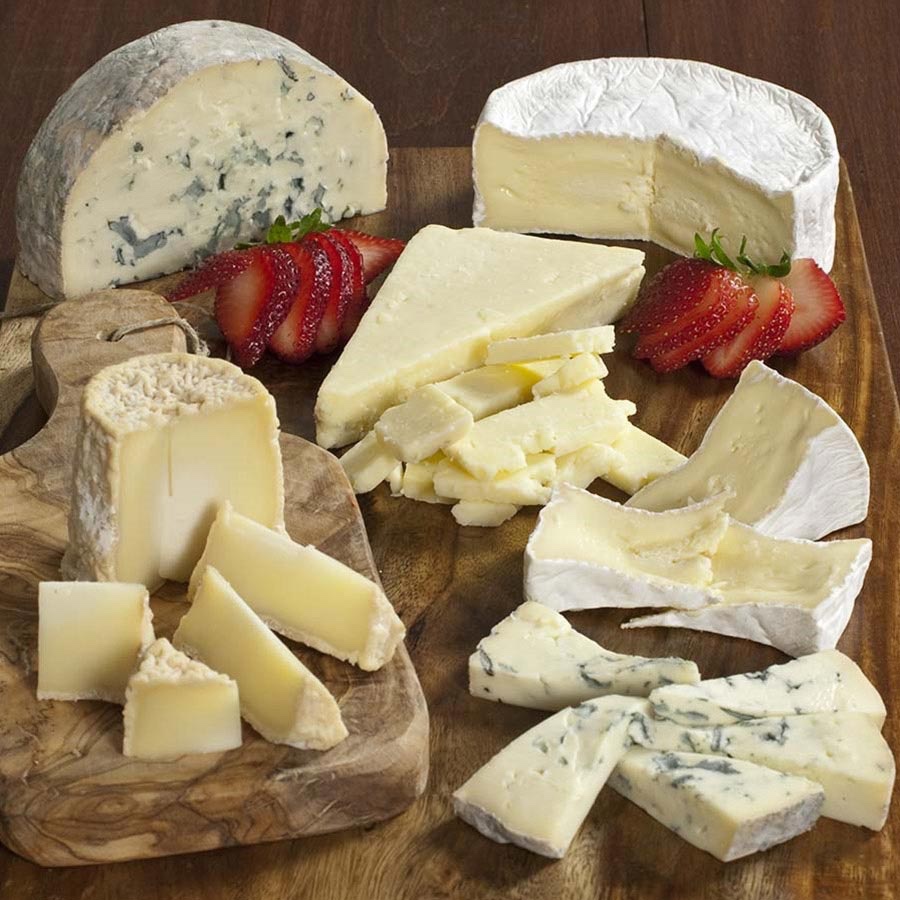
French Cheese Organization

41CFDB8A-4F46-4966-9A5C-709D22F853D8

Fresh cheeses – Like fromage frais, cheese curds that can be either chunky or smooth.  Cheeses that are just a few days old.

6A1C77F0-AF5C-44EF-A87F-8F36E8F64549.jpeg

Soft, bloomy rind cheeses – Like Camembert, Brie, Coulommiers, and Neufchâtel. These cheeses are somewhat elastic, ranging from firm when they are unripened, to tender when they are fully ripened. These cheeses take on an aroma of ammonia when they are overripe.

33EA6DED-32BD-4CED-91C6-4C38E95BBA5F.jpeg

Soft, washed-rind cheese – Like Livarot, Maroilles, Pont l’Évêque, and Époisses, these cheeses are washed with anything from naturally colored brine to beer, wine, or even tea. The longer these cheeses are aged, the more intense their aroma.

815D6F28-F970-4544-9476-2541B7ED92FA

Pressed cheeses – Uncooked and cooked, St. Nectaire, Cantal, Salers, Laguiole, and Morbier are among the uncooked pressed cheeses.

FF653B69-566D-4572-A95C-077CB140F70D.jpeg

Blue or “parsleyed” cheeses – These cheeses can be made with cow, sheep, or goat milk. Penicillium is injected into them.

5FFF3641-F93C-42F4-A66E-C2AB2D115760

Cooked, pressed cheeses – These are mountain cheeses that can age for up to many years. The milk is heated, then curdled and pressed into a mold. Once out of the mold they are salted, sometimes by being floated in a salt brine, then carefully aged. Comté, Beaufort, Gruyère, Abondance, and Emmenthal are all members of this family of cheese.

859CA659-14AA-49C9-A297-B319112EB15F

Goat cheese – These are small cheeses, because goats give up to just two liters of milk per day. They range from very soft and wet to elastic and creamy to extremely hard. They offer a wide panoply of flavors, and those that have aged to a firm hardness can be used in place of Parmigiano Reggiano.

C18993DA-8766-4BE6-A48B-42519045924B

Fromage fondu – These aren’t really cheeses, but a cheese product made from melted cheese and other ingredients, including whey, powdered milk, and other substances. These are low-priced dairy products, and often used industrially. They count, however, as a family of cheese.

E340249E-7D88-42B6-9580-63970B6E1209.jpeg

Basic Halva

Halva is a confection made from raw tehina and sugar, sometimes stabilized with additives.  In Israel, you’ll see halva stalls with huge slabs in every imaginable flavor, from rose water to pistachio to chocolate to coffee.

2 cups sugar
½ vanilla bean, scraped
Zest of 1 lemon
1½ cups tehina
Pinch kosher salt

Line an 8-inch square baking pan with parchment paper. Have ready another sheet of parchment paper.

Combine the sugar, vanilla, and lemon zest with ½ cup water in a saucepan over medium heat, stirring to dissolve the sugar. Then cook, without stirring, until the mixture registers 245 degrees on a candy thermometer.

While the sugar syrup is cooking, place the tehina and salt in the bowl of a stand mixer fitted with the paddle. Beat on medium speed.

When the sugar syrup reaches 245 degrees carefully stream it into the tehina with the mixer running. Mix until the syrup is incorporated and the mixture begins to pull away from the sides of the bowl.

Working quickly with a flexible heatproof spatula, transfer the mixture to the prepared pan. Press the top of the halva flat with the sheet of parchment paper and your hands. Let cool completely to room temperature. Cut into squares and store at room temperature, well wrapped in plastic wrap.

Will keep for up to a week.

Easy Latkes

This recipe is for a classic, unadorned latkes.

Ingredients:

  • 2 large Russet potatoes (about 1 pound), scrubbed and cut lengthwise into quarters
  • 1 large onion (8 ounces), peeled and cut into quarters
  • 2 large eggs
  • ½ cup all-purpose flour
  • 2 teaspoons coarse kosher salt (or 1 teaspoon fine sea salt), plus more for sprinkling
  • 1 teaspoon baking powder
  • ½ teaspoon freshly ground black pepper
  • Safflower or other oil, for frying

Preparation:

  1. Using a food processor with a coarse grating disc, grate the potatoes and onion. Transfer the mixture to a clean dishtowel and squeeze and wring out as much of the liquid as possible.
  2. Working quickly, transfer the mixture to a large bowl. Add the eggs, flour, salt, baking powder and pepper, and mix until the flour is absorbed.
  3. In a medium heavy-bottomed pan over medium-high heat, pour in about 1/4 inch of the oil. Once the oil is hot (a drop of batter placed in the pan should sizzle), use a heaping tablespoon to drop the batter into the hot pan, cooking in batches. Use a spatula to flatten and shape the drops into discs. When the edges of the latkes are brown and crispy, about 5 minutes, flip. Cook until the second side is deeply browned, about another 5 minutes. Transfer the latkes to a paper towel-lined plate to drain and sprinkle with salt while still warm. Repeat with the remaining batter.

Chicken Marbella

One of the recipes in The Silver Palate Cookbook published in 1981 was for Chicken Marbella, which was apparently the most popular dish at the Silver Palate. It ended up becoming a Shabbat dinner and Passover Seder staple throughout America.  While that may seem odd, it actually makes a good bit of sense. There’s a strong tradition of pairing fruit and meat in Jewish culinary history, and as a Jew Sheila Lukins was a part of this tradition.  Here is my riff on that recipe for a large group of people.

  • 4 chickens (2 1/2 pounds each), cut up
  • 1 head of garlic
  • 1/4 cup of oregano
  • Salt
  • Pepper
  • 1/2 cup red wine vinegar
  • 1/2 cup olive oil
  • 1 cup pitted prunes
  • 1/2 cup pitted Spanish olives
  • 1/2 cup capers
  • 6 bay leaves
  • 1 cup brown sugar
  • 1/4 cup Italian parsley, chopped
  • 1 cup of good white wine

Marinate chicken with all but last three ingredients in the refrigerator overnight. Preheat oven to 350 degrees.  Arrange in a single layer.  Sprinkle brown sugar, pour white wine around and bake for 50-60 minutes.  Using a slotted spoon transfer chicken, prunes, olives and capers to a platter.  Moisten with a few tablespoons of pan juices.  Sprinkle parsley over top.  Reduce pan juices and use as a gravy.

Mexican Shakshouka

Shakshouka typically is a simple and quick North African dish of eggs poached in a spicy stew of tomatoes and peppers.  Here is a riff of the classical dish with Mexican flavors.

  • 1 1/2 pounds sausage (Turkey sausage if you keep kosher)
  • butter
  • 1 green pepper, diced
  • 1 medium onion, diced
  • 1/2 cup salsa
  • 4-6 tomatoes, diced
  • salt, pepper, sugar to taste
  • cheese, typically cheddar
  • 8 eggs

brown sausage. Add peppers, onions and salsa.  Stir in tomatoes, salt, pepper and sugar to taste.  Place cheese slices on top to melt.  Break eggs over melted cheese.  Cover.