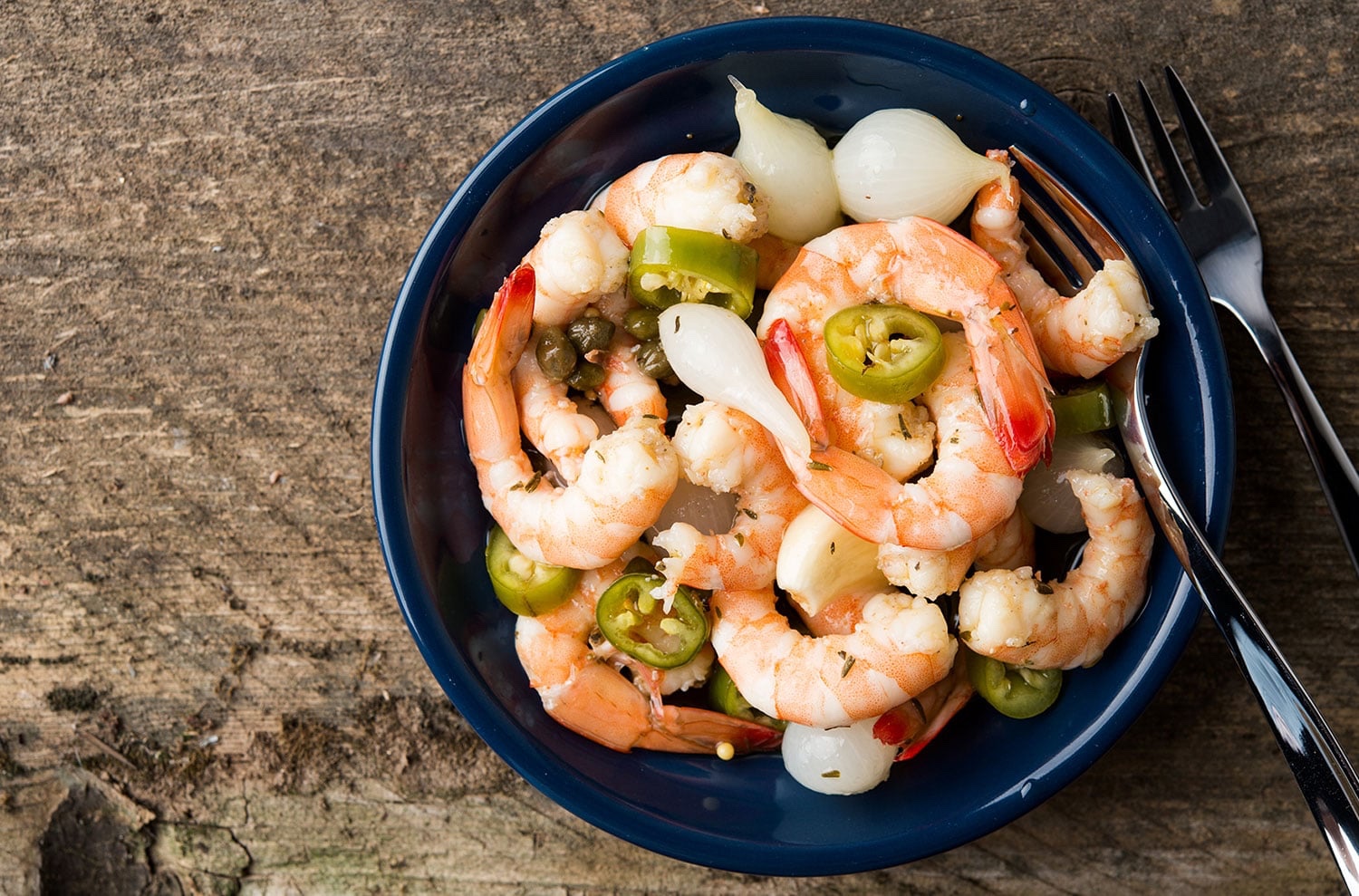
Quick Pickled Shrimp

1 gallon water
2 tablespoons plus 1 teaspoon kosher salt
2 pounds large shrimp, peeled and deveined
1 cup sliced onions
3 bay leaves
⅓ cup capers
¼ cup fresh lemon juice
1 cup cider vinegar
½ cup olive oil
1 teaspoon minced garlic
1 teaspoon celery seeds
1 teaspoon hot red pepper flakes
1/2 cup chopped fresh parsley

Heat the water in a large pot over high heat and bring to a hard boil. Add 2 tablespoons of the salt and stir to dissolve. Add the shrimp and boil just until they turn pink, about 30 seconds or so. Drain.

Meanwhile, in a large bowl combine the onions, bay leaves, capers without juice, lemon juice, vinegar, olive oil, garlic, remaining 1 teaspoon salt, celery seeds, pepper flakes, and parsley. Transfer the shrimp to the marinade.

Cover tightly and refrigerate for 8 to 12 hours.
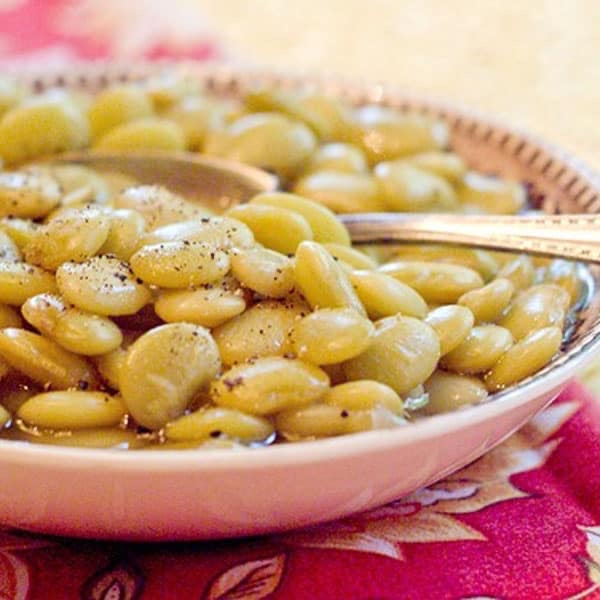
Butter Beans

Here’s what a butter bean most certainly is not: a conventional lima bean that Southerners have given a more palatable moniker. Butter beans aren’t green; they’re creamy white. They should never be served from a can; look for them sold straight from a cooler in plastic bags along Southern roads for about a three-week period sometime between June and August. And they don’t have any tartness; they’re sweeter and smoother than their sometimes off-putting mass-market lima cousin. Also known as a Dixie bean or sieva, the butter bean has been a go-to hereabouts for succotash and stews since the 1700s. You can boil them until tender and dress simply with lemon zest, sea salt, and olive oil. Or cook them with a big ol’ ham hock and spoon them over hot crusty cornbread for a classic helping of Southern goodness.

~ “S is for Southern,” by the editors of Garden & Gun

Pickled Refrigerator Mushrooms

3 pounds cremini, button mushrooms, or other variety
1½ cups rice wine vinegar
½ cup apple cider vinegar
1½ cups sugar
½ cup honey
3 tablespoons Dijon mustard
3 tablespoons whole-grain mustard
1 tablespoon kosher salt
5 thyme sprigs
1 fresh bay leaf

Lightly rinse the mushrooms; do not soak them. Dry the mushrooms, cut into bite-sized pieces, and put in a glass container.

Combine all of the remaining ingredients in a small saucepan, stir well, and bring to a boil over medium-high heat.

Pour the brine over the mushrooms and cool to room temperature. Cover and refrigerate for at least 1 week before eating to allow the mushrooms to cure. The mushrooms will keep for up to 2 weeks in the refrigerator.

Refrigerator Watermelon Rind Pickles

½ small watermelon (about 5 lb.)
3 tablespoons  salt
¾ cup sugar
¾ cup white vinegar (5% acidity)
2 star anise

Place watermelon cut side down and slice into ¾-inch slices. Trim all but ¼ inch flesh from slices. Remove outer green layer of rind using a vegetable peeler; discard. Cut rind slices crosswiseinto 1-inch lengths. Place in a large bowl.

Stir together salt and 3 cups water; pour over rind. Cover and chill 24 hours. Drain; rinse well.

Combine rind, sugar, vinegar, and ¾ cup water in a 4 quart saucepan. Bring to a boil until sugar dissolves. Remove from heat. Cool completely.

Place star anise in clean jars. Transfer rind to jars; cover with pickling liquid. Apply lids. Chill 24 hours before serving. Stores in refrigerator for up to 1 week.

Refrigerator Cucumber Pickles

  • 3 cups sugar
  • 2 cups white vinegar
  • 2 tablespoons salt
  • 1 teaspoon celery seeds
  • 2 onions sliced thin
  • Cucumbers, sliced thin

Stuff jars with cucumbers and onions. Add sugar, vinegar, salt and celery seeds together and mix. Add liquid mixture to the top. This recipe makes 3 quarts.

Store in refrigerator and they will keep for months. Do not heat liquid, just stir vinegar, sugar and salt until dissolved and pour over the cucumbers and onions.

Bread & Butter Pickles

  • 6 pounds cucumbers, unpeeled
  • 8 onions thinly sliced
  • 2 green peppers thinly sliced
  • 2 red peppers thinly sliced
  • 1/2 cup salt
  • 1 quart crushed ice
  • 5 cups sugar
  • 1 1/2 teaspoons turmeric & mustard seed
  • 1 teaspoon celery seed
  • 1/4 teaspoon ground cloves
  • 1 quart white vinegar

Slice cucumbers very thin.  Place in two gallon container with onions and peppers. Mix salt and ice.  Pack on top of vegetables. Cover with weighted lid, and allow to stand for 3 hours. Drain.  Mix remaining ingredients and pour over vegetables in a large pot.    Bring to a boil over low heat. Stop cooking immediately, do not overcook.  Ladle into hot sterilized jars and seal.

Sazerac

In 1838, Antoine Amedie Peychaud, owner of a New Orleans apothecary, treated his friends to brandy toddies of his own recipe, including his “Peychaud’s Bitters,” made from a secret family recipe. The toddies were made using a double-ended egg cup as a measuring cup or jigger, then known as a “coquetier” from which the word “cocktail” was derived.

By 1850, the Sazerac Cocktail, made with Sazerac French brandy and Peychaud’s Bitters, was immensely popular, and became the first branded cocktail. In 1873, the recipe for the Sazerac Cocktail was altered to replace the French brandy with American Rye whiskey, and a dash of absinthe was added.

In March 2008, Louisiana state senator Edwin R. Murray (D-New Orleans) filed Senate Bill 6 designating the Sazerac as Louisiana’s official state cocktail. The bill was defeated on April 8, 2008. After further debate, on June 23, 2008, the Louisiana Legislature agreed to proclaim the Sazerac as New Orleans’ official cocktail.

⅛ Teaspoon herbsaint or pernod liqueur
2 ounces rye whiskey
1 teaspoon simple syrup
3 or 4 dashes peychaud’s bitters
1 strip lemon peel

Pour the Herbsaint or Pernod into a small, chilled old-fashioned glass and swirl it along the sides of the glass before discarding the excess liquid, if desired.

Combine the rye, simple syrup, and bitters in a cocktail shaker filled with ice; shake well to combine.

Moisten the edge of the glass with the lemon peel. Strain the cocktail into the glass, and drop in the peel.

Rhubarb Jam

2 pounds rhubarb
3 cups granulated sugar
Juice of 1 lemon or of ½ orange and ½ lemon

Wash, trim and dice the rhubarb. You will have about 8 cups.

In a large pot combine the rhubarb, sugar, and citrus juice and toss to mix. Bring the rhubarb mixture to a boil over medium-high heat and cook for 2 minutes. Remove the pot from the heat and let sit for 1 to 2 hours.

Set a stockpot on the stove and fill with enough water to cover the jars by 1 to 2 inches. Bring the water to a boil over medium-high heat. Sterilize the jars in the water bath.

For a jam with some texture, set a colander over a bowl and, using a slotted spoon, transfer the rhubarb to the colander.  Bring the juices to a boil over medium-high heat and cook until thickened.  Add the rhubarb back to the pot, along with any juices that have collected in the bowl under the colander. Bring to a boil over medium-high heat, stirring frequently, and cook about 5 minutes longer.

For the smoother jam, cook the fruit with the juices over medium-high heat for 15 to 20 minutes. Remove the pot from the heat.

Bring the water bath back to a boil. Simmer the lids in a saucepan of hot water. Ladle the jam into the jars, leaving ¼-inch headspace. Wipe the rims clean and set the lids on the mouths of the jars. Twist on the rings.

Using a jar lifter, gently lower the jars into the pots. When the water returns to a boil, decrease the heat to an active simmer, and process the jars for 10 minutes.

Transfer the jars from the pot and let sit for at least 6 hours, until cool enough to handle. Check to be sure the jars have sealed.  Store the sealed jam for 6 months to 2 years. Once open, store in the refrigerator for up to 3 months.

Tomato Jam

3 large ripe tomatoes (about 3 pounds)
2 cups cider vinegar
1 cup brown sugar
½ cup Worcestershire sauce
½ cup extra-virgin olive oil
Kosher salt
nutmeg

Bring a medium pot of water to a boil. Make an ice bath in a bowl with equal parts ice and water. Submerge the tomatoes in the boiling water for 20 seconds. Remove and submerge them in the ice bath to cool them.  Drain, then peel, halve, seed, and chop the tomatoes.

Combine the vinegar and sugar in a saucepan and bring to a boil over high heat to dissolve the sugar. Boil until reduced by half. Add the tomatoes and Worcestershire sauce and bring back to a boil, then reduce the heat to low and simmer the mixture, stirring often, until it is a dark brown color and very thick, around 20 minutes.

Transfer the jam to a blender, add the olive oil, and blend on high until smooth. Season with salt and 1 or 2 gratings of nutmeg.  Pour the jam into a clean pint canning jar, cover, let cool, and refrigerate.

The jam will keep for up to 3 weeks in the refrigerator.