Birth control activist Margaret Sanger was born in New York in 1879, the sixth of 11 children in an Irish Catholic family. Her mother’s death at the age of 49, after 18 pregnancies, had a profound influence on Sanger. She qualified as an obstetrics nurse, which confirmed her views on the impact multiple pregnancies had on women, especially the poor. Involved in radical politics, she joined the New York Socialist Party.
In 1916, Sanger opened a short-lived birth control clinic, and in 1921, she established the American Birth Control League. She went on to organize the first World Population Conference in Geneva, Switzerland, and in 1953 became president of the International Planned Parenthood Federation. Sanger died of heart failure in Tucson, Arizona, in 1966.
Key works: 1914 Family Limitation 1916 What Every Girl Should Know 1931 My Fight for Birth Control
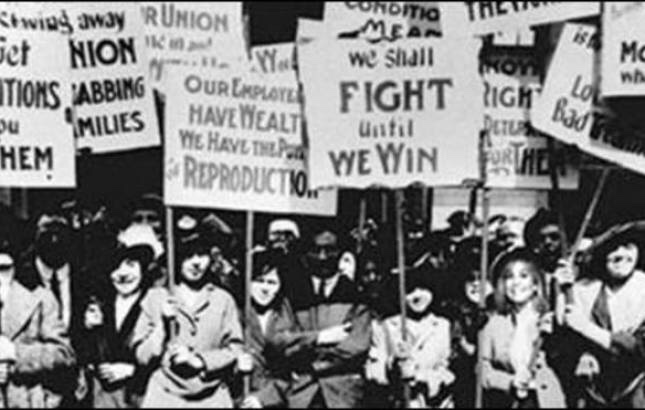
Celebrated annually on March 8, International Women’s Day is traced back to the US in 1907, when more than 15,000 female textile workers marched through New York City, demanding better working conditions and voting rights. In 1909, the Socialist Party of America declared a National Women’s Day, celebrated until 1913 on the last Sunday of February.
In 1910, about 100 women from 17 countries attended the Second International Conference of Women in Copenhagen, Denmark, at which Clara Zetkin proposed the establishment of International Women’s Day, on which women would highlight women’s issues. The following year, more than one million women and men attended International Women’s Day rallies worldwide. In Russia in 1917, women marked the day with a four-day strike for “peace and bread” that was a key event in the lead up to Russia’s October Revolution that year.
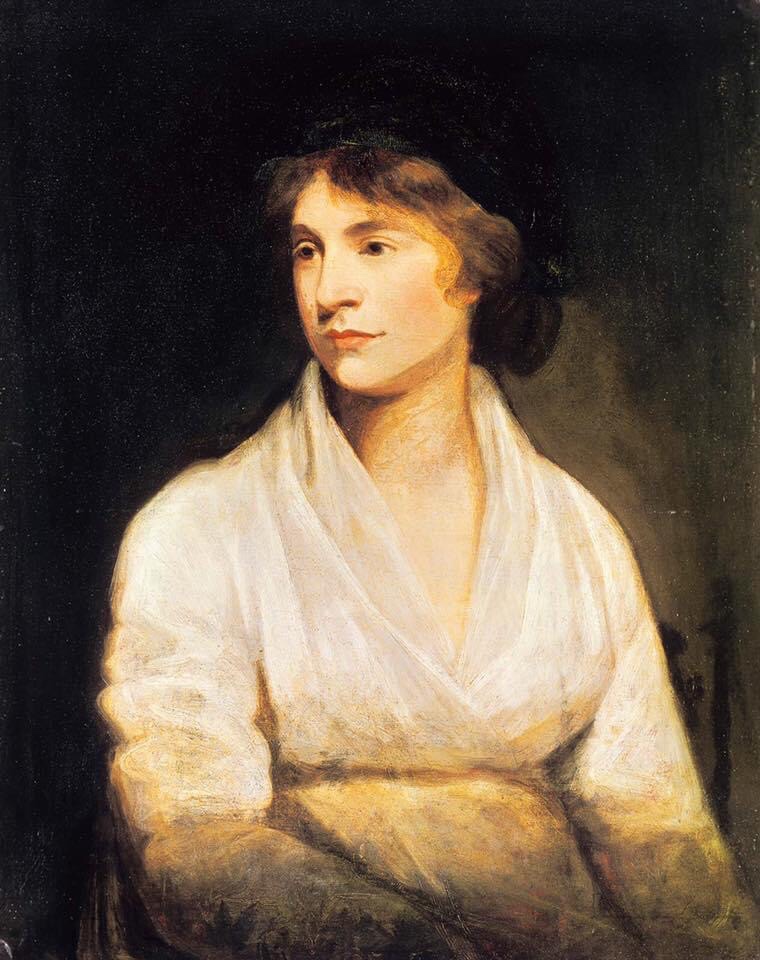
In 1792, with the publication of A Vindication of the Rights of Woman, Mary Wollstonecraft fired a powerful early salvo in the battle for female emancipation from domesticity. She wrote her feminist polemic in response to 18th-century Enlightenment thinkers, such as the philosopher Jean-Jacques Rousseau, who did not extend their ideas of liberalism to women. She criticizes the injustice and inconsistency of such men calling for freedom yet still subjugating women. She also rejects the contemporary perception that women were less rational.
“Who made man the exclusive judge?” she demands. Women, she writes, might be weaker physically, but are just as capable of rational thought as men.
Wollstonecraft maintains that women remained inferior because they were kept in the domestic sphere, forced to be men’s “toys and playthings.” Society taught them that looks, male opinion, and marriage were more important than intellectual and personal fulfilment. Sculpted by a gender stereotype that their mothers reinforced, girls were brought up to exploit their looks in order to find a man who would support and protect them.
Wollstonecraft was the first feminist to describe “marriage for support” as a form of prostitution— a shocking assertion for the time. A lack of means often compelled women to marry. Degraded by their dependency on male approval, they effectively became men’s slaves. She felt that such a restricted life, limited by domestic trivia, could also wreak psychological damage.
To restore women’s dignity, Wollstonecraft recommends “a revolution in female manners.” She believed women and men should be educated equally, even suggesting a coeducational system. Women, she believed, should be in the public sphere and should be trained for work outside the home, in areas such as medicine, midwifery, and business. She urges an end to the social distinction between the sexes and calls for equal rights for women to enable them to take control of their lives. Mixed reactions
Vindication was well received, particularly in intellectual circles. A hostile press, however, described Wollstonecraft as a “hyena in petticoats” for both her book and her unorthodox lifestyle. The book was not reprinted until the mid-19th century, when it was admired by figures such as British suffragist Millicent Fawcett and American activist Lucretia Mott. Wollstonecraft’s advanced ideas would be echoed in the works of feminists from Barbara Bodichon to Simone de Beauvoir”
Amelia Earhart writing to the NYT publisher in 1932 requesting that the paper stop referring to her as her husband’s wife and start calling her by her name. (She won)
On this date in 1759, Mary Wollstonecraft was born in London, the second of seven children. The industrious young woman worked as a companion, governess and then opened her own school. Her first book, Thoughts on the Education of Daughters, was published in 1786, followed by a novel, a children’s book (re-issued with illustrations by William Blake), a translation, and The Female Reader. When Edmund Burke read her review of a sermon by dissenting minister Richard Price, he wrote a famous attack on the American and French Revolutions. Mary was the first to rebut his polemic. A Vindication of the Rights of Men was published five weeks later, rejecting all arguments from authority or precedent. Her seminal A Vindication of the Rights of Woman was published in 1792. The first influential book calling for the equality of the sexes, it urged that women be educated and treated as “rational creatures.” Wollstonecraft championed dress reform, breast-feeding, early education and a national system of coeducational primary schools. She warned of those who practice “on the credulity of women.”
She gave birth to a daughter in an unhappy liaison with Gilbert Imlay, then married atheist William Godwin in 1797. Following an uneventful pregnancy, 38-year-old Mary gave birth to a second daughter, Mary. The new mother died of a childbirth infection after ten intense days of suffering. Her daughter Mary ran off as a teenager with poet Percy Shelley, and wrote Frankenstein at age 19. Wollstonecraft was an ardent rationalist and Deist who adopted an agnostic point of view toward the end of her life. D. 1797.
“. . . the being cannot be termed rational or virtuous who obeys any authority but that of reason.” ~ Mary Wollstonecraft, A Vindication of the Rights of Woman (1792)
On this date in 1830, Clémence-Auguste Royer was born in Nantes, France. Her parents were Catholic royalists, and Royer’s early education took place in a convent school. Royer became a republican following the Revolution of 1848, and began to question other common views at that time. Royer obtained a teaching certificate and taught at girls schools in Wales, where she mastered English, and in France. She read widely on science in these school libraries. In 1855, as a result of her inquiries, she rejected Catholicism thoroughly, and devoted herself to science. She began to offer lectures on science and logic for women in Lausanne, Switzerland, in 1858. Royer translated Charles Darwin’s Origin of Species into French in 1863. She famously wrote a preface to the work which used Darwin’s mechanism for evolution as part of an anti-religious argument which Darwin himself did not make — by this time, the book was in its third English edition and contained several strong references to a creator. Royer had been an evolutionist before reading Darwin, having been strongly influenced by the writings of Jean Baptiste LaMarck. French scientists, especially atheists and anthropologists, were strongly influenced by evolution and natural selection as framed by Royer, who also discussed the implications of evolutionary theory for human beings and society in her introduction (it would be almost ten years before Darwin himself grappled with these issues in The Descent of Man). Royer continued as Darwin’s official French translator until the third French edition of Origin was published in 1870.
Royer, despite not being a research scientist, remained a popular interpreter of science as well as a philosopher of science throughout her life. As a woman, she was denied access to many learned societies, as well as university teaching positions. It has been argued by Jennifer Michael Hecht, among others, that Royer opened doors to women within the freethinking movement. Royer was a feminist who argued passionately for the rights of women, married and unmarried, to child custody, property, education and equality with men. In 1866, she had a son by her lover and life partner, Pascal Duprat, a married man, which sharpened her concern about the major legal obstacles then present to unwed mothers and their children. She published many books and articles throughout her life, and considered the pinnacle to be 1900’s Natura rerum, her theory of nature. In 1900, Royer was named a Chevalier of the Legion of Honor for her contributions as “a woman of letters and a scientific writer.” D. 1902
“Yes, I believe in revelation, but a permanent revelation of man to himself and by himself, a rational revelation that is nothing but the result of the progress of science and of the contemporary conscience, a revelation that is always only partial and relative and that is effectuated by the acquisition of new truths and even more by the elimination of ancient errors. We must also attest that the progress of truth gives us as much to forget as to learn, and we learn to negate and to doubt as often as to affirm.” ~ Clémence Royer, preface to Charles Darwin, L’origine des espèces, in Jennifer Michael Hecht, The End of the Soul
Today in history —> French philosopher Charles Fourier was born on this day in 1772. Although he was considered a radical in his time for his philosophy of utopian socialism, many of his ideas have now become mainstream. For instance, Fourier was a fervent believer in gender equality and is credited with coining the term “feminism” in 1837.
A few quotes by Mary Wollstonecraft, author of “A Vindication of the Rights of Woman,” for women’s history month:
“I do not wish them [women] to have power over men; but over themselves.”
“My own sex, I hope, will excuse me, if I treat them like rational creatures, instead of flattering their fascinating graces, and viewing them as if they were in a state of perpetual childhood, unable to stand alone.”
“[I]f we revert to history, we shall find that the women who have distinguished themselves have neither been the most beautiful nor the most gentle of their sex.”
“Taught from their infancy that beauty is woman’s sceptre, the mind shapes itself to the body, and roaming round its gilt cage, only seeks to adorn its prison.”
“I love man as my fellow; but his scepter, real, or usurped, extends not to me, unless the reason of an individual demands my homage; and even then the submission is to reason, and not to man.”
“The beginning is always today.” ~ Mary Wollstonecraft (1759-1797)
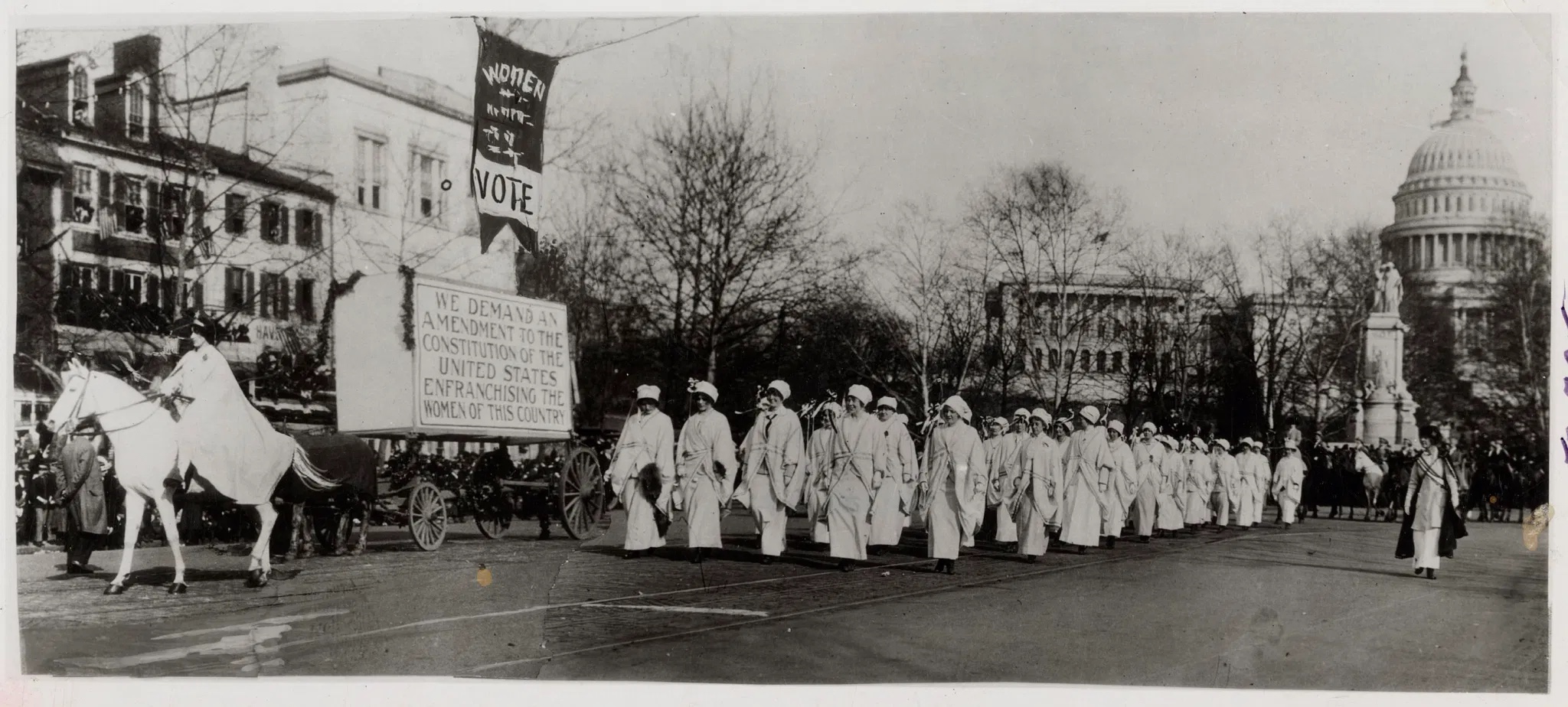
Today in Women’s Rights —-> 1913 – Thousands of women march in the Woman Suffrage Procession in Washington, D.C.
Here’s a photo of the procession, with the women all in white. They finally won the right to vote in 1920 when Tennessee became the last state needed to ratify the Nineteenth Amendment to the Constitution.






 Mark Bere Peterson’s Counterculture, Urban Legends, Paganism & Witchcraft