
Supreme Allied Commander Dwight D. Eisenhower had studied his World War II enemy, he was unprepared for the Nazi brutality he witnessed at Ohrdruf concentration camp in April 1945. Bodies were piled like wood and living skeletons struggled to survive. On International Holocaust Remembrance Day, learn how Eisenhower foresaw a day when the horrors of the Holocaust might be denied and hear about his vigilance to preserve its truth…
Category: The Holocaust
Otto Frank Liberated from Auschwitz
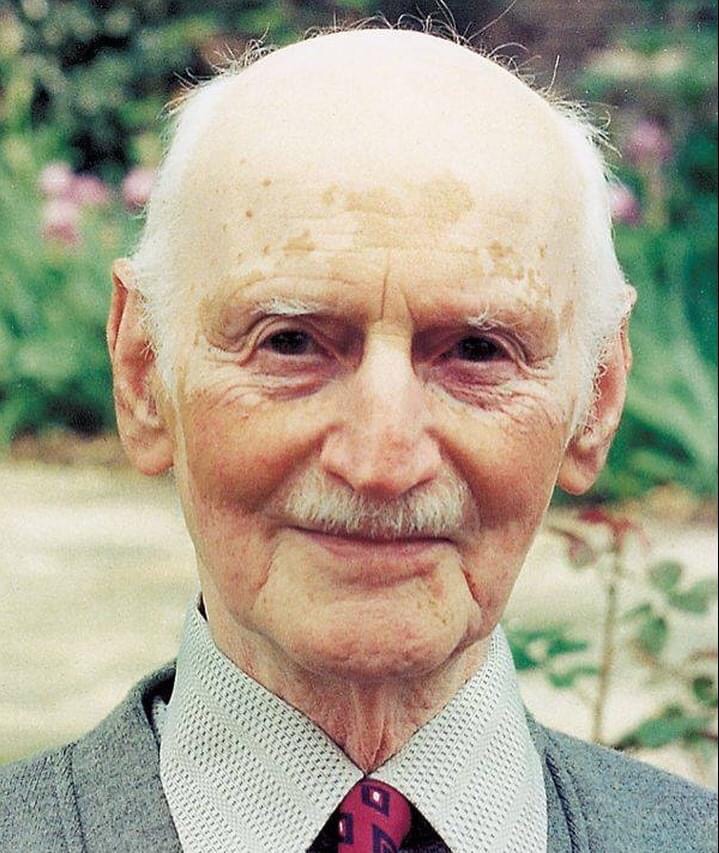
On this day in 1945, the Russian army liberates Auschwitz concentration camp. Otto Frank is one of around 8,000 prisoners remaining in the camp, most of them desperately ill.
Otto Frank is the only one of the eight people who hid in the Secret Annex to survive the horrors of the war. He has lost his wife Edith and his daughters Margot and Anne.
Shortly before his death he says:
“I am now almost ninety and my strength is slowly failing. Still, the task I received from Anne continues to restore my energy: to struggle for reconciliation and human rights throughout the world.”
Otto Frank died on 19 August 1980.
Photo Otto Frank 1979.
#HMD #HolocaustMemorialDay #Auschwitz
Steve Ross (né Szmulek Rozental)

Holocaust survivor Steve Ross (né Szmulek Rozental) was born in 1931 near Łódź, Poland. He spent five years in ten different concentration camps, including Budzyń, Auschwitz, and Dachau. He survived medical experiments, starvation, sexual abuse, and brutal beatings on a daily basis. When Ross was liberated from Dachau in April 1945, he was 14 years old and weighed 50 lbs. Among the American troops who liberated the camp was Lt. Steve Sattler, whose act of kindness restored Ross’s hope in humanity, even after everything he had been through. When Lt. Sattler saw Ross, he jumped down from atop his tank, hugged the emaciated child, and shared his food rations with him. He also gave the boy a handkerchief decorated with the American flag. After the war, Ross settled in the Boston area where he became a social worker and spent his life helping at-risk youth. When speaking to students about his experience, he would carefully unfurl the American flag handkerchief, and share how one small act of kindness can transform a life.
Photo: Steve Ross holding handkercheif (Getty Images)
Source: American Society for Yad Vashem
Raoul Wallenberg

Today in Holocaust History –> On this day 17 January 1945, Righteous Among the Nations, Raoul Wallenberg was taken away by Russian soldiers. He was never seen again.
Just prior to the Soviet army entering Budapest, Wallenberg said to his colleague in the Swedish embassy:
“I’ve taken on this assignment, and I will never be able to go back to Stockholm without knowing … that I’d done all a man could do to save as many Jews as possible”.
~ Raoul Wallenberg, Righteous Among the Nations
Raoul Wallenberg was sent to Budapest in 1944 to rescue Jews with connections to Sweden. He arrived with a list of Jews whom he was to help and 650 protective passports. However, he quickly widened the scope of his efforts by issuing 1000’s of “protective letters” and setting up a network of protective houses for Jews .
As the situation in Hungary deteriorated, Wallenberg abandoned all diplomatic protocol and attempted to rescue as many Jews as he could at great risk to himself.
Wallenberg used unconventional methods, including bribery and blackmail, to finance and run his huge rescue operation, successfully saving thousands of Jews. When Adolf Eichmann ordered a “death march” of tens of thousands of persons to the Austrian border, Wallenberg followed the marchers in their vehicles, and distributed food, clothing, and medications. He was able to free Jews from the death march by claiming that they were his “protected” Jews.
In 1956, 11 years after his disappearance, the Soviets finally stated that Raoul Wallenberg had died in prison in 1947.
In 1963 Yad Vashem recognized Raoul Wallenberg as Righteous Among the Nations.
Source: Yad Vashem
Simone Segouin

Simone Segouin, mostly known by her codename, Nicole Minet, was only 18-years-old when the Germans invaded. Her first act of rebellion was to steal a bicycle from a German military administration, and to slice the tires of all of the other bikes and motorcycles so they couldn’t pursue her. She found a pocket of the Resistance and joined the fight, using the stolen bike to deliver messages between Resistance groups.
She was an extremely fast learner and quickly became an expert at tactics and explosives. She led teams of Resistance fighters to capture German troops, set traps, and sabotage German equipment. As the war dragged on, her deeds escalated to derailing German trains, blocking roads, blowing up bridges and helping to create a German-free path to help the Allied forces retake France from the inside. She was never caught.
Segouin was present at the liberation of Chartres on August 23, 1944, and then the liberation of Paris two days later. She was promoted to lieutenant and awarded several medals, including the Croix de Guerre. After the war, she studied medicine and became a pediatric nurse. She is still going strong, and this October (2021) she will turn 96.
Miep Gies
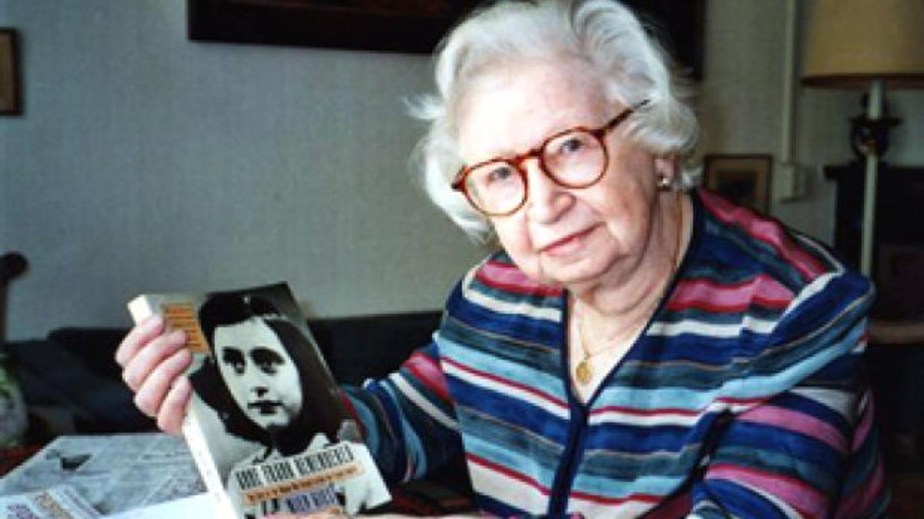
Today in History –> On this day in 2010, Miep Gies, the last survivor of a small group of people who helped hide a Jewish girl, Anne Frank, and her family from the Nazis during World War II, dies at age 100 in the Netherlands. After the Franks were discovered in 1944 and sent to concentration camps, Gies rescued the notebooks that Anne Frank left behind describing her two years in hiding. These writings were later published as “Anne Frank: The Diary of a Young Girl,” which became one of the most widely read accounts of the Holocaust.
Paddington Bear

Did you know:
Did you know that the beloved character Paddington Bear was inspired by Jewish children who escaped the Holocaust on the Kindertransport? Creator Michael Bond (1926-2017) was motivated by his memories of children arriving at London’s Reading station during WWII. These young refugees each carried a small suitcase and wore labels around their necks to identify them. It’s no coincidence that in the book, the little bear is found sitting on his suitcase in Paddington Station in London with a note around his neck that reads, “Please take care of this bear. Thank you.” He is discovered and adopted by the Brown family, thus the name Paddington Bear. In the story, Paddington’s best friend is Mr. Samuel Gruber, an elderly Jew from Hungary who escaped the Nazis. ❤️
Photo: Geoff Pugh
Source: American Society for Yad Vashem
#PaddingtonBear #Kindertransport
First Kindertransport
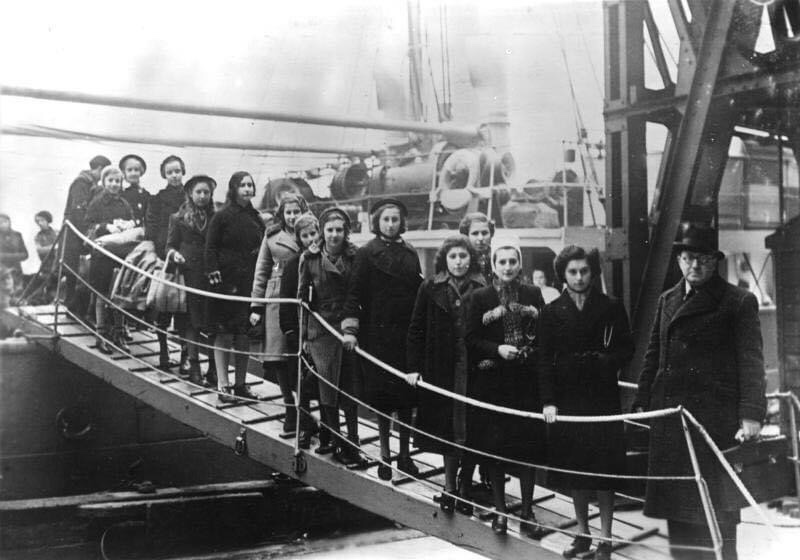
82 years ago, the first Kindertransport train left Germany:
Following the Kristallnacht pogrom in 1938, the British government changed its immigration policy to allow Jewish children to enter the country, providing that charities could pay a £50 bond for each child as a guarantee that they would leave the country when the situation improved. The children’s parents were not allowed to join them unless they had the financial means to support themselves, so most children travelled alone on what became known as the Kindertransport (‘children’s transport’).
Most of the almost 10,000 Kindertransportees never saw their parents again.
#Kindertransport #Holocaust
Holocaust Memorial Miami Beach, Florida


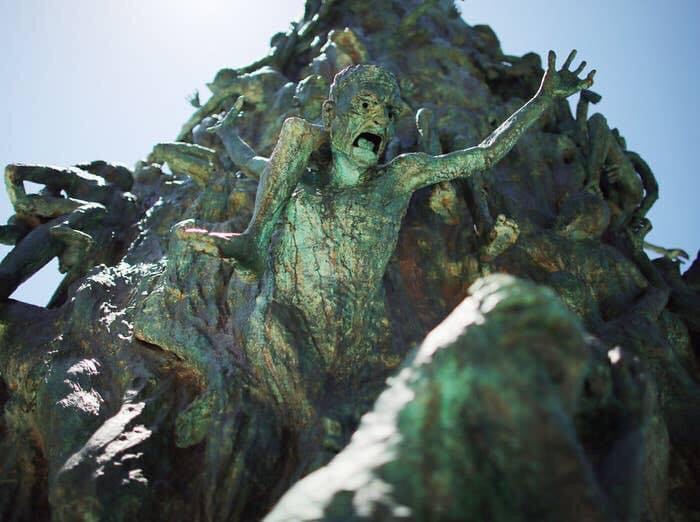


Memorial sculptures at Miami Beach, Florida. Statues by artist Kenneth Treister, on display as part of a memorial depicting thousands of victims crawling into an open hand representing freedom.
Ursula von Kardoff on Sophie Scholl and the White Rose

On Sophie Scholl and the White Rose:
“I will never forget the excitement when a leaflet was pressed into my hand by somebody in the editorial room of the Allgemeine Zeitung. The leaflets were being circulated by White Rose followers in Hamburg. Something inflammatory, heartening—yes, magical!—emanated from these typewritten and hectographed [mimeographed] lines.
We copied them off and passed them on. A wave of enthusiasm swept over us—we who risked so damned little in comparison.”
~ Ursula von Kardoff (reporter at Nuremberg War Crimes Tribunal, 1945)
 Mark Bere Peterson’s Counterculture, Urban Legends, Paganism & Witchcraft