Beneath the suburban Cu Chi district of Ho Chi Minh City is a network of tunnels that served as a home, air raid shelter, weapon storage facility, and supply route for the Viet Cong during the Vietnam War. For years, thousands of people effectively lived underground, only emerging after dark to gather supplies. It was a grim existence—the air was stale, the food and water scarce, and malaria spread fast through the claustrophobic, insect- and vermin-infested passages.
Construction on the tunnels began in the 1940s, as Vietnam fought to gain its independence from France. By the 1960s, the network stretched to over 100 miles (161 km). Tiny tunnel entrances, concealed beneath leaves on the jungle floor, required bodily contortion to squeeze into. To guard against enemy infiltration, the tunnel maintainers incorporated traps, such as dead-end passages and revolving floor panels that sent enemies tumbling into pits of sharpened bamboo. Should a foe make it past these snares and into the underground city, the Viet Cong might respond with a handful of scorpions or a well-aimed snake to the face.
Large sections of the tunnels are gone, having collapsed or been destroyed, but a preserved section, enlarged to fit larger tourist bodies, is open to the public. Visits end with the seemingly inappropriate opportunity to fire AK-47s and M-16s at a shooting range.
On this date in 1830, Clémence-Auguste Royer was born in Nantes, France. Her parents were Catholic royalists, and Royer’s early education took place in a convent school. Royer became a republican following the Revolution of 1848, and began to question other common views at that time. Royer obtained a teaching certificate and taught at girls schools in Wales, where she mastered English, and in France. She read widely on science in these school libraries. In 1855, as a result of her inquiries, she rejected Catholicism thoroughly, and devoted herself to science. She began to offer lectures on science and logic for women in Lausanne, Switzerland, in 1858. Royer translated Charles Darwin’s Origin of Species into French in 1863. She famously wrote a preface to the work which used Darwin’s mechanism for evolution as part of an anti-religious argument which Darwin himself did not make — by this time, the book was in its third English edition and contained several strong references to a creator. Royer had been an evolutionist before reading Darwin, having been strongly influenced by the writings of Jean Baptiste LaMarck. French scientists, especially atheists and anthropologists, were strongly influenced by evolution and natural selection as framed by Royer, who also discussed the implications of evolutionary theory for human beings and society in her introduction (it would be almost ten years before Darwin himself grappled with these issues in The Descent of Man). Royer continued as Darwin’s official French translator until the third French edition of Origin was published in 1870.
Royer, despite not being a research scientist, remained a popular interpreter of science as well as a philosopher of science throughout her life. As a woman, she was denied access to many learned societies, as well as university teaching positions. It has been argued by Jennifer Michael Hecht, among others, that Royer opened doors to women within the freethinking movement. Royer was a feminist who argued passionately for the rights of women, married and unmarried, to child custody, property, education and equality with men. In 1866, she had a son by her lover and life partner, Pascal Duprat, a married man, which sharpened her concern about the major legal obstacles then present to unwed mothers and their children. She published many books and articles throughout her life, and considered the pinnacle to be 1900’s Natura rerum, her theory of nature. In 1900, Royer was named a Chevalier of the Legion of Honor for her contributions as “a woman of letters and a scientific writer.” D. 1902
“Yes, I believe in revelation, but a permanent revelation of man to himself and by himself, a rational revelation that is nothing but the result of the progress of science and of the contemporary conscience, a revelation that is always only partial and relative and that is effectuated by the acquisition of new truths and even more by the elimination of ancient errors. We must also attest that the progress of truth gives us as much to forget as to learn, and we learn to negate and to doubt as often as to affirm.” ~ Clémence Royer, preface to Charles Darwin, L’origine des espèces, in Jennifer Michael Hecht, The End of the Soul
On this day in 1909 Joan of Arc was beatified (Beatification is a recognition accorded by the Catholic Church of a deceased person’s entrance into Heaven and capacity to intercede on behalf of individuals who pray in his or her name), nearly 500 years after her execution; which is somewhat coy of the Vatican when viewed in the light of recent fast-tracking of saintly candidates.
Regardless of the supernatural elements of her story, she remains an interesting historical character. Quite how a teenage peasant girl in the early years of the 15th century managed to convince a garrison commander and then the uncrowned king of France Charles VII that she could lead an army against English forces remains to this day a mystery shrouded in legendary tales.
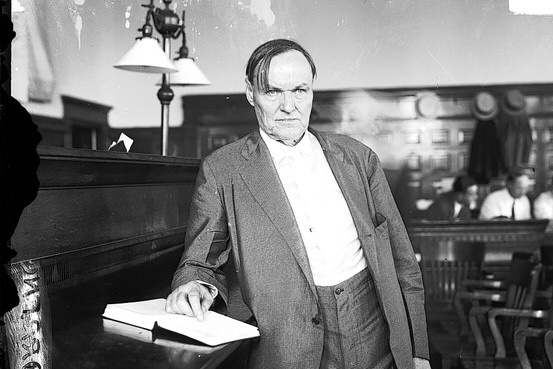
On this date in 1857, Clarence Darrow, later dubbed “Attorney for the Damned” and “the Great Defender,” was born. For a time he lived in an Ohio home that had served as a stop on the Underground Railroad. His father was known as the “village infidel.” Darrow attended the University of Michigan Law School for one year, then passed the bar in 1878 and moved to Chicago. There he joined protests against the trumped-up charges against four radicals accused in the Haymarket Riot case. Darrow became corporate counsel to the City of Chicago, then counsel for the North Western Railway. He quit this lucrative post when he could no longer defend their treatment of injured workers, then went on to defend without pay Socialist striker Eugene V. Debs. In 1907, Darrow successfully defended labor activist “Big Bill” Haywood, charged with assassinating a former governor. His passionate denunciation of the death penalty prompted him to defend the famous killers, Loeb and Leopold, who received life sentences in 1924.
His most celebrated case was the Scopes Trial, defending teacher John Scopes in Dayton, Tenn., who was charged with the crime of teaching evolution in the public schools. Darrow’s brilliant cross-examination of prosecuting attorney William Jennings Bryan lives on in legal history. During the trial, Darrow said: “I do not consider it an insult, but rather a compliment to be called an agnostic. I do not pretend to know where many ignorant men are sure–that is all that agnosticism means.” Darrow wrote many freethought articles and edited a freethought collection. His two appealing autobiographies are The Story of My Life (1932), containing his plainspoken views on religion, and Farmington (1932). He also wrote Resist Not Evil (1902), An Eye for An Eye (1905), and Crime, Its Causes and Treatments (1925). His freethought writings are collected into Why I Am an Agnostic and Other Essays. He told The New York Times, “Religion is the belief in future life and in God. I don’t believe in either” (April 19, 1936). D. 1938.
“I don’t believe in God because I don’t believe in Mother Goose.” ~ Clarence Darrow, speech, Toronto, 1930.
Imagine if a white American guy tortured and murdered a black woman, first beating her up and kicking her while shouting “white power!” and then throwing her out the window to her death. This would, of course be all over the Western media as an example of a racist crime. And imagine further that the murderer gets off completely because the courts find that before the murder he’d smoked marijuana, so he wasn’t responsible for his deed. Now that would, rightly, be a national scandal, all over the media of all stripes.
Now imagine instead that the murderer was an anti-Semitic Muslim who did the same thing to an Orthodox Jewish French woman who was his neighbor, crying “Allahu akbar,” uttering Muslim prayers, and then torturing her before throwing her out the window to her death. And then the courts let him off because he was high on weed.
As part of the infamous “swimming test,” accused witches were dragged to the nearest body of water, stripped to their undergarments, bound and then tossed in to to see if they would sink or float. Since witches were believed to have spurned the sacrament of baptism, it was thought that the water would reject their body and prevent them from submerging. According to this logic, an innocent person would sink like a stone, but a witch would simply bob on the surface. The victim typically had a rope tied around their waist so they could be pulled from the water if they sank, but it wasn’t unusual for accidental drowning deaths to occur.
Witch swimming derived from the “trial by water,” an ancient practice where suspected criminals and sorcerers were thrown into rushing rivers to allow a higher power to decide their fate. This custom was banned in many European counties in the Middle Ages, only to reemerge in the 17th century as a witch experiment, and it persisted in some locales well into the 18th century. For example, in 1710, the swimming test was used as evidence against a Hungarian woman named Dorko Boda, who was later beaten and burned at the stake as a witch.
2. Prayer Test
Medieval wisdom held that witches were incapable of speaking scripture aloud, so accused sorcerers were made to recite selections from the Bible—usually the Lord’s Prayer—without making mistakes or omissions. While it may have simply been a sign that the suspected witch was illiterate or nervous, any errors were viewed as proof that the speaker was in league with the devil. This twisted test of public speaking ability was commonly used as hard evidence in witch trials. In 1712, it was applied in the case Jane Wenham, an accused witch who supposedly struggled to speak the words “forgive us our trespasses” and “lead us not into temptation” during her interrogation. Still, even a successful prayer test didn’t guarantee an acquittal. During the Salem Witch Trials, the accused sorcerer George Burroughs flawlessly recited the prayer from the gallows just before his execution. The performance was dismissed as a devil’s trick, and the hanging proceeded as planned.
3. Touch Test
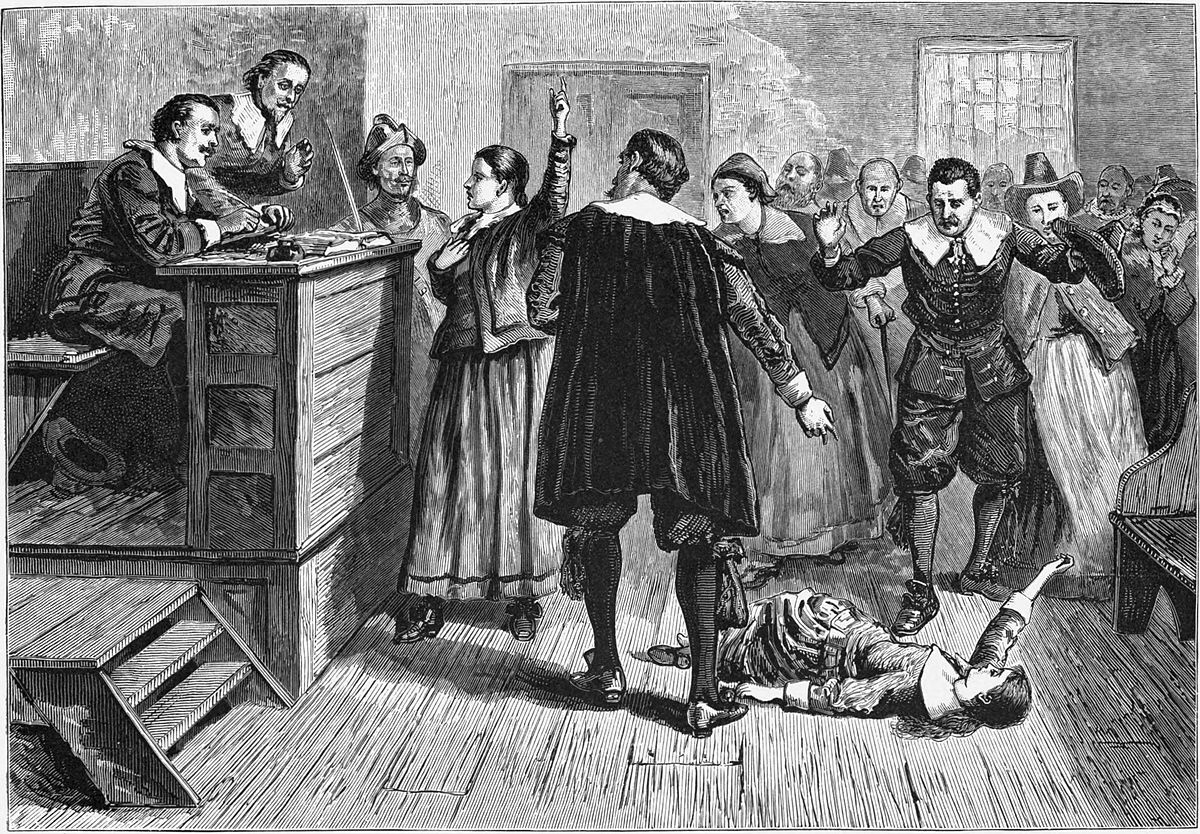
The touch test worked on the idea that victims of sorcery would have a special reaction to physical contact with their evildoer. In cases where a possessed person fell into spells or fits, the suspected witch would be brought into the room and asked to a lay a hand on them. A non-reaction signaled innocence, but if the victim came out of their fit, it was seen as proof that the suspect had placed them under a spell.
Touch tests played a famous part in the 1662 trial of Rose Cullender and Amy Denny, two elderly English women charged with bewitching a pair of young girls. The children had been suffering from fits that left their fists clenched so tightly that even a strong man could not pry their fingers apart, but early tests showed they easily opened whenever Cullender or Denny touched them. To ensure the reaction was genuine, judges had the children blindfolded and touched by other members of the court. The girls unclenched their fists anyway, which suggested they were faking, but even this was not enough to prove the women’s innocence. Cullender and Denny were both later hanged as witches.
4. Witch Cakes
A bizarre form of counter-magic, the witch cake was a supernatural dessert used to identify suspected evildoers. In cases of mysterious illness or possession, witch-hunters would take a sample of the victim’s urine, mix it with rye-meal and ashes and bake it into a cake. This stomach-turning concoction was then fed to a dog—the “familiars,” or animal helpers, of witches—in the hope that the beast would fall under its spell and reveal the name of the guilty sorcerer. During the hysteria that preceded the Salem Witch Trials, the slave Tituba famously helped prepare a witch cake to identify the person responsible for bewitching young Betty Parris and others. The brew failed to work, and Tituba’s supposed knowledge of spells and folk remedies was later used as evidence against her when she was accused of being a witch.
5. Witch’s Marks
Witch-hunters often had their suspects stripped and publicly examined for signs of an unsightly blemish that witches were said to receive upon making their pact with Satan. This “Devil’s Mark” could supposedly change shape and color, and was believed to be numb and insensitive to pain. Prosecutors might also search for the “witches’ teat,” an extra nipple allegedly used to suckle the witch’s helper animals. In both cases, it was easy for even the most minor physical imperfections to be labeled as the work of the devil himself. Moles, scars, birthmarks, sores, supernumerary nipples and tattoos could all qualify, so examiners rarely came up empty-handed. In the midst of witch hunts, desperate villagers would sometimes even burn or cut off any offending marks on their bodies, only to have their wounds labeled as proof of a covenant with the devil.
6. Pricking and Scratching Tests
If witch-hunters struggled to find obvious evidence of “witch’s marks” on a suspect’s body, they might resort to the ghastly practice of “pricking” as a means of sussing it out. Witch-hunting books and instructional pamphlets noted that the marks were insensitive to pain and couldn’t bleed, so examiners used specially designed needles to repeatedly stab and prick at the accused person’s flesh until they discovered a spot that produced the desired results. In England and Scotland, the torture was eventually performed by well-paid professional “prickers,” many of whom were actually con men who used dulled needlepoints to identify fake witch’s marks.
Along with pricking, the unfortunate suspect might also be subjected to “scratching” by their supposed victims. This test was based on the notion that possessed people found relief by scratching the person responsible with their fingernails until they drew blood. If their symptoms improved after clawing at the accused’s skin, it was seen as partial evidence of guilt.
7. Incantations
Also known as “charging,” this test involved forcing the accused witch to verbally order the devil to let the possessed victim come out of their fit or trance. Other people would also utter the words to act as a “control,” and judges would then gauge whether the statements had any effect on the victim’s condition. Charges were famously used in the 16th century witch trial of Alice Samuel and her husband and daughter, who were accused of bewitching five girls from the wealthy Throckmorton family. During the proceedings, judges forced the Samuels to demand that the devil release the girls from their spell by stating, “As I am a witch…so I charge the devil to let Mistress Throckmorton come out of her fit at this present.” When the possessed girls immediately recovered, the Samuels were found guilty and hanged as witches.
In March 1662, John and Bethia Kelly grieved over the body of their 8-year-old daughter inside their home. Little Elizabeth had been fine just days before when she returned home with a neighbor, Goodwife Ayres. The distraught parents, grasping at any explanation for their loss, saw the hand of the devil at work.
The parents were convinced that Elizabeth had been fatally possessed by Goody Ayres. The Kellys testified that their daughter first took ill the night after she returned home with her neighbor, and that she exclaimed, “Father! Father! Help me, help me! Goodwife Ayres is upon me. She chokes me. She kneels on my belly. She will break my bowels. She pinches me. She will make me black and blue.”
After Elizabeth’s death, accusations of bewitchment flew, and fingers were pointed at numerous townspeople. Hysteria gripped Hartford, a town that a generation before had witnessed the first execution of a suspected witch in the American colonies. Alse Young of Windsor, Connecticut, was sent to the gallows erected in Hartford’s Meeting House Square on May 26, 1647.
Witchcraft was one of 12 capital crimes decreed by Connecticut’s colonial government in 1642. The legal precedent cited by the devoutly Puritan colonists was of a divinely higher order: biblical passages such as Exodus 22:18 (“Thou shalt not suffer a witch to live”) and Leviticus 20:27 (“A man also or woman that hath a familiar spirit, or that is a wizard, shall surely be put to death”).
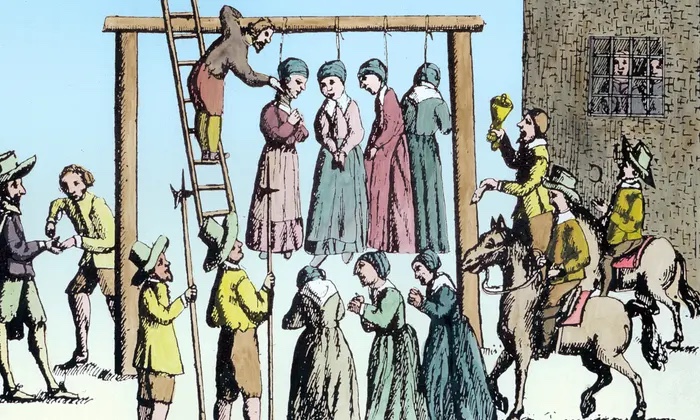
After Young’s public hanging, at least five other Connecticut residents met a similar fate. However, it was in Hartford in 1662, 30 years before the infamous Salem witch trials, that a witch hunt hysteria took hold, resulting in seven trials and four executions.
Shortly after Elizabeth Kelly’s death, the pious Ann Cole suddenly became “afflicted,” shaking violently and spouting blasphemy. According to one account, Cole was “taken with strange fits, wherein she held a discourse for a considerable time.” Cole blamed her bewitchment on neighbor Rebecca Greensmith, described by one townsperson as “a lewd, ignorant, considerably aged woman,” and others already suspected of witchcraft in the Kelly case. The accused began to accuse others, and even their spouses, of being the true witches. In what became a vicious circle, neighbors began testifying against neighbors. Goody Ayres’ husband, perhaps in an attempt to save his wife, joined in the chorus of Greensmith’s accusers.
The most damning testimony supposedly came from Greensmith herself, who reportedly admitted to having “familiarity with the devil” and said that “at Christmas they would have a merry meeting” to form a covenant. Greensmith implicated her husband and said she had met in the woods with seven other witches, including Goody Ayres, Mary Sanford and Elizabeth Seager. Neighbors testified that they saw Seager dancing with other women in the woods and cooking mysterious concoctions in black kettles.
Two of the suspects, likely the Greensmiths, were subjected to the swimming test in which their hands and feet were bound and they were cast into the water to test the theory that witches are unable to sink. After they were tried, the Greensmiths were indicted “for not having the fear of God before thine eyes; thou hast entertained familiarity with Satan the grand enemy of God and mankind and by his help hast acted things in a preternatural way.” The court’s verdict: “According to the law of God and the established law of this commonwealth, thou deserves to die.”
Rebecca Greensmith had confessed in open court. Nathaniel Greensmith had protested his innocence. But they both met the same fate: the noose. Sanford was also sent to the gallows. After their executions, Cole reportedly was “restored to health.” Ayres fled Hartford, while Seager was finally convicted of witchcraft in 1665, although the governor reversed the verdict the following year. Mary Barnes of Farmington, Connecticut, was also swept up in the region’s witch hunt and executed alongside the Greensmiths.
The four executions of suspected witches in Hartford were to be Connecticut’s last. Another hysteria broke out in Fairfield, Connecticut, in 1692, but none of those convicted met death. Connecticut held its final witch trial in 1697, a half century after Alse Young’s execution. During that period, there were 46 prosecutions and at least 11 executions.
Walking around the Bjældskovdal bog in 1950, brothers Emil and Viggo Højgaard (along with Grethe, Viggo’s wife) stumbled upon a body. Believing the man to be the victim of a recent killing, they called the police. Further investigations revealed that he had indeed been murdered—some 2,300 years earlier.
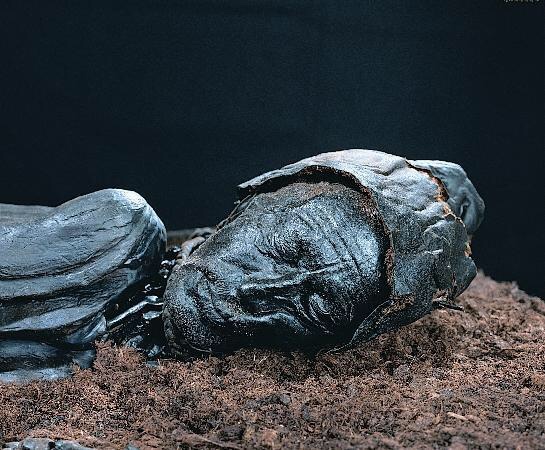
The Tollund Man was found curled in the fetal position with his eyes closed and a serene expression frozen on his face. The cold, acidic, oxygen-starved conditions of the peat bog had kept him remarkably well preserved. His hair, beard stubble, eyelashes, and toenails were all intact, and he was nude, but for a sheepskin cap and wide belt around his waist. A rope was wound tightly around his neck. The Iron Age man had been hanged, likely during a ritual sacrifice.
In 1950, it was not yet known how best to preserve discoveries like Tollund Man. Accordingly, only the head of the original specimen was kept intact. The rest of the body was subjected to various tests to determine his probable age (probably around 40, due to the presence of wisdom teeth and wrinkles) and the conditions surrounding his life and death. Among the details found: Tollund Man was 5 feet 3 inches (1.6 m) tall, his final meal was a gruel made from barley and flaxseed, and his “sacrificers” (read: killers) took the time to close his mouth and eyes after death.
Thousands of “bog bodies” have been discovered in sphagnum swamps across Northern Europe, but the Tollund Man remains the best preserved. His original head and reconstructed body now reside at the Silkeborg Museum. The rope used to end his life is still wrapped around his throat.
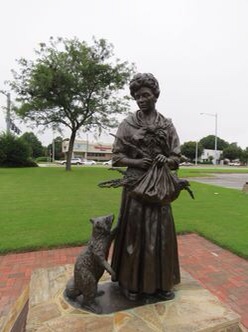
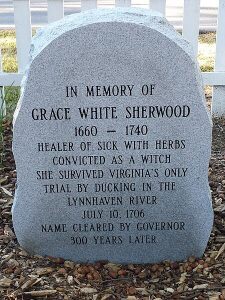
One of the most famous witches in Virginia’s history is Grace Sherwood, whose neighbors alleged she killed their pigs and hexed their cotton. A farmer, healer, and midwife, she was accused by her neighbors of transforming herself into a cat, damaging crops, and causing the death of livestock. She was charged with witchcraft several times. Sherwood was accused of bewitching her neighbor, Elizabeth Hill, causing Hill to miscarry. Other accusations followed and Sherwood was brought to trial in 1706.
The court decided to use a controversial water test to determine her guilt or innocence. Sherwood’s arms and legs were bound and she was thrown into a body of water. It was thought if she sank, she was innocent; if she floated, she was guilty. Sherwood didn’t sink and was convicted of being a witch. She wasn’t killed but put in prison and for eight years.
A satirical article (supposedly written by Benjamin Franklin) about a witch trial in New Jersey was published in 1730 in the Pennsylvania Gazette. It brought to light the ridiculousness of some witchcraft accusations. It wasn’t long before witch mania died down in the New World and laws were passed to help protect people from being wrongly accused and convicted.
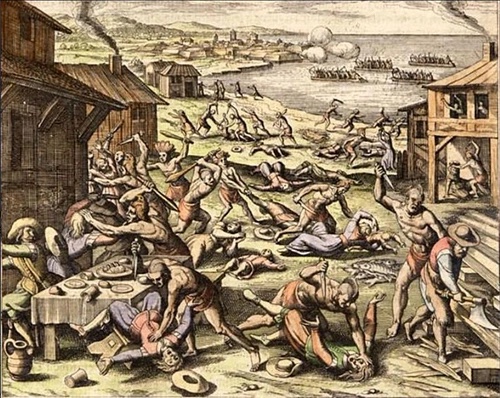
The power of the “Indian Curse” – whether in New England or in Virginia, as in the case of the equally famous Curse of Chief Cornstalk – was considered an irrefutable truth by the colonists because of their belief in the Native Americans as diabolical servants of Satan. This belief was strengthened early on by the Indian Massacre of 1622 in Virginia when, on the morning of 22 March 1622, the chief of the Powhatan Confederacy, Opchanacanough (l. 1554-1646) launched a surprise attack on the settlements, killing 347 people. Prior to the attack, the natives had appeared friendly (purposefully so, on Opchanacanough’s orders, to lower the colonists’ defenses), and this, to the colonists, was proof that no native could be trusted and all posed a potential threat.
The belief in natives wielding supernatural powers continued, however, as they became more marginalized, and it was understood that they had grounds for holding a grudge. Other minorities were equally apt to be suspect though, whether African slaves – who were thought to be able to cast spells through their own associations with Satan – or Catholics whose religious beliefs were considered diabolic by the majority of Protestants.
Witchcraft, thought to be practiced by all three of these groups, was understood as an intimate relationship between a person or people with Satan himself, God’s adversary, who continually plotted against those whom the Bible claimed God had made in his own image. Although the Salem Witch Trials are easily the most famous expression of the fear and hysteria generated by a belief in witchcraft, marginalized people – most often women – were charged, convicted, and hanged or otherwise dispatched in colonies from Massachusetts down to Florida.
Source: World History Encyclopedia Online, ancient.eu







 Mark Bere Peterson’s Counterculture, Urban Legends, Paganism & Witchcraft