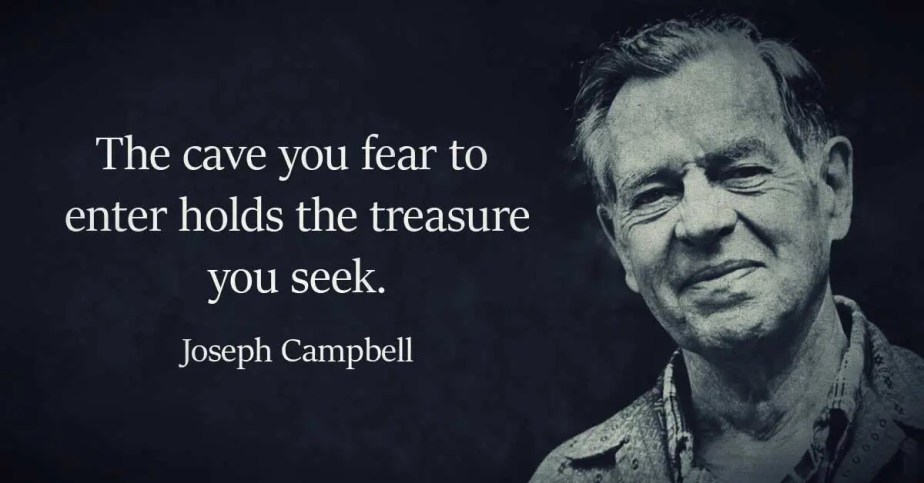
Joseph Campbell on Being Born in Interesting Times

“I have read somewhere of an old Chinese curse: ‘May you be born in an interesting time!’ This is a VERY interesting time: there are no models for ANYTHING that is going on. It is a period of free fall into the future, and each has to make his or her own way. The old models are not working; the new have not yet appeared. In fact, it is we who are even now shaping the new in the shaping of our interesting lives. And that is the whole sense (in mythological terms) of the present challenge: we are the ‘ancestors’ of an age to come, the unwitting generators of its supporting myths,the mythic models that will inspire its lives.”

~ Joseph Campbell

Joseph Campbell from “The Power of Myth”

“When a judge walks into the room, and everybody stands up, you’re not standing up to that guy, you’re standing up to the robe that he’s wearing and the role that he’s going to play. What makes him worthy of that role is his integrity, as a representative of the principles of that role, and not some group of prejudices of his own. So what you’re standing up to is a mythological character. I imagine some kings and queens are the most stupid, absurd, banal people you could run into, probably interested only in horses and women, you know. But you’re not responding to them as personalities, you’re responding to them in their mythological roles. When someone becomes a judge, or President of the United States, the man is no longer that man, he’s the representative of an eternal office; he has to sacrifice his personal desires and even life possibilities to the role that he now signifies.”

~ Joseph Campbell, “The Power of Myth”

Anne Frank on War

“I don’t believe that the big men, the politicians and the capitalists alone are guilty of the war. Oh, no, the little man is just as keen, otherwise the people of the world would have risen in revolt long ago! There is an urge and rage in people to destroy, to kill, to murder, and until all mankind, without exception, undergoes a great change, wars will be waged, everything that has been built up, cultivated and grown, will be destroyed and disfigured, after which mankind will have to begin all over again.”

~ Anne Frank, “The Diary of a Young Girl – 3 May 1944”

#FavoriteQuotes #AnneFrank

Joseph Campbell from “The Ecstasy of Being”

“Mythology, in other words, is not an outmoded quaintness of the past, but a living complex of archetypal, dynamic images, native to, and eloquent of, some constant, fundamental stratum of the human psyche. And that stratum is the source of the vital energies of our being. Out of it proceed all the fate-creating drives and fears of our lives. While our educated, modern waking-consciousness has been going forward on the wheels and wings of progress, this recalcitrant, dream-creating, wish-creating, under-consciousness has been holding to its primeval companions all the time, the demons and the gods.”

~ Joseph Campbell, “The Ecstasy of Being”

#JosephCampbell #FavoriteQuotes

Carl Sagan on US Becoming a Service Information Economy

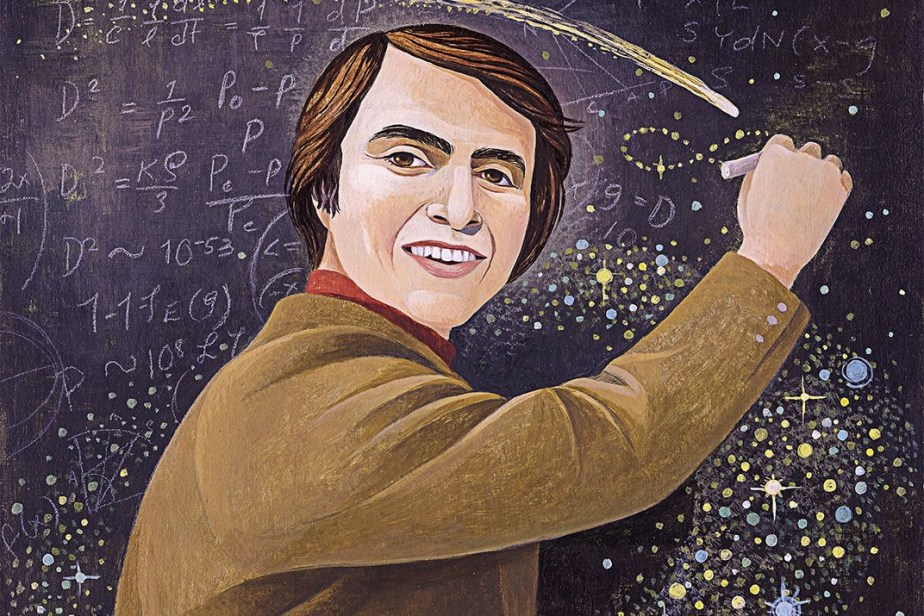
“Science is more than a body of knowledge; it is a way of thinking. I have a foreboding of an America in my children’s or grandchildren’s time—when the United States is a service and information economy; when nearly all the key manufacturing industries have slipped away to other countries; when awesome technological powers are in the hands of a very few, and no one representing the public interest can even grasp the issues; when the people have lost the ability to set their own agendas or knowledgeably question those in authority; when, clutching our crystals and nervously consulting our horoscopes, our critical faculties in decline, unable to distinguish between what feels good and what’s true, we slide, almost without noticing, back into superstition and darkness.”

~ Carl Sagan

Today in Literary History —> Virginia Woolf Born in 1882

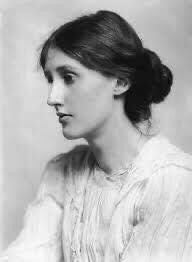
Today in Literary History —> Today is the Birthday of one of my favorite authors. Virginia Woolf was born in Kensington, Middlesex, England on this day in 1882.

Upon the death of her mother in 1895, Woolf suffered the first of the mental health episodes which blighted her life, including a more serious breakdown when her father passed away in 1904.

She began writing at an early age, having her first piece published in December 1904, and writing for the Times Literary Supplement from the following year.

Along with her husband, Leonard, whom she married in 1912, she became part of an influential group of writers known as the Bloomsbury Group prominent in London during the early 20th century.

Woolf’s first novel, The Voyage Out, was published in 1915, and her subsequent writings established her as one of the leading novelists and essayists of her time.

“Time, unfortunately, though it makes animals and vegetables bloom and fade with amazing punctuality, has no such simple effect upon the mind of man. The mind of man, moreover, works with equal strangeness upon the body of time. An hour, once it lodges in the queer element of the human spirit, may be stretched to fifty or a hundred times its clock length; on the other hand, an hour may be accurately represented on the timepiece of the mind by one second.”

~ Virginia Woolf, “Orlando: A Biography” (1928)

“So long as you write what you wish to write, that is all that matters; and whether it matters for ages or only for hours, nobody can say. But to sacrifice a hair of the head of your vision, a shade of its colour, in deference to some Headmaster with a silver pot in his hand or to some professor with a measuring-rod up his sleeve, is the most abject treachery.”

~ Virginia Woolf, “A Room of One’s Own” (1929)

“Let us never cease from thinking—what is this ‘civilisation’ in which we find ourselves? What are these ceremonies and why should we take part in them? What are these professions and why should we make money out of them?”

~ Virginia Woolf, “The Three Guineas” (1938)

#VirginiaWoolf #FavoriteAuthors

Viking Runes Introduction

By the beginning of the Viking Age, the Scandinavian rune-masters had developed an alphabet, or “futhark” (from the value of the first six characters), of sixteen characters that was quite distinct from the rest of the Germanic peoples. This alphabet was known as the “younger futhark”.

However, even within Scandinavia, there was no standard form for the characters and there are variations from inscription to inscription, but basically there were two main forms of futhark: the Common or Danish futhark (although it occurs outside of Denmark), and the Swedo-Norwegian futhark (although this also occurs outside of Sweden and Norway.

One can see that there are shortcomings with these alphabets. For example, there are characters for b, k and t, but there are none for p, g and d (this is because the futhark does not distinguish between these voiced and voiceless pairs. Therefore the rune-master had to use b for p, k for g and t for d.

There were other peculiarities: although there were two characters for the two different types of a, there were no symbols for e and o. This meant that the name “Svein” appears as in runes “suin” and the name “Gormr” appears as “kurmR”.

It becomes even more complicated, as the spelling practice allowed n to be omitted when it occurred before a consonant. Therefore the name Thormundr appears as thurmutR.

This of course means that many runic inscriptions can be very difficult to read and there can be a great deal of dispute about their true meaning.

Despite the difficulties in reading runic inscriptions, they can provide a good deal of useful information.

Source: Swedish National Museum Heritage Board’s website, but that page no longer exists.