More than 80% of children 6 to 17 years old diagnosed with mental health issues went untreated.
In an online survey, only 28% of 292 early childhood and elementary school teachers felt that they had the knowledge required to address the mental health needs of children.
In the same survey, 276 teachers reported on what they felt their schools’ mental health support lacked: adequate parent support programs (67%), prevention programs for students with externalizing behavior (62%), prevention programs for students with internalizing behavior (61%), and staff training and coaching (51%).
Sources:
Kataoka SH, Zhang L, Wells KB. Unmet need for mental health care among U.S. children: variation by ethnicity and insurance status. Am J Psychiatry. 2002;159(9):1548-1555.
Reinke WM, Stormont M, Herman KC, Puri R, Goel N. Supporting children’s mental health in schools: teacher perceptions of needs, roles, and barriers. Sch Psychol Q. 2011;26(1):1-13. 3
I met Guilt, Pity and Envy in a black corridor,
They conceived a bastard love child,
He grows within my gut, tearing my belly asunder.
“Fuck off,” I screamed at the bastard buckling over,
His parents glared at me, surrounding me,
Their laugher echoes in my mind.
Guilt, Pity and Envy closed in on me,
I felt their breaths on the nape of my neck,
I smelled their foul air, the odor made me wretch.
I could feel the bastard consuming me from the inside,
Filling me up with a perverse version of his parent’s being,
Guilt, Pity, Envy and now Deceit.
“I will not succumb,” I cried, my eyes rolling into the back of my head,
I arched my back, contorting my body into a twisted mangle of flesh,
My body poured with sweat and tears, “You won’t take me without a fight.”
Their claws tore into my flesh,
Ripping my gut open,
Spilling my bowels across the floor.
“You can’t have me,” I snarled.
Their voices echoed in a gibberish I strained to comprehend,
Deep within my consciousness.
Guilt, Pity, and Envy swirled within me, whispering half-truths,
Deceit tears at me from inside, the bastard love child,
I see the straight razor glistening before me on the counter.
I hack open my throbbing wrists,
Spilling out all the Guilt,
All the Envy, All the Pity.
The bastard’s hands are around my throat,
Choking off my breaths, extinguishing my free will,
Deceit vanquishes my meager resistance.
I tear the bastard from me; he is not what I envisioned him to be,
The love child, Deceit, is a tall lustful shameless blond,
Dressed in a pristine glistening backless black latex gown.
“Stay out of my fucking head,” I scream, glaring at the bitch,
She smiles wryly, with a wink; she blows me a kiss,
I sigh deeply, Am I this pathetic?
Defiantly I raise the back of my hand to strike her,
Deceit’s talons burrow deeper into my flesh,
My hand drops submissively, pathetically, longingly.
Tears stream down my cheeks, my eyes smolder with an unfamiliar intensity,
“Enough whore,” I cry my eyes rolling back into my head,
I glare into her eyes, mine lowering to her neck, my fingers caress the razor.
Guilt, Pity and Envy, their laughter echoes in my mind,
Deceit steps forward grinding her body against my own,
I gasp as my body reacts to her touch, “Fucking bitch,” I mutter.
Her embrace is intense not quite tender; I feel her sucking my freewill.
“I despise you,” I whisper in desperation,
My eyes close to the clatter of the razor hitting the floor.
A silent sob,
The taste of blood on my lips,
She has won…
I found this simulation to be a tad over the top, but not completely unrealistic. This would be me if I was off my meds or during a psychotic episode. I lived for many years due to my stubbornness off psychiatric medications, instead I self-medicated with lots of alcohol and sometimes drugs. It’s hard to believe now, but in my late teens and twenties I believed everyone heard voices and I was just poor at dealing with them.
A sigh,
a breath,
striving to sleep.
…Our conversation a few hours old,
courses through my mind,
conjuring thoughts, memories.
Things I hold dear,
things I despise.
I open my eyes unable to sleep,
our conversation resurfaces,
my eyes close,
peace at last.
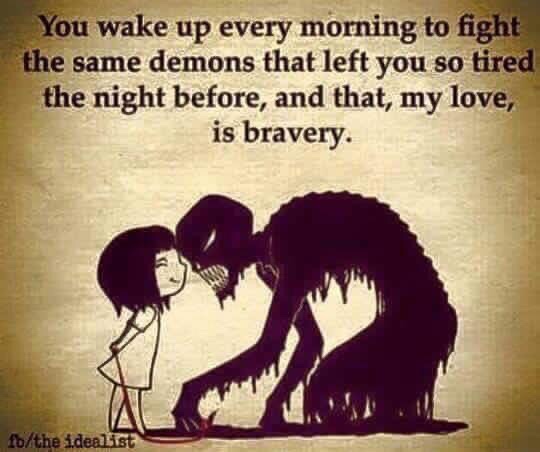
I sat there the silence deafening staring blankly at AnneMarie, my therapist for the past year and a half. I trusted her completely, trusted her with my life. I knew I’d be dead without her. Times had been rough after my liver transplant in 2011. When I should be putting my life back together filled with hope, mine was crashing around me. Today I was numb. I’d been numb for weeks, feeling nothing.Failure, you’re fucking worthless. The depths of clinical depression, of schizoaffective disorder is horrible, but the numbness is worse, much worse. No highs, no lows, not feeling anything at all, just the unceasing voices screaming at me from inside my head. I can’t imagine anything worse than fighting your own brain everyday, every night, every morning when you wake up.
“Mark,” she repeats no impatience in her voice only concern, “let’s see your arms.” I roll up my left sleeve. The cuts aren’t deep, but repeated. Parallel line after line up the length of my arm where I had dragged the razor blade over my tender skin. It was pink, inflamed, not infected but obviously sore. Cut deeper you failure,the screaming continued. I’ve been cutting myself off and on since I was sixteen. It slows the racing thoughts, quiets the voices, allows me to feel something, anything. “How many times did you cut yourself since I last saw you?”
“Maybe a hundred,” I reply calmly without a sense of regret. It had been less than a week. “It’s better than the numbness.”
“You don’t deserve this,” I shrug my shoulders. “As I said earlier, I’m leaving it up to you, River Point Behavioral Health or Wekiva Springs for an evaluation. I’ll give you through tomorrow.”
“I won’t go inpatient,” I stammer, “not here, not in Florida.” Florida is 49thin mental health funding. I’ve flatly refused to go inpatient here in the past even though I’ll admit I probably needed it. There are two hospitals I’m willing to go to: Johns Hopkins in Baltimore and McLean outside Boston. Both are long shots at best, perhaps that is the idea.
“You’re critical Mark. I never said inpatient just an evaluation and possibly a partial hospitalization or intensive outpatient (IOP). If you don’t I’ll have to baker act you.” I know she doesn’t say this lightly. Just imagining the police taking me involuntarily is frightening. The threat of Involuntary commitment rings in my ears. It’s not the first time she’s threatened commitment, nor will it be the last. She knows it will get me to do what is in my best interest.
“Fine,” I shrug. I know it’s for the best, but that doesn’t mean I’m happy about it. “I’ll go this afternoon.”
“Are you okay to drive.”
“I think so, yes.”
“Have you been having anymore visual hallucinations?” I shake my head the pit of depression opening up again swallowing me whole as I’m resigned to my course. You’re fucking pathetic, tell her no,the voice snaps. At best I’ll be spending weeks at the mental hospital. I just went through IOP a few months ago and returning is not what I had envisioned for me. “How are the voices?”
“Constant,” I say matter of factly.
“What are the saying?”
“That I’m worthless. I’d be better off dead. They’re laughing at me. To cut myself. The usual.”
“You’re listening to them then?”
“Sometimes,” I concede.
“Are you suicidal, having suicidal thoughts?”
“Thoughts yes. No plans though.” She nods understanding that I do not intend to kill myself. In the past when I’ve been suicidal I’ve had very intricate plans: listen to particular music, a last meal, the exact outfit I plan to wear, etc. “I fantasized about swimming out into the ocean until I didn’t have the strength to go any further.”
“Is that your plan?”
“No I’d throw myself in front of a train,” I confess, “It’s quick and a sure thing.”
“When did you come to that decision?”
“Recently,” I admit. “I can’t though. I owe it to my donor’s family to survive.”
“Yes you do. How’s your sleep?”
“Terrible. I’m getting only three hours a night or less.”
“Nightmares?”
“The same as always. Jerked awake in a cold sweat, my heart racing. Always the same dream. I relive it every night. Every night since I was sixteen.”
“Are you meditating?”
“Every evening before bed.”
“I think you should try meditation in the morning as well. Keep meditating at night as well as the rest of your evening routine. We have to get you more sleep. Are you taking your trazadone?”
“No. It makes me loopy all the next morning.”
“I understand, but you need some sleep. You need to focus on how far you’ve come the past couple of years. You are healthy physically after your transplant. You are sober. Those are major accomplishments.”
“I try.” There are currently 120,000 people on the organ waiting list, 17,000 people on the liver transplant waiting list. Only 6,000 receive a liver annually. The guilt that I didn’t deserve one is consuming me. The fact that I lied my way through the Mayo Clinic psych evaluation haunts my memory. Am I sorry for that? No, it was the only way to get a transplant. I’d have been listed as potentially noncompliant. Did I deserve the organ? I don’t think so. Add it to the list of my issues.
The limp body father and son carried a couple days earlier, an arm over each of their shoulders, was jaundiced, and helpless. They were headed for Doctor Patterson’s office hastily not certain what was wrong with their load. It would only take him a moment to recognize the signs and call the emergency room. A few hours earlier the father had broken into his youngest son’s apartment to find him confused and disoriented soaked in sweat and droplets of blood.
I had been diagnosed with end-stage liver disease. I was forced to close my little bookstore I lived above. I was lying in the intensive care unit as I had almost bled out from ruptured esophageal varices, abnormal, enlarged veins in the lower part of the esophagus. My parents were moving my possessions from my apartment into storage, I was moving back in with them unable to care for myself. I was an alcoholic who had brought this on myself. I was at ground zero, I had bottomed out, my life was in shambles and I was clinging to the unknown, the long road ahead of me through liver transplant and back to life. I had screwed up, screwed up big this time. I don’t make small mistakes, I make grandiose ones. I don’t screw up my life in subtle ways, I go over the top. I hadn’t really been living for sometime, merely existing, languishing too afraid to live, too afraid to die. My parent’s worried faces were burnt into my brain as they looked down on my body love in their eyes, tubes pouring out of me to the ticking, clicking, beeping monitors that kept me alive. The doctors had poured seven units of blood into my body in an effort to save my life, with three more to come in the next few days. It’d worked. Beyond all reason, I was ready to fight!
I had known for sometime I was slowly killing myself with each drink, I was unhappy, severely clinically depressed, ready to die. I had begun passing blood two days before my thirty-seventh birthday. My stool was black, grainy, appearing like coffee grounds. I googled the symptoms. Word for word there it was on the computer screen, I was passing blood. Get yourself to the emergency room immediately. There was no grey area in the instructions. I poured myself another pint sized vodka tonic, heavy on the cheap vodka, Kamchatka. The tonic water just enough to give the hint of effervescence. I was sitting in the dark at my desk in the bookstore a half empty bottle of Jameson Irish whiskey on the desk, my vodka tonic in hand, and the computer screen screaming liver failure, alcoholic cirrhosis. I didn’t care, perhaps this would be it. I’d lie my head on the pillow and never wake, an end I was anticipating, even welcoming.
This tightrope, this cliff, this edge was the precipice where I seemed to live. The only people who truly know this precipice are those that have gone to excess. I had fallen. This was it, this is where I’d been headed for a few years. I wasn’t the heaviest drinker I knew, far from it in fact. There was Taylor who infamously in my circle of friends routinely completed the Jäger challenge. I’d watch with some perverse fascination as he’d slam down an entire pint glass of Jagermeister in one swallow. It was impressive on some level. There was Frank who was twenty years my senior and would drink pint glasses of whiskey sours with maybe a shot of sour mix. I would sit with him while he drank four, five, six or more of these in an evening, every evening. I was always the quiet one at the end of the bar, a classic novel perhaps Hemingway or Tolstoy in front of me, sipping my vodka tonic and a rocks glass of Jameson Irish Whiskey. I used to be a beer drinker, but that had changed somewhere along the way. I had built up a tolerance and needed something stronger, faster, cheaper.
I knew I had lost control about a year and a half earlier. Up until then I never drank at home, I never drank alone. Now my alarm went off in the morning and I’d pour myself a shot of Jameson and drink it down before I sat up in bed. How had I gotten to this point? The negative self talk had gotten worse, much worse. I’d wake each morning tremors wracking my hands as I needed my fix. A shot of whiskey and my hands calmed down, not steady but functional. I’d head downstairs to open my store. I’d pour myself a vodka tonic I kept in the dorm fridge behind my desk. My store that had once been doing pretty well, now the recession, a new public library, recently opened Barnes & Noble and Borders Books all cutting into the bottom line. I had poured myself into my little store and somehow I’d turn it around I endlessly told myself. I couldn’t fail at this, it’s all I had. I wasn’t ready to admit failure, not if I could help it, I’d rather die first.
Something had transpired between those last days of drinking and waking up in intensive care gazing into my parent’s eyes. It was utterly simple, for the first time I could recall in several years I wanted to live. I’m not sure at first if I wanted to live for them or myself, but unmistakably my thirst for life had returned. I had long known I needed a therapist, a psychiatrist. I desperately needed help. It had come on slow and suddenly at the same time. I guess that’s how mental illness works. It was hard to recall when I hadn’t been depressed. I was barely a teenager when I first noticed the hole growing inside me, something empty. It was small at the time, faint and lacking the substance it would develop in later years as I fed it with each cocktail. I’d learn to nurture and focus on the emptiness I felt so acutely. Did I really have it all that bad though, so many had it worse. After all I had a loving family, my own business, friends, and vodka. I’d just feed the growing hole another drink, ignore it, block it out. It was a sign of weakness to seek professional help for your problems, I could handle it myself, I’d simply pull up my bootstraps and carry on.
They say what doesn’t kill us makes us stronger. You are only given what you can handle. The cliches are endless and infuriating, but sometimes on target. I had the most difficult fight of my life directly ahead of me. I was being held together by tubes and wires, the intensive care nurse checking on me every few minutes to take my vitals. I had no idea what I had been through the last few days as I lie there fading in and out of consciousness. No recollection of what I’d put my parents through as they prayed that I’d survive. I could read the worry in their faces as the doctor asked me questions. “Do you know the date? Do you know where you are? Do you know who these people are?” I could only imagine he’d asked me these questions before and I hadn’t known the answer. Guilt was already swelling inside me, but there was a more acute emotion dominating shame. Admitting to my Alcoholism was only the final confirmation of how weak I truly felt. My natural reaction was to pour myself another shot of Jameson and bury these feelings, but that wasn’t available to me here. Instead when the doctor asked how much pain I was in, I responded with a ten. In minutes a shot of morphine was administered and I faded into sweet numbness these negative thoughts would be there when I woke. The running was over, I’d make my stand.
The criss-crossing clash of tiny dishes echo in my mind,
The self-orchestrated visions of my past resurface,
Times of glory, times of disgust and hate,
I scream in the darkness of my mind,
As the ether mask is placed over my mouth, choking my protests.
A guilt that consumes,
A guilt that devours,
Reaches down wrenching out my soul,
I shudder, my legs tremor,
My back stiffens,
A gasp released from my lungs.
I stare in disbelief at my guilt,
As it actualizes before me,
It twists, it turns and swirls,
Taking a perverse form before me,
I drop to my knees, body rigid,
Offering myself in prayer to my guilt, to my soul.
Do I deserve what I desperately require,
Is it fair to ask this of the world,
My mind spins to the ringing chorus of answers,
To each of my pertinent questions,
I cringe straining to make out their replies,
Is this my personal hell?
I formed and molded my private hell,
Out of each decision along my road,
Stretching back as far as I can remember,
“No,” I don’t deserve what I seek,
The voice echoing in my mind,
Whispers with a mocking laugh.
A laugh I shall not be soon to forget,
Mockingly the voices swirl within my mind,
I stumble from question to question,
All the while the laughing echoes,
Into the recesses of my vacant soul,
Tears flow down my ashen face.
My jaws are pried wide open in horror,
The ceiling spins, the walls melt away into darkness,
My eyes blink as the needle impales my vein,
Insecurity washes over and through me,
Will I succumb to the voices, will it wash hope away.
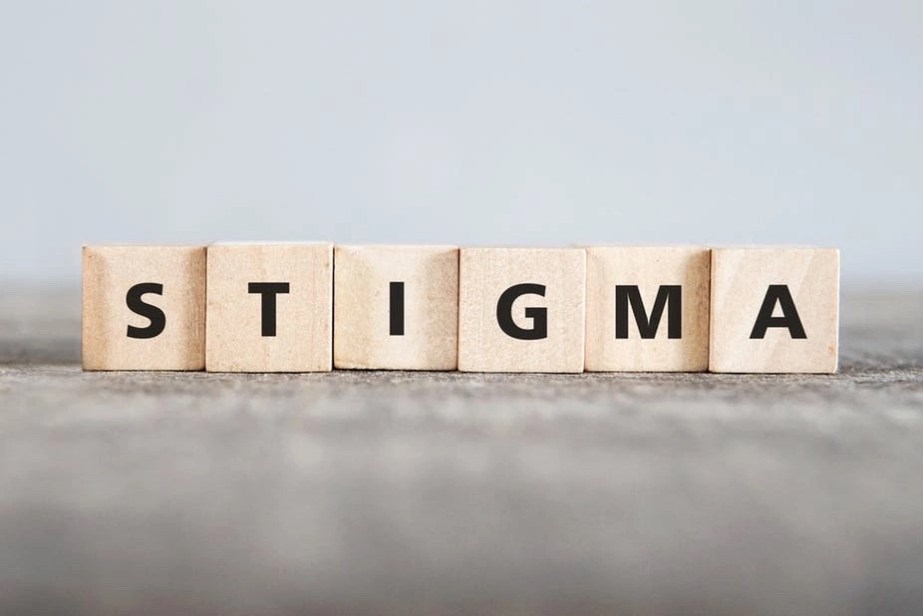
Stigma is a mark of disgrace associated with a particular circumstance, quality, or person. Never is this so acute in American society as when discussing mental illness, the boogeyman of all health conditions. I’m not going to try to bore you with statistics, but there are a few to understand to put this epidemic in perspective (Statistics provided by the National Institute of Mental Health and American Journal of Psychiatry):
• 43.8 million adults experience mental illness in a given year.
• 1 in 5 adults in America experience a mental illness.
• Nearly 1 in 25 (10 million) adults in America live with a serious mental illness.
• One-half of all chronic mental illness begins by the age of 14; three-quarters by the age of 24.
• 18.1% (42 million) of American adults live with anxiety disorders.
• 6.9% (16 million) of American adults live with major depression.
• 2.6% (6.1 million) of American adults live with bipolar disorder.
• 1 in 100 (2.4 million) American adults live with schizophrenia.
• Depression is the leading cause of disability worldwide, and is a major contributor to the global burden of disease.
• Serious mental illness costs America $193.2 billion in lost earning every year.
• 90% of those who die by suicide have an underlying mental illness. Suicide is the 10th leading cause of death in the U.S.
• Nearly 60% of adults with a mental illness didn’t receive mental health services in the previous year.
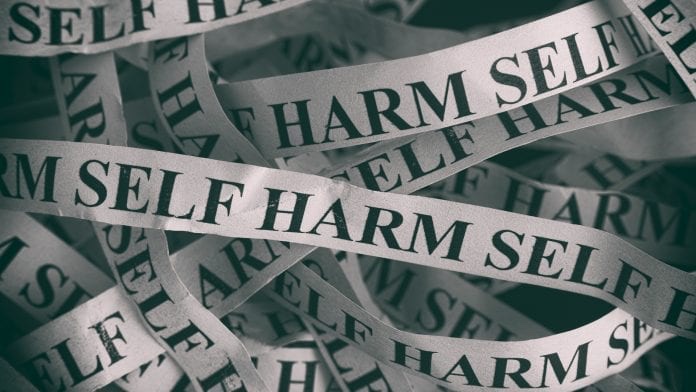
When you hear of mental illness and self-harm most people immediately jump to thoughts of cutting or burning. The simple fact though is there are so many other ways people punish themselves, punishing yourself day after day because you feel like you are deserving of that because you truly believe you need to be punished.
Self-punishment has a lot of shapes and forms. It can go from not taking an umbrella when it rains because you feel like you don’t deserve to be dry, writing 100 lines saying “I am worthless and the world is better without me,” not adjusting the thermostat when it’s freezing cold or overwhelmingly hot, or walking two more miles because your legs don’t ache enough yet. It’s choosing chocolate over vanilla because you prefer the vanilla one, or writing an essay by hand because typing would be easier. It’s not allowing yourself to sleep, or to take your medication or go for a relaxing walk. It’s putting yourself in dangerous situations but it’s also is not taking that shower because you feel like you are so incredibly undeserving of kindness towards yourself.
You are enough just the way you are, and you deserve help coping…






 Mark Bere Peterson’s Counterculture, Urban Legends, Paganism & Witchcraft