Psychological Projection and Other Defense Mechanisms

Psychological Projection —> Psychological projection is a defense mechanism people subconsciously employ in order to cope with difficult feelings or emotions. Psychological projection involves projecting undesirable feelings or emotions onto someone else, rather than admitting to or dealing with the unwanted feelings. Have you ever disliked someone only to become convinced that the person had a vendetta against you? This is a common example of psychological projection. Luckily, there are methods you can use to identify why you are projecting your emotions and put a stop to this coping mechanism.

Other common defense mechanisms include:

Denial – Refusing to admit to yourself that something is real (e.g., not believing the doctor when she tells you some particularly bad news about your health).

Distortion – Changing the reality of a situation to suit your needs (e.g., thinking that your boyfriend cheated on you because he was scared of commitment).

Passive Aggression – Indirectly acting out your aggression (e.g., purposely parking in your co-worker’s parking spot as retribution for a previous dispute).

Repression – Covering up feelings or emotions instead of coming to terms with them (e.g., being unable to recall the details of a car crash you were involved in – the brain sometimes purposely “loses” these memories to help you cope).

Sublimation – Converting negative feelings into positive actions (e.g., cleaning the house whenever you are angry about something).

Dissociation – Substantially but temporarily changing your personality to avoid feeling emotion (e.g., trying to “keep yourself together” at a funeral for the benefit of others).

Word Salad

Word Salad

Times lapses repeating always inside my mind,
Trauma assault voices always the same time lapses,
They’re coming implanting thoughts actions in my head,
Time lapses repeating inside outside assault voices,
Stop the noise overwhelming destroying screaming.
Past past future present moments in time shadow,
Darkness echoes whispers time forgotten realities,
Shadow people cloaked darkness, eyeless, faceless,
Across all time pursuing reality lapses inside out,
Clawing cutting scaring skin stretches too tight blood,
Trickling down releases screaming always the same.
Voices in my head chirping chirping scratching,
Whispers whispers in my head, images of a time only I see,
Time races time crawls time stops in moments of lucidity.

Generalized Anxiety Disorder: Symptoms

It’s normal to feel anxious from time to time, especially if your life is stressful. However, excessive, ongoing anxiety and worry that are difficult to control and interfere with day-to-day activities may be a sign of generalized anxiety disorder.

Generalized anxiety disorder symptoms can vary. They may include:

• Persistent worrying or anxiety about a number of areas that are out of proportion to the impact of the events

• Overthinking plans and solutions to all possible worst-case outcomes

• Perceiving situations and events as threatening, even when they aren’t

• Difficulty handling uncertainty

• Indecisiveness and fear of making the wrong decision

• Inability to set aside or let go of a worry

• Inability to relax, feeling restless, and feeling keyed up or on edge

• Difficulty concentrating, or the feeling that your mind “goes blank”

Physical signs and symptoms may include:

• Fatigue

• Trouble sleeping

• Muscle tension or muscle aches

• Trembling, feeling twitchy

• Nervousness or being easily startled

• Sweating

• Nausea, diarrhea or irritable bowel syndrome

• Irritability

There may be times when your worries don’t completely consume you, but you still feel anxious even when there’s no apparent reason. For example, you may feel intense worry about your safety or that of your loved ones, or you may have a general sense that something bad is about to happen.

Your anxiety, worry or physical symptoms cause you significant distress in social, work or other areas of your life. Worries can shift from one concern to another and may change with time and age.

Cutting: A Love Story

I wrote this eight years ago in an attempt to explain the love/hate addiction to cutting. The impulse when I felt so numb that the pain of the razor blade slicing my arms and the blood trickling down to my open palm was preferred to feeling nothing at all:

Cutting: A Love Story

Long ago you made the choice, that first cut,

You found the pain incredible, the blood a release,

The cuts were shallow, hardly scratches really,

They healed quickly, not even a scar left behind.

A choice, a choice to isolate, a life in constant shame,

You lie to those closest and dearest to your heart,

Sometimes now they take months to heal,

Scars carved into your flesh for all to witness.

You’ll define your life as before and after cutting,

Terrified you’ll fear the touch of a friend,

Skin burning from the sweet release of your blood,

Wincing you’ll fear the tender touch of a friend.

The cuts spread, no longer constrained to your arms,

Deeper they grow week by precious week,

You’ll realize you’re losing all self-control,

Fear your next cut, love it, how deep will it be?

Your life revolving around the next chance to cut,

A razor blade hidden away in your wallet,

Will today be the day you cut too deep?

A day when the blood won’t stop, gasping, shaking.

Blood won’t stop flowing, ever down your arm,

Fearful, terrified a panic attack chokes your heart,

Alone, always alone, you’ll swear you’ll stop,

A sweet lie as the blood pools in your hand.

This is just the beginning of the romance,

You’ll learn to take care of your one true love,

Antibiotic cream, bandages, medical tape,

The cuts will grow wider, grow deeper.

Watching, hoping to find someone who understands,

Searching, the signs will be everywhere and nowhere,

Long sleeve shirts, bracelets, wristbands,

But their skin will be untouched, perfect, and flawless.

Isolating more and more, alone, always alone,

Your last cuts deeper, burning through the shame,

The relief doesn’t last nearly as long anymore,

You know you need to cut deeper, wider.

You dream of cutting, or just letting one person know,

You love, you hate the day you made the first cut,

Each time you pray for the strength to push harder,

Rolling up your sleeve, face-to-face with your one true love.

#MySchizLife #Cutting #SelfHarm

Post Traumatic Stress Disorder (PTSD): Symptoms

Post-traumatic stress disorder (PTSD) is a mental health condition that’s triggered by a terrifying event — either experiencing it or witnessing it. Symptoms may include flashbacks, nightmares and severe anxiety, as well as uncontrollable thoughts about the event.

Intrusive memories

Symptoms of intrusive memories may include:

  • Recurrent, unwanted distressing memories of the traumatic event
  • Reliving the traumatic event as if it were happening again (flashbacks)
  • Upsetting dreams or nightmares about the traumatic event
  • Severe emotional distress or physical reactions to something that reminds you of the traumatic event

Avoidance

Symptoms of avoidance may include:

  • Trying to avoid thinking or talking about the traumatic event
  • Avoiding places, activities or people that remind you of the traumatic event

Negative changes in thinking and mood

Symptoms of negative changes in thinking and mood may include:

  • Negative thoughts about yourself, other people or the world
  • Hopelessness about the future
  • Memory problems, including not remembering important aspects of the traumatic event
  • Difficulty maintaining close relationships
  • Feeling detached from family and friends
  • Lack of interest in activities you once enjoyed
  • Difficulty experiencing positive emotions
  • Feeling emotionally numb

Changes in physical and emotional reactions

Symptoms of changes in physical and emotional reactions (also called arousal symptoms) may include:

  • Being easily startled or frightened
  • Always being on guard for danger
  • Self-destructive behavior, such as drinking too much or driving too fast
  • Trouble sleeping
  • Trouble concentrating
  • Irritability, angry outbursts or aggressive behavior
  • Overwhelming guilt or shame


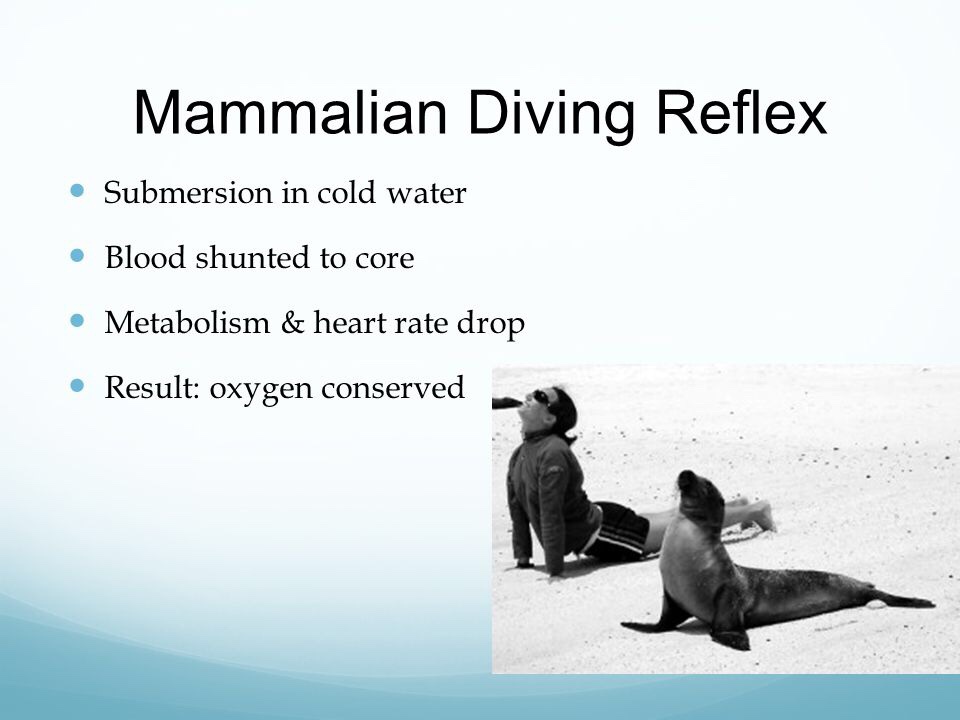
Mammalian Diving Reflex

How to Activate the Mammalian Diving Reflex:

In order to get ourselves to a place of being capable of processing information, we must find a way to essentially “reset” the nervous system. Fortunately, all mammals have something called the “mammalian diving reflex” that forces the parasympathetic nervous system (PNS) to kick in, which functions to relax us and calm us down.

Dr. Linehan explained that this reflex is activated by icy cold water (i.e., not freezing) on the face. In particular, the icy cold water must hit the parts of the face just below the eyes and above the cheekbones for the dive reflex to be activated. She suggests that when in an extremely heightened state of emotional arousal:

• Fill a bowl with icy cold water

• Bend/lean over

• Hold your breath

• Put face in icy cold water for 30 seconds

• Make sure that area underneath eyes/above cheekbones (most sensitive part of the face) feels the icy water

Dr. Linehan reports that this surprisingly simple technique will “calm you down immediately” and is “incredibly effective.” Other ways to activate the diving reflex and get the parasympathetic nervous system to kick in and calm you down include an icy cold gel mask over/around the eye area. It is worth noting that this technique also works best (to activate the dive reflex) if you hold your breath and bend over for 30 seconds.

Warnings:

Caveats to using this technique:

• Activating the dive reflex slows the heart rate, so anyone with heart problems or a slow heartbeat should avoid this strategy

• Those with eating disorders (particularly anorexia nervosa) should avoid activating the dive reflex, as this is dangerous for the heart

Not convinced that something so simple could be so powerfully effective? Evolutionary processes have existed for thousands of years to provide means of regulating our emotions, since effective regulation of emotion is so vital to our survival. Consider how likely a person is to survive over the long-term if they are utterly incapable of calming themselves down when in an intense state of emotional arousal.

An incredible part of this simple technique is that it provides immediate relief and is intended to get you into a functional state of mind where you are capable of using problem-solving skills to solve the intense problem at hand. The next time that you experience an event so intense that you are completely overwhelmed to the point of not being able to think clearly or process information, activate the diving reflex. Thirty seconds later, you will be able to process incoming information and use problem-solving skills.

The Existence of Shadow People

I SEE GHOSTS OR SHADOWS

If you’re seeing things that aren’t there, it’s important to ask yourself a few questions to find out if something more serious is going on:

~ Does this happen often?

~ Are you sure no one else is seeing it? (This might sound weird, but it’s important to check your reality.)

~ Does seeing strange things bother you?

~ Do you experience other things that are weird or hard to explain, like hearing voices or feeling like people are watching you all the time?

If the answer to the above questions are yes, then you might be struggling with the early signs of psychosis.

WHAT SHOULD I DO NEXT?

Psychosis can get worse if you are especially stressed, don’t get enough sleep, or don’t reach out to get help. The sooner you can get help the better.

Here are some things to consider doing if you’re struggling with psychosis:

~ Take a mental health screen. You can show the results to someone you trust to discuss what to do next.

~ Manage your stress. Do you notice things that make your symptoms worse? How can you manage those situations so they can be avoided or be less stressful? Stress makes everything worse.

~ Are you getting enough sleep? Not getting enough sleep (especially for days at a time) can indicate that you’re experiencing other mental health problems, like bipolar disorder.

GETTING TREATMENT:

With treatment, early signs of psychosis can be resolved. Take a comprehensive approach to getting better. Someone can help you with school, work, family life, medications, and relationships. This type of treatment is called Coordinated Specialty Care. Psychosis also responds relatively quickly (within a week) to medications. If you are interested in getting medication, you want to talk to a doctor to find the right kind of medication treatment.

Don’t struggle alone and don’t wait. Taking some kind of step early is key to getting better.

#ShadowPeople #Psychosis #Schizophrenia #Bipolar

5 Types of Distorted Thinking

1. All or Nothing / Black and White / Polarized Thinking – thinking you’re good or bad, smart or dumb. Seeing a person as perfect or completely flawed. Not seeing the shades of gray of life, the middle ground.

2. Overgeneralization – When something goes wrong you assume everything will go wrong. Someone breaks up with you and you assume nobody will like you.

3. Focusing on  the Negative – You focus on the negative and you ignore the positive. You get 2 A’s, 2 B’s, and a D. Instead of focusing on the positives out obsess on the D.

4. Jumping to Conclusions / Mind Reading / Fortune Telling – You assume the worst. You think you can read minds. People are laughing and you assume it is about you.

5. Catastrophizing – You magnify the negative. You decide a small setback is a major catastrophe. You magnify your faults and ignore your achievements.

Depressive Schizoaffective Disorder: Symptoms

Delusions: These are false beliefs that are not based in reality. For example, you think that you’re being harmed or harassed; certain gestures or comments are directed at you; you have exceptional ability or fame; another person is in love with you; or a major catastrophe is about to occur. Delusions occur in most people with schizophrenia.

Hallucinations: These usually involve seeing or hearing things that don’t exist. Yet for the person with schizophrenia, they have the full force and impact of a normal experience. Hallucinations can be in any of the senses, but hearing voices is the most common hallucination.

Disorganized thinking (speech): Disorganized thinking is inferred from disorganized speech. Effective communication can be impaired, and answers to questions may be partially or completely unrelated. Rarely, speech may include putting together meaningless words that can’t be understood, sometimes known as word salad.

Extremely disorganized or abnormal motor behavior: This may show in a number of ways, from childlike silliness to unpredictable agitation. Behavior isn’t focused on a goal, so it’s hard to do tasks. Behavior can include resistance to instructions, inappropriate or bizarre posture, a complete lack of response, or useless and excessive movement.

Negative symptoms: This refers to reduced or lack of ability to function normally. For example, the person may neglect personal hygiene or appear to lack emotion (doesn’t make eye contact, doesn’t change facial expressions or speaks in a monotone). Also, the person may lose interest in everyday activities, socially withdraw or lack the ability to experience pleasure. Impaired occupational, academic and social functioning.

Depressive Features:

  • Feelings of sadness, tearfulness, emptiness or hopelessness
  • Angry outbursts, irritability or frustration, even over small matters
  • Loss of interest or pleasure in most or all normal activities, such as sex, hobbies or sports
  • Sleep disturbances, including insomnia or sleeping too much
  • Tiredness and lack of energy, so even small tasks take extra effort
  • Reduced appetite and weight loss or increased cravings for food and weight gain
  • Anxiety, agitation or restlessness
  • Slowed thinking, speaking or body movements
  • Feelings of worthlessness or guilt, fixating on past failures or self-blame
  • Trouble thinking, concentrating, making decisions and remembering things
  • Frequent or recurrent thoughts of death, suicidal thoughts, suicide attempts or suicide
  • Unexplained physical problems, such as back pain or headache