Although, the term “wearh” cannot be directly translated into “vampire,” it is an Old English term that has been used to describe vampires.
A wearh is a monster or evil spirit.
Many authors still use the term when writing about vampires and Anglo-Saxons between England and Scotland between the mid-5th century and the mid-12th century.
The Aniukha is a creature in Serbian stories. The Aniukha is a small creature (somewhere between the size of an insect and a rodent depending upon source) that sucks the blood out of infants. A Shaman must be called to help get get rid of the creature.
The Occitan language is a romance language that is spoken in southern France, Italy’s Occitan Valleys, Monaco and Spain’s Val d’Aran. It’s also spoken in Calabria, Italy, and Occitan is the official language in Catalonia.
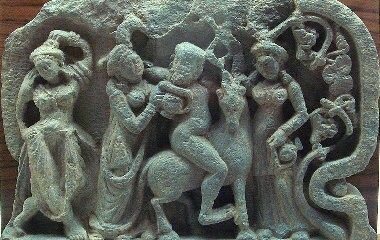
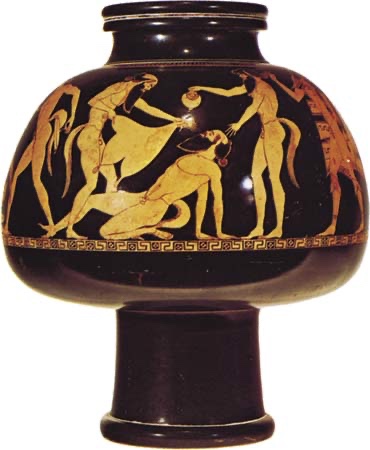
Satyrs were male hybrid creatures who were part horse and part human. They stood and walked upright, unlike the quadruped, half-horse Centaurs to whom they were akin, and in their original, traditional form, they had horses’ tails, long hair and beards, horses’ ears, bulbous foreheads, and snub noses. Artistic representations also showed them sometimes with the legs and hooves of a horse as well as with enlarged, erect penises. It was only in the Hellenistic Period (after 323 BCE, the death of Alexander the Great) that Satyrs, in an assimilation to the rustic god Pan, took on a goatlike appearance, having shorter tails and sprouting horns.
Satyrs, who in earliest times were indistinguishable from Silens, were woodland spirits or daemons that lived in the wild, being found in mountains, forests, and caves alongside Nymphs with whom they cavorted and whom these lusty creatures amorously pursued. Lustfulness, enthusiasm for wine, and a propensity for mischief were characteristic of them. Silens, on the other hand, came to be viewed as elderly Satyrs.
Alongside Nymphs, both Satyrs and Silens formed the typical entourage of the shape-shifting god Dionysus. The best-known Satyr in Classical mythology was also the most tragic of them. This was Marsyas, who had found the flute cast aside by the goddess Athena, and, when he discovered that he had a talent for playing the instrument, he made the terrible mistake of challenging Apollo to a music contest. As a consequence of his pridefulness, he was flayed alive. Another Satyr, his name unknown, pursued the Danaid Amymone, but was driven off by Poseidon, who then took up in the pursuit of the maiden himself.
The word, Alukah, literally means “horse-leech,” which is a type of leech that has many teeth and feed on the throats of animals. But, some Biblical Scholars believe ‘Alukah’ can also mean “blood-lusting monster.”
Alukah is a Hebrew vampire that was first referenced in Proverbs 30:15 in the Bible. Solomon refers to a female demon named “Alukah” in a riddle he tells in Proverbs. The riddle involves Alukah’s ability to curse a womb bearing seed.
Historically, Alukah has been closely associated with Lilith. Some believe that Alukah is the direct descendant of Lilith, whereas others think that the name Alukah may merely be another title for Lilith.
The most detailed description of Alukah appears in Sefer Chasidim, where the creature is said to be a living human being that can shape-change into a wolf. Alukah can fly by releasing her long hair. Alukah would eventually die if she is prevented from feeding on blood for a long enough time.
To prevent a vampire from becoming a demon, she needs to be buried with her mouth stuffed with earth.
Vampires vary throughout Jewish traditions in history. Sometimes they are demonic spirits and other times they are described as a type of witch.
The ancient Roman festival of Lupercalia (celebrated to avert evil spirits and purify the city, releasing health and fertility) has been one of the earliest records of the term Valentine’s Day. But the holiday isn’t what you would imagine.
The event, which was held February 13 to February 15, began with the traditional sacrifice of an unlucky goat and dog.
A group of priests called the Luperci then cut off a piece of the skin of the two animals, touched it to their foreheads and then struck it against every woman nearby. The thinking, it was said, is that the women hoped it would help make them more fertile.
By the end of the 5th century, Pope Gelasius I had seen enough — he replaced Lupercalia with St. Valentine’s Day.
“One might reasonably define mythology as other people’s religion. The definition of religion is equally uncomplicated: it is misunderstood mythology. The misunderstanding consists typically in interpreting mythological symbols as though they were references to historical facts. . . . One finds the same basic mythological themes in all the religions of the world, from the most primitive to the most sophisticated, from the North American plains to European forests to Polynesian atolls. The imagery of myth is a language, a ‘lingua franca’ that expresses something basic about our deepest humanity.”
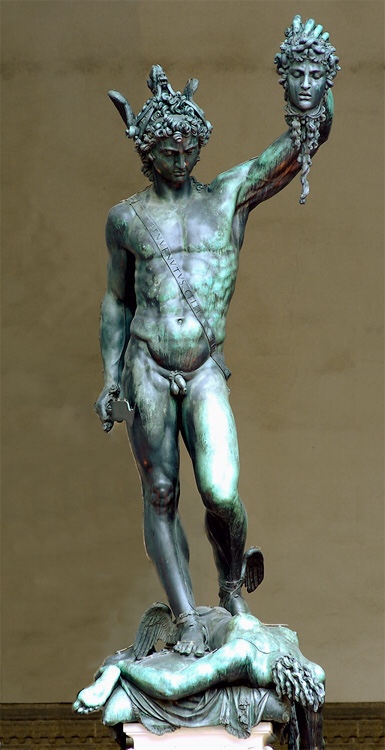
Today in 1571 – Benvenuto Cellini, Italian painter and sculptor (b. 1500)
Here’s one of Cellini’s masterpieces: Perseus with the Head of Medea (1545-1554). The sculpture is thought to be the first statue since the classical age where the base included a figurative sculpture forming an integral part of the work.
“I have read somewhere of an old Chinese curse: ‘May you be born in an interesting time!’ This is a VERY interesting time: there are no models for ANYTHING that is going on. It is a period of free fall into the future, and each has to make his or her own way. The old models are not working; the new have not yet appeared. In fact, it is we who are even now shaping the new in the shaping of our interesting lives. And that is the whole sense (in mythological terms) of the present challenge: we are the ‘ancestors’ of an age to come, the unwitting generators of its supporting myths,the mythic models that will inspire its lives.”







 Mark Bere Peterson’s Counterculture, Urban Legends, Paganism & Witchcraft