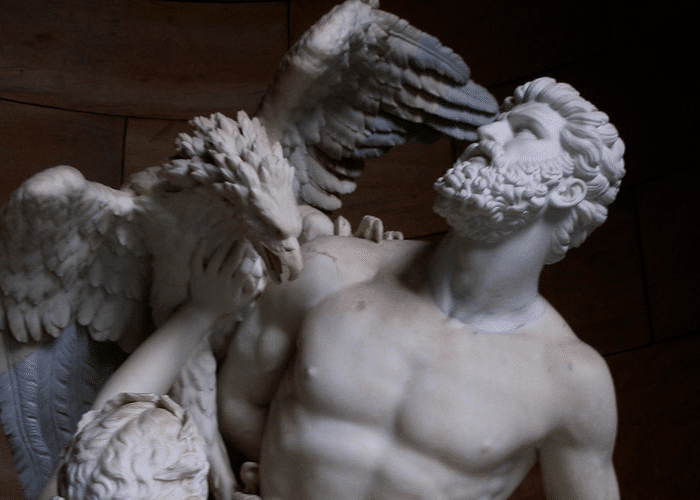
Everyone knows Prometheus stole fire from the gods on behalf of mankind. That’s all some people, especially youths, today need know to inspire them to adapt Prometheus as their icon, and to adapt the Greek deity’s name for their online monikers.
The actual Greek myth is a bit more complex. In a reductionist nutshell: Prometheus is a Greek god of Olympus, ruled by Zeus. He initiates animal sacrifices. One day during a sacrifice he sasses Zeus. He cuts up a bull and divides it into two parts: one containing the flesh and intestines wrapped up in the skin; and the other consisting of only bones and fat. Prometheus asks Zeus to choose his share; the rest is to be given to man. Zeus picks the bones and fat, making him bitter against Prometheus and against humankind. Zeus punishes the mortals by withholding from them the gift of fire. Prometheus steals it back. Then Prometheus—who is known to have the gift of foresight—further sasses the great god Zeus by predicting that one of Zeus’ children would one day dethrone him, but refusing to say which one. The enraged Zeus punishes Prometheus by binding him in steel chains to a rock in the Caucasus Mountains. There, every day for eternity, an eagle is sent to tear and eat Prometheus’ liver. Every night, the god Prometheus’ immortal liver renews itself so that he can be tortured again in the next day’s light.
Sources: Counterculture Through the Ages by Ken Goffman & Dan Joy
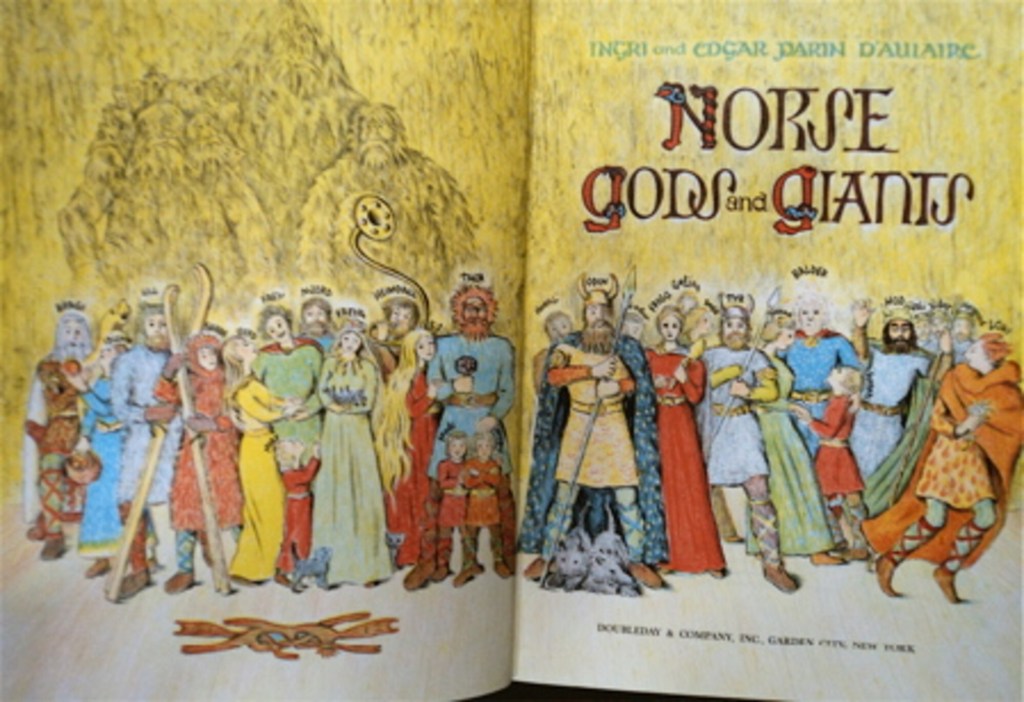
The word Asgard comes from the Old Norse word Ásgarðr, meaning Enclosure of the Aesir. Asgard is one of the nine worlds in Norse Mythology, along with Niflheim, Muspelheim, Midgard, Jotunheim, Vanaheim, Alfheim, Svartalfheim, and Helheim. Asgard is the home of the Aesir, deities of one of two tribes of Norse gods. The other tribe, the Vanir, used to share Asgard but the two tribes fought a long, epic war over their differences and the Vanir were forced to leave Asgard. The two tribes did reach an eventual truce as they joined forces against their common enemy, the Giants.
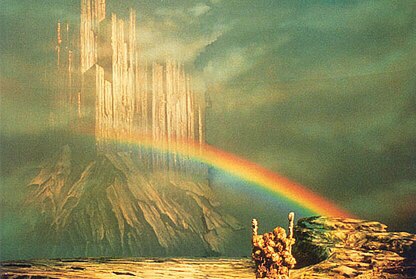
Snorri Sturluson, author of the Prose Edda, wrote that Asgard was created by the gods after they created Jotunheim (Giantland), Midgard (Middle Earth or home of humanity), the seas, sky, clouds and the Earth. The home of the gods is said to be a giant fortress with walls reaching up into the clouds to protect them from their enemies, particularly the frost-giants.
Asgard is situated in the sky upon the plains of Idavoll, where the gods met to discuss important matters. It was connected to Midgard by a rainbow bridge called Bifrost. The mythical place was invisible and inaccessible to mortal men.
The ruler of the gods, Odin, had his throne in Asgard, in a hall called Valaskjalf. His throne was called Hlidskjalf and it is believed that when Odin sat on Hlidskjalf, he could see the whole of heaven and Earth and everything that happened anywhere! A hall made of pure gold was also situated in the home of the gods. It was called Gladsheim and housed the thrones of Odin and the 12 highest gods. The goddesses’ hall was called the Vingolf or hall of friendship. The gods and goddesses would meet every day and discuss the fate of world at the Well of Urd (destiny), from which the Yggdrasil (the tree connecting the nine worlds) grew.
Asgard also housed Valhalla (the hall of the fallen). Odin granted access to the worthy dead, the majority of whom were esteemed warriors. Here, he feasted and celebrated with the battle heroes. Valhalla was easily recognizable by its rafters formed of spears, and use of shields as roof tiles. According to certain sources, the doors of Valhalla were so wide that 800 warriors could walk through at the same time! A vast river, the Thund, and a barred gate, Valgrind, protected the entrances of Valhalla.
One of the most recognizable ancient Egyptian symbols, the ankh, is one of the few vestiges to survive the decay of the old religions and still be in use today.
What Is the Ankh?
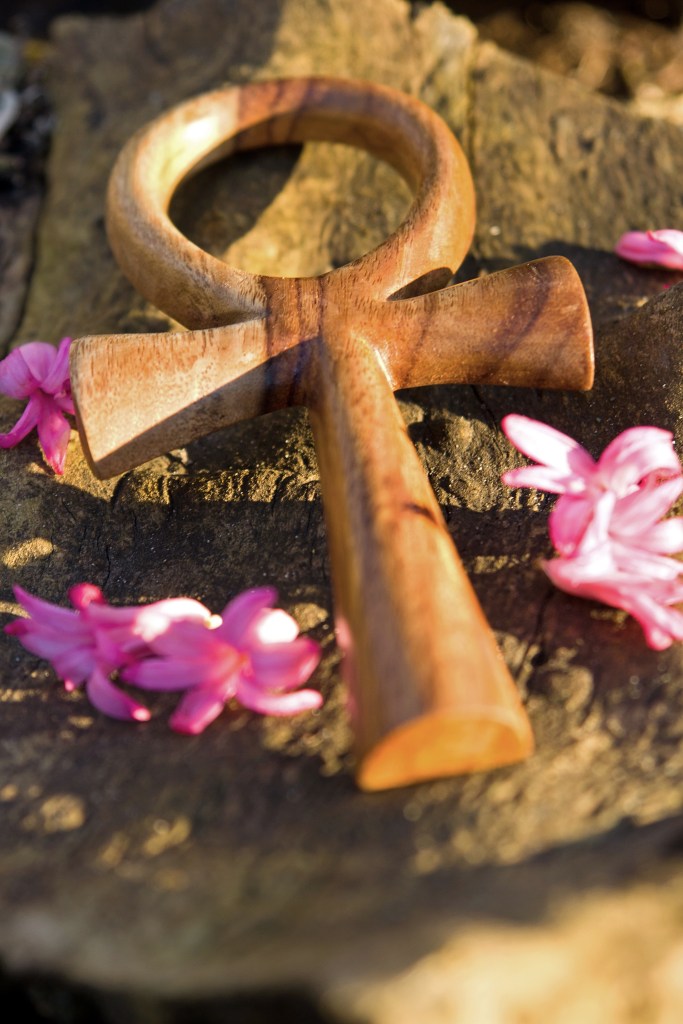
The ankh is an ancient Egyptian hieroglyph or symbol known as the cross of life or key of life and dates back to the Early Dynastic period (3150 BC – 2613 BC). The symbol resembles a cross with a loop on the top. The ankh is seen in the hands of almost every deity, carried by the loop or with arms crossed and one in each hand. The symbol was found as far afield as Persia and Mesopotamia in dig sites and was said to connote both mortal existence as well as eternal life.
Origin
Various theories exist about the origin of the symbol, but popular opinion suggests the origin is unknown. In 1869, mythologist Thomas Inman believed the ankh was a sexual symbol, and Egyptologist E. A. Wallis Budge similarly thought it may symbolize the belt buckle of Isis or Tyet. The ceremonial girdle or Knot of Isis, was alleged to represent female genitalia and fertility. Egyptologist Alan Gardiner posited it represented a sandal strap, as the word sandal and ankh came from the same root word. His theory was further affirmed by the fact that the sandal was a part of daily life in Egypt and the ankh also represented life. In a more recent publication, The Quick and the Dead, the authors claim the ankh ties to ancient cattle culture.
Usage
The symbol was portrayed on amulets, with the Djed (meaning stability) or Was (meaning strength) – symbols which were said to provide the protection of the gods to the wearer. Ptah is also seen making offerings with these three symbols in images representing him. The ankh was associated with the purifying power of water. This was evident on numerous temples where the king was depicted with two gods pouring a stream of ankhs over his head to cleanse him.
Gods and kings are frequently depicted holding the ankh to show their immortality and command over life and death. For those that had passed into the afterlife, the symbol was carried when their souls were weighed or aboard the boat of the Sun God, indicating their desire for immortality like the gods. According to the Dictionary of Symbols by Jean Chevalier and Alain Gheerbrant, it also represents the spring of eternal life and divine virtues. When it was held by the loop, usually in funeral rites, it may have been perceived as the key to opening the gateway to the Fields of Aalu, the Egyptian version of the Elysium Fields. Chevalier and Gheerbrant further postulated that when the ankh was placed between the eyes, it symbolized the duty of the person to keep the mystery he was initiated into a secret.
Early Dynastic and Old Kingdom Period
In the Early Dynastic period, the symbol became popular through the rise of the cult of Isis and Osiris. Isis is seen holding the ankh more frequently than other deities. Since the cult of Isis promised immortality through personal resurrection, the symbol became imbued with greater meaning and potency.
During the Old Kingdom Period, the ankh was well known as a symbol of eternal life. The dead were called ankhu and the symbol appeared frequently on sarcophagi and caskets.
Middle Kingdom and New Kingdom Period
The word ’nkh became associated with mirrors, from the Middle Kingdom Period onward. The Egyptians believed mirrors were magical and used them in divination. An ankh-shaped gilded mirror was found in Tutankhamun’s tomb. The Egyptians believed the afterlife was a perfect reflection of life on earth – a mirror image. During a particular festival, called the Festival of Lanterns, the Egyptians would light oil lamps to create a night sky of stars on earth to mirror the stars in the sky and the afterlife. When they did this, it was said to help them commune with the dead who had passed on the Fields of Aalu or Field of Reeds.
During the New Kingdom, the ankh was used in ceremonies and became associated with the cult of Amun. During the Amarna period, images of Aten the sun-disk often contained ankhs at the end of the sun’s rays.
Knot of Isis
The Tyet, or Knot of Isis, is very similar to the ankh. The arms of the cross are bent downward, differentiating the Knot of Isis from its counterpart, but it similarly means life or welfare. Sources claim the Tyet combines the concept of life and immortality with the knots which fasten mortal life to earth. To savor immortal life, the knot purportedly needs to be unraveled.
Modern Use
The symbol is used by modern Pagans as a symbol of faith, in healing and to promote psychic communication. It is viewed as a symbol of life by various new age religions. Thelemites, followers of the religion created by Aleister Crowley, also make use of the ankh as a union of opposites, a symbol of advancing one’s destiny or of divinity.
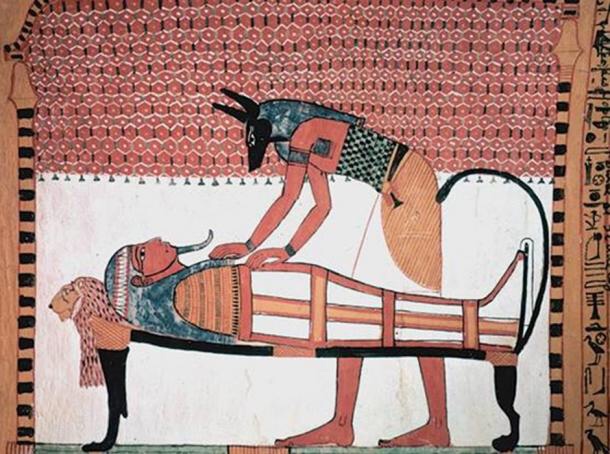
“Anubis was the guardian of all kinds of magical secrets. In the Papyrus Jumilhac, he appears as the leader of the armed followers of Horus. His ferocity is a match for the violence of Seth. In magical texts of a similar date, Anubis is named as ‘Lord of the Bau’. Whole battalions of messenger demons are under his command. In the magical papyri dating to Roman times, Anubis acts as the main enforcer of curses. The gracious deities of the cult temples are scarcely recognizable in the pitiless gods and goddesses encountered in everyday magic. (…) A story in Papyrus Jumilhac (c. 300 BC) explains the custom by relating how Seth once turned himself into a panther after attacking the body of Osiris. Anubis captured and branded the panther, creating the leopard’s spots. The jackal god decreed that leopard skins should be worn by priests in memory of his victory over Seth.”
They are one of two clans of Norse gods, the other being the Vanir. The Aesir and Vanir were in conflict for quite some time, leading to the Aesir-Vanir war. Later on, however, they seemed to get along just fine and the Vanir were eventually considered to be a sub-group of the Aesir.
Therefore, depending on the time in which a specific myth is set, the word Aesir may refer to all Norse gods or only to the ones that began as Aesir.
In Norse mythology, there are nine world that various beings may inhabit. These worlds are held in the branches of the World Tree, also known as Yggdrasil. We humans live in Midgard, whereas the Aesir live in Asgard. The Vanir have their own world: Vanaheim.
Although they lived in a different world to humans, they actively ruled over the lives of men. Norse people would call on the different gods who represented specific aspects of life when they needed aid or blessing. There are many stories surrounding the Aesir, such as that of Odin the Allfather coming to Midgard. They would teach people lessons or otherwise influence what happened in Midgard.
The Aesir also acted in other worlds in Yggdrasil, such as Jotunheim, where the ice giants live. One of their most important duties is to keep the ice giants at bay, protecting the worlds from them.
Interestingly, although the Aesir are the principal gods of Norse mythology, they are not the creators of the cosmos. They are, however, the creators of mankind and the worlds within the cosmos.
In the beginning, there were two worlds: Muspelheim and Niflheim. Muspelheim was the realm of fire, while Niflheim was the realm of ice. Between them lay an empty void known as the Ginnungagap. The fire and ice met and filled the gap, and from this event, the first giant, Ymir, was formed. Ymir’s sweat produced further giants, who were the first beings in the cosmos. As the frost melted, the cow Audhumbla emerged to feed Ymir. The cow lived on the saltlicks in the ice. Her licking revealed Buri, the first Aesir, who had apparently been stuck in the ice.
Buri went on to marry a giant, Bestla, so his children Odin (who is the most famous), Vili and Ve were all half-giants. These three brothers decided to end Ymir’s life and, in a rather grisly development, used the various parts of his body to make the world. For example, his blood became the oceans, and the dome of his skull became the sky.
These gods then got around to creating us, the humans of Midgard. The first humans were a male and female pair with the names Ask and Embla. When they had finished jump-starting humanity, the gods decided to give humans their own world, a fenced-off region they named Midgard.
But why did they feel the need to slay Ymir? The most likely reason is that Ymir was a being of chaos, and the Aesir’s purpose is to bring order to the cosmos. That’s also the root of their main struggle with the ice giants, who want to destroy the world during Ragnarok, restoring the primordial chaos of the Ginnungagap.
“The snake that gives birth to itself also incestuously makes love to itself, putting its own tail in its mouth; it is the seminal member and womb of creation in one. It represents the source and origin of all life and the place where it comes to renew itself in time. The uroboros is both alpha and omega, an image of death drive and sexuality intertwined; both self-fertilization and rebirth come to be as one. The notion of this life force or “cosmic” sexual energy is always found at the heart of mythology.” ~ Norland Tellez
Image: The serpent Ouroboros, from Cyprianus, 18th Century
Politeness and respect goes a long way. It could save your ass and it is really a universal skill to have.
If a faery starts talking to you be sure to be polite. It will not do you any harm. Woe if you’re rude or pompous because you may find yourself in a heap of trouble.
Do not purposely insult the Fae. Apologize and truly mean it– even then they might not forgive you. (Humans are the same way…)
Please do not assume that all Fae know one another, or like one another.
Faery food is fine it is from someone your personally trust then you do need not to be weary about what you are eating.
Do offer the fae folk sweet, shiny, natural gifts. We like the shiny.
Honey.
Recognize your environmental/carbon footprint. Plenty of fae dedicate time and effort in helping protect the planet. You should too!
According to lore it would be wise not to walk into circles of mushrooms. In Faerie they are spellbound.
Circles of dark green grass, too.
If you choose to befriend a faery do not carry cold iron on you. (However, iron that’s been shaped into other things, such as steel and Wrought iron is not as lethal) and they will take it offensively.
Faerie time is different from Earthly time.
Try to not say thank you. The fae find it disrespectful as it dilutes their act of kindness or whatever they have done for you. Say “you are most kind” or “I appreciate your help/act of kindness/fellowship” etc. as a means of gratitude.
Not over or under, but in-between, is where you’ll find the blessed and unblessed unseen.
Nothing in Faerie is black or white, everything is gray.
Keeping the rule of number 13 in mind, do not say I’m sorry. Say “my apologies”, “pardon me”, or “I express regret”.
When the fae speak they mean everything they say. The tongue holds power so be careful what you say and listen closely to them because they may be saying more than they let on.
If you are so super awesome that you can get the fae to promise something they will stick to that promise even if it means them death. The phrases “a faery’s promise” and “you have my word” are very powerful. Either of these sayings mean business.
Fae are masters of manipulation. They will twist your words and generally make you regret what you asked for. Do understand that manipulation is a survival skill and it honestly isn’t narrowed down to just Fae culture.
You can actually contract a fae: bond between you and them where both parties have to do something for one another– be careful. Faeries are very good at finding loopholes. Ex: You say they can’t cause you any injury and then they bite you, explaining the fact that they simply chose to take injury as meaning “verbal insult” instead of “bodily harm”. Very sly.
The fae are able use glamour to confuse you or mislead you if that is their goal.
If you are going for walks in wooded areas and get an overwhelming feeling of not being welcome then leave immediately. The Fae there probably feel threatened by your arrival and do not want you there. Or it could be something else entirely not fae.
Some areas are more prone to fae activity than others, they could be urban or wild.
Branches from hawthorn trees have a protective abilities. They also lure faeries and you might be able to see them there.
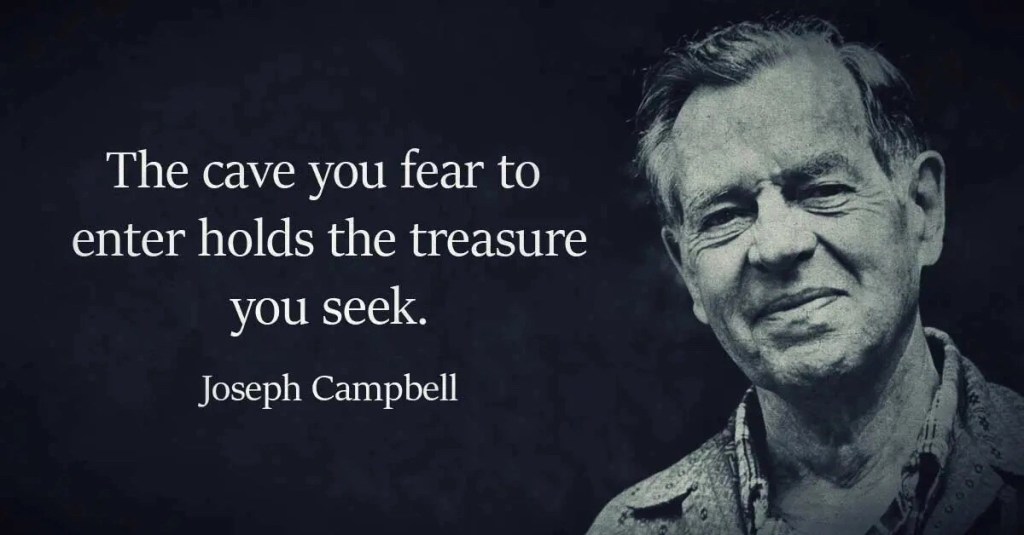
“What is it we are questing for? It is the fulfillment of that which is potential in each of us. Questing for it is not an ego trip; it is an adventure to bring into fulfillment your gift to the world, which is yourself. There is nothing you can do that’s more important than being fulfilled. You become a sign, you become a signal, transparent to transcendence; in this way you will find, live, become a realization of your own personal myth.” ~ Joseph Campbell
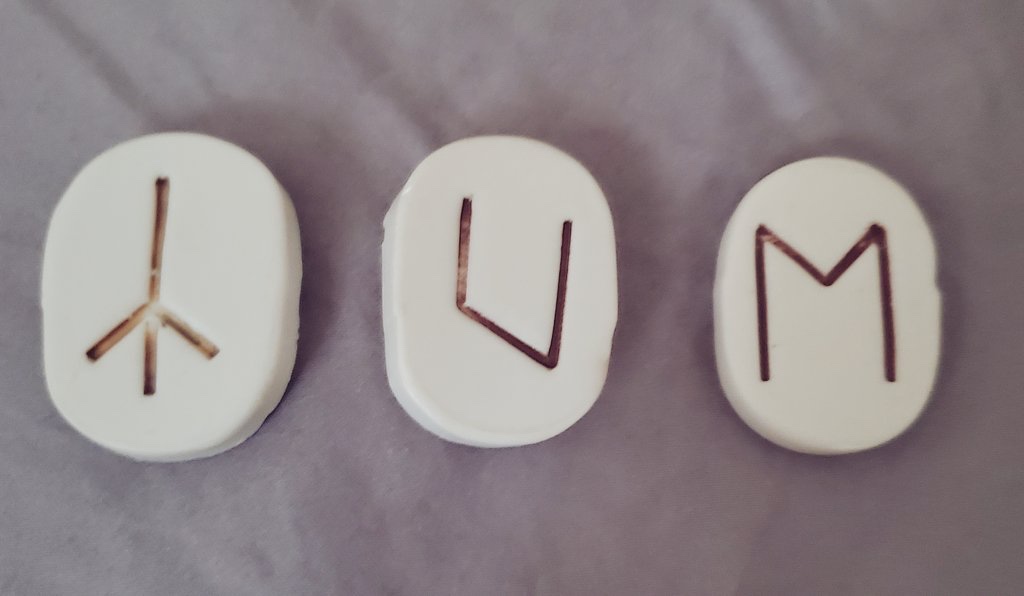
The number “three” figures prominently in the oracular practices of the ancients. The Three Rune Spread which, according to Tacitus, was already in use 2,000 years ago, is satisfactory for all but the most demanding situations.
With an issue clearly in mind, select three Runes one at a time, and place them from right to left, in order of selection. To avoid consciously changing the direction of the stones, especially as you become familiar with their symbols, you may want to place them blank side up, and then turn them over.
Once you have selected the Runes, they will lie before you. Reading from the right, the first Rune provides the Overview of the Situation; the second Rune (center) identifies the Challenge; and the third Rune (on the left) indicates the Course of Action Called For.
How you happen to turn the stones may still alter the direction of the glyphs to either an Upright or Reversed position, but this too is part of the process. Since only nine Runes read the same Upright and Reversed, the readings for the other sixteen will depend on how you place or turn the stones.
Long before Christianity came to northern Europe, the people there – our ancestors – had their own religions. One of these was Asatru. It was practiced in the lands that are today Scandinavia, England, Germany, France, the Netherlands, and other countries as well. Asatru is the original or native religious belief for the peoples who lived in these regions.
What does the word “Asatru” mean?
It means, roughly, “belief in the Gods” in Old Norse, the language of ancient Scandinavia in which so much of our source material was written. Asatru is the name by which the Norsemen called their religion.
When did Asatru start?
Asatru is thousands of years old. Its beginnings are lost in prehistory, but it is older than Christianity, Islam, Buddhism, or most other religions. The spiritual impulses it expresses are as ancient as the European peoples themselves – at least 40,000 years, and perhaps much older.
Why do we need Asatru? Aren’t most people who want religion satisfied with Christianity or one of the other “Established” religions?
People are attracted to the better-known religions because they have genuine spiritual needs which must be filled. People are looking for community and for answers to the “big questions”: What life is all about, and how we should live it. For many people today, the so-called major faiths do not have answers that work. Asatru has answers, but it has not been an alternative for most seekers because they haven’t known about it. Once they realize that there is another way – a better, more natural, more honorable way – they will not be satisfied with anything less than a return to the religion of their ancestors.
Why is the Religion of our Ancestors the Best One for Us?
Because we are more like our ancestors than we are like anyone else. We inherited not only their general physical appearance, but also their predominant mental, emotional, and spiritual traits. We think and feel more like they did; our basic needs are most like theirs. The religion which best expressed their innermost nature – Asatru – is better suited to us than is some other creed which started in the Middle East among people who are essentially different from us. Judaism, Islam, and Christianity are alien religions which do not truly speak to our souls.
Why Did Asatru Die Out if it was the Right Religion for Europeans?
Asatru was subjected to a violent campaign of repression over a period of hundreds of years. Countless thousands of people were murdered, maimed, and exiled in the process. The common people (your ancestors!) did not give up their cherished beliefs easily. Eventually, the monolithic organization of the Christian church, bolstered by threats of economic isolation and assisted by an energetic propaganda campaign, triumphed over the valiant but unsophisticated tribes.
Or so it seemed! Despite this persecution, elements of Asatru continued down to our own times – often in the guise of folklore – proving that our own native religion appeals to our innermost beings in a fundamental way. Now, a thousand years after its supposed demise, it is alive and growing. Indeed, so long as there are men and women of European descent, it cannot really die because it springs form the soul of our people. Asatru isn’t just what we BELIEVE, it’s what we ARE.
Wasn’t the Acceptance of Christianity a Sign of Civilization – A Step up From Barbarism?
No! The atrocities committed by Christians, Muslims, and Jews throughout history are hardly a step up from anything. The so-called “barbarians” who followed Asatru (the Vikings, the various Germanic tribes, and so forth) were the source of our finest civilized traditions – trial by jury, parliaments, Anglo Saxon common law, and the rights of women, to name a few. Our very word “law” comes from the Norse language, not from the tongues of the Christian lands. We simply did not and do not need Christianity to be civilized.
You Say That Asatru was the Religion of the Vikings, Among Other Early European Cultures. Weren’t They a Pretty Bloodthirsty Lot?
Modern historians agree that the Vikings were no more violent than the other peoples of their times. Remember, the descriptions of Viking raids and invasions were all written by their enemies, who were hardly unbiased. Both the Islamic and Christian cultures used means every bit as bloody, if not more so, than the Norsemen. It was a very rough period in history for all concerned!
We Keep Talking About the Vikings. Does This Mean That Asatru is Only for People of Scandinavian Ancestry?
No. Asatru, as practiced by the Norse peoples, had so much in common with the religion of the other Germanic tribes, and with their cousins the Celts, that it may be thought of as one version of a general European religion. Asatru is for all European peoples, whether or not their heritage is specifically Scandinavian.
What are the Basic Beliefs of Asatru?
We believe in an underlying, all-pervading divine energy or essence which is generally hidden from us, and which is beyond our immediate understanding. We further believe that this spiritual reality is interdependent with us – that we affect it, and it affects us.
We believe that this underlying divinity expresses itself to us in the forms of the Gods and Goddesses. Stories about these deities are like a sort of code, the mysterious “language” through which the divine reality speaks to us.
We believe in standards of behavior which are consistent with these spiritual truths and harmonious with our deepest being.
How Does Asatru Differ From Other Religions?
Asatru is unlike the better-known religions in many ways. Some of these are:
We are polytheistic. That is, we believe in a number of deities, including Goddesses as well as Gods. We do not accept the idea of “original sin”, the notion that we are tainted from birth and intrinsically bad, as does Christianity. Thus, we do not need “saving”.
The Middle Eastern religions teach either a hatred of other religions or a duty to convert others, often by force. They have often practiced these beliefs with cruel brutality.
We do not claim to be a universal religion or a faith for all of humankind. In fact, we don’t think such a thing is possible or desirable. The different branches of humanity have different ways of looking at the world, each of which is valid for them. It is only right that they have different religions, which of course they do.
Do You Consider the Norse Myths to be True?
The myths are stories about the Gods and Goddesses of Asatru. They are ways of stating religious truths. That is, we would say they contain truths about the nature of divinity, our own nature, and the relationship between the two. We do not contend that the myths are literally true, as history.
What About These Gods and Goddesses? Are They Real?
Yes, they are real. However, just as most Christians do not think their God is really an old bearded figure sitting on a golden chair in heaven, we do not believe Thor (for example) is actually a muscular, man-shaped entity carrying a big hammer. There is a real Thor, but we approach an understanding of him through this particular mental picture.
Do followers of Asatru Pray to Their Gods and Goddesses?
Yes, but not quite the way most people mean by the word. We never surrender our will to theirs or humble ourselves before them, because we see ourselves as their kin, not as inferior, submissive pawns. Nor do we beg and plead. We commune with them and honor them while seeking their blessing through formal rites and informal meditation. Living a full and virtuous live is a form of prayer in itself. Our religion affects all parts of our lives, not just those fragments that we choose to call “religious”.
Don’t You Worship Stones and Trees and Idols?
No. These objects are not Gods, so we don’t worship them. We do sometimes use these items as reminders of a God or Goddess, and we believe they can become “charged” with a certain aspect of the divine energy, but we would never confuse them with the actual deities.
What are the Standards of Behavior Taught in Asatru?
Some of the qualities we hold in high regard are strength, courage, joy, honor, freedom, loyalty to kin, realism, vigor, and the revering of our ancestors. To express these things in our lives is virtuous, and we strive to do this. Their opposites – weakness, cowardice, adherence to dogma rather than to the realities of the world, and the like – constitute vices and are to be avoided. Proper behavior in Asatru consists of maximizing one’s virtues and minimizing one’s vices. This code of conduct reflects the highest and most heroic ideals of our people.
Don’t all Religions Believe in These Things You’ve Just Named?
No. People may honestly believe that this is the case, but examination does not bear this out. They believe in freedom, yet their scriptures say they are slaves to their God. They accept that joy is good, but their teachings laden them with guilt because of some imaginary “original sin”. Their instinct is to understand Nature’s world from verifiable evidence, yet they are trained to believe black is white, round is flat, and natural instincts are evil without question when the teachings of their church conflict with reason or with known facts.
Many of us instinctively believe in the values of Asatru because they have been passed down to us from our ancestors. We want to believe that other religions espouse those values, so we see what we want to see. Most people just haven’t yet realized that the major religions are saying things that conflict with the values we know in our hearts are right. To find northern European virtues, one should look where those virtues have their natural home – Asatru.
What do You Have to Say About Good and Evil?
Good and evil are not constants. What is good in one case will not be good in another, and evil in one circumstance will not be evil under a different set of conditions. In any one instance, the right course of action will have been shaped by the influence of the past and the present. The result may or may not be “good” or “evil”, but it will still be the right action.
In no case are good and evil dictated to us by the edicts of an alien, authoritarian deity, as in the Middle East. We are expected to use our freedom, responsibility, and awareness of duty to serve the highest and best ends.
What Does Asatru Teach About an Afterlife?
We believe that there is an afterlife, and that those who have lived virtuous lives will go on to experience greater fulfillment, pleasure, and challenge. Those who have led lives characterized more by vice than by virtue will be separated from kin and doomed to an existence of dullness and gloom. The precise nature of the afterlife – what it will look like and feel like – is beyond our understanding and is dealt with symbolically in the myths.
There is also a tradition in Asatru of rebirth within the family line. Perhaps the individual is able to choose whether or not he or she is re-manifested in this world, or there may be natural laws which govern this. In a sense, of course, we all live on in our descendents quite apart from an afterlife as such.
We of Asatru do not overly concern ourselves with the next life. We live here and now, in this life. If we do this and do it well, the next life will take care of itself.
Does Asatru Involve Ancestor Worship?
Asatru says we should honor our ancestors. It also says we are bonded to those ancestors in a special way. However, we do not actually worship them.
We believe our forebears have passed to us certain spiritual qualities just as surely as they have given us various physical traits. They live on in us. The family or clan is above and beyond the limits of time and place. Thus we have a reverence for our ancestry even though we do not involve ourselves in ancestor worship as such.
Does Asatru Have a Holy Book, Like the Bible?
No. There are written sources which are useful to us because they contain much of our sacred lore in the form of myths and examples of right conduct, but we do not accept them as infallible or inspired documents. Any religion which does this is deceiving its members about the purity and precision of the written word. The various competing factions of Middle Eastern religions are proof of this. Their conflicting interpretations can not all be correct!
There are two real sources of holy truth, and neither expresses itself to us in words. One is the universe around us, which is a manifestation of the underlying divine essence. The other is the universe within us, passed down from our ancestors as instinct, emotion, innate predispositions, and perhaps even racial memory. By combining these sources of internal and external wisdom with the literature left us by our ancestors, we arrive at religious truths. This living spiritual guidance is better than any dusty, dogmatic “holy book”, whose writings are often so ambiguous that even clerical scholars disagree and whose interpretations change with the politics of the times.
Asatru has Been Described as a “Nature Religion”. What Does That Mean?
We treasure the spiritual awe, the feeling of “connecting” with the Gods and Goddesses, which can come from experiencing and appreciating the beauty and majesty of Nature. Our deities act in and through natural law. By working in harmony with Nature we can become co-workers with the Gods. This attitude removes the opposition between “natural” and “supernatural” and between religion and science.
For us, following a “Nature religion” means recognizing that we are part of Nature, subject to all its laws, even when that offends our Christian-influenced misconceptions. We may be Gods-in-the-making, but we are also members of the animal kingdom – a noble heritage in its own right. Our ancestors and their predecessors prevailed through billions of years of unimaginable challenges, a feat which must awe even the Gods themselves.
Where Did the Universe Come From, According to Asatru?
Our myths describe the beginning of the universe as the unfolding of a natural process, rather than one requiring supernatural intervention. Followers of Asatru need not abandon modern science to retain their religion. The old lore of our people describes the interaction of fire and ice and the development of life from these – but this is symbolic, and we will leave it to our scientists to discover how the universe was born.
What are the Runes, and What do They Have to do With Asatru?
Runes are ancient Germanic symbols representing various concepts or forces in the universe. Taken together, they express our ancestors’ world view. Their meanings are intimately connected with the teachings of Asatru. Our myths tell how Odin, father of the Gods, won them through painful ordeal so that Gods and humans alike might benefit from their wisdom.
How is Asatru Organized?
Asatru is non-authoritarian and decentralized, expressing our love of freedom. While we do have definite tenets, we have little dogma. There is no all-powerful spiritual leader whose word is law, no “pope” of Asatru to dictate truth. No guru or priest has an exclusive direct line to the Gods. The Gods live in you!





 Mark Bere Peterson’s Counterculture, Urban Legends, Paganism & Witchcraft