Time to take back Viking history and Symbolism from racists and white supremacists

“All manner of Viking symbols and misconceptions about a golden age of Nordic racial purity have been appropriated by racist extremists looking to justify their xenophobia and acts of violence, according to the University of Alberta researcher.

Van Deusen said the age of racial purity never existed and she is determined to debunk the corrosive myth at every turn, especially in the classroom.

Viking symbols are everywhere among the ultra-right. When the Unite the Right rally took place in Charlottesville in 2017, some protesters carried banners featuring the Norse god Thor’s hammer, popular among the Nazis and neo-Nazi groups.

The perpetrator of New Zealand’s Christchurch massacre last year wrote, “See you in Valhalla”-referring to the great hall where heroes of Norse mythology go after they die-at the end of his manifesto.

Closer to home, the Soldiers of Odin-a Finnish white supremacist movement named after another Norse god in 2015-have recently emerged in Alberta and throughout Canada.

“The precedent was set with the Nazis,” said Van Deusen. “National Socialism and Hitler idealized the Norse people-those who lived in the Nordic areas. Even the swastika is based in part on a symbol based on Viking artifacts.”

Source: https://www.ualberta.ca/folio/2020/07/white-supremacists-are-misappropriating-norse-mythology-says-expert.html

Democratic Party Symbolized As A Donkey

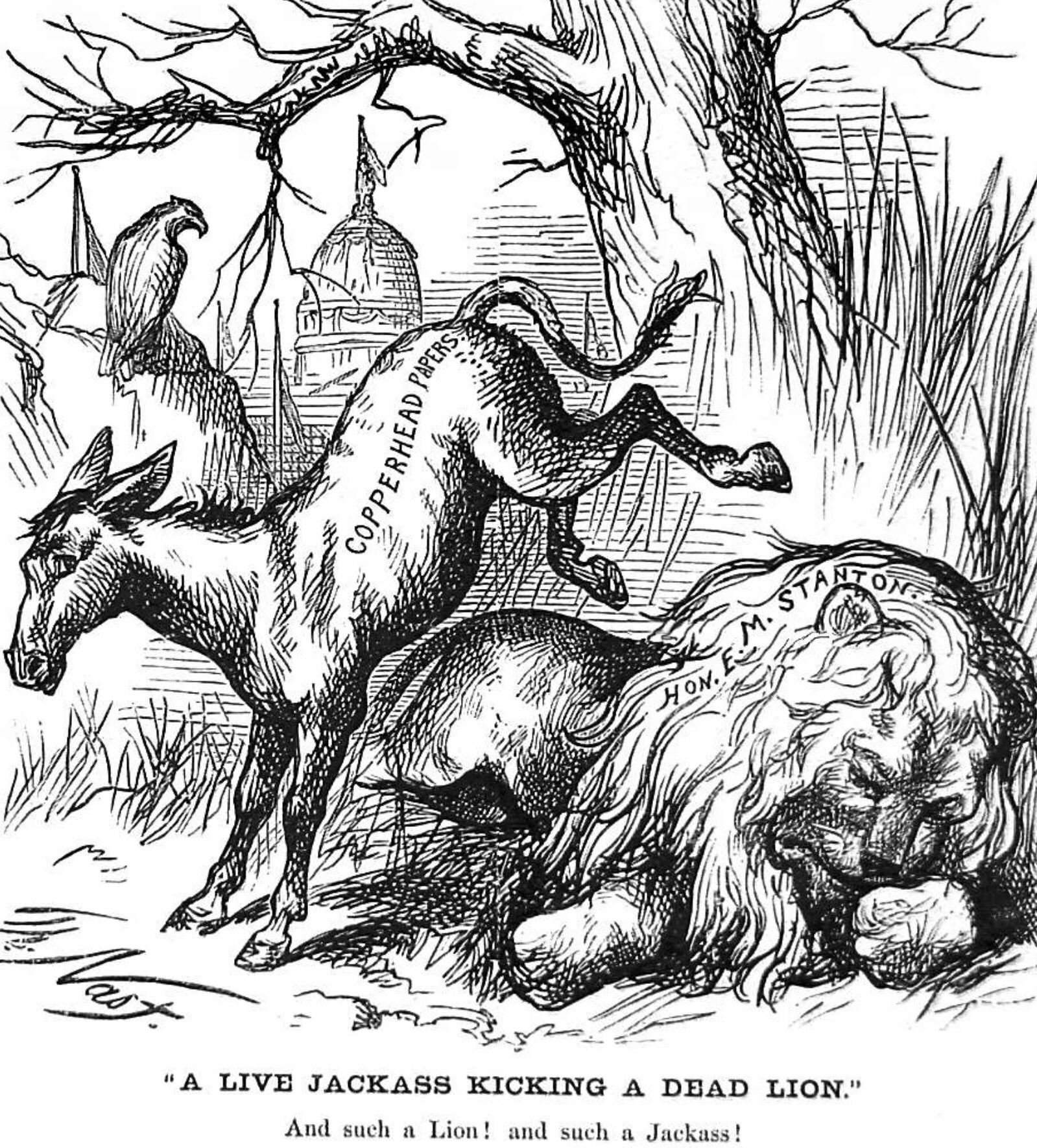
Today in History —> On this day in 1870 – A political cartoon for the first time symbolizes the Democratic Party with a donkey (“A Live Jackass Kicking a Dead Lion” by Thomas Nast for Harper’s Weekly).

Here’s the cartoon. Andrew Jackson’s enemies twisted his name to “jackass” as a term of ridicule regarding a stupid and stubborn animal. However, the Democrats liked the common-man implications and picked it up too, therefore the image persisted and evolved.

Marcus Licinius Crassus

Marcus Licinius Crassus (115-53 BCE) was perhaps the richest man in Roman history and in his eventful life he experienced both great successes and severe disappointments. His vast wealth and sharp political skills brought him two consulships and the kind of influence enjoyed only by a true heavyweight of Roman politics. A mentor to Julius Caesar in his early career, Crassus would rise to the very top of state affairs but his long search for a military triumph to match his great rival Pompey would, ultimately, bring about his downfall.

Marcus Tullius Cicero

Marcus Tullius Cicero (3 January 106 BC – 7 December 43 BC) was a Roman statesman, orator, lawyer and philosopher, who served as consul in the year 63 BC. He came from a wealthy municipal family of the Roman equestrian order, and is considered one of Rome’s greatest orators and prose stylists.

His influence on the Latin language was so immense that the subsequent history of prose, not only in Latin but in European languages up to the 19th century, was said to be either a reaction against or a return to his style. According to Michael Grant, “the influence of Cicero upon the history of European literature and ideas greatly exceeds that of any other prose writer in any language”. Cicero introduced the Romans to the chief schools of Greek philosophy and created a Latin philosophical vocabulary (with neologisms such as evidentia, humanitas, qualitas, quantitas, and essentia)distinguishing himself as a translator and philosopher. Though he was an accomplished orator and successful lawyer, Cicero believed his political career was his most important achievement.

Crisis Intervention Teams (CIT)

The lack of mental health crisis services across the U.S. has resulted in law enforcement officers serving as first responders to most crises. A Crisis Intervention Team (CIT) program is an innovative, community-based approach to improve the outcomes of these encounters.

In over 2,700 communities nationwide, CIT programs create connections between law enforcement, mental health providers, hospital emergency services and individuals with mental illness and their families. Through collaborative community partnerships and intensive training, CIT improves communication, identifies mental health resources for those in crisis and ensures officer and community safety.

Core Components of CIT Programs

Community Collaboration: Vitally important to successful CIT programs is building relationships. Community ownership should occur in all phases of CIT programs–initial planning, curriculum development, policies and procedures, and ongoing problem solving. This broad-based, grassroots community collaboration is what makes CIT programs sustainable over time, especially during challenging fiscal and political times.

A Vibrant and Accessible Crisis System: An outcome of productive community collaboration is the transformation of a crisis response system that is vibrant, responsive and easily accessible. Communities should work to provide a 24/7 crisis response, a “no wrong door” philosophy, and a 15 minute or under turnaround time to get first responders back on the streets. Depending on your community (urban, suburban, rural, frontier), these crisis system models may need to be creatively adapted to meet your needs.

Training for law enforcement and other first responders: The training curriculum is designed to be taught by local specialists from the law enforcement, behavioral health and consumer/advocate field. Upon completion of the course,

officers/first responders are better equipped to:

  • Understand common signs and symptoms of mental illnesses and co-occurring disorders;
  • Recognize when those signs and symptoms represent a crisis situation.
  • Safely de-escalate individuals experiencing behavioral health crises;
  • Utilize community resources and diversion strategies to provide assistance.

At the heart of effective CIT programs is officers who volunteer to be identified as a CIT officer and who are skilled and passionate about responding to these calls. Ongoing continuing education and advanced CIT training should be incorporated into the model.

Behavioral Health Staff Training: It is imperative that behavioral health staff develop an understanding of the role of law enforcement/first responders, and why they are trained to respond in ways that they do. This deeper understanding helps to provide insight and gain appreciation for what can otherwise be a culture divide. It is often beneficial for behavioral health staff to do ride- alongs with officers, and vice versa, for law enforcement to do home visits with case managers/therapists. It is also beneficial for law enforcement to provide training to front-line behavioral health workers on law enforcement culture. The goal is a deeper understanding and appreciation of one another’s roles, leading to improved collaboration.

Family/Consumer/Advocate Participation: People with lived experience provide invaluable insight in the training, and consumers and family members are key resources in advocating for CIT programs and improved crisis services. Consumer and family involvement in CIT programs also helps to inform understanding of how law enforcement is trained, building reasonable expectations of what to anticipate when law enforcement is called. Families and advocates also provide important feedback about the overall crisis response system, contributing to continuous quality improvement initiatives.

Police & First Responders Benefits

Not only can CIT programs bring community leaders together, they can also help keep people with mental illness out of jail and in treatment, on the road to recovery. That’s because diversion programs like CIT reduce arrests of people with mental illness while simultaneously increasing the likelihood that individuals will receive mental health services. CIT programs also:

• Give police officers more tools to do their job safely and effectively. Research shows that CIT is associated with improved officer attitude and knowledge about mental illness. In Memphis, for example, CIT resulted in an 80% reduction of officer injuries during mental health crisis calls.

• Keep law enforcement’s focus on crime. Some communities have found that CIT has reduced the time officers spend responding to a mental health call. This puts officers back into the community more quickly.

• Produce cost savings. It’s difficult to estimate exactly how much diversion programs can save communities. But incarceration is costly compared to community-based treatment. For example in Detroit an inmate with mental illness in jail costs $31,000 a year, while community-based mental health treatment costs only $10,000 a year.

Overall Benefits of CIT Programs

• Positive community relationships

• Improved crisis response system

• Trained response to behavioral health crisis calls

• Reduced unnecessary arrests or use of force

• Reduced officer/citizen injuries

• Increased officer confidence in skills

• Reduced liability

• More efficient use of criminal justice resources, including increased jail diversion

Sources: NAMI, CIT International

Science Denialism and the Trump Administration

Science Denialism & Scientific Ignorance of the Trump Administration Policy and Statements:

(All quotes by Donald Trump unless otherwise noted)

~  “You like the F-35? You can’t see it. You literally can’t see it. It’s hard to fight a plane you can’t see.” (Guardian interview November 2017)

Nope it’s not literally invisible. It’s an impressive piece of machinery, equipped with stealth technology designed to make the craft less visible to radar, infrared, and radio-frequency detection. However, for all its technical wizardry, it’s not literally invisible.

~ According to Bill Gates, Donald Trump didn’t grasp the difference between HIV and HPV. In Spring 2018, Gates met with Donald Trump to discuss the possibility of him becoming a science advisor. Although he respectfully declined the offer, one gem did emerge from the meeting: Trump asked Gates if there was a difference between HIV and HPV. Twice. (Spring 2018)

~ “Remember, new ‘environment friendly’ lightbulbs can cause cancer. Be careful – the idiots who came up with this stuff don’t care.” (Tweet 2012)

Um nope, sorry this has no basis in fact.

~ “I know President Obama said global warming is our biggest problem and I would say that no, it’s nuclear warming is our biggest problem by a factor of about five million. I believe global warming is the single biggest problem in our country, but it’s made of the nuclear variety.” (Sean Hannity interview July 2018)

Nuclear warming isn’t a thing, nope never has been, never will be.

~ “If we didn’t remove incredibly powerful fire-retardant asbestos & replace it with junk that doesn’t work, the World Trade Center would never have burned down.” (Tweet 2012)

Do I really need to address how preposterous this statement is?

~ “You gotta take care of the floors. You know the floors of the forest, very important. I was with the President of Finland and he said: ‘We have, much different, we are a forest nation.’ He called it a forest nation. And they spend a lot of time on raking and cleaning and doing things, and they don’t have any problem.” (To reporters November 2018)

Um Finland doesn’t rake their forests. This is just beyond ludicrous.

~ “I think something’s happening [climate change]. Something’s changing and it’ll change back again. I don’t think it’s a hoax, I think there’s probably a difference. But I don’t know that it’s manmade.” (CBS News October 2018)

~ “Some say that [anthropogenic climate change] and some say differently, I mean you have scientists on both sides of it.” (November 2018)

~ “Brutal and Extended Cold Blast could shatter ALL RECORDS – Whatever happened to Global Warming?” (Tweet November 2018)

There is no debate AT ALL going on about this within the scientific community anthropogenic climate change is real. Its manmade. It’s not going to just change back in the short term geologically speaking. Please tell me Trump understands the difference between weather and climate.

~ “Despite the hysteria from the political class and the media, smoking doesn’t kill. In fact, 2 out of every three smokers does not die from a smoking-related illness and 9 out of ten smokers do not contract lung cancer.” ~ Mike Pence (Op-Ed 2000)

Please can we just not.

~ “In three years people won’t be building wind turbines anymore – they are obsolete & totally destroy the environment in which they sit. Wind turbines will quadruple your electric bills and destroy the value of your home. The wind is a very deceiving thing. It ruins golf courses and kills all the birds” (Twitter 2013)

Ludicrous with no basis in fact. Fun fact: although around 300,000 birds in North America die via wind turbines annually, cats kill as many as 3.7 billion. I’m not sure what Trump thinks about cats, though.

~ in August 2017, Trump said that at an unspecified coal mine in Pennsylvania, they would burn clean coal, “meaning they’re taking out coal and they’re going to clean it.”

Clean coal, for all intents and purposes, doesn’t exist. There will never be a low-carbon coal fuel source, nor is there any system that removes greenhouse gases and pollution from coal ignition operations

~ “In the East, it could be the COLDEST New Year’s Eve on record. Perhaps we could use a little bit of that good old Global Warming that our Country, but not other countries, was going to pay TRILLIONS OF DOLLARS to protect against. Bundle up!” (Twitter 2017)

The problems with this tweet, designed to stir up climate denial shenanigans, are multifaceted, but a) it’s not unusual that it’s cold in winter, b) the particularly cold spike was likely due to a temporarily warped polar jet stream, and c) one weather data point cannot be extrapolated to explain the long-term meteorological trends, or – as it’s better known – the climate.

~ According to a New Yorker article published back in May 2017, the President reportedly claimed that exercise – unless it’s golf – is misguided, positing that a person, like a battery, is born with a finite amount of energy.

This isn’t how biology or physics works. If this were true, then professional athletes would all be keeling over in their 20s, and those living a sedentary lifestyle would all be nonagenarians.

~ “If they don’t start [opiods], they won’t have a problem,” (August 2017)

Eye roll. Over 40 percent of all US opioid overdose deaths are due to prescriptions, not illegally obtained painkillers. At the same time, around a quarter of those who get them for non-cancer treatments struggle with addiction.

~ “We are very strong on the environment. I feel very strongly about the environment.” (November 2017)

His track record suggests that he either doesn’t care about the environment or simply doesn’t quite understand what its whole deal is. He certainly doesn’t feel very strongly about it, but his peons certainly enjoy trashing it as much as possible in the name of propagating fossil fuels.


School Prayer – Yes or No?

Congress shall make no law respecting an establishment of religion or prohibiting the free exercise thereof.”
~ First Sixteen Words of the First Amendment

The Constitution guarantees each of us religious freedom: the right to believe what you want, or not believe at all. Preaching and teaching are very different things. Telling teachers and school officials that they can’t preach to their students does not in any way bar our educators from teaching about religion.

The reason for this becomes clear when you stop and think about the mandate of public education in a pluralistic society. Public schools should give all kids an equal sense of belonging and respect their rights. School boards, principals and teachers must embrace this reality, and this means they must not be in the business of deciding which religious beliefs matter for students, and which don’t.

These examples are not hypothetical, but plucked from the plethora of choices in the news. This is not an uncommon occurrence:

An elementary school teacher walks around her classroom in Louisiana asking each of her young students what they want to pray for, they bow their heads and she recites a Christian prayer. But not all of her students are Christian. Do they opt out and risk being ostracized?

A coach in Michigan leads his players in prayer on a public high school football field after the games. But not all the kids agree with the coach’s faith, and some are not religious at all. Do they not participate, but then have to worry about the coach retaliating and not letting them play in the next game?

Preaching in public schools also undermines the unifying role public schools play in our communities. More than 90 percent of our nation’s children attend public schools. Those institutions are open to all students regardless of religion, race or ability; they should be safe spaces that enable all students to learn and grow. Public schools bring us together across our differences, rather than divide us because of them.

Religion’s effect on humanity and American life in particular is undeniable — and profound. In fact, you simply can’t understand subjects such as history, art, music, literature and even science without grasping how religion has shaped our thinking. So, it can be argued that a public school teacher should have the right to discuss religion with students — as long as it’s part of a legitimate program of instruction. American society is grounded in religious freedom. We should celebrate, treasure and honor this right and the diversity it fosters whether you’re Christian, Jewish, Muslim, Buddhist, Hindu, Sikh or any of the multitude of other religious belief system or not a believer at all.

Stop Blaming Mental Illness For Mass Shootings

STOP BLAMING MENTAL ILLNESS FOR MASS SHOOTINGS:

“If you were to suddenly cure schizophrenia, bipolar, and depression overnight, violent crime in the US would fall by only 4 percent.”
~ Jeffrey Swanson, Duke University professor, a sociologist and psychiatric epidemiologist who studies the relationship between violence and mental illness.

What they found was that mentally ill people who didn’t have substance abuse issues, who weren’t maltreated as children, and who didn’t live in adverse environments have a lower risk of violence than the general population.

(According to a Epidemiologic Catchment Area (ECA) study, sponsored by the National Institute of Mental Health the share of overall violence explained by serious mental illness — was between 3 percent and 5.3 percent, for a midpoint estimate of about 4 percent. That’s where the idea that if you wiped out serious mental illness overnight, violence would fall 4 percent comes from.)

Here’s the never ending pattern:

1) Mass Shooting

2) Advocates of gun control point out that taking guns off the streets and limiting who can buy them will save lives.

3) Opponents of gun control argue that there are no regulations that can stop a determined shooter and that what we really need is to address mental health.

Examples:

“This is also a mental illness problem. These are people that are very, very seriously mentally ill.”
~ President Trump said, following the script, after shootings in Dayton and El Paso.

“Mental health is a large contributor to any type of violence or shooting violence.”
~ Texas Gov. Greg Abbott

The convenient cries of “mental health” after mass shootings are worse than hypocritical. They’re factually wrong and stigmatizing to millions of completely nonviolent Americans living with severe mental illness.

The share of America’s violence problem (excluding suicide) that is explainable by diseases like schizophrenia and bipolar disorder is tiny. Being male or having a substance abuse issue are both bigger risk factors.

At the very least if you’re going to scapegoat mental illness then increase its funding dramatically which the government is unwilling to do, as a matter of fact they do the opposite.

Hate and anger aren’t a mental illness!

Stop stigmatizing innocent nonviolent people.

H. L. Mencken

Politics 1920’s edition:

“The larger the mob, the harder the test. In small areas, before small electorates, a first-rate man occasionally fights his way through, carrying even the mob with him by force of his personality. But when the field is nationwide, and the fight must be waged chiefly at second and third hand, and the force of personality cannot so readily make itself felt, then all the odds are on the man who is, intrinsically, the most devious and mediocre — the man who can most easily adeptly disperse the notion that his mind is a virtual vacuum.

The Presidency tends, year by year, to go to such men. As democracy is perfected, the office represents, more and more closely, the inner soul of the people. We move toward a lofty ideal. On some great and glorious day the plain folks of the land will reach their heart’s desire at last, and the White House will be adorned by a downright moron.”
~ H. L. Mencken (Baltimore Evening Sun: “Bayard vs. Lionheart” 26 July 1920)

#Quotes #Elections #Politics

Mental Health Funding

~ 47,173 people died from suicide in 2017 (last year with statistics) compared with 29,199 in 1999.

~ In 2016 136 million people voted for president.

~ There are 43.8 million adults that live with mental illness.

~ That’s a huge voting block.

~ Let’s see some real policy plans this year from presidential candidates.

~ Congress we’ve had enough lip service, pass some common sense mental health legislation with increased funding.

#MentalHealth #EndStigma #IncreaseMentalHealthFunding