The Pharaoh of Exodus: Evidence or No Evidence

Date: 1440 BC

Discovered: Elephantine, Egypt

Period: Exodus

Torah Passages: Exodus 2:11–5:1; 12:37-41; 14:4-30; Acts 7:20-30

Pharaoh and his servants had a change of heart toward the people… So he made his chariot ready and took his people with him… and he chased after the sons of Israel (Exodus 14:5-8).

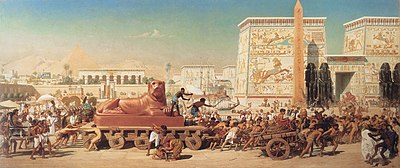
Pharaoh Amenhotep II reigned over Egypt beginning in about 1450 BC during the powerful 18th Dynasty of the New Kingdom. His monuments and inscriptions indicate that he was one of the most boastful pharaohs of ancient Egypt, claiming such feats as being able to shoot arrows through a copper target a palm thick, rowing a ship by himself faster and farther than 200 Egyptian sailors, singlehandedly killing 7 prince warriors of Kadesh, having the kings of Babylon, the Hittites, and Mitanni all come to pay tribute to him, and supposedly conducting the largest slave raid in Egyptian history.

According to a match of chronological information from Egyptian king lists and the Bible, Amenhotep II was probably also the pharaoh of the Exodus, which occurred in approximately 1446 BC. One of the most significant artifacts relating to the circumstantial evidence for Amenhotep II being the pharaoh of the Exodus is a stele that he commissioned to commemorate one of his campaigns.

While earlier in the 18th Dynasty the Egyptians had a powerful military, especially during the reign of Thutmose III, who conducted 17 known military campaigns, after the beginning of the reign of Amenhotep II there is a steep decline.  In fact, Amenhotep II had only two confirmed campaigns during his reign—the first took place prior to the Exodus, while the second was primarily a slave raid that occurred soon after the Exodus and was recorded on the Elephantine Stele.

This monumental stone inscription with its accompanying artwork was originally erected at the southern city of Elephantine, and it records the campaign of Amenhotep II to Canaan in which he claims to have brought back over 101,128 captives to be used as slaves.31 In comparison, other Egyptian military campaigns of the period brought back nowhere near the amount of captives, with the largest total being only 5,903, and as a result most scholars consider the number of slaves captured by Amenhotep II in this text to be a massive exaggeration. Because this happened right after the Exodus, perhaps it is indicative of an urgent need to replace the lost slave population in Egypt, or purely as propaganda making it appear that the pharaoh had recovered or replenished the slaves lost during the Hebrew Exodus.

Additional indicators include that the pharaoh preceding the Exodus must have had a reign of over 40 years, since Moses killed an Egyptian and fled to Midian for 40 years until the pharaoh who knew him had died. Thutmose III, the father and predecessor of Amenhotep II, reigned for 54 years and is the only pharaoh in the dynasty with a reign of 40 or more years. The Exodus pharaoh must also have recently begun his reign, since Moses returned and confronted the Exodus pharaoh soon after the previous pharaoh died, and Amenhotep II took the throne only about four years or less prior to the Exodus.

The first campaign of Amenhotep II was launched in his third year, or approximately 1448 BC. The second campaign, to Canaan, occurred in his seventh year, approximately 1444 BC, which seems to have been only one or two years after the Exodus.

Sources: Essential Judaism, Unearthing the Bible, myjewishlearning.com, Chabad.org
St. George’s Monastery (West Bank, Palestine)

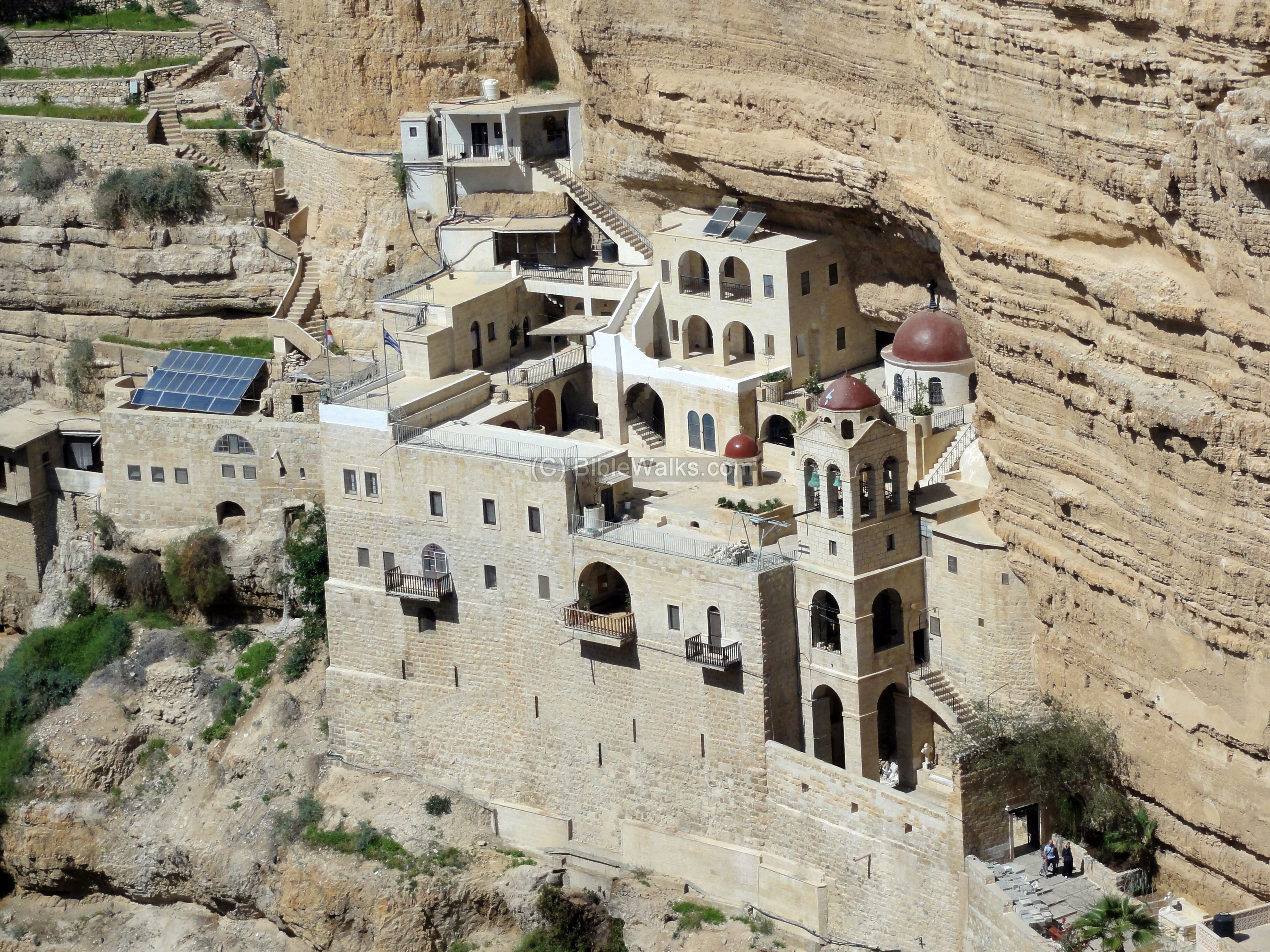
St. George’s Monastery (West Bank, Palestine)

Clinging to a cliff on the edge of the Wadi Qelt gorge is a Greek Orthodox monastery that’s endured many centuries of turmoil and destruction.

The original monastery was founded in the 5th century by a group of cave-dwelling hermits. They chose the site because it was located next to the cave where the prophet Elijah is said to have been fed by ravens during the 9th century BCE.

A Persian invasion in the 7th century drove out the hermits and left the monastery in ruins. Around 500 years later, Crusaders rebuilt St. George’s, only to be driven from the site following the Islamic re-conquest of Jerusalem.

The late 19th century saw St. George’s restored once again. The monastery is now home to two churches, a small group of Greek Orthodox monks, and the tombs of the five hermits who got the whole thing started.

A 15-minute drive from St. George’s is the Mount of Temptation—so named because, according to the Bible, it is the place where Jesus was tempted by the devil. This mountain has its own cliffside monastery, established in the 6th century, which has only a single permanent resident. There is also a nearby collection of hermit caves—some of which are said to still occasionally be inhabited by ascetic monks.

Source: Atlas Obscura

The Plagues: Evidence or No Evidence

Date: 13th century BCE

Discovered: Saqqara, Egypt

Period: Exodus

Torah Passage: Exodus 7:14–12:36

I will strike the water that is in the Nile with the staff that is in my hand, and it will be turned to blood…and the blood was through all the land of Egypt (Exodus 7:17,21).

An ancient Egyptian text, written by a man named Ipuwer and referred to as the Admonitions of an Egyptian Sage, was a poetic lamentation addressed to the “All Lord,” who is typically understood to be the sun god Ra. The poem describes a time in which the natural order in Egypt was severely disrupted by death, destruction, and plagues.

The only surviving copy of the papyrus dates to the 13th century BCE, perhaps as early as 1300 BCE. While most scholars suggest it was originally written in the Second Intermediate Period due to content, the linguistics of the text and the date of the copy indicate that it was composed during the 18th Dynasty around the 16th–14th centuries BCE.

The name Ipuwer is also know from inscriptions of the 18th Dynasty, and in particular one from the time of Hatshepsut and Thutmose III just prior to the Exodus. Any historical events mentioned in the text must have occurred prior to the 13th century BCE and possibly in the 18th Dynasty. If the Admonitions describes events similar to the plagues recorded in Exodus, and the Egyptian account was composed in the same general time period as the events of the Exodus, then it is plausible that the two documents contain independent accounts of the identical episode in history but from different perspectives.

Passages in the poem, such as the river being blood, blood everywhere, plague and pestilence throughout the land, the grain being destroyed, disease causing physical disfigurement, the prevalence of death, mourning throughout the land, rebellion against Ra the sun god, the death of children, the authority of the pharaoh being lost, the gods of Egypt being ineffective and losing a battle, and jewelry now being in the possession of the slaves, are all occurrences in common with the Exodus story.

Thematic and even linguistic links between the Admonitions and the plagues of Exodus have been recognized by scholars, but typically these connections are discounted on the presupposition that neither the book of Exodus nor the Admonitions of Ipuwer describe historical events, and that even if they did, the two texts would be too far separated in time from one another.

However, since the chronology may overlap, and the match in specificity of many of the events suggests the possibility that the documents are describing the same general events and period of hardship in Egypt, the Admonitions could be an Egyptian remembrance and near contemporary account of the time of the Exodus plagues.

Sources: Essential Judaism, Unearthing the Bible, myjewishlearning.com, Chabad.org.

Eggplant Casserole for Passover

1 large onion

3 Tablespoons oil

1 medium eggplant, peeled and then cut into cubes or thin slices

1/4 cup diced green pepper

11 oz tomato-mushroom sauce (or any jarred Kosher for Passover sauce you want)

1 teaspoon salt

1/2 teaspoon pepper

2 large tomatoes, diced

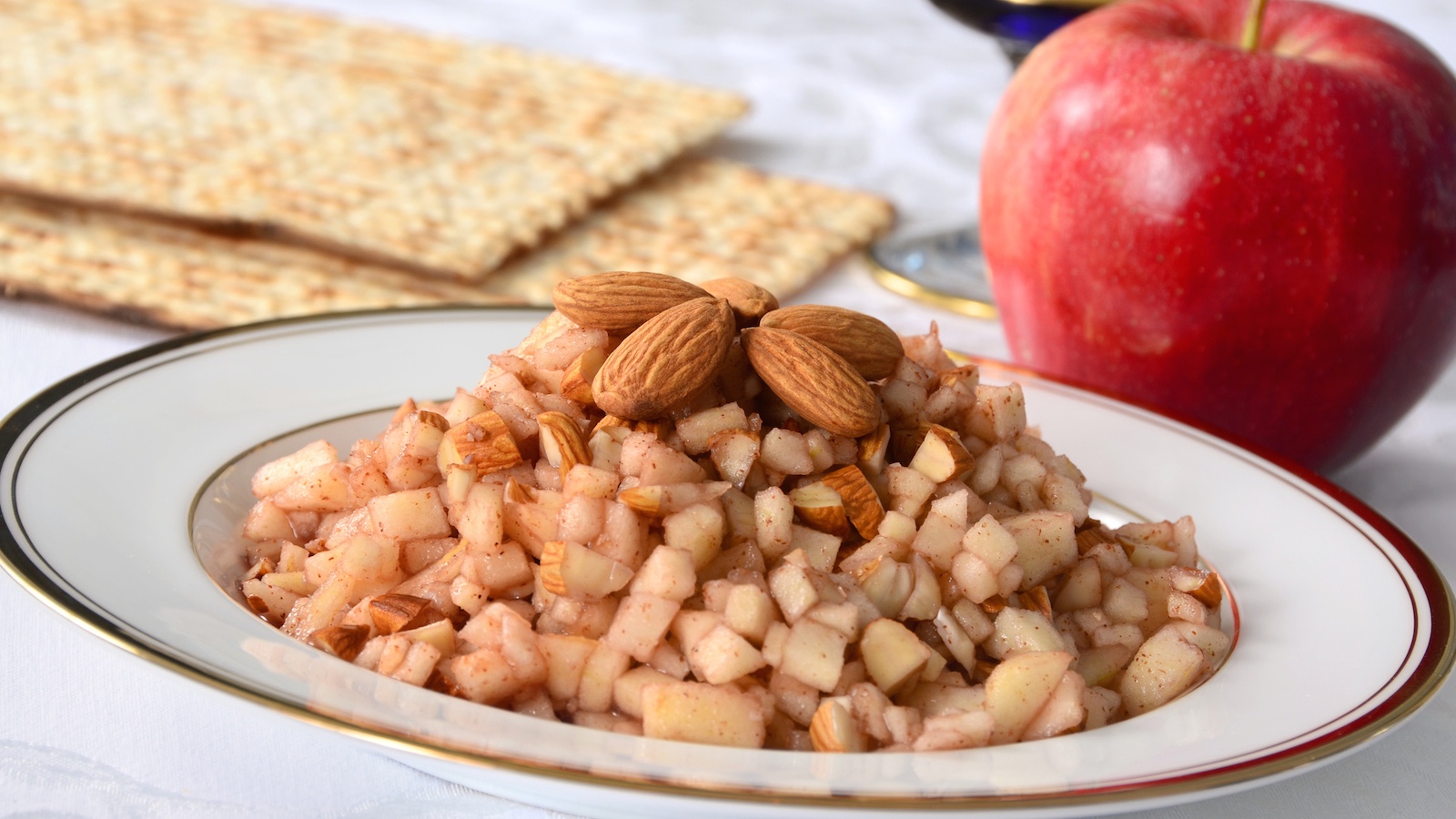
1 1/2 cups matzah farfel *

Saute onions in oil until tender. Combine onions, eggplant, green pepper, tomato-mushroom sauce, and seasoning. Cook, covered, for 15 min or until eggplant is tender. Stir in tomatoes. Alternately layer vegetable mixture and farfel, beginning and ending with the vegetable mixture in a 2 quart baking dish (9 x 13 size).

Bake at 350 uncovered for 25 min.

* Farfel is small pellet- or flake-shaped pasta used in Ashkenazi Jewish cuisine. It is made from an egg noodle dough and is frequently toasted before being cooked. It can be served in soups or as a side dish. In the United States, it can also be found pre-packaged as egg barley.

Matzah farfel is simply matzah broken into small pieces. The Baal Shem Tov, founder of the Hasidic movement, ate farfel every Friday night because the word was similar to the word farfaln which means “wiped out, over and finished”.

Razzouk Ink (Jerusalem, Israel)

As the sole surviving pilgrimage-tattoo business, Razzouk Ink is a place where ancient artifacts meet contemporary machines and rich history intersects with modern technology.

Just inside the Jaffa Gate in Jerusalem’s Old City, a big sign above a tiny shop reads tattoo with heritage since 1300. For over 700 years the Razzouk family has been tattooing marks of faith. As Coptic Christians who settled in Jerusalem generations ago, the family had learned the craft in Egypt, where the devout wear similar inked inscriptions. Evidence of such tattoos dates back at least as far as the 8th century in Egypt and the 6th century in the Holy Land, where Procopius of Gaza wrote of tattooed Christians bearing designs of crosses and Christ’s name. Early tattoos served as a way for indigenous Christians in the Middle East and Egypt to self-identify. Later, as the faithful came to the Holy Land on pilgrimage, the practice expanded to offer these travelers permanent evidence of their devotion and peregrination.

Razzouk Ink’s stone walls and exposed beams lend antique character to the space. A museum-like case holds heirlooms, and an exhibition of pictures on the walls offers glimpses into the family’s past.

Pilgrims’ accounts dating to the late 16th century show how purveyors such as the Razzouks must have tattooed back then, with sewing needles bound to the end of a wooden handle.

How to Tie Tzitzit

How to Tie Tzitzit

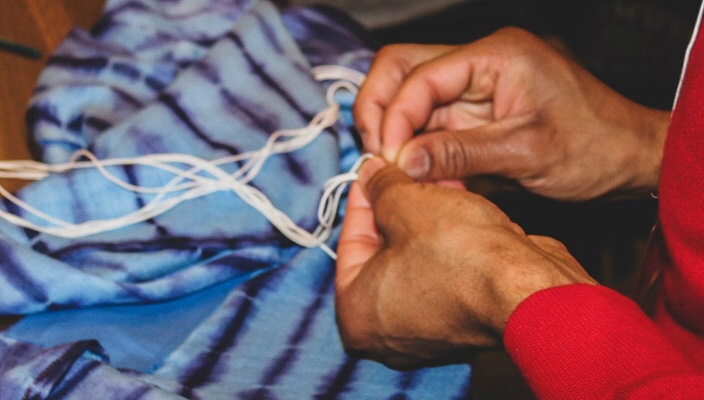
1. Before you try tying tzitzit to your tallit, it is advisable to practice with twine or heavy string looped around a chair leg.

2. Although you can spin or devise your own tzitzit strands, it is easier to buy a tzitzit pack, which is available at most Hebrew bookstores.

3. There will be 16 strands in the pack–4 long ones and 12 short ones. Separate these into four groups with one long and three short in each.

4. The longer strand is called the shamash [or helper] and is the one used for the winding.

5. Even up the four strands at one end and push the group through one of the corner holes in the tallit.

6. Even up seven of the eight strands (the four being doubled) and leave the extra length of the shamash hanging to one side.

7. With four strands in one hand and the other four in the other hand, make a double knot near the edge of the material. Take the shamash and wind it around the other seven strands in a spiral–seven turns. Be sure you end the winding where you began–otherwise you may end up with 7 1/2 or 6 1/2 winds. Make another double knot at this point (four over four).

8. Spiral the shamash eight times around. Double knot. Spiral the shamash 11 times around. Double knot. Spiral the shamash 13 times around. Final double knot.

This is the common, and halakhically [according to Jewish law] precise type of tying. There are, however, two variations on this:

1.  A Sephardic tying adds another dimension to the pattern: each time the shamash is brought around, take it under the previous wind before winding it further. This will produce a curving ridge around the tzitzit. This, too, should be practiced before trying it on the tallit.

2. Although not in strict accordance with the halakhah, some tie the tzitzit with the shamash spiraling 10-5-6-5 times respectively.

Sources: Essential Judaism, myjewishlearning.com

Tzitzit

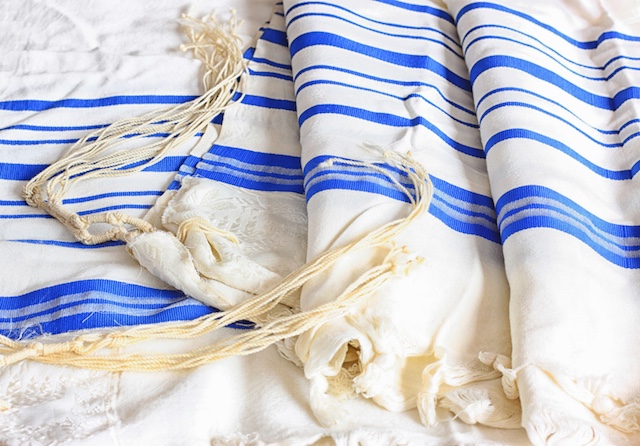
Tzitzit (tseet-tseet or TSIT-sis) are the strings, or fringes, tied to each of the four corners of a tallit, or prayer shawl. They are widely considered a reminder, not unlike a string around one’s finger, to think of God at all times.

Tzitzit fulfill the following commandment in Numbers 37, in the Torah portion called Parshat Shlah:

Speak to the Israelite people and instruct them to make for themselves fringes on the corners of their garments throughout the ages; let them attach a cord of blue to the fringe at each corner. That shall be your fringe; look at it and recall all the commandments of the LORD and observe them, so that you do not follow your heart and eyes in your lustful urge. Thus you shall be reminded to observe all My commandments and to be holy to your God.

The commandment to wear tzitzit is repeated in the V’ahavta section of the Shema prayer.

While traditional Jewish law says one must have these tzitzit on every four-cornered garment one wears, today most clothing doesn’t have corners. Instead, the tzitzit are on the prayer shawl and on a special small tallit , called a tallit katan, that some traditional Jews wear under their clothes. Some traditional Jews let the tzitzit from their tallit katan hang out, while others tuck them in.

The tzitzit are attached to the corners and knotted according to a specific pattern.

To learn how to tie tzitzit:

Tallit (Jewish Prayer Shawl)

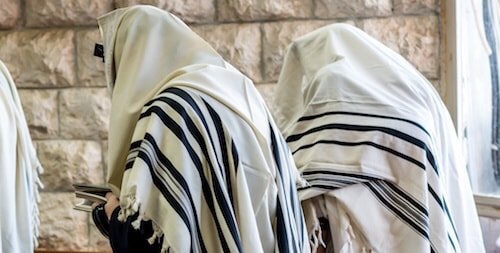
The tallit (tall-EET) or tallis (TALL-us) is a large rectangular shawl made of wool, cotton or synthetic fibers. In each of the four corners of the shawl are strings tied in a particular pattern, called tzitzit. The origin of the tzitzit is biblical; the practice is prescribed in Numbers 15. The precept is to put these strings on the four corners of one’s garment — in ancient tradition, with a single strand of blue as well–as a reminder of the duties and obligations of a Jew. Since we no longer wear four-cornered garments, the tallit is worn specifically to fulfill the biblical precept.

Traditionally, men wear a tallit during morning services; in non-Orthodox synagogues, many women also wear a tallit. In some Orthodox congregations, only married men wear a tallit. One may see people gathering the tzitzit in their left hand and kissing them when the paragraph from the Torah referring to them is recited.

Most synagogues have prayer shawls available for visitors to use during services. However, many people prefer to purchase their own prayer shawl. A wide variety are sold at most Judaica stores and on the Internet.

Before putting on the prayer shawl, it is customary to say the following blessing:

Watch the video below for more on how to put on tallit:

Sources: Essential Judaism, myjewishlearning.com

President’s Room (Jerusalem, Israel)

President’s Room (Jerusalem, Israel)

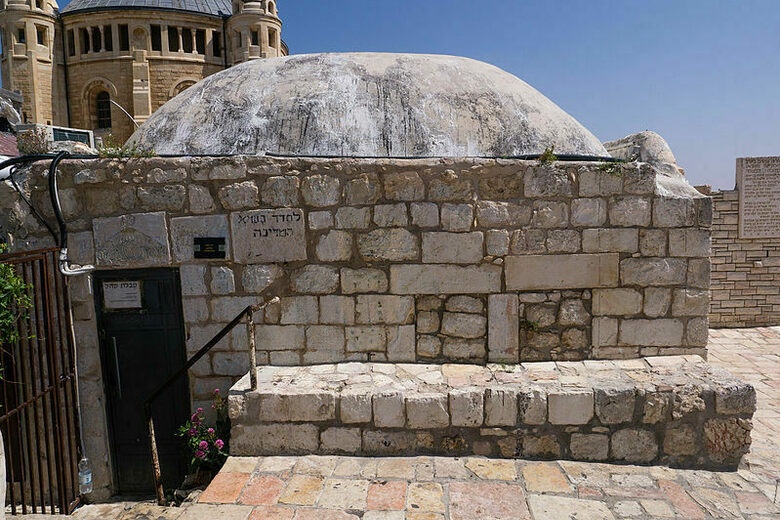
Just south of the Old City on Mount Zion is a building that houses two holy sites. On the ground floor is the Tomb of King David; upstairs is the Upper Room, or Cenacle—the location of the Last Supper.

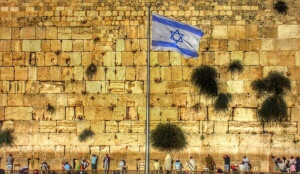
Less conspicuous is the small domed chamber on the roof, known as the President’s Room. From 1948 to 1967, when Jordan controlled East Jerusalem, Jews were prevented from visiting sacred places in the Old City, such as the Western Wall and the Mount of Olives. During this time, Mount Zion was one of the closest vantage points for viewing the forbidden sites. The Ministry of Religious Affairs established the President’s Room so that Israel’s first head of state, Chaim Weizmann, could keep watch over the Western Wall.

Weizmann never used the room. But his successor, President Yitzhak Ben-Zvi, did. Three times a year, he would ascend the stairs to the dome and look toward the Temple Mount.

Source: Atlas Obscura