Seneca from “Natural Questions”

“The time will come when diligent research over long periods will bring to light things which now lie hidden. A single lifetime, even though entirely devoted to the sky, would not be enough for the investigation of so vast a subject…And so this knowledge will be unfolded only through long successive ages. There will come a time when our descendants will be amazed that we did not know things that are so plain to them…Many discoveries are reserved for ages still to come, when memory of us will have been effaced. Our universe is a sorry little affair unless it has in it something for every age to investigate…Nature does not reveal her mysteries once and for all.”

~ Seneca (4 BC – 65 AD), “Natural Questions”

#FavoriteQuotes #Seneca #Science

Daniel Dennett with the Institute of Art and Ideas

From the philosophy section of Institute of Art and Ideas, we have a new 30-minute interview with philosopher Daniel Dennett. It’s basically about “the arc of his life”, and has some interesting revelations. I’ll just touch on a few key ideas, but you should listen to it yourself:

• Dan’s father was a spy who worked for the OSS, but Dan didn’t learn that until his dad died.

• Dan says that most of his good ideas came from his Ph.D. thesis and postdoc, and since then he’s been largely “turning the crank” on (i.e., working out the consequences of) his early ideas.

• Those good ideas involved “the intentional stance”, how learning takes place, and views about consciousness and the evolution of the brain. He doesn’t talk much about consciousness, though, and doesn’t mention free will once during the interview, much to my relief.

• In new work, Dan says he and a colleague are extending the intentional-stance view down to the level of the cell, visualizing development as the consequences of “what the cell wants.” This isn’t like panpsychism, for Dan isn’t dumb enough to think that cells really have desires, but he’s looking at it as Dawkins looked at the metaphor of the “selfish gene”, gaining insight by imagining how genes would behave if they were selfish even though he realizes (and has repeatedly emphasized in the light of misinterpreters) that genes don’t have desires.

• Dan doesn’t admit that he ever had a wrong idea. But he does say he’s worked to prevent misuses of his ideas.

• Dan decries the truth-denial aspect of postmodernism as “intellectual vandalism,” but also ponders the question of whether some ideas or truths are too dangerous to impart to the world. I’ll leave you listen to that bit yourselves.

• There’s a lot about religion at the end, with Dan arguing that it’s time for the world to “grow up and leave religion behind”. And he thinks many faiths are in fact doing this, stripping out the false claims and injurious morality and leaving the ceremonial bits—bits that he has no quarrel with.

https://iai.tv/video/arc-of-life-daniel-dennett5

Irène Joliot-Curie

Died today in 1956 – Irène Joliot-Curie, French physicist and chemist, Nobel Prize laureate (b. 1897)

Joliot-Curie, the eldest daughter of Marie Curie, won the Nobel with her husband Frederic for creating radioactive elements by bombarding non-radioactive ones with alpha particles. She died at 58 of leukemia, probably from exposure to radiation. This may be the only case of a whole family getting Nobel Prizes. Here’s Irène with her mother in 1925.

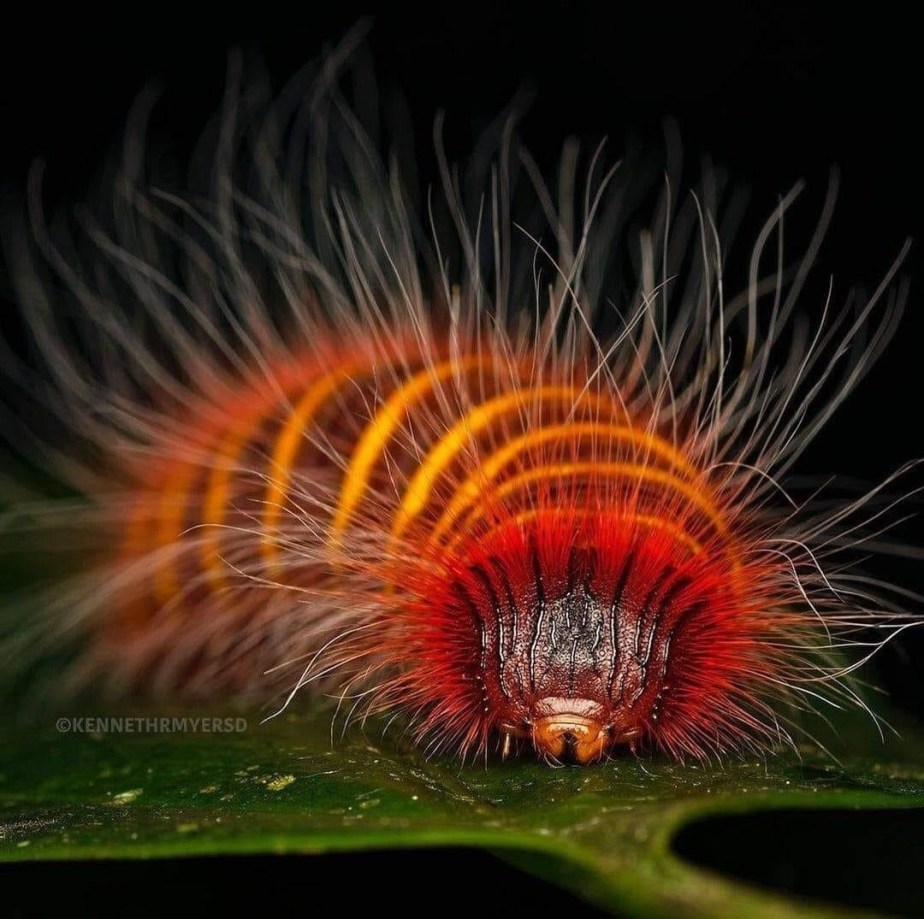
Firetip (Pyrrhopyge thericles)

Firetip (Pyrrhopyge thericles): Often known as the “Red Hot Cat” this caterpillar is of a Black winged Butterfly species from South America. The black body and wings are often with a bronze-green or deep blue lustre, spotted red on the head and abdomen. The larvae are haired on the body, shaggily on the head, brown or reddish with yellow, zebra-like stripes. They live on different trees, notably on guava pear-trees.

📸: Ken Myers in Brazil.

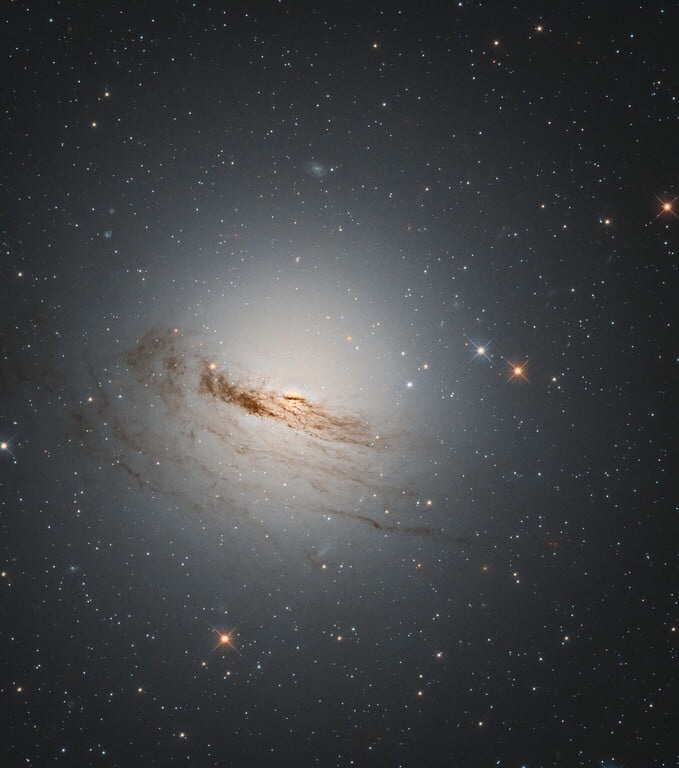
Galaxy NGC 1947

The Hubble Space Telescope has captured a image of a lenticular galaxy called NGC 1947. A lenticular galaxy is one that is neither a spiral galaxy, like our Milky Way, nor an elliptical galaxy, but somewhere in between the two. It has a large disk in the middle but unlike other spiral galaxies, it does not have spiral arms reaching out from its center.

This galaxy wasn’t always this way, however. At a point in its past, it did have spiral arms. You can see the evidence of these arms in the swirls of dust which still surround it, as the European Space Agency writes: “the faint remnants of the galaxy’s spiral arms can still be made out in the stretched thin threads of dark gas encircling it.”

Another difference between lenticular galaxies like NGC 1947 and other kinds of galaxy is the rate of star formation. Galaxies like the Milky Way continue to form new stars, especially in their spiral arms, as clouds of dust and gas clump together and are eventually bound by gravitational forces. In lenticular galaxies, however, there is very little star formation. These galaxies have used up most of their interstellar matter so there is not enough material for the formation of many new stars.

This means that the average age of stars in NGC 1947 is getting older, and the galaxy is fading over time. To see the galaxy for yourself, you’d need to be located in the southern hemisphere as it is further south than the celestial equator.

Source: Digital Trends

Planet GJ 1132 b Regenerates Atmosphere

Scientists know that the atmospheres of planets change over time — Mars, for example, is gradually losing its atmosphere as it evaporates into space. The examples we know of suggested this was a one-way process, where an atmosphere developed and then was subsequently lost. But now, researchers using the Hubble Space Telescope have discovered a very odd planet that seems to be re-growing its atmosphere after having lost it in the past. This is the first time such a thing has been observed.

Planet GJ 1132 b is several times the size of Earth, making it a type called a sub-Neptune, and it started out with a thick atmosphere of hydrogen and helium. But, being close to its hot, young star, this atmosphere was quickly lost and the planet was reduced to a core around the size of Earth. So far, so typical.

Where it gets weird is recent observations from Hubble which show the planet has a secondary atmosphere of hydrogen, hydrogen cyanide, methane, and ammonia. Researchers think that hydrogen from the original atmosphere was absorbed by the planet’s mantle, and is now being released once more by volcanic activity. The atmosphere seems to be replenishing itself even as hydrogen continues to be lost into space.

It’s super exciting because we believe the atmosphere that we see now was regenerated, so it could be a secondary atmosphere,” said study co-author Raissa Estrela of NASA’s Jet Propulsion Laboratory (JPL) in a statement. “We first thought that these highly irradiated planets could be pretty boring because we believed that they lost their atmospheres. But we looked at existing observations of this planet with Hubble and said, ‘Oh no, there is an atmosphere there.’”

Source: Digital Trends

Sea Slug Regeneration

Two Japanese researchers found that a substantial proportion (33%) of two species of sea slugs (Elysia cf. marginata and E. atroviridis) were observed to shed their own heads (“autotomy”, a fancy word for “self amputation”) in the laboratory. Moreover, the heads regenerated new bodies—and quite quickly: within 20 days. The shed bodies, which did not regenerate new heads but died, contained the heart and the digestive systems. The heads, meanwhile, closed the wound from “voluntary” separation, began eating algae within hours, and the regeneration of the entire body was complete within 20 days.

Here’s a shot of four phases of the autotomy from the paper (as is the caption):

A) Head and body of Elysia cf. marginata (individual no. 1) just after autotomy (day 0), with the pericardium (heart) remaining in body section (arrow). (B) day 7, (C) day 14, (D) day 22, showing whole-body regeneration.