Icelandic Elf School (Reykjavík, Iceland)

Icelandic Elf School (Reykjavík, Iceland)

When Icelandic member of parliament Árni Johnsen escaped unharmed from a car crash in 2010, he knew whom to credit for his survival: elves. After rolling five times, the politician’s SUV came to rest beside a 30-ton boulder. Johnsen, believing that multiple generations of elves called that boulder home, concluded that they used their magic to save him. When roadwork later required the removal of the boulder, he claimed it for himself, transporting it to his home to ensure the elves would continue to watch over him.

Johnsen’s beliefs are not unusual. According to Icelandic folklore, thousands of elves, fairies, dwarves, and gnomes—collectively known as “hidden people”—live in rocks and trees throughout the country. It is no wonder, then, that the world’s only elf school is located in Reykjavík.

Historian Magnús Skarphéðinsson, who has spent decades documenting people’s encounters with elves, established the school in 1991. Classes focus on the distinguishing characteristics of Iceland’s 13 varieties of hidden people. The school also offers five-hour classes for travelers, which include a tour of Reykjavík’s elf habitats. Students receive a diploma in “hidden people research.”

Skarphéðinsson has never seen an elf. His knowledge of their appearance and behavior comes from the hundreds of testimonies he has collected from people who claim to have made contact with hidden people.

Though Skarphéðinsson has devoted 30 years to the subject and considers himself the foremost authority on elves, he maintains a sense of humor about it all. At the end of class, he serves homemade coffee and pancakes and tells stories about the people who come up to him to say, “I swear I’m not on drugs, but I saw the strangest thing . . .”

Source: Atlas Obscura

NASA Chooses SpaceX to Return Humans to the Moon

NASA has selected SpaceX to land the first astronauts on the surface of the Moon since 1972, the agency said Friday, in a huge victory for Elon Musk’s company.

The contract, worth $2.9 billion, involves the prototype Starship spacecraft that is being tested at SpaceX’s south Texas facility.

“Today I’m very excited, and we are all very excited to announce that we have awarded SpaceX to continue the development of our integrated human landing system,” said Lisa Watson-Morgan, NASA’s Human Landing System program manager.

SpaceX beats out Jeff Bezos’ Blue Origin and defense contractor Dynetics to be the sole provider for the system, a surprising break from the past when NASA has chosen multiple companies in case one fails.

Industry analysts said the decision underscores the company, founded by Musk in 2002 with the goal of colonizing Mars, as NASA’s most trusted private sector partner. 

Last year, SpaceX became the first private firm to successfully send a crew to the International Space Station, restoring American capacity to accomplish the feat for the first time since the Shuttle program ended.

For its Moon lander bid, SpaceX put forward its reusable Starship spacecraft, which is designed to carry large crews and cargo for deep space voyages, and land upright both on Earth and other celestial bodies.

Prototypes of the vessel are currently being put through their paces at the company’s south Texas facility, though all four versions that have so far attempted test flights have exploded.

Under the Artemis program to return humans to the Moon, NASA wants to use the Space Launch System rocket to launch four astronauts on board an Orion crew capsule, which will then dock with a lunar space station called Gateway.

Starship will be waiting to receive two crew members for the final leg of the journey to the surface of the Moon. 

The idea is for Gateway to be the go-between but for the initial mission Orion might dock directly with Starship, Watson-Morgan said.

The astronauts would then spend a week on the Moon before boarding Starship to return to lunar orbit, then take Orion back to Earth.

Separately, SpaceX has plans to combine the Starship spaceship with its own Super Heavy rocket, to make a combined vessel that will tower 394 feet (120 meters) tall and be the most powerful launch vehicle ever deployed.

Humanity last stepped foot on the Moon in 1972 during the Apollo program.

NASA wants to go back and establish a sustainable presence, complete with a lunar space station, in order to test new technologies that will pave the way for a crewed mission to Mars. 

Sources: Phys.org

Isak Dinesen

On this date in 1885, Karen Dinesen, later known under the pen-name Isak Dinesen, was born in Denmark to a well-to-do Unitarian family. She attended the Royal Academy of Art in Copenhagen, and studied in four European countries. She published several short stories in 1907. She married her cousin, Baron Bror Blixen-Finecke, in 1914, and lived with him on a coffee plantation in Kenya. After they divorced in 1921 (he famously had given her syphilis, which she recovered from), Dinesen ran the plantation herself until 1931, when she returned to Denmark.

Those years are chronicled in her famous book, Out of Africa (1937), whose accounts of her adventurous struggles captured the public imagination. A film of the same name, directed by Sydney Pollack in 1985, was loosely based on the book. Her other books include Seven Gothic Tales (1934), several collections of short stories, and two other autobiographical works written after she returned many years later to Africa. Anecdotes of Destiny includes “Babette’s Feast,” originally written for a magazine, which also became the basis of a movie. Dinesen wrote in English, then translated her writings back into Danish. D. 1962.

“Africa, amongst the continents, will teach it to you: that God and the Devil are one, the majesty coeternal, not two uncreated but one uncreated, and the Natives neither confounded the persons nor divided the substance.”
~ Isak Dinesen, Out of Africa (1937)

Antisemitism Murder in France

Antisemitism at it’s finest:

Imagine if a white American guy tortured and murdered a black woman, first beating her up and kicking her while shouting “white power!” and then throwing her out the window to her death. This would, of course be all over the Western media as an example of a racist crime. And imagine further that the murderer gets off completely because the courts find that before the murder he’d smoked marijuana, so he wasn’t responsible for his deed. Now that would, rightly, be a national scandal, all over the media of all stripes.

Now imagine instead that the murderer was an anti-Semitic Muslim who did the same thing to an Orthodox Jewish French woman who was his neighbor, crying “Allahu akbar,” uttering Muslim prayers, and then torturing her before throwing her out the window to her death. And then the courts let him off because he was high on weed.

For more follow the link.

#DisappointingFrance #AntiSemitism

https://honestreporting.com/media-ignore-outrageous-french-court-acquittal-of-antisemitic-murderer/

Modern European Paganism

Just as Christianity, Judaism, and Islam can be grouped together as monotheistic “Abrahamic” religions that believe in a single all-powerful god, polytheistic religions that honor a multitude of deities also form religious “families.” Among them we find the myriad Hindu sects, Buddhism, which is nontheistic in its theology but includes polytheistic elements in its practice, tribal traditions from the Americas and Asia, the African and Afro-diasporic faiths, which include modern Umbanda and Santeria, and European paganism.

Until very recently, the possibility that a Native European polytheistic faith could be a viable option would have been met with incomprehension. Today, however, a linear worldview that includes an inevitable progress toward a cataclysm decreed by a single, all-powerful God is proving dangerously attractive to some, and to the rest of us, simply dangerous. Instead of a worldview in which neither humanity nor nature have intrinsic meaning because all such meaning derives only from God, or polarizes into a conflict between absolute Good and absolute Evil, we need a worldview that sees holiness in everything, recognizes that spirit takes many forms, and believes that history moves in circles, not a straight line.

The first European polytheistic religion to become well known in Europe and North America in the twentieth century was Pagan Witchcraft, or Wicca, which includes a multitude of traditions derived from or inspired by survivals from European folk religion and the work of Gerald Gardner.  However, Wicca is by no means the only kind of European paganism to flourish today. A second, and rapidly growing, branch of the family consists of the “reconstructed” traditions based on the practices and beliefs of specific cultures. These include the Celtic traditions, among them the different kinds of Druids; the Hellenic traditions, which draw from ancient Greece; the Kemetics, who base their practice on the religion of Egypt; Baltic traditionalists, who have revived their native religions in their newly independent nations; and the religions of the Germanic peoples in Scandinavia, on the Continent, and in England.

Sources: Diana L. Paxson from “Essential Asatru”

Banshee

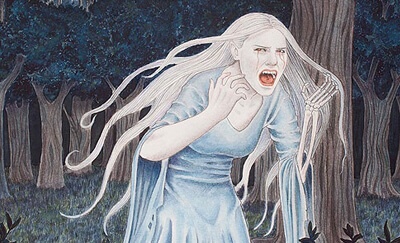
Banshee – actually should be spelled Bean Sidhe. She’s an Irish death spirit. Their keening fortells a death. They have very long, flowing hair and wear green dresses with grey cloaks. Their eyes are bright red because of their continuous weeping; or Benshee – an Irish faery attached to a house. Common name for the Irish Bean Sidhe. In Scotland the banshee is known as caoineag (wailing woman) also Bean-Nighe and, although seldom seen, she often heard in the hills and glens, by lakes or running water.

Bean Sidhe – In Irish folklore, the Bean Sidhe (woman of the hills) is a spirit or fairy who presage a death by wailing. She is popularly known as the Banshee. She visits a household and by wailing she warns them that a member of their family is about to die. When a Banshee is caught, she is obliged to tell the name of the doomed. The antiquity of this concept is vouched for by the fact that the Morrigan, in a poem from the 8th century, is described as washing spoils and entrails. It was believed in County Clare that Richard the Clare, the Norman leader of the 12th century, had met a horrible beldame, washing armor and rich robes “until the red gore churned in her hands”, who warned him of the destruction of his host. The Bean Sidhe has long streaming hair and is dressed in a gray cloak over a green dress. Her eyes are fiery red from the constant weeping. When multiple Banshees wail together, it will herald the death of someone very great or holy. The Scottish version of the Banshee is the Bean Nighe. Aiobhill is the banshee of the Dalcassians of North Munster, and Cliodna is the banshee of the MacCarthys and other families of South Munster.

Bean-Nighe – pronounced “ben-neeyah”; type of Banshee around streams in Scotland and Ireland. She washed bloodstained clothing of people who will soon die. They are rumored to be the ghosts of women who died in childbirth and will continue to wash until the day they should have died. The Washer at the Ford.

Upyr

Upyr (Oo-PEER)

Variations: Oupyr, Uppyr

This Russian vampire revenant is created when a heretic, sorcerer, or witch dies or as the child of a werewolf and a witch. Active between noon and midnight it looks like a normal person and preys on the children of a family and then moves on to the parents. After draining the victim of blood it will open a hole in the chest with its ironlike teeth and consume the heart.

Its grave can only be found by attaching a spool of thread to its clothing and following the thread. The grave must be soaked in Holy water and a stake driving though it in a single blow or the vampire will still rise. Another method of destruction is to decapitate the vampire and burn its corpse to ashes.

Joseph Campbell on Immortality

“Those who know, not only that the Everlasting lives in them, but that what they, and all things, really are IS the Everlasting, dwell in the groves of the wish-fulfilling trees, drink the brew of immortality, and listen everywhere to the unheard music of eternal concord. These are the immortals.”

~ Joseph Campbell, from “The Hero with a Thousand Faces”

#JosephCampbell #Mythology #FavoriteBooks