On this date in 1858, one of the most significant founders of sociology, David Emile Durkheim, was born in Epinal in Lorraine, France. His father, grandfather and great-grandfather were prominent rabbis. Durkheim spent time in rabbinical school but broke with Judaism early in life (Emile Durkheim: An Introduction to Four Major Works by Robert Alun Jones, 1986). Durkheim excelled in school, earning his bachelor in letters and sciences in 1875, two years earlier than normal, from College d’Epinal. He was admitted to the prestigious École normale supérieure in 1879 and passed examinations to become a philosophy lecturer in 1882. He was appointed to the Faculty of Letters at Bordeaux to lecture on the “Science Sociale,” marking the first time sociology officially entered the French university system.
Durkheim founded the Année Sociologique in 1898, the first French social science journal, still in existence. In 1902, Durkheim was appointed chair of education at the Sorbonne in Paris. For a time, his courses were the only lectures required at the Sorbonne. Durkheim believed religion served a unique role in human life, and indeed shaped many social structures, but that its origins were in human society, not from a divine source (“Reasons people choose atheism,” BBC, Oct. 22, 2009). “Frequently described as a ‘secular pope,’ Durkheim was viewed by critics as an agent of government anti-clericalism” (Jones, 1986). Some of his greatest contributions to sociology include: The Division of Labour in Society (1893), Rules of the Sociological Method (1895), On the Normality of Crime (1895), Suicide (1897), Sociology and Its Scientific Domain (1900) and The Elementary Forms of Religious Life (1912). Published posthumously were other important works including Education and Sociology (1922), Sociology and Philosophy (1924) and Pragmatism and Sociology (1955). Overwork and the death of a beloved son in war (in 1916) had severe repercussions on Durkheim’s health. He suffered a stroke and died at the age of 59. He is buried in Paris. D. 1917.
“Religious force is nothing other than the collective and anonymous force of the clan.” ~ Emile Durkheim in The Elementary Forms of the Religious Life, 1912.
Today in 1452 Leonardo da Vinci was born. Leonardo di ser Piero da Vinci (15 April 1452 – 2 May 1519), more commonly Leonardo da Vinci or simply Leonardo, was an Italian polymath whose areas of interest included invention, painting, sculpting, architecture, science, music, mathematics, engineering, literature, anatomy, geology, astronomy, botany, writing, history, and cartography. He has been variously called the father of palaeontology, ichnology, and architecture, and is widely considered one of the greatest painters of all time. Sometimes credited with the inventions of the parachute, helicopter and tank, he epitomised the Renaissance humanist ideal.
Many historians and scholars regard Leonardo as the prime exemplar of the “Universal Genius” or “Renaissance Man”, an individual of “unquenchable curiosity” and “feverishly inventive imagination”. According to art historian Helen Gardner, the scope and depth of his interests were without precedent in recorded history, and “his mind and personality seem to us superhuman, while the man himself mysterious and remote”. Marco Rosci notes that while there is much speculation regarding his life and personality, his view of the world was logical rather than mysterious, and that the empirical methods he employed were unorthodox for his time.
Born out of wedlock to a notary, Piero da Vinci, and a peasant woman, Caterina, in Vinci in the region of Florence, Leonardo was educated in the studio of the renowned Florentine painter Andrea del Verrocchio. Much of his earlier working life was spent in the service of Ludovico il Moro in Milan. He later worked in Rome, Bologna and Venice, and he spent his last years in France at the home awarded to him by Francis I of France.
Leonardo was, and is, renowned primarily as a painter. Among his works, the Mona Lisa is the most famous and most parodied portrait and The Last Supper the most reproduced religious painting of all time. Leonardo’s drawing of the Vitruvian Man is also regarded as a cultural icon, being reproduced on items as varied as the euro coin, textbooks, and T-shirts. Perhaps fifteen of his paintings have survived. Nevertheless, these few works, together with his notebooks, which contain drawings, scientific diagrams, and his thoughts on the nature of painting, compose a contribution to later generations of artists rivalled only by that of his contemporary, Michelangelo.
Leonardo is revered for his technological ingenuity. He conceptualised flying machines, a type of armoured fighting vehicle, concentrated solar power, an adding machine, and the double hull. Relatively few of his designs were constructed or even feasible during his lifetime, as the modern scientific approaches to metallurgy and engineering were only in their infancy during the Renaissance. Some of his smaller inventions, however, such as an automated bobbin winder and a machine for testing the tensile strength of wire, entered the world of manufacturing unheralded. A number of Leonardo’s most practical inventions are nowadays displayed as working models at the Museum of Vinci. He made substantial discoveries in anatomy, civil engineering, geology, optics, and hydrodynamics, but he did not publish his findings and they had no direct influence on later science.
Today, Leonardo is widely considered one of the most diversely talented individuals ever to have lived.
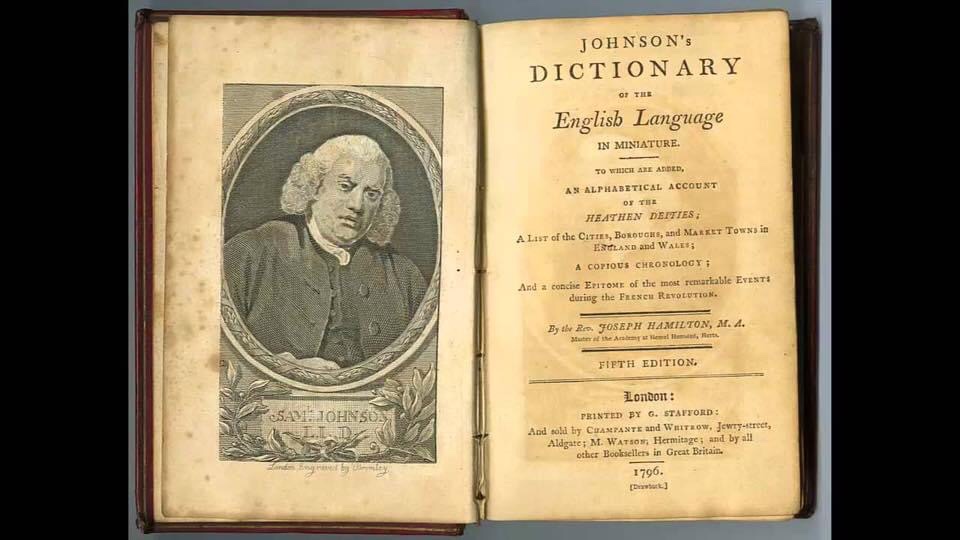
Today in 1755 Samuel Johnson’s “A Dictionary of the English Language” was published in London. It was a mammoth undertaking, requiring almost a decade of work and it remained the definitive authority until the Oxford Dictionary was completed nearly two centuries later. It had been deliberately commissioned as pre-existing dictionaries were relatively poor and incomplete. Johnson’s dictionary is a little different from the relatively dry descriptions and meticulously researched etymologies that we are used to today, for example:
Cough: A convulsion of the lungs, vellicated by some sharp serosity. It is pronounced coff
Excise: a hateful tax levied upon commodities and adjudged not by the common judges of property but wretches hired by those to whom excise is paid
As it was, Johnson’s dictionary was so large and expensive that it cost more to print than Johnson’s entire remuneration on the project and sold at around 200 copies per year for the next three decades. Although it was hardly without flaw or error, it was hugely influential for more than a century.
Out of body experiences and seeing the light at the end of the tunnel (Heaven)??
“The “light at the end of a tunnel” can be duplicated by putting pilots in an ultracentrifuge. As blood drains from their head, the outer rim of their retina loses blood, so you only see the center of the retina, so you see a light at the end of the tunnel. The “light at the end of the tunnel,” caused by a drop in blood pressure, can also happen in an accident, so therefore people think they have died and seen heaven.
“Out of body experiences” can also be duplicated by electrically stimulating certain regions of the brain. By stimulating the boundary between two areas of the brain, it gets confused. To make sense of these contradictory signals, the brain interprets this as being outside the body. This effect can simply be created by an electrical probe to the brain.” ~ Dr. Michio Kaku, Theoretical Physicist
As part of the infamous “swimming test,” accused witches were dragged to the nearest body of water, stripped to their undergarments, bound and then tossed in to to see if they would sink or float. Since witches were believed to have spurned the sacrament of baptism, it was thought that the water would reject their body and prevent them from submerging. According to this logic, an innocent person would sink like a stone, but a witch would simply bob on the surface. The victim typically had a rope tied around their waist so they could be pulled from the water if they sank, but it wasn’t unusual for accidental drowning deaths to occur.
Witch swimming derived from the “trial by water,” an ancient practice where suspected criminals and sorcerers were thrown into rushing rivers to allow a higher power to decide their fate. This custom was banned in many European counties in the Middle Ages, only to reemerge in the 17th century as a witch experiment, and it persisted in some locales well into the 18th century. For example, in 1710, the swimming test was used as evidence against a Hungarian woman named Dorko Boda, who was later beaten and burned at the stake as a witch.
2. Prayer Test
Medieval wisdom held that witches were incapable of speaking scripture aloud, so accused sorcerers were made to recite selections from the Bible—usually the Lord’s Prayer—without making mistakes or omissions. While it may have simply been a sign that the suspected witch was illiterate or nervous, any errors were viewed as proof that the speaker was in league with the devil. This twisted test of public speaking ability was commonly used as hard evidence in witch trials. In 1712, it was applied in the case Jane Wenham, an accused witch who supposedly struggled to speak the words “forgive us our trespasses” and “lead us not into temptation” during her interrogation. Still, even a successful prayer test didn’t guarantee an acquittal. During the Salem Witch Trials, the accused sorcerer George Burroughs flawlessly recited the prayer from the gallows just before his execution. The performance was dismissed as a devil’s trick, and the hanging proceeded as planned.
3. Touch Test
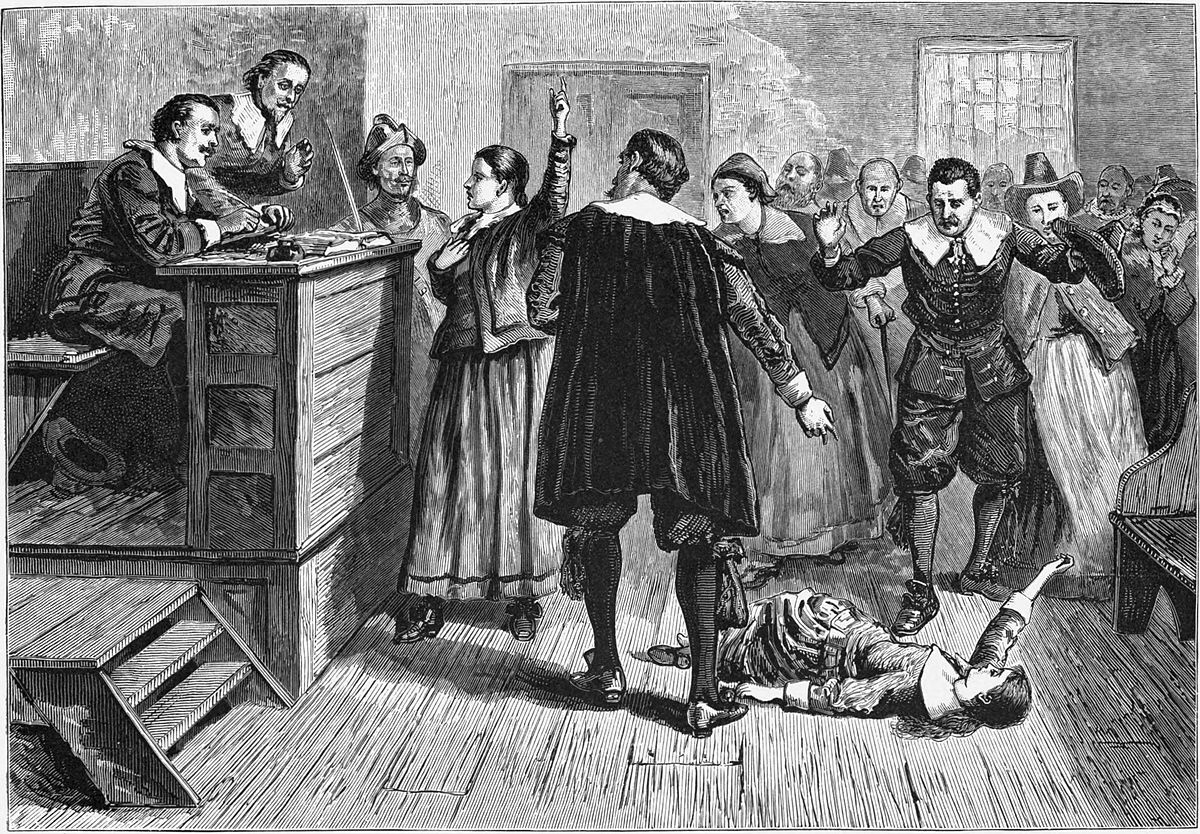
The touch test worked on the idea that victims of sorcery would have a special reaction to physical contact with their evildoer. In cases where a possessed person fell into spells or fits, the suspected witch would be brought into the room and asked to a lay a hand on them. A non-reaction signaled innocence, but if the victim came out of their fit, it was seen as proof that the suspect had placed them under a spell.
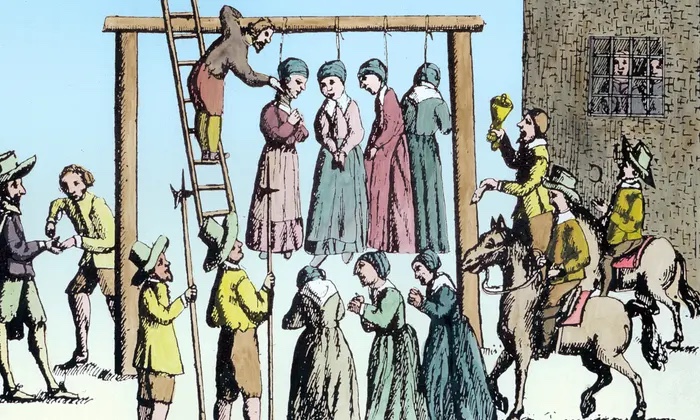
Touch tests played a famous part in the 1662 trial of Rose Cullender and Amy Denny, two elderly English women charged with bewitching a pair of young girls. The children had been suffering from fits that left their fists clenched so tightly that even a strong man could not pry their fingers apart, but early tests showed they easily opened whenever Cullender or Denny touched them. To ensure the reaction was genuine, judges had the children blindfolded and touched by other members of the court. The girls unclenched their fists anyway, which suggested they were faking, but even this was not enough to prove the women’s innocence. Cullender and Denny were both later hanged as witches.
4. Witch Cakes
A bizarre form of counter-magic, the witch cake was a supernatural dessert used to identify suspected evildoers. In cases of mysterious illness or possession, witch-hunters would take a sample of the victim’s urine, mix it with rye-meal and ashes and bake it into a cake. This stomach-turning concoction was then fed to a dog—the “familiars,” or animal helpers, of witches—in the hope that the beast would fall under its spell and reveal the name of the guilty sorcerer. During the hysteria that preceded the Salem Witch Trials, the slave Tituba famously helped prepare a witch cake to identify the person responsible for bewitching young Betty Parris and others. The brew failed to work, and Tituba’s supposed knowledge of spells and folk remedies was later used as evidence against her when she was accused of being a witch.
5. Witch’s Marks
Witch-hunters often had their suspects stripped and publicly examined for signs of an unsightly blemish that witches were said to receive upon making their pact with Satan. This “Devil’s Mark” could supposedly change shape and color, and was believed to be numb and insensitive to pain. Prosecutors might also search for the “witches’ teat,” an extra nipple allegedly used to suckle the witch’s helper animals. In both cases, it was easy for even the most minor physical imperfections to be labeled as the work of the devil himself. Moles, scars, birthmarks, sores, supernumerary nipples and tattoos could all qualify, so examiners rarely came up empty-handed. In the midst of witch hunts, desperate villagers would sometimes even burn or cut off any offending marks on their bodies, only to have their wounds labeled as proof of a covenant with the devil.
6. Pricking and Scratching Tests
If witch-hunters struggled to find obvious evidence of “witch’s marks” on a suspect’s body, they might resort to the ghastly practice of “pricking” as a means of sussing it out. Witch-hunting books and instructional pamphlets noted that the marks were insensitive to pain and couldn’t bleed, so examiners used specially designed needles to repeatedly stab and prick at the accused person’s flesh until they discovered a spot that produced the desired results. In England and Scotland, the torture was eventually performed by well-paid professional “prickers,” many of whom were actually con men who used dulled needlepoints to identify fake witch’s marks.
Along with pricking, the unfortunate suspect might also be subjected to “scratching” by their supposed victims. This test was based on the notion that possessed people found relief by scratching the person responsible with their fingernails until they drew blood. If their symptoms improved after clawing at the accused’s skin, it was seen as partial evidence of guilt.
7. Incantations
Also known as “charging,” this test involved forcing the accused witch to verbally order the devil to let the possessed victim come out of their fit or trance. Other people would also utter the words to act as a “control,” and judges would then gauge whether the statements had any effect on the victim’s condition. Charges were famously used in the 16th century witch trial of Alice Samuel and her husband and daughter, who were accused of bewitching five girls from the wealthy Throckmorton family. During the proceedings, judges forced the Samuels to demand that the devil release the girls from their spell by stating, “As I am a witch…so I charge the devil to let Mistress Throckmorton come out of her fit at this present.” When the possessed girls immediately recovered, the Samuels were found guilty and hanged as witches.
In March 1662, John and Bethia Kelly grieved over the body of their 8-year-old daughter inside their home. Little Elizabeth had been fine just days before when she returned home with a neighbor, Goodwife Ayres. The distraught parents, grasping at any explanation for their loss, saw the hand of the devil at work.
The parents were convinced that Elizabeth had been fatally possessed by Goody Ayres. The Kellys testified that their daughter first took ill the night after she returned home with her neighbor, and that she exclaimed, “Father! Father! Help me, help me! Goodwife Ayres is upon me. She chokes me. She kneels on my belly. She will break my bowels. She pinches me. She will make me black and blue.”
After Elizabeth’s death, accusations of bewitchment flew, and fingers were pointed at numerous townspeople. Hysteria gripped Hartford, a town that a generation before had witnessed the first execution of a suspected witch in the American colonies. Alse Young of Windsor, Connecticut, was sent to the gallows erected in Hartford’s Meeting House Square on May 26, 1647.
Witchcraft was one of 12 capital crimes decreed by Connecticut’s colonial government in 1642. The legal precedent cited by the devoutly Puritan colonists was of a divinely higher order: biblical passages such as Exodus 22:18 (“Thou shalt not suffer a witch to live”) and Leviticus 20:27 (“A man also or woman that hath a familiar spirit, or that is a wizard, shall surely be put to death”).
After Young’s public hanging, at least five other Connecticut residents met a similar fate. However, it was in Hartford in 1662, 30 years before the infamous Salem witch trials, that a witch hunt hysteria took hold, resulting in seven trials and four executions.
Shortly after Elizabeth Kelly’s death, the pious Ann Cole suddenly became “afflicted,” shaking violently and spouting blasphemy. According to one account, Cole was “taken with strange fits, wherein she held a discourse for a considerable time.” Cole blamed her bewitchment on neighbor Rebecca Greensmith, described by one townsperson as “a lewd, ignorant, considerably aged woman,” and others already suspected of witchcraft in the Kelly case. The accused began to accuse others, and even their spouses, of being the true witches. In what became a vicious circle, neighbors began testifying against neighbors. Goody Ayres’ husband, perhaps in an attempt to save his wife, joined in the chorus of Greensmith’s accusers.
The most damning testimony supposedly came from Greensmith herself, who reportedly admitted to having “familiarity with the devil” and said that “at Christmas they would have a merry meeting” to form a covenant. Greensmith implicated her husband and said she had met in the woods with seven other witches, including Goody Ayres, Mary Sanford and Elizabeth Seager. Neighbors testified that they saw Seager dancing with other women in the woods and cooking mysterious concoctions in black kettles.
Two of the suspects, likely the Greensmiths, were subjected to the swimming test in which their hands and feet were bound and they were cast into the water to test the theory that witches are unable to sink. After they were tried, the Greensmiths were indicted “for not having the fear of God before thine eyes; thou hast entertained familiarity with Satan the grand enemy of God and mankind and by his help hast acted things in a preternatural way.” The court’s verdict: “According to the law of God and the established law of this commonwealth, thou deserves to die.”
Rebecca Greensmith had confessed in open court. Nathaniel Greensmith had protested his innocence. But they both met the same fate: the noose. Sanford was also sent to the gallows. After their executions, Cole reportedly was “restored to health.” Ayres fled Hartford, while Seager was finally convicted of witchcraft in 1665, although the governor reversed the verdict the following year. Mary Barnes of Farmington, Connecticut, was also swept up in the region’s witch hunt and executed alongside the Greensmiths.
The four executions of suspected witches in Hartford were to be Connecticut’s last. Another hysteria broke out in Fairfield, Connecticut, in 1692, but none of those convicted met death. Connecticut held its final witch trial in 1697, a half century after Alse Young’s execution. During that period, there were 46 prosecutions and at least 11 executions.
Aeval was a Celtic faerie queen of northern Munster. She was part of the Tuatha Dé Danann tribe and associated with the O’ Brien Clan. She Became the Banshee of the O’Brien Family and began her lament whenever one of the family members died. Her name means beautiful. She made Craig Liath her home which mean Gray Rock. She held a midnight court to determine if Husbands were satisfying their wives sexual needs. When found to be remiss the husband would to ordered to over come there prudishness and give their wives what they need.
Aeval had a lover once who was a servant of Murchadh named Dudhlaing Ua Artigan. Murchadh was the eldest son of Brian Boru. Aeval placed a druid mist around her lover to ensure that he would not go into battle in the Battle of Clontarf and be killed. Aeval went to Brian Boru’s tent to tell him that he would be victorious in battle but that he would loose his own life and the first son to visit him in his tent would become king. Brian sent for his eldest son Murcahd, but Murchadh decided to delay to change clothing. So instead his other son Donnchadh was the first to enter the tent. Murchadh went into battle with Dudhlaing, and they struck their enemies a mighty blow on either side. Murchadh said they he heard the sound of Dudhlaing’s blows but could not see him. It seems that Dudhlaing did not want to keep the magick mist about him when Muchadh could not see him, so he withdrew from the druid cloack. They went to the plain where Aeval was because they thought she could give them news of the battle. Aeval pleaded with the two men to stop and stay away from the battle. Murchadh refused and said that fear of his mortality would not keep him from going into battle, and that if he fell, he would bring the enemy down with him. She pleaded with Dudhlaing that if he stayed with her he would know 200 years of happiness to which he replied that he will not soil his good name for gold or silver. Aeval told the two men that they would fall in battle and that by tomorrow your blood will be spilt on the plains.
Aeval had a harp whose music was sweet and beautiful, but deadly to mortals. It is said that whoever heard the music of the harp would die shortly afterwards. The harp did not have to be strummed or plucked by her. It would play whatever it was told to play by her. The victims of her harp were usually young men. It is said that she gifted her harp to the son of Meardha when he was learning at the school of the Sidhe at Connacht. He learned that his father had been killed by the King of Lochlann. The son of Meardha went to where the three sons of the King of Lochlann were, and played his harp. The three sons died shortly afterward.
The Varacolaci vampire is from Romania. This is one of the most powerful of the undead creatures. It’s said that the Varacolaci has the ability to cause lunar and solar eclipses.
The Varacolaci, a vampire revenant in Romania, is said to be created when an unbaptized baby died or if a person committed suicide. But there are also some instances that being a varacolaci becomes inherited or passed down from generation to generation.
If a varacolaci was created after his death, the person who turned into a varacolaci would look exactly the same, though would tend to look pale and with dried out skin. The varacolaci hunts its prey all year round but it is particularly active during St. Andrew’s Day and St. George’s Day. This creature is also said to be one of the most dangerous types of vampire since it was considered as the strongest type of vampire in the folklore of Romania.
A varacolaci like any vampire drains the blood of its victim, but it does not leave any bite marks. It can shape shift into any animals, but it usually takes the form of a flea, cat, spider, frog and dog. It is also said to be responsible for causing lunar eclipse and solar eclipse by putting itself into a trance.
The varacolaci also has the ability of “midnight spinning”, a sort of astral projection that allows them to travel safely at night anywhere they wish to go. While they were on astral projection, the creature seems to look like a dragon or a creature with several mouths. However if one manages to find a varacolaci in this state, the creature would be unable to return to its body causing it to sleep forever and leaving its soul to wander around eternally.
Traditionally, those corpses that are suspected of becoming a varacolaci, can be prevented on rising from its grave by planting a thorny plant on its grave. If in an instance that a person dies by committing suicide the only way to prevent him from being a varacolaci is to throw his body into a river immediately.
An intricate ritual needs to be performed in order to completely vanquish the vampire being, first the vampire must rise from its grave and must be captured. In the case of a male varacolaci, their heart must be ripped off and cut in half. A nail must be punctured into its forehead and whole cloves of garlic must be placed inside its mouth. The corpse is then filled with a pig fat that comes from a pig that was slaughtered on St. Ignatius Day. A burial shroud is then dipped into a holy water and wrapped on the corpse. The body was then reburied into an isolated area far from the community. In the case of a female varacolaci an iron fork must be driven into its eyes and heart and the body was buried into a very deep grave.
Ocean Fun Fact —> There are more squid in the ocean than fish:
Over the last half-century, rising ocean temperatures and overfishing have drastically reduced the world’s populations of tuna, shark, swordfish and other large predatory fish; populations of octopuses, cuttlefish and squid, meanwhile, have increased in number around the globe…
On this date in 1949, writer and columnist Christopher Hitchens was born in Portsmouth, England. He attended Cambridge and graduated from Oxford in 1970, reading in philosophy, politics and economics. From 1971-1981 he worked as a book reviewer for The Times. In 1981 he emigrated to the United States. Hitchens wrote “Minority Report,” a column for The Nation, from 1982-2002. He then wrote for Slate, The Daily Mirror, as a contributing editor to The Atlantic Monthly and Vanity Fair, and also wrote for Harpers and many other U.S. newspapers and journals. As a foreign correspondent, he covered events in 60 countries on all five continents. Hitchens wrote a host of books, but is best-known in freethought circles for authoring God Is Not Great (2007). His criticisms of Clinton and pro-Iraqi war views made Hitchens increasingly controversial among progressive readership, but he remained a stalwart atheist and iconoclast. In “Papal Power: John Paul II’s other legacy” (Slate.com, April 1, 2005), Hitchens pointed out that the pope “was a part of the cover up and obstruction of justice that allowed the child-rape scandal to continue for so long.” Hitchens became a U.S. citizen in 2007. D. 2011.
“Gullibility and credulity are considered undesirable qualities in every department of human life—except religion . . . Why are we praised by godly men for surrendering our ‘godly gift’ of reason when we cross their mental thresholds? . . . Atheism strikes me as morally superior, as well as intellectually superior, to religion. Since it is obviously inconceivable that all religions can be right, the most reasonable conclusion is that they are all wrong.”
~ Christopher Hitchens, “The Lord and the Intellectuals,” Harper’s (July 1982), cited by James A. Haught in 2,000 Years of Disbelief (1996)








 Mark Bere Peterson’s Counterculture, Urban Legends, Paganism & Witchcraft