
Days of the Week: Sunday

Arguably, the sun is the most essential thing for life on this planet. So, it comes as no surprise that ancient cultures either worshiped the sun directly or made sun gods key members of their pantheons. The Egyptians had Ra. Apollo was worshiped across the Mediterranean. Later, Roman rulers tried to make Sol Invictus (the Invincible Sun) the official god of the Empire. So, it is no surprise that the Romans named the first day of the week Dies Solis (Sun Day). However, in later Romance languages (like Spanish, French, or Italian), the name changed to reflect Catholic culture (i.e., domingo/domenica/dimanche).

The Vikings seem to have had a different view, though. In Norse belief, the sun was not some powerful masculine god. Instead, the sun was a woman (a goddess presumably, but never expressly called that). This woman, Sunna or Sól, drives her chariot lit from the sparks of Muspellsheim (the land of fire) across the sky (i.e. Sunna’s Day or Sun Day). Sól’s horses are called Arvak and Alsvinn, and they are cooled by bellows under their shoulders. Sól is continuously pursued by a giant wolf named Skoll, who is a relative of Fenrir.

There is significant archeological evidence that there was once a prominent cult of the sun in Scandinavia. However, almost all of these monuments and solar symbols faded away in the 6th century. This coincides with a great time of famine, frost, and darkness in the north that decimated the population and shattered people’s way of life. This little ice age was caused by two volcanic eruptions around the 540s. Some archaeologists theorize these catastrophes discredited the sun cult, driving the survivors of those grim decades to alter their faith. So, by the time of the Vikings some three centuries later, the Norse had no significant sun deity – just a woman fleeing from wolves. Many of the fertility and prosperity features one would expect from a sun deity were (apparently) transferred to gods and goddesses like Freyr or Sif.

Odin vs. Santa

Odin vs. Santa:

According to Norse Pagan myths, Odin was the leader of the Wild Hunt every Yule and he would ride his eight-legged horse, Sleipnir around the whole time. Sleipnir could cover long distances in a very short period of time, just like Santa’s sleigh and reindeer. According to the same traditions, children would fill their boots with carrots, straw and sugar, and place them near the chimney for Odin’s flying horse to eat while resting. Odin would then return the favor and reward those children for their kindness by leaving gifts, toys, and candies in the boots. Sound familiar?

Cicero

People will disagree with me, but hands down best politician in history and it’s not even close:

~ He squared off against Caesar and was friends with young Brutus.

~ He advised the legendary Pompey on his somewhat botched transition from military hero to politician.

~ He lambasted Mark Antony and was master of the smear campaign, as feared for his wit as he was for exposing his opponents’ sexual peccadilloes.

~ Brilliant, voluble, cranky, a genius of political manipulation but also a true patriot and idealist, Cicero was Rome’s most feared politician, one of the greatest lawyers and statesmen of all times.

~ Machiavelli, Queen Elizabeth, John Adams and Winston Churchill all studied his example.

If you haven’t read any of his books I’d suggest reading his book: “Orations” and then one or more of “Tusculan Disputations” or “On the Commonwealth and On the Laws” or “On Moral Ends” or “The Nature of the Gods.”

#Cicero

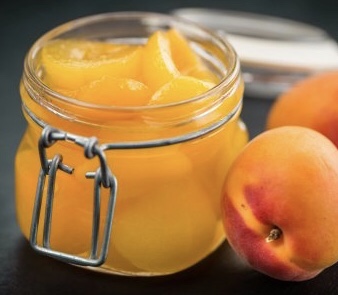
Pickled Peaches

12 small peaches, peeled with 4 cloves per peach
1 1/2 cups sugar
1 cup white vinegar
3 large cinnamon sticks

(Makes 3 pints)

Cut a shallow X in the bottom of each peach with a sharp knife and blanch in batches in a large pot of boiling water for 10–15 seconds.

Transfer the peaches to a large bowl of ice water and let stand until cool enough to handle. Peel the peaches, then halve them lengthwise and pit. Toss the peaches with the sugar and chill, covered, for at least 8 hours.

In a large stockpot, mix the vinegar and cinnamon sticks, with the peaches and their accumulated juices. Bring to a boil over moderate heat.  Skim off the foam. Reduce the heat and simmer until the peaches are barely tender, 3 minutes or so.

Divide the peaches and cinnamon sticks among the prepared jars. Return the peach-cooking liquid to a boil, then pour into the jars, leaving 1/4 inch of space at the top.

Wipe off the rims of the filled jars with a damp kitchen towel, place the lids on the jars, then firmly screw on the rings. Put the sealed jars on the rack of the canner and, if necessary, add enough hot water to cover the jars by 2 inches.

Boil the jars for 20 minutes, covered, then transfer to a towel-lined surface to cool. The jars will seal as they cool.

After the jars have cooled for 12–24 hours, press the center of each lid to check that it’s concave and that a vacuum has formed and they are sealed.  Store in a cool dry place for up to 1 year.

Place any jars that haven’t sealed in the refrigerator and use them first.

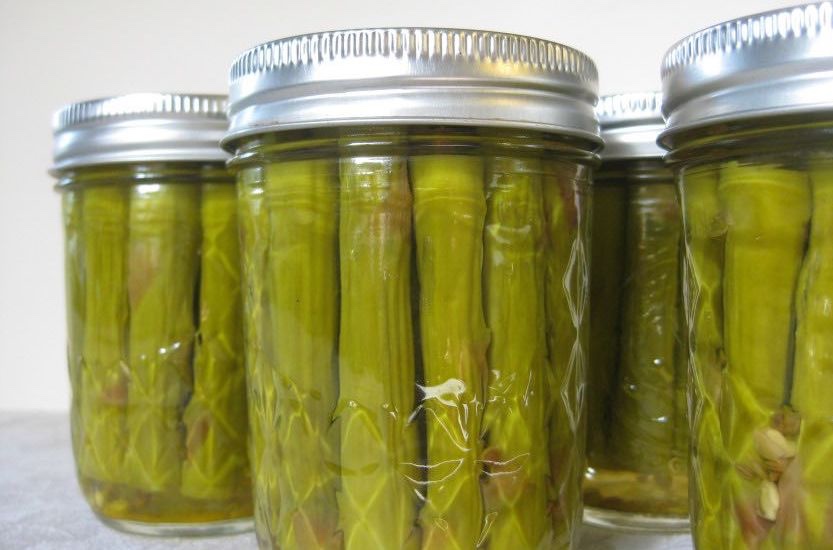
Pickled Lemon Asparagus

1⁄2 pound asparagus
3⁄4 cup distilled white vinegar
3⁄4 cup water
1 1/2 teaspoons sugar
1 (3-inch) strip lemon zest
2 garlic cloves
1 teaspoon coriander seeds
1 teaspoon pickling salt

Trim the woody ends from the asparagus. Cut the asparagus into 2-inch lengths.

Combine the white vinegar, water, and sugar in a saucepan and heat to boiling, stirring to dissolve the sugar.

Pack the lemon zest, garlic, coriander seeds, and salt into a hot 1-pint canning jar. Fill with the asparagus. Pour in the hot vinegar mixture, leaving 1⁄2 inch headspace. Seal.

Process in a boiling-water bath for 10 minutes.  Let cool undisturbed for 12 hours. Store in a cool, dry place. Do not open for 6 weeks to allow the flavors to develop.

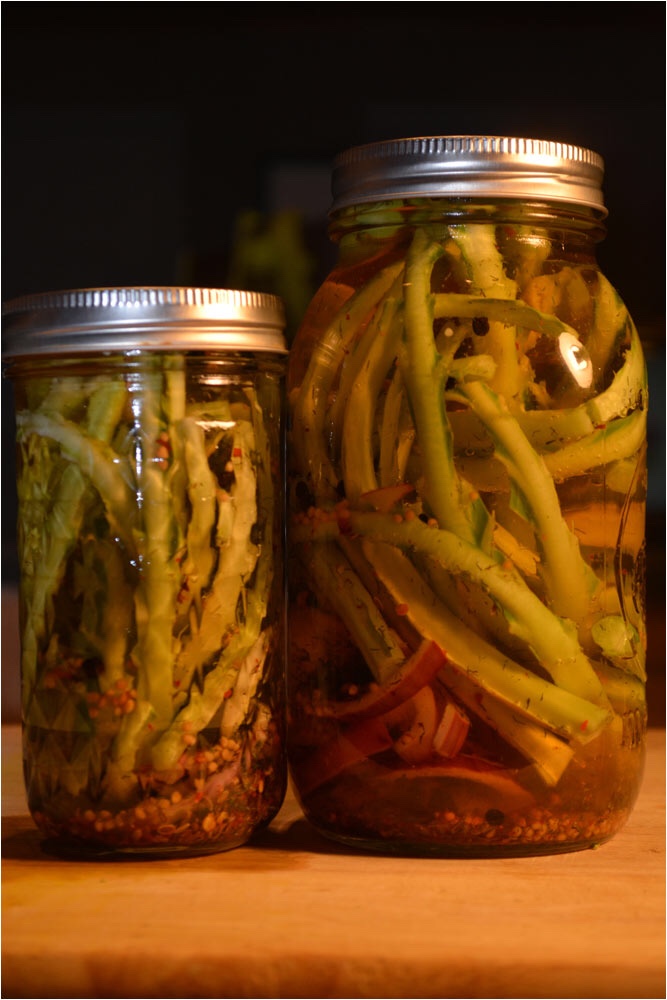
Pickled Collard Stems

  • 1 gallon glass container with lid or smaller jars
  • Stems from 2 bunches of collards, trimmed to 1 inch shorter than glass jar
  • 1/2 onion, sliced thinly
  • 6 cloves of minced garlic
  • 2 teaspoons whole black peppercorns
  • 3 bay leaves
  • 1 tablespoon diced jalapenos
  • 1 gallon filtered water
  • 3/4 cup pickling salt
  • 1/2 cup apple cider vinegar

Pack jar tightly with stems, onions, and spices. Bring water, salt, and vinegar to a low boil. Remove brine from heat and let cool for 15 minutes. Pour brine over veggies, making sure brine covers everything. Place a fermentation weight over the top to prevent as much contact between the air and the brine surface, or rig up something of your own that will serve the same purpose not the lid though.

Let your container sit at room temperature for 3-5 days, until your stems have the perfect saltiness, flavor, and crunchiness. When they reach that point, trade the weight for a lid and place the whole container in the fridge. Your pickled stems will last several weeks or less depending how much you enjoy them.

Green Tomato Chow Chow

  • 6 cups coarsely chopped green tomatoes, about 2 pounds

  • 2 cups chopped sweet onion
  • ½ cup diced red bell pepper
  • ⅓ cup seeded and minced red jalapeño pepper
  • 1 Tablespoon kosher salt
  • 1 cup cider vinegar
  • ⅔ cup sugar
  • 1 teaspoon crushed red pepper
  • 2 teaspoons sorghum syrup
  • 3/4 teaspoon celery seeds

Working in batches, pulse tomatoes and onion in a food processor until finely chopped. Transfer to a 6-quart Dutch oven. Stir in peppers and salt. Cover and chill for at least 8 hours, preferably overnight.

Uncover and bring to a rolling boil over medium-high heat, stirring occasionally. Pour through a wire-mesh strainer into a bowl, pressing with back of a spoon to release liquid. Discard liquid or save for another use.  Return solids to Dutch oven.

Add remaining ingredients; bring to a boil over medium-high heat. Boil, stirring occasionally for a few minutes until liquid evaporates. Spoon into clean jars. Let cool slightly. Cover and chill.  Keeps in the refrigerator for up to 3 weeks.

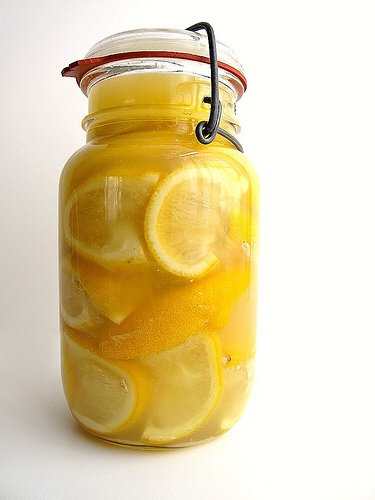
Sliced Pickled Lemons

Makes 1 quart jar

6 whole lemons
1 cup salt
1 cup sugar
1 cup pickling spice
4 cups distilled white vinegar

Bring 5 cups of water to a boil in a medium pot over high heat. Add the lemons and cook for 5 minutes. Drain. Cut off and discard the ends once cooled. Cut the lemons into thin slices and layer the slices into the jar, leaving 1 inch of headspace.

Combine the salt, sugar, pickling spice, and vinegar in a small saucepan, bring to a boil over high heat, and boil for 10 minutes. Pour this brine over the lemons to cover them and fill the jar, leaving ½ inch headspace. Cover with the lid and ring, and refrigerate for 10 days before using. These will keep for a month, refrigerated.

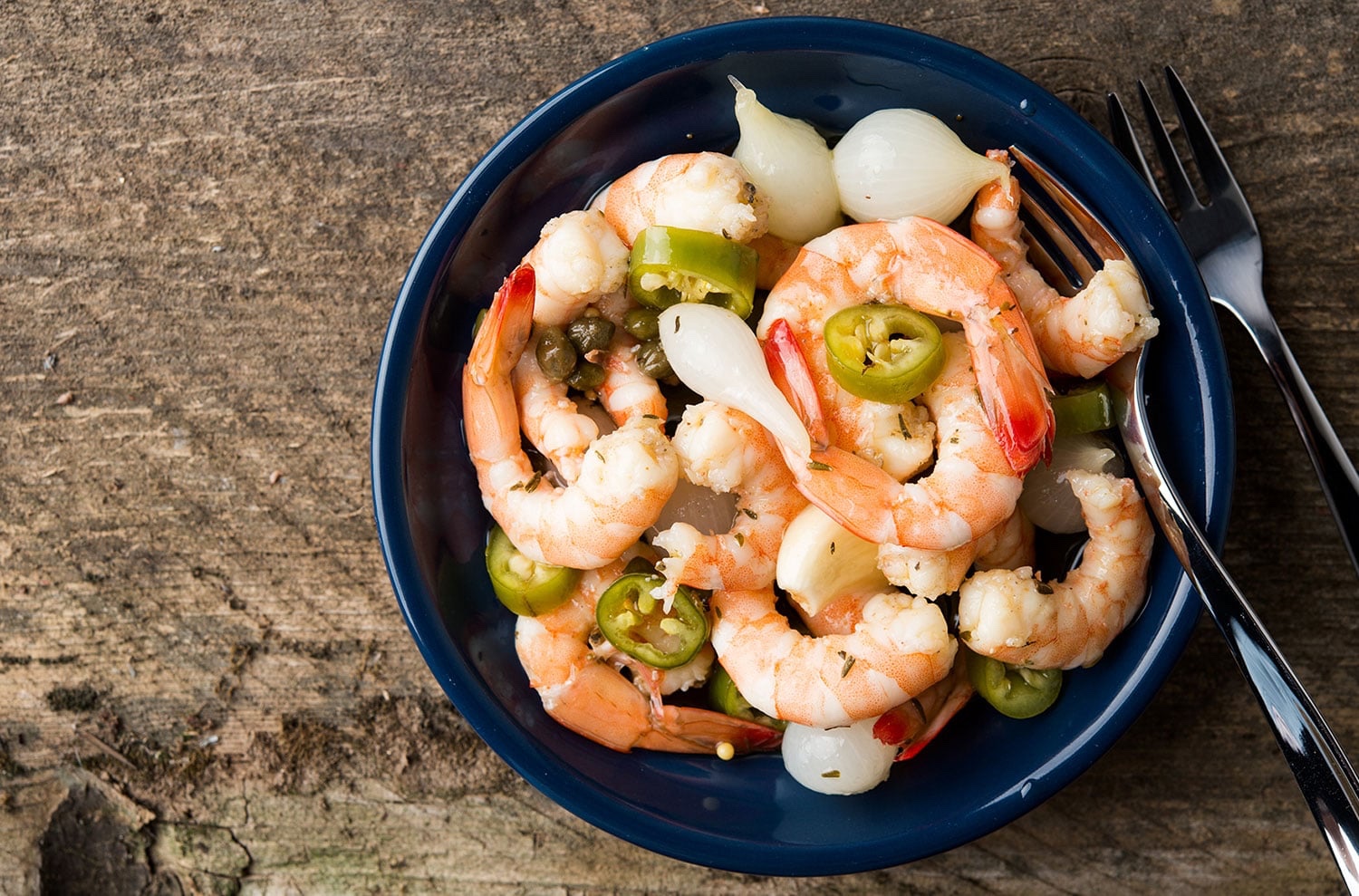
Quick Pickled Shrimp

1 gallon water
2 tablespoons plus 1 teaspoon kosher salt
2 pounds large shrimp, peeled and deveined
1 cup sliced onions
3 bay leaves
⅓ cup capers
¼ cup fresh lemon juice
1 cup cider vinegar
½ cup olive oil
1 teaspoon minced garlic
1 teaspoon celery seeds
1 teaspoon hot red pepper flakes
1/2 cup chopped fresh parsley

Heat the water in a large pot over high heat and bring to a hard boil. Add 2 tablespoons of the salt and stir to dissolve. Add the shrimp and boil just until they turn pink, about 30 seconds or so. Drain.

Meanwhile, in a large bowl combine the onions, bay leaves, capers without juice, lemon juice, vinegar, olive oil, garlic, remaining 1 teaspoon salt, celery seeds, pepper flakes, and parsley. Transfer the shrimp to the marinade.

Cover tightly and refrigerate for 8 to 12 hours.

Butter Beans

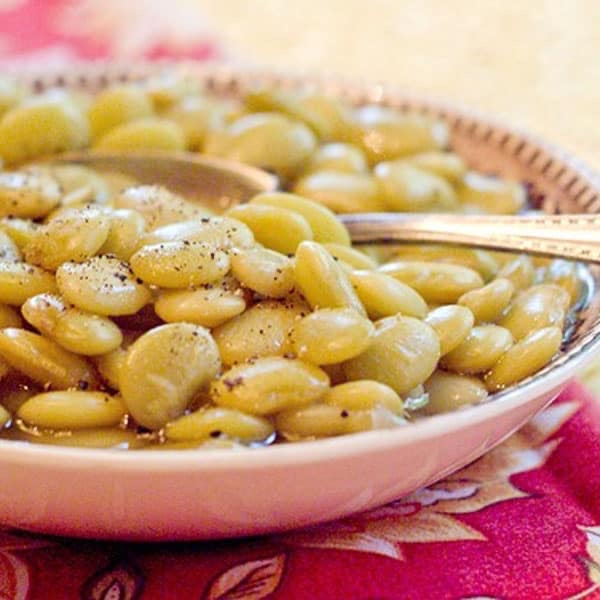
Here’s what a butter bean most certainly is not: a conventional lima bean that Southerners have given a more palatable moniker. Butter beans aren’t green; they’re creamy white. They should never be served from a can; look for them sold straight from a cooler in plastic bags along Southern roads for about a three-week period sometime between June and August. And they don’t have any tartness; they’re sweeter and smoother than their sometimes off-putting mass-market lima cousin. Also known as a Dixie bean or sieva, the butter bean has been a go-to hereabouts for succotash and stews since the 1700s. You can boil them until tender and dress simply with lemon zest, sea salt, and olive oil. Or cook them with a big ol’ ham hock and spoon them over hot crusty cornbread for a classic helping of Southern goodness.

~ “S is for Southern,” by the editors of Garden & Gun