Brownies

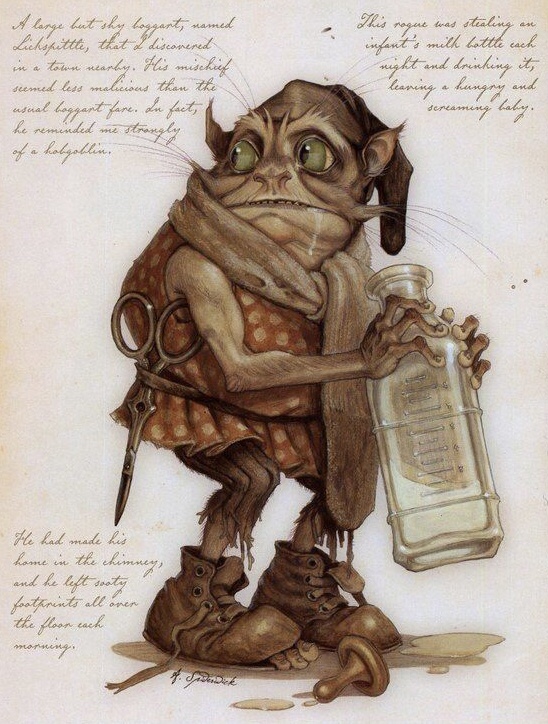
Brownies are somewhat unusual among the wider groupings of fairies because they prefer to live with or near humans, either in human homes or in mills, although some have also been connected to bodies of water like ponds.  Brownies in mills come out at night and work in the mill, not always in a way that helps the human owners, while Brownies in homes come out while the human inhabitants are sleeping and clean. Overall Brownies have a good reputation as helpful spirits, however, in older folklore they were seen as ambiguous beings and potentially dangerous particularly to those outside their chosen family, although even that family could be on the receiving end of the Brownie’s destructive temper if it was angered.

In descriptions Brownies are usually, as the name implies, a nut-brown color and are said to dress in rags. This style of dress may be a preference as stories tell of the unfortunate results of well-meaning humans offering their resident Brownie a new set of clothes. In best case scenarios the Brownie snatches up the clothing and leaves forever, sometimes singing happily that the new clothes mean that they will not work anymore; worst case scenarios the helpful Brownie is so offended it transforms into a malicious Boggart. This may be because the Brownie is bound to service and can only be released with purposeful payment, or because they are mortally offended by any implication that they are serving humans.

When Brownies appear in folklore the focus is usually on their role around human homes or farms, and secondarily their place at mills. Around a home they are known to do chores while on a farm they will help bring in crops and tend to the livestock. In one story centered on a mill, a human girl goes to grind wheat after dusk only to find the mill occupied by a Brownie who she douses with boiling water when he gets too amorous with her; he flees to his mother but later dies of his burns.

Brownies must be paid surreptitiously for their work, with food being left out for them but never directly given to them. A household with a Brownie would be expected to leave a bowl of milk and small loaf of bread or cake out once a week to show their gratitude for the Brownie’s efforts.  This food and drink should be left without verbal thanks and not directly as a gift, but placed carefully where the faerie would find it to avoid any chance of offending them. In this we see a juxtaposition of careful preparation and seemingly casual placement, with the housewife ensuring the Brownie’s continued effort for the household this way

Besides leaving if given clothes there are a few other things that will force a Brownie to leave a location. Several accounts of Brownies attached to homes describe the faeries being driven off by well-intentioned efforts to baptize them or reading from the Christian Bible in their presence, two things these faeries apparently cannot tolerate. Farm-oriented Brownies will become destructive and leave if the quality of their work is insulted or more generally if a person speaks ill of them.
First Kindertransport

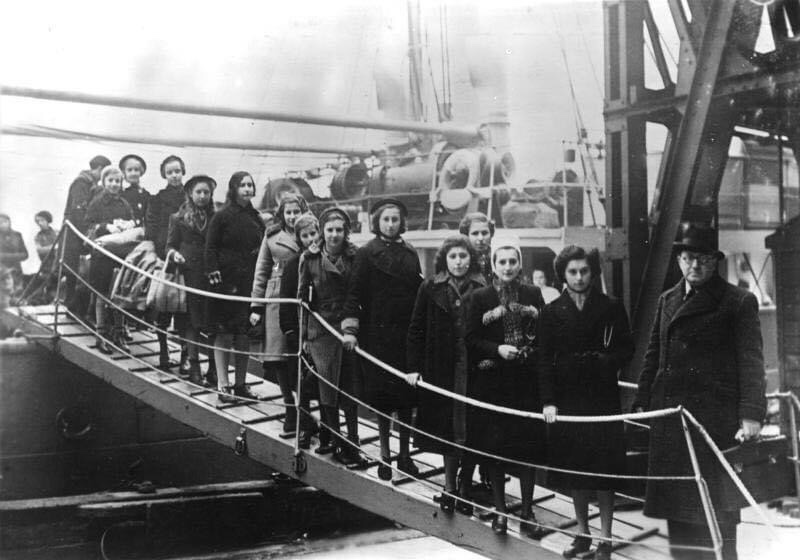
82 years ago, the first Kindertransport train left Germany:

Following the Kristallnacht pogrom in 1938, the British government changed its immigration policy to allow Jewish children to enter the country, providing that charities could pay a £50 bond for each child as a guarantee that they would leave the country when the situation improved. The children’s parents were not allowed to join them unless they had the financial means to support themselves, so most children travelled alone on what became known as the Kindertransport (‘children’s transport’).

Most of the almost 10,000 Kindertransportees never saw their parents again.

#Kindertransport #Holocaust

Ancient Egyptian Medicine

Ancient Egyptian medicine was arguably the most advanced of its time. Natural and supernatural remedies were used together by practitioners/priests in order to cure injury, illness, and disease. Evidence of different diagnoses and treatments have been found on numerous papyri, giving details of both natural and supernatural cures for different ailments. These texts were organized from sections of the body, or focused on one form of treatment. Some of the most known of these are the Edwin Smith Papyrus describing cases of surgical procedures, the Ebers Papyrus which contains multiple natural remedies along with incantations, and the Domotic Magical Papyrus of London and Leiden describing incantations and magical processes (which show similarities to Greek papyri).

From symptoms, a diagnoses was found in order to treat ailments with natural treatments. Depending on the diagnoses numerous remedies would have been used. Medications were herbal/plant, mineral, or animal based. Castor oil was a very popular remedy for many ailments of all types. Honey was also used often, especially for wounds as a natural antiseptic. Some remedies were used domestically as pesticides to ward off insects and animals. Cosmetic remedies were also used to rid wrinkles, etc. Surgical procedures were not used often, only for broken bones, large wounds, circumcision, abscesses, and of course at death during the removal of organs for mummification. All surgical procedures also included medicines an most likely incantations as well.

The Chester Beatty Medical Papyrus, dated c. 1200 BCE, prescribes treatment for anorectal disease (problems associated with the anus and rectum) and prescribes cannabis for cancer patients (pre-dating the mention of cannabis in Herodotus, long thought to be the earliest mention of the drug). The Berlin Medical Papyrus (also known as the Brugsch Papyrus, dated to the New Kingdom, c. 1570 – c. 1069 BCE) deals with contraception, fertility, and includes the earliest known pregnancy tests. The Ebers Papyrus (c. 1550 BCE) treats cancer (for which, it says, there is no treatment), heart disease, diabetes, birth control, and depression. The Edwin Smith Papyrus (c. 1600 BCE) is the oldest work on surgical techniques.

The Demotic Magical Papyrus of London and Leiden (c. 3rd century CE) is devoted entirely to magical spells and divination. The Hearst Medical Papyrus (dated to the New Kingdom) treats urinary tract infections and digestive problems. The Kahun Gynaecological Papyrus (c. 1800 BCE) deals with conception and pregnancy issues as well as contraception. The London Medical Papyrus (c. 1782-1570 BCE) offers prescriptions for issues related to the eyes, skin, burns, and pregnancy. These are only the papyrii recognized as focusing entirely on medicine. There are many more which touch on the subject but are not generally accepted as medical texts.

Along with natural remedies, the supernatural was equally important. ‘Magic’ (tied more closely to religion) and medicine were effective together in order to heal, which is why practitioners/doctors were also priests. Incantations are extremely prominent and go hand in hand with treatments of all types, which is prominent especially in the Ebers Papyrus. Amulets were also used and worn for protection against illness. Invocations gods such as Isis and other rituals are also noted to heal or ward off sickness, similar to ancient Greek practices.

Soy Milk Mousse

  • 1¾ fluid ounces soymilk 
  • 4½ ounces silken tofu
  • 1 tablespoon raw sugar
  • 1 tablespoon maple syrup
  • 1¾ ounces banana
  • Fruits or Nuts (optional)

Sugar Syrup

  • 1 ounce raw sugar
  • ⅔ fluid ounces water

For the sugar syrup, combine sugar and water in a saucepan over low heat. Gently stir until all sugar is dissolved.

Set aside to cool.

Add soymilk, tofu, banana, sugar and maple syrup in a blender. Blend until smooth.

Divide into 4 portions and keep refrigerated for 2 hours.

To serve, add sugar syrup.

Top with fruits or nuts if desired

Japanese Fruit Sandwich

  • 4 oz whipping cream (1/2 cup)
  • 4 oz mascarpone (1/2 cup)
  • 1 tbsp sugar
  • 2 tbsp jam any type
  • 4 slices thick white bread (Use Shokupan Japanese bread if possible),
  • 4 small strawberries
  • 1/2 kiwi fruit
  • Small banana
  1. Place whipping cream, mascarpone and sugar in a large mixing bowl. Whip them all together by hand till it makes a soft peak. Refrigerate whipped cream and mascarpone till it is needed.
  2. Wash strawberries and cut the stem off and wipe off water. Peel and cut kiwi fruit. Peel and cut banana about 2cm (0.8inch) thick.
  3. Spread the jam on one side of 4 slices of bread. Place the bread on a cling wrap and spread the whipped cream about 1cm (0.4inch) thick. Layout the fruit according to how you want to cut the bread, and how the fruit will look when it is cut.
  4. Drop more whipped cream over the fruit and place another slice of bread to sandwich. Wrap with the cling wrap and draw the location of where each fruit piece is with a permanent marker over the cling wrap.
  5. Refrigerate at least 2 hours to settle. After refrigerated for 2 hours, take them out and slice.

Miso and Ginger Dashi Poached Salmon

Miso and Ginger Dashi Poached Salmon

4 – 8 ounce salmon fillets
1/3 cup white, yellow or red miso paste depending upon taste
4 to 5 cups simple traditional dashi, or enough to cover the fish
1 inch fresh ginger, peeled and diced
3 garlic cloves, crushed
1 bunch enoki mushrooms

Simple Traditional Dashi

One 3 x 6 inch piece of kombu
8 cups of water
2 handfuls of katsuobushi

Directions

Rinse the kombu. Combine it with water in a saucepan. Bring water to a simmer. Turn off stove. Steep for 10 minutes. Remove the pan from heat. Add the katsuobushi.. Cover and let steep for 7 minutes. Strain the dashi through cheesecloth.

Add and mix 2 cups of dashi and all ingredients for the poaching liquid in a pot. Bring it to a boil and turn the heat down to medium. Simmer the liquid for 5 minutes and turn the heat down to low. Place the salmon skin-side down. Add a little more dashi if the fish is not completely covered and enoki mushrooms. Cook on low heat and poach the salmon approximately 8 to 12 minutes depending on thickness or until salmon reaches an internal temperature of 145 degrees.

Plate the salmon in a wide bowl with a little bit of the poaching liquid and enoki mushrooms. Garnish with chopped spring onions or chives and toasted sesame seeds if desired.

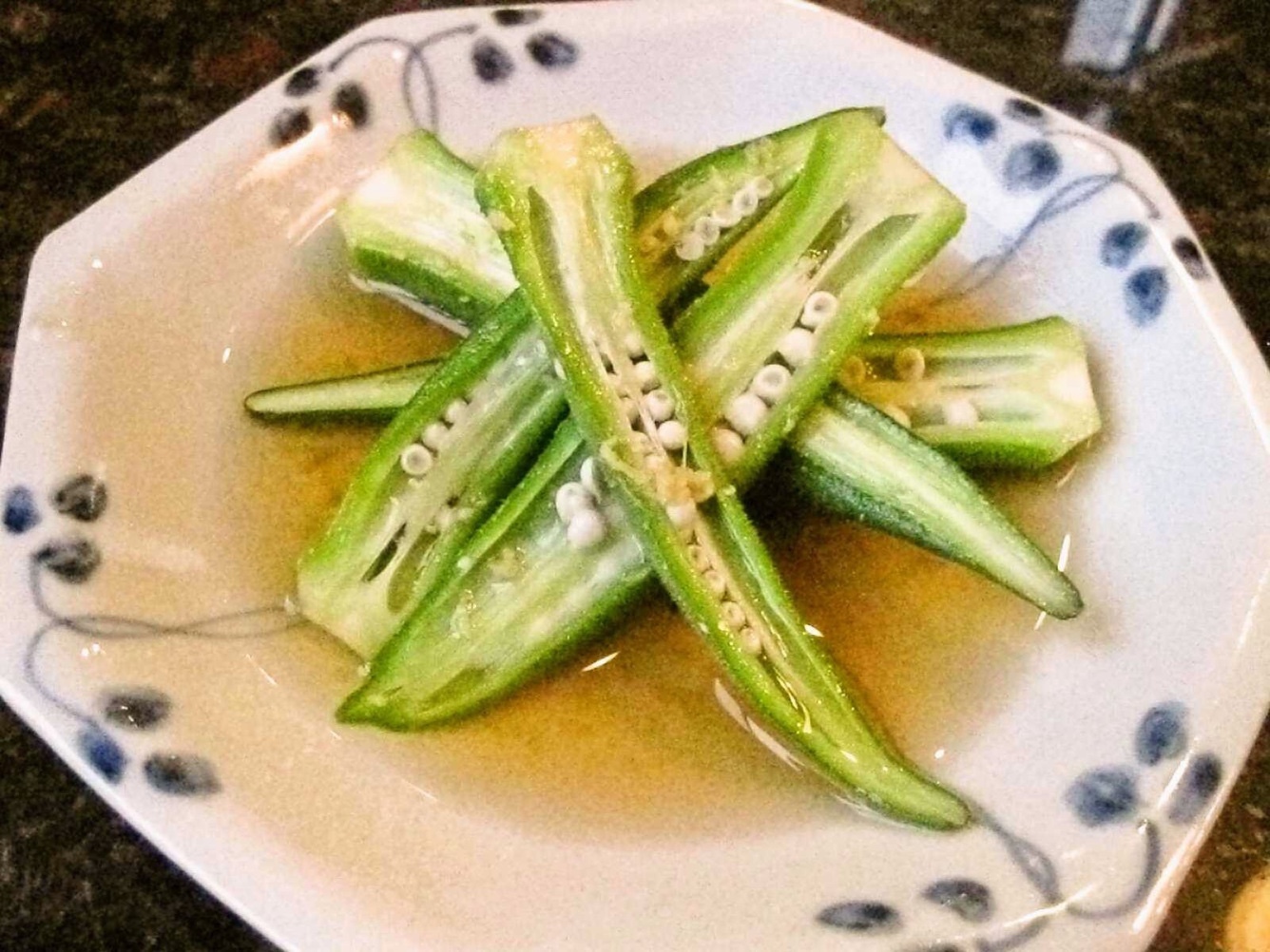
Okra in Ginger Sauce

  • 6 1/3 ounces small okra *
  • 1/3 ounce grated ginger
  • 8 fluid ounces Shiitake Mushroom Dashi
  • 2 Tablespoons  Japanese soy sauce
  • 1 Tablespoon  sake
  • 1 Tablespoon  mirin
  • 1 teaspoon  sesame oil
  • ¼ teaspoon sea salt

Wash and trim stem ends of okra.

Add Shiitake Mushroom Dashi, soy sauce, sake, mirin, sesame
oil and sea salt in a saucepan and bring to the boil. Lower
heat and add okra and grated ginger. Simmer for
about 10 minutes.

Remove and arrange on 4 individual serving plates.
Serve with some broth spooned over.

* Cut into halves if you are using okra of longer lengths.

Lotus Chips

Oil, for frying
7 oz lotus root, peeled and thinly sliced
Salt, to serve
Ichimi powder, to serve *

Pour enough oil into a wok or deep frying pan to come one-third of the way up the side and place over high heat until shimmering. Cook the lotus root, in batches, for 3–5 minutes, or until golden.
Drain on paper towel and sprinkle with the salt and ichimi powder to serve.

Ichimi powder —> Japanese Hot Red Chili Pepper, naturally dried in the sun and milled into a powder. Can be bought online or at most Asian Grocers.

Green Beans with Miso

Miso Sauce
3 tablespoons white miso
1 teaspoon caster (superfine) sugar
2 tablespoons sake
½ teaspoon Japanese soy sauce
5 drops of sesame oil
150 g or 5 ½ oz. baby green beans, trimmed

To make the miso sauce, combine all the ingredients in a small bowl along with 2 tablespoons of water.

Bring a large saucepan of salted water to the boil. Add the beans and cook for 2 minutes, or until just tender. Drain and plunge into a bowl of iced water. Drain again.

Transfer the beans to a bowl. Add the miso sauce, toss to combine and serve.

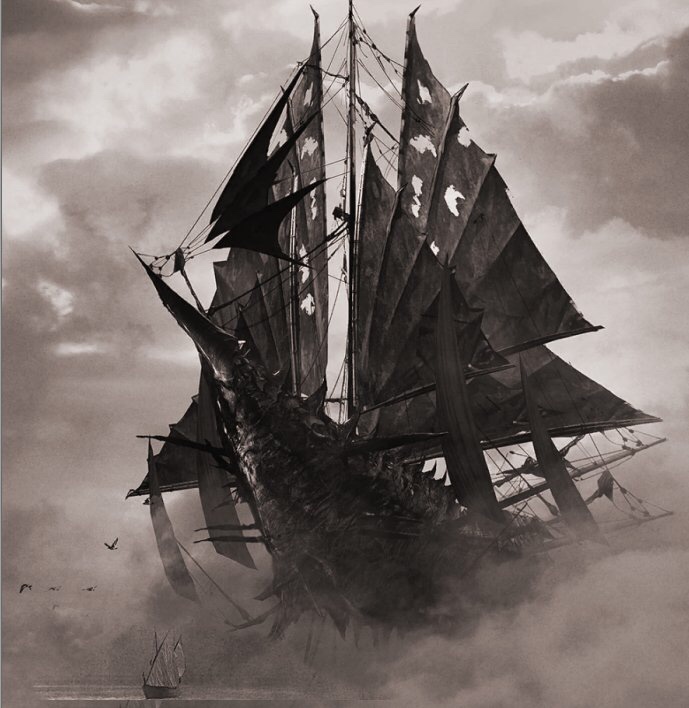
Naglfar (“Nail-ship”)

Naglfar (“Nail-ship”): This is the ship of the dead. It is made from the fingernails and toenails of the dead. This is why it is always necessary to trim the nails of the deceased before burying them, for if this is not done the nails will provide building material for the construction of Naglfar. The completion of the ship-building will be the sign that the end of the world has begun. The sons of Muspell will then travel on Naglfar to join the assault on Ásgarðr.

The ship sails from the east and is packed with forces of evil and chaos, according to the Poetic Edda.

Naglfar is on its way into the battle against the Aesir gods and will arrive on the shores of Midgard, just in time when the Midgard serpent emerges from the sea.

The captain of the ship is the giant Hrym, who brings with him all the legions of the giants, while Loki takes the helm of the fatal ship full of giants. He steers Naglfar over the stormy and cold northern waters, to Vigrid (Norse: Vígríðr), the plain where the decisive battle will take place.

Superstitions have often accompanied ancient people in their daily life. According to ancient Norse beliefs, it was important that no one in the Viking world should die with untrimmed nails. There is one way to delay the ship’s arrival. The ship’s size would depend on how many deceased had been buried with unpaired fingernails.

If someone dies with long fingernails, the surviving relatives of the dead must immediately cut them short before the deceased is laid to rest. Otherwise, their nails will be used to build the Naglfar larger and stronger.

The ancient Vikings believed that this action could significantly delay the construction of the ghost ship and the day of the end of the world.