The Fight, Flight or Freeze Response

The fight or flight response has been around as long as human beings have been around. It’s the body’s hardwired alarm system. If you think of the human body as a computer, the fight-­or-­flight response is an essential part of the operating system. You couldn’t really function (or live that long) without it.

When you encounter a dangerous or threatening situation, this alarm system goes off, and your body goes through a number of changes. For example, during the fight-­or-­flight response, you may experience the following symptoms:

  • An increase in heart rate
  • Perspiration or sweating
  • Narrowing of field of vision (also called “tunnel vision”)
  • Muscle tension
  • Sensitive hearing
  • Racing thoughts
  • Shortness of breath
  • Goose bumps
  • Dry mouth

These experiences aren’t random; they all serve a very important purpose. They prepare you for immediate action. They are preparing you either to flee the situation to avoid any harm or to fight if escape is not possible. In situations where fleeing or fighting is not necessarily a good option, your body may also freeze (kind of like a deer caught in a car’s headlights).

This response is automatic. It occurs without thinking. This is important because it allows you to respond quickly when you are in a dangerous situation. For example, let’s say that you are walking through the woods and come across a bear. Your fight-­or-­flight response will be activated, and you will likely freeze or flee. The sudden and automatic changes that your body goes through will help keep you alive in this dangerous situation. Now, if you had to think about the situation before the fight-­or-­flight response was activated, you would waste precious time. You would have to evaluate the size of the bear and the sharpness of its claws and teeth. And, by the time you figured all of that out, you would probably be supper for the bear! Therefore, the fight-­or-­flight response is incredibly helpful and adaptive. We likely wouldn’t be alive as a species today without it.

Sources: The Dialectical Behavior Therapy Skills Workbook for Anxiety

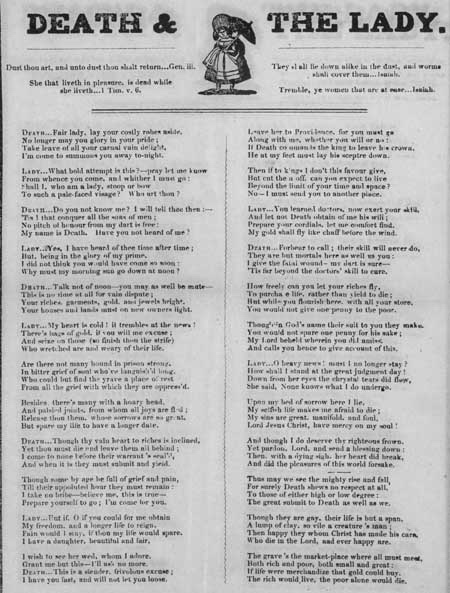
Death and the Lady

This ballad is structured as a dialogue between Death and a woman, and is clearly intended for moral instruction. The implication is that the woman has led an extravagant, sinful life, and death has caught her before she has had the chance to reflect and pursue a more Christian lifestyle. The fact that this heavy-handed lesson is aimed specifically at women illustrates the Calvinist, paternalistic, sometimes misogynistic moral codes that prevailed in Scottish society of the time.

Early ballads were dramatic or humorous narrative songs derived from folk culture that predated printing. Originally perpetuated by word of mouth, many ballads survive because they were recorded on broadsides. Musical notation was rarely printed, as tunes were usually established favourites. The term ‘ballad’ eventually applied more broadly to any kind of topical or popular verse.

This ballad was printed by J. Deacon sometime between 1683 and 1700. It was printed as The Great Messenger of Mortality, or a Dialogue betwixt Death and a Lady. The The Dance of Death (conversations between Death and his victims) was a popular theme throughout the 14th and 15th centuries and again in the 18th century.

Death:

‘Fair Lady, throw those costly robes aside,
No longer may you glory in your pride;
Take leave of all your carnal vain delight,
I’m come to summon you away this night.’

Lady:

What bold attempt is this? Pray let me know
From whence you come, and whither I must go.
Shall I, who am a lady, stoop or bow
To such a pale-faced visage? Who art thou?’

Death:

Do you not know me? I will tell you then:
I am he that conquers all the sons of men,
No pitch of honour from my dart is free,
My name is Death! Have you not heard of me?’

Lady:

‘Yes; I have heard of thee, time after time;
But, being in the glory of my prime,
I did not think you would have come so soon;
Why must my morning sun go down at noon?’

Death:

‘Talk not of noon! you may as well be mute;
There is no time at all for vain dispute,
Your riches, gold, and garments,jewels bright,
Your house, and land, must on new owners light.’

Lady:

‘My heart is cold; it trembles at such news!
Here’s bags of gold, if you will me excuse
And seize on those; and finish thou their strife,
Who wretched are, and weary of their life.

Are there not many bound in prison strong
In bitter grief? and souls that languish long,
Who could but find the grave a place of rest
From all their grief; by which they are opprest.

Besides there’s many with a hoary head
And palsied joints; from whom all joy is fled
Release thou them whose sorrows are so great,
And spare my life until a later date!’

Death:

‘Though thy vain heart to riches is inclined
Yet thou must die and leave them all behind.
I come to none before their warrant’s sealed,
And, when it is, they must submit, and yield.

Though some by age be full of grief and pain,
Till their appointed time they must remain;
I take no bribe, believe me,this is true.
Prepare yourself to go; I’m come for you.’

Lady:

‘But if, oh! if you could for me obtain
A freedom, and a longer life to reign,
Fain would I stay, if thou my life wouldst spare.
I have a daughter, beautiful and fair,
I wish to see her wed, whom I adore;
Grant me but this, and I will ask no more?’

Death:

‘This is a slender frivolous excuse!
I have you fast! I will not let you loose!
Leave her to Providence, for you must go
Along with me, whether you will or no!

If Death commands the King to leave his crown
He at my feet must lay his sceptre down;
Then, if to Kings I do not favour give
But cut them off, can you expect to live
Beyond the limits of your time and space?
No! I must send you to another place.’

Lady:

‘Ye learned doctors, now exert your skill,
And let not Death on me obtain his will!
Prepare your cordials, let me comfort find,
My gold shall fly like chaff before the wind!’

Death:

‘Forbear to call! that skill will never do;
They are but mortals here as well as you.
I give the fatal wound, my dart is sure,
And far beyond the doctors’ skill to cure.

Flow freely you can let your riches fly
To purchase life, rather than yield and die!
But,while you flourished here with all your store,
You would not give one penny to the poor.

Though in God’s name they sue to you did make
You would not spare one penny for His sake.
My Lord beheld wherein you did amiss,
And calls you hence, to give account of this!’

Lady:

‘Oh! heavy news! must I no longer stay?
How shall I stand at the great Judgement Day?’
Down from her eyes the crystal tears did flow,
She says, ‘None knows what I now undergo!

Upon my bed of sorrow here I lie!
My selfish life makes me afraid to die!
My sins are great, and manifold,and foul;
Lord Jesus Christ have mercy on my soul!

Alas! I do deserve a righteous frown!
Yet pardon, Lord, and pour a blessing down!’
Then with a dying sigh her heart did break,
And did the pleasures of this world forsake.

Thus may we see the mighty rise and fall,
For cruel Death shews no respect at all
To those of either high or low degree.
The great submit to Death as well as we.

Though they are gay, their life is but a span,
A lump of clay, so vile a creature’s Man!
Then happy they whom God hath made his care,
And die in God, and ever happy are!

The grave’s the market place where all must meet
Both rich and poor, as well as small and great;
If life were merchandise, that gold could buy,
The rich would live — only the poor would die.

The Match Girls’ Strike

In July 1888, 1,400 women and girls walked out of the Bryant & May match factory in London, in what came to be known as the Match Girls’ Strike. British socialist Annie Besant used her newspaper, The Link, to publicize the 14-hour workday, toxic materials, and the unfair difference between shareholder profits and the poverty wages paid to employees.

Workers complained of fines that cut into their wages, and of unfair dismissals. They also suffered breathing difficulties and other health problems because of the phosphorus fumes in the factory.

Bryant & May attempted to crack down on public criticism by making their workers sign a written denial of any ill-treatment. This, combined with another unfair dismissal, set off the strike. The public sided with the workers, and Bryant & May relented. The success of the match girls inspired a wave of similar strikes in the UK and boosted the rise of trade unionism.”

Sources : The Feminism Book (DK)

Nobody-But-Yourself – e.e. cummings

“Almost anybody can learn to think or believe or know, but not a single human being can be taught to feel. Why? Because whenever you think or you believe or you know, you’re a lot of other people: but the moment you feel, you’re nobody-but-yourself.

To be nobody-but-yourself-in a world which is doing its best, night and day, to make you everybody else-means to fight the hardest battle which any human being can fight; and never stop fighting.”

~ e.e. cummings

Huda Sha’arawi

Often described as Egypt’s first feminist, Huda al-Sharaawi was born into a privileged family in Cairo in 1879. She was married by the age of 13, yet managed to further her studies and travel during a temporary separation from her husband.

Sharaawi later joined her husband as an anticolonial activist. After going to Europe in 1914, she returned to Egypt to mobilize women against British rule. In 1923, she founded the Egyptian Feminist Union.
After her husband’s death, Sharaawi famously removed her face veil (but not her head scarf) for the first time in public at the International Woman Suffrage Alliance of 1923 in Rome.

Sharaawi also wrote poetry, and in 1925 began publishing a journal called L’Egyptienne (The Egyptian Woman). She died from a heart attack in 1947.

Key works:

Harem Years: The Memoirs of an Egyptian Feminist (1879–1924)

Car Wars

Drive Offensively! Car Wars is a game featuring freeways of the future in which the right of way goes to those with the biggest guns. Players choose their vehicle — complete with weapons, armor, power plants, suspension, and even body style — then they take them out on the road, either to come home as “aces” or to crash and burn. If a driver survives, his abilities improve and he can earn money to buy bigger and better cars. Advanced rules let players design their own customized cars, trucks, and cycles.

Playing time 30 minutes and up, for players 10 and older. Any number can play . . . games with 2 to 8 are best.

Game components include:

  • 103 full-color die-cut game counters, storage bag, and Turning Key.
  • 64-page rulebook, plus extra tables and record sheets.
  • 2-sided game map, with autoduel arena and raceway.
  • Four 6-sided dice.

Awards:

  • 1981 Charles S. Roberts Best Science-Fiction Board Game Winner
  • 1981 Charles S. Roberts Best Science-Fiction Board Game Nominee

La Voisin

In a darkened room stands a 40-year-old woman named Catherine Monvoisin. Her figure is lit only by torches held by the faceless men standing in front of her, men who are sentencing her to death by fire. It is the 17th century, where such a death sentence is an unusual ending to someone’s life. But Catherine is an unusual woman.

Catherine was the wife of a silk merchant and jeweler and lived a life of comfort in Parisian Society. She was a philanthropist, entrepreneur, fortune teller, mother, and art lover. But she was also a professional poisoner, alleged provider of sorceries, and an alleged witch who plunged the French aristocracy into turmoil, and even tried to kill a king.

She was more famously known as “La Voisin” and was a central figure in “L’affaire des Poisons” or the “Affair of the Poisons”. Catherine controlled a wide network of fortune-tellers from her position in Paris society. She provided poison, abortion, aphrodisiacs, arranged black masses, and even claimed to offer magical services.

She was so famous that she even drew clients from the aristocracy, who could afford to pay her high prices which funded her lavish lifestyle. Her organization, in performing commissioned black magic and murder by poison, took thousands of lives.

The claimed alchemist Adam Lesage, one of the lovers of Catherine, told of her murdering her own husband, an accusation she denied. It is believed that throughout her life, she might have been responsible for the deaths of around 2,500 infants due to her poisoning. However, throughout this time she remained a high-profile socialite, and her sheer charm made no one suspect her.

Sources: Bipin Dimri

What is Tardive dyskinesia?

Tardive dyskinesia (TD) is a neurologic disorder associated with the long-term use of certain medications (dopamine receptor-blocking agents) for some types of mental illnesses, such as major depressive disorder, bipolar disorder, and schizophrenia. TD causes involuntary movements of the body such as facial-tics, rapid eye blinking, sticking out of the tongue, lip pursing, and jaw clenching.

Some people experience involuntary twitching and jerking of their arms, legs, or torso. In this video, Lauren shares her personal experience with TD, and also sits down with Dr. Leslie Citrome, a psychiatrist and Clinical Professor of Psychiatry and Behavioural Sciences at New York Medical College, and who specializes in tardive dyskinesia.

Margaret Sanger

Birth control activist Margaret Sanger was born in New York in 1879, the sixth of 11 children in an Irish Catholic family. Her mother’s death at the age of 49, after 18 pregnancies, had a profound influence on Sanger. She qualified as an obstetrics nurse, which confirmed her views on the impact multiple pregnancies had on women, especially the poor. Involved in radical politics, she joined the New York Socialist Party.

In 1916, Sanger opened a short-lived birth control clinic, and in 1921, she established the American Birth Control League. She went on to organize the first World Population Conference in Geneva, Switzerland, and in 1953 became president of the International Planned Parenthood Federation. Sanger died of heart failure in Tucson, Arizona, in 1966.

Key works:
1914 Family Limitation
1916 What Every Girl Should Know
1931 My Fight for Birth Control