In addition to performing acupuncture, a Chinese medicine practitioner almost always burns moxa in a therapy called moxibustion. This is an ancient practice known to increase energy in the body and warm it up. The plant burned is Artemesia vulgaris, otherwise known as mugwort. Practitioners burn it on strategic areas of the body, including acupuncture points and along meridians where chi is stuck and/or depleted, giving rise to pain, coldness, edema, fatigue, and other imbalances. Moxa comes in many forms, including raw leaves, salves, topical tinctures, and pressed into pencil- to cigar-size sticks. For home use of moxa, I recommend using a tiger warmer (more on this in the next section). Thousands of years ago, moxa was placed under a patient’s pillow to bring about dreams, visions, and insight, as well as to eliminate nightmares.
Moxibustion can be applied directly or indirectly. In direct moxibustion, the moxa cone rests on your body at the treatment point. The practitioner lights the cone and lets it burn slowly until your skin begins to turn red. Once you begin to feel heat, the practitioner removes it. Moxa can also be placed on the acupuncture needle and ignited. It burns on the needle until it’s extinguished. The heat travels through the needle to the acupuncture point.
Indirect moxibustion is more commonly practiced. It’s also a safer option, since the burning moxa doesn’t actually touch your skin. Instead, the practitioner will hold it about an inch from your body. They’ll remove it once your skin becomes red and warm. Another method of indirect moxibustion uses an insulating layer of salt or garlic between the cone and your skin. In another option, “moxa boxes” may be filled with moxa, ignited, and placed on the body.
With a gateway for its symbol, this Rune indicates that there is work to be done both inside and outside yourself. Thurisaz represents the frontier between Heaven and the mundane. Arriving here is a recognition of your readiness to contact the numinous, the Divine, to illuminate your experience so that its meaning shines through its form.
Thurisaz is a Rune of non-action. Thus, the gateway is not to be approached and passed through without contemplation. Here you are being confronted with a clear reflection of what is hidden in yourself, what must be exposed and examined before right action can be undertaken. This Rune strengthens your ability to wait. Now is not a time to make decisions. Deep transformational forces are at work in this next-to-last of the Cycle Runes.
Reversed: A quickening of your development is indicated here. Yet even in times of accelerated growth, you will have reason to halt along the way, to reconsider the old, to integrate the new. Take advantage of these halts.
If you are undergoing difficulties, remember: The nature of your passage depends upon the quality of your attitude, the clarity of your intention and the steadfastness of your will. Be certain that you are not suffering over your suffering.
Drawing Thurisaz Reversed demands contemplation on your part. Hasty decisions at this time may cause regrets, for the probability is that you will act from weakness, deceive yourself about your motives, and create new problems more severe than those you are attempting to resolve. Impulses must be tempered by thought for correct procedure. Do not attempt to go beyond where you haven’t yet begun. Be still, collect yourself, and wait on the Will of Heaven.
A large segment of a Chinese rocket is expected to make an uncontrolled re-entry into the Earth’s atmosphere on the weekend, but Beijing has downplayed fears and said there is a very low risk of any damage.
A Long March-5B rocket launched the first module of China’s new space station into Earth’s orbit on April 29. Its 18-tonne main segment is now in freefall and experts have said it is difficult to say precisely where and when it will re-enter the atmosphere.
Re-entry is expected to be around 2300 GMT on Saturday, according to the Pentagon, with a window of nine hours either side.
Chinese authorities have said most of the rocket components would likely be destroyed on re-entry.
“The probability of causing harm… on the ground is extremely low,” Chinese foreign ministry spokesman Wang Wenbin told reporters on Friday.
Although there has been fevered speculation over exactly where the rocket—or parts of it—will land, there is a good chance any debris that does not burn up will just splash down into the ocean, given that the planet is 70 percent water.
“We’re hopeful that it will land in a place where it won’t harm anyone,” said Pentagon spokesman Mike Howard.
Howard said the United States was tracking the rocket segment but “its exact entry point into the Earth’s atmosphere cannot be pinpointed until within hours of its re-entry”.
Defense Secretary Lloyd Austin earlier said that the US military had no plans to shoot it down, and suggested that China had been negligent in letting it fall out of orbit.
“Given the size of the object, there will necessarily be big pieces left over,” said Florent Delefie, an astronomer at the Paris-PSL Observatory.
“The chances of debris landing on an inhabited zone are tiny, probably one in a million.”
In 2020, debris from another Long March rocket fell on villages in the Ivory Coast, causing structural damage but no injuries or deaths.
Jonathan McDowell, an astrophysicist at the Harvard–Smithsonian Center for Astrophysics, said that although there was no need to worry “too much”, the rocket’s design needed a re-think to stop such a scenario happening again.
“There is a real chance of damage to whatever it hits and the outside chance of a casualty,” he said.
“Having a ton of metal shards flying into the Earth at hundreds of kilometres per hour is not good practice, and China should redesign the Long-March 5B missions to avoid this.”
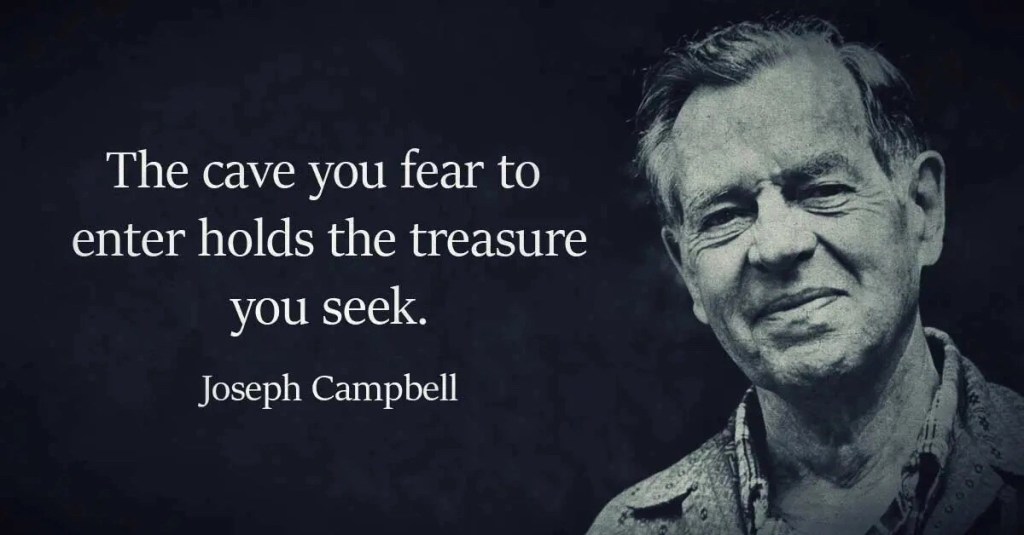
“What is it we are questing for? It is the fulfillment of that which is potential in each of us. Questing for it is not an ego trip; it is an adventure to bring into fulfillment your gift to the world, which is yourself. There is nothing you can do that’s more important than being fulfilled. You become a sign, you become a signal, transparent to transcendence; in this way you will find, live, become a realization of your own personal myth.” ~ Joseph Campbell
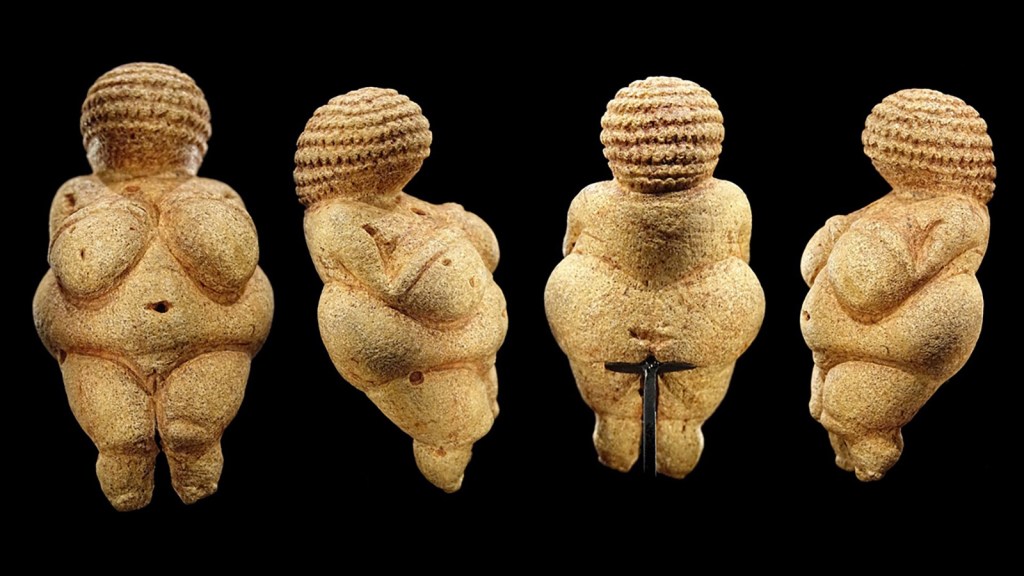
Figurines of women carved or sculpted from stone, ivory, or clay are a type of Paleolithic art found widely across Europe. These figurines share many striking similarities. While details such as facial features and feet are largely ignored, feminine sexual characteristics (breasts, belly, hips, thighs, and vulva) are often exaggerated. The focus on features related to sexuality and fertility, and the round body shapes depicted (during the Ice Age fat would have been a precious commodity) suggest that the figurines may have played a symbolic role as a charm relating to childbirth or, more generally, fertility.
Some researchers believe that the figures represent a “mother goddess,” but there is no real evidence for such an interpretation. Others have focused instead on the fact that the figurines demonstrate widely shared cultural ideas and symbols. These would have been crucial to social interactions and exchanges of resources, information, and potential marriage partners in the Ice Age world.
Galileo was born in Pisa, but later moved with his family to Florence. In 1581, he enrolled in the University of Pisa to study medicine, then switched to mathematics and natural philosophy. He investigated many areas of science, and is perhaps most famous for his discovery of the four largest moons of Jupiter (still called the Galilean moons). Galileo’s observations led him to support the Sun-centered model of the solar system, which at the time was in opposition to the teachings of the Roman Catholic Church. In 1633, he was tried and made to recant this and other ideas. He was sentenced to house arrest, which lasted the rest of his life. During his confinement, he wrote a book summarizing his work on kinematics (the science of movement).
Key works:
1623 The Assayer
1632 Dialogue Concerning the Two Chief World Systems
1638 Discourses and Mathematical Demonstrations Relating to Two New Sciences
The Rune of terminations and new beginnings, drawing Uruz indicates that the life you have been living has outgrown its form. That form must die so that new energy can be released in a new form. This is a Rune of passage and, as such, part of the Cycle of Initiation.
Positive growth and change, however, may involve a descent into darkness as part of the cycle of perpetual renewal. As in nature, this progression consists of five aspects: death, decay, fertilization, gestation, rebirth. Events occurring now may well prompt you to undergo a death within yourself. Since self-change is never coerced—we are always free to resist—remain mindful that the new life is always greater than the old.
Prepare, then, for opportunity disguised as loss. It could involve the loss of someone or something to which you have an intense emotional bond, and through which you are living a part of your life, a part that must now be retrieved so you can live it out for yourself. In some way, that bond is being severed, a relationship radically changed, a way of life coming to an end. Seek among the ashes and discover a new perspective and new strength.
Reversed: Without ears to hear and eyes to see, you may fail to take advantage of the moment. The result could well be an opportunity missed or the weakening of your position. It may seem that your own strength is being used against you.
For some, Uruz Reversed will serve to alert, offering clues in the form of minor failures and disappointments. For others, those more deeply unconscious or unaware, it may provide a hard jolt. Reversed, this Rune calls for serious thought about the quality of your relationship to your Self.
But take heart. Consider the constant cycling of death and rebirth, the endless going and return. Everything we experience has a beginning, a middle and an end, and is followed by a new beginning. Therefore do not draw back from the passage into darkness: When in deep water, become a diver.”
Greenland, or Grœnland in Old Norse, was settled by Norwegian and Icelandic explorers during the 10th century AD, where two major Viking settlements emerged until their abandonment in the 15th century AD.
According to a medieval text called the Landnámabók, translated as “Book of Settlements”, Greenland was supposedly first sighted by Gunnbjörn Ulfsson, also known as also known as Gunnbjörn Ulf-Krakuson during the early 10th century AD when his ship was blown off course.
In AD 978, Snæbjörn galti Hólmsteinsson is said to have set sail for Greenland with about two dozen companions, and settled on the islands of Gunnbjarnar Skerries, a small group of islands lying off the coast of Greenland, that according to Johannes Ruysch’s map from AD 1507 had “completely burned up” (possibly by volcanic activity). After spending a terrible winter on the islands, the settlers murdered Snæbjörn and his foster father, and abandoned the settlement to return to Iceland.
The first successful settlement of Greenland was by Erik Thorvaldsson, otherwise known as Erik the Red. According to the sagas, the Icelanders had exiled Erik during an assembly of the Althing for three years, as punishment for Erik killing Eyiolf the Foul over a dispute.
Erik went in search of land that had been reported to lie to the north and reached the coastline of Greenland where he spent the three years of his exile exploring the new land.
Upon returning to Iceland, he is said to have brought with him stories of “Greenland”, an auspiciously named land in order to sound more appealing than “Iceland” to lure potential settlers.
Erik returned to Greenland in AD 985 or 986 with a large number of colonists, who established two colonies on the southwest coast: The Eastern Settlement or Eystribyggð, in what is now Qaqortoq, and the Western Settlement or Vestribygð, close to present-day Nuuk. A later Middle Settlement emerged in what is now Ivittuut, but this is generally considered to be associated with an expansion from the Eastern Settlement.
Erik built his personal estate of Brattahlíð, near present-day Narsarsuaq where he ruled as paramount chieftain of Greenland until his death. According to legend, Erik had planned to journey with his son Leif Erikson (who is believed to have established a Norse settlement at Vinland), but Erik fell off his horse on his way to the ship. He later died from a pandemic that killed many of the island’s colonists in the winter after his son’s departure.
At their peak, the settlements are estimated to have had a combined population of between 2,000-10,000 inhabitants (sources differ), with archaeologists identifying the ruins of approximately 620 farmsteads spread across Greenland’s south-western fjords.
The settlers shared the island with the late Dorset culture, who lived in the northern and western parts of Greenland, and later with the Thule culture (who the Norsemen called the Skræling) that entered from the north around AD 1300 after migrating from Alaska.
In AD 1126, the Roman Catholic Church founded a diocese at Garðar in the Eastern Settlement at present-day Igaliku, which was subject to the Norwegian archdiocese of Nidaros and constructed several churches. By AD 1261, the Greenlanders had accepted rule by the King of Norway, which then entered into a union with the Kingdom of Denmark in AD 1380.
The settlements continued to prosper until the 14th century AD, where they entered a period of decline until their abandonment in the 15th century AD. Various theories have been proposed to explain the abandonment, with the most prominent being gradual climate change, loss of contact and support from Denmark, opportunities for migration back to Europe after the plague had left farmsteads abandoned, economic factors, or conflicts with the Inuit peoples.
The last written record from the Viking Greenlanders dates from AD 1408, which documents a marriage between Thorstein Olafsson and Sigrid Björnsdóttirin.
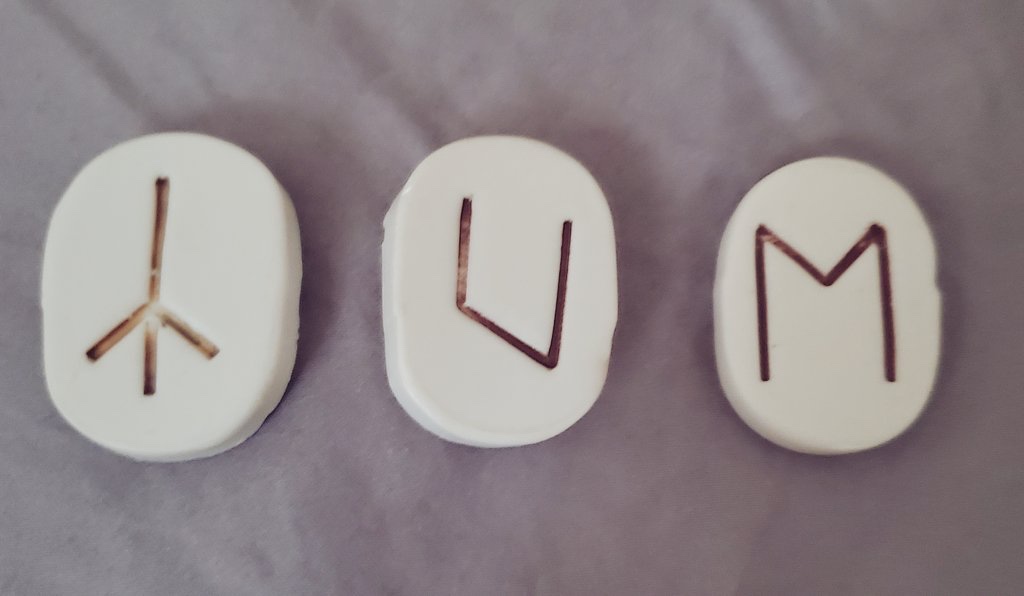
The number “three” figures prominently in the oracular practices of the ancients. The Three Rune Spread which, according to Tacitus, was already in use 2,000 years ago, is satisfactory for all but the most demanding situations.
With an issue clearly in mind, select three Runes one at a time, and place them from right to left, in order of selection. To avoid consciously changing the direction of the stones, especially as you become familiar with their symbols, you may want to place them blank side up, and then turn them over.
Once you have selected the Runes, they will lie before you. Reading from the right, the first Rune provides the Overview of the Situation; the second Rune (center) identifies the Challenge; and the third Rune (on the left) indicates the Course of Action Called For.
How you happen to turn the stones may still alter the direction of the glyphs to either an Upright or Reversed position, but this too is part of the process. Since only nine Runes read the same Upright and Reversed, the readings for the other sixteen will depend on how you place or turn the stones.
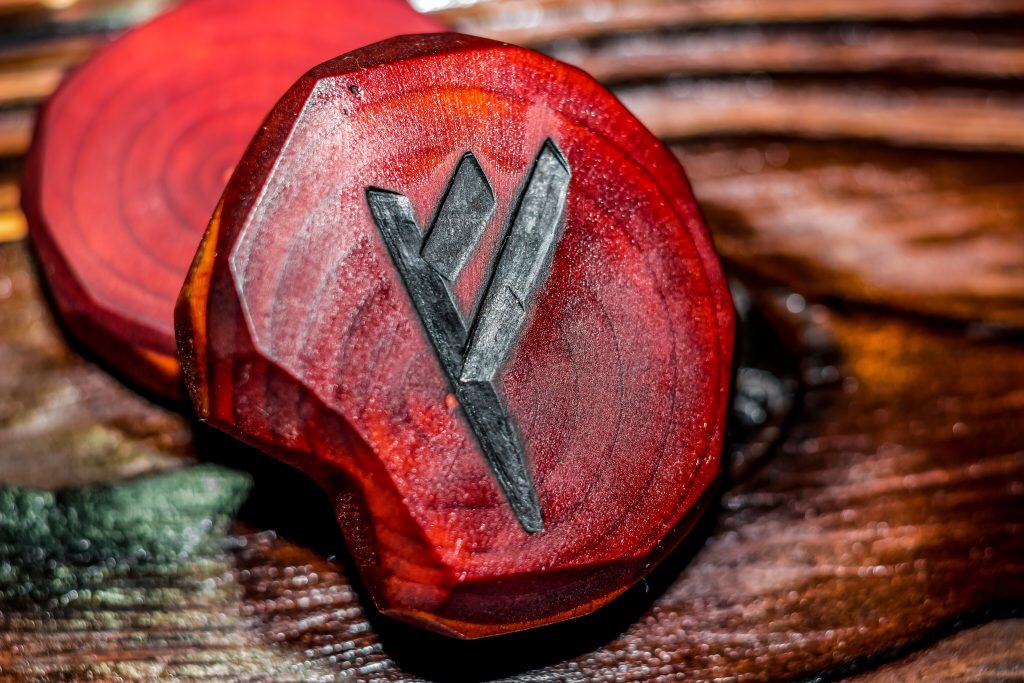
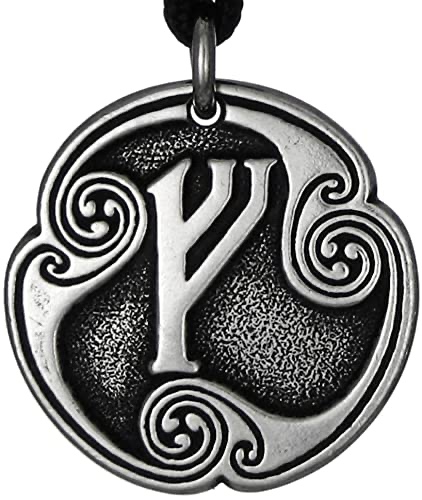
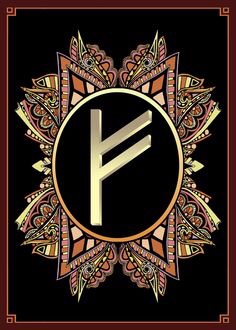
Fehu is associated and sacred to the God and Goddess Frey and Freyja. In Norse mythology, Freya is portrayed as a Goddess of love, beauty and fertility. Blonde, blue-eyed and beautiful, Freya is described as the fairest of all goddesses, and people prayed to her for happiness in love. She was also called on to assist childbirths and prayed to for good seasons.
Fehu is a Rune of fulfillment: ambition satisfied, love shared, rewards received. It promises nourishment from the most worldly to the sacred and the Divine. For if the ancient principle “As above so below” holds true, then we are also here to nourish God.
This Rune calls for a deep probing of the meaning of profit and gain in your life. Look with care to know whether it is wealth and possessions you require for your well-being, or rather self-rule and the growth of a will.
Another concern of Fehu is to conserve what has already been gained. This Rune urges vigilance and continual mindfulness, especially in times of good fortune, for it is then that you are likely to collapse yourself into your success on the one hand, or behave recklessly on the other. Enjoy your good fortune and remember to share it, for the mark of the well-nourished self is the ability and willingness to nourish others.
Reversed: There may be considerable frustration in your life if you draw Fehu Reversed, a wide range of dispossessions ranging from trivial to severe. You fall short in your efforts, you reach out and miss; you are compelled to stand by and watch helplessly while what you’ve gained dwindles away. Observe what is happening. Examine these events from an open perspective and ask, “What do I need to learn from this in my life?
Even if there is occasion for joy, do not let yourself be seduced into mindless joyousness. Reversed, this Rune indicates that doubtful situations are abundant and come in many forms and guises. Here you are being put in touch with the shadow side of possessions. Yet all this is part of coming to be and passing away, and not that which abides. In dealing with the shadow side of Fehu, you have an opportunity to recognize where your true nourishment lies.







 Mark Bere Peterson’s Counterculture, Urban Legends, Paganism & Witchcraft