“Daniel Dennett, in Freedom Evolves, writes that it makes no difference whether our moral impulses are evolved or learned. “[T]he theory that explains morality … should be neutral with regard to whether our moral attitudes, habits, preferences, and proclivities are a product of genes or cultures.” I think this is true because culture itself is ultimately a product of evolution. Whether you think “instinct” is purely biological or a learned habit, or a combination of the two, it comes down to the same goal: the minimization of harm to biological organisms.” ~ Dan Barker, Life Driven Purpose, pg 66
“The rise and fall of religious beliefs is difficult to predict with assurance. It’s doubtful whether many Romans in the early second century would have predicted the rise of Christianity, whether many Europeans in the early sixteenth century would have predicted the Reformation and the subsequent rejection of Catholicism by much of the continent, whether many Americans in the early twentieth century would have foreseen the simultaneous decline of mainstream Protestant denominations and the rise of Protestant fundamentalism, or whether many in the West anticipated the recent spike in atheists, agnostics, and other nonbelievers. Perhaps over the next one hundred years, some faith will sweep aside other beliefs; perhaps religious beliefs, in general, will decline precipitously and all but disappear. Either outcome is possible.
However, a much more likely outcome is a significant increase in the number of nonbelievers, accompanied by a decrease, but not a collapse, in the number of believers. This increase could come fairly quickly if nonbelievers reach a critical mass, which would allow for greater acceptance and the sense among many nominal believers that it’s no longer socially injurious to acknowledge that one is an atheist or agnostic. The big break in the United States will come if and when a number of politicians who are open atheists and nominal believers to come out of the closet. But even if there is an exponential increase in the number of nonbelievers, it’s improbable that religion will be completely abandoned. Religious belief is resilient. Some debate whether religious belief has a genetic basis, but regardless of whether it has a biological foundation, it’s undeniable it has deep cultural and psychological roots. Beliefs that have had a firm grip on the human psyche for millennia are unlikely to vanish in a century.” ~ Ron Lindsay, (The Necessity of Secularism, pgs 15-16)
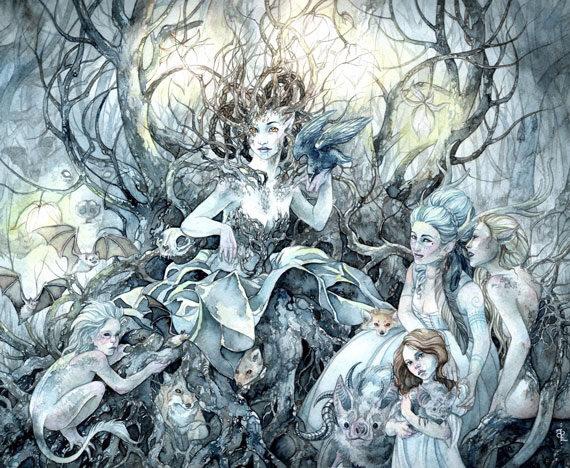
The seelie and unseelie courts of Scottish fairies are a particular feature of the folklore of that country; the clear separation of the faes into good and bad groupings that’s entailed is almost unique in folklore. Moreover, the notion of the two courts has, in recent years, attracted considerable attention and popularity- notwithstanding the fact that they are not mentioned in the majority of the Scottish faery-lore texts and collections. Probably the majority of recorded Scottish folklore relates to the Highlands and Islands, the Gaelic (and Norse) speaking regions, which may explain why we have relatively little material documenting the two courts.
The Scots word ‘seelie’ derives from the Anglo-Saxon (ge)sælig/ sællic meaning ‘happy’ or ‘prosperous.’ The evolution of the word in Middle English and Scots seems to have been in two directions. One sense was ‘pious,’ ‘worthy,’ ‘auspicious’ or ‘blessed.’ The second development extended the meaning incrementally through ‘lucky,’ ‘cheerful,’ ‘innocent,’ and ‘simple,’ from whence it was a short final step to ‘simple-minded,’ as the modern English ‘silly’ denotes. Because of this evolution, as well as because of the dialectical differences between English and Scots, it is preferable to use ‘seelie’ rather than to try to translate it. In passing, we might observe that Scots is in many cases far nearer to original Anglo-Saxon than modern English, which has imported so many French and Latin words.
By late medieval and early modern times, ‘seelie’ or ‘seely’ in Scots meant happy or peaceable, as in ‘seely wights,’ and the ‘seely court,’ which was the ‘happy or pleasant court.’ It followed from this that ‘unseelie’ or ‘unsilly’ described something that was unhappy or wretched. The poet Dunbar referred to Satan’s “unsall meyne” (his “wretched troop of followers”), a phrase which could be a very appropriate term for the fairies.
The Scots word with a variety of spellings, particularly sely, and meanings including “lucky, happy, blessed”; the adjective is applied euphemistically to fairies in Scotland. This term is used in relation to the Scottish fairies, calling them both ‘Seelie court’ and ‘gude wichts’. Court in this sense meaning a group or company, and wichts meaning beings. Seelie fairies are those who are benevolently inclined towards humans and likely to help around homes and farms. It should be remembered though that they are as able and likely to cause harm as any fairy. The use of the term Seelie in relation to fairies dates back to at least the 15th century in Scotland and can be found in a book from 1801; in the ‘Legend of the Bishop of St Androis’ it says:
Before turning their thoughts to the intriguing legends associated with these ruins, any person who strays off the marked footpaths and loses his or her footing on the edge of the precipices that drop away on every side of this aptly nicknamed “citadel in the sky.” And let us not forget that early in 1244 it was a feat of rock climbing that sealed the fate of the Cathars when they were besieged here by the army of King Louis IX. After seven months, during which traditional military strategies had brought nothing but failure, Hugues des Arcis, the commander of the forces encamped at the foot of this eagle’s nest, finally decided to send a small group of particularly agile soldiers up the cliff face. Under cover of darkness, this detachment reached the summit, captured a watchtower, and installed a trebuchet, with which it proceeded to bombard the interior of the castle without respite, making life impossible for the besieged, who were forced to surrender after a few weeks.
The fate of this community, the last bastion of the Cathar faith in France, is well known. One Sunday in March 1244, the day of the equinox, the believers—more than two hundred men and women—were led down to a pyre that had been set up at the foot of the hill, steadfastly refusing to renounce their faith. What else could they do, these pacifists who had taken a vow to show courage in the face of suffering and death? The name Cathar—from the Greek katharos, meaning “pure”—was given them by their contemporaries on account of their asceticism and refusal to compromise in any way. For the same reason, those who had undergone the rite of ordination called the consolamentum were known as perfecti, although among one another they preferred the terms “good man” and “good woman.” The band of sympathizers protecting the pacifist Cathars were allowed to go free provided they pledged to stop supporting heresy and swore allegiance to the king of France.
The Château de Montségur that stands today is not the same fortress that existed at the time of these dreadful events. Historians, archeologists, and local storytellers cannot agree on all the details. For example, was the Cathars’ place of martyrdom the prats dels cremats (“field of the burned”), as indicated today by a stele, or was it a neighboring hill? At this magnificent site, so many questions remain unanswered. There’s the legendary Cathar treasure, said to have been held in safekeeping at Montségur before being smuggled out to an unknown destination. And then there are the four men deputed by the community to slip away under the utmost secrecy prior to the ultimate surrender, carrying with them who knows what. Items of treasure? Precious documents? Mysterious keys enabling the Cathar tradition to be revived elsewhere? At Montségur nothing seems impossible. In the last century a team of German researchers came, with the blessing of the Nazi regime, to investigate, convinced that the castle housed the Holy Grail, the famous cup believed to have been used to catch Christ’s blood.
What should we make of the site’s architecture, of the spectacular alignment of the sun’s rays at solstice time, as if its architects had wanted the castle to function as a kind of astronomical calendar? And doesn’t its floor plan reflect the constellation of Boötes, with the donjon representing the star Arcturus? Is it also mere chance that “Cant del Boièr” (Song of the Herdsman) remains one of the most popular folk songs in the Occitanian canon, with some people reading into its words a coded message addressed to future generations?
“After seven hundred years the bay tree will flower again”—and with it, no doubt, the Cathar faith. Thus were the words of the troubadour in the Occitania of old. Or was it the last of the perfecti to be burned at the stake? Or even a poet born generations later? Basically, nobody knows. It is even possible that the bay tree could be an olive tree, and that the date is regularly adjusted so that it never loses its relevance. No matter. The legend remains perplexing enough for visitors to be drawn in by its verses while contemplating the ruins of what the inquisitors called “Satan’s synagogue” – but never quite managed to utterly destroy.
In Greek mythology, Antigone was the daughter of Oedipus by his own mother, Jocasta, and the sister of Eteocles, Polyneices, and Ismene. When her father went into exile she accompanied the blind man as his guide.
Two versions exist of Antigone’s fate after she defied King Creon. In the first, the subject of the tragedy Antigone by Sophocles, Creon ordered that she be immured as a punishment, but rather than face burial while alive she hanged herself; Haemon, the son of Creon to whom she was betrothed, committed suicide alongside her. In the second version, Creon turned Antigone over to Haemon for punishment, but he smuggled her away, and she later bore him a son. When Creon refused to forgive them, Haemon killed both himself and Antigone.
Joe Biden has officially termed the mass killings and death marches of Armenians by the Ottoman Empire, which occurred in 1915 and 1916, as a “genocide.” Historians estimate that a million or more Armenians died during this atrocity. There is simply no longer any doubt that this took place, though Turkey has denied it for a century and even at the time took steps to hide the murders. Biden’s gesture is an admirable stand for human rights, and of course endangers the U.S. relationship with our NATO ally Turkey. But Turkey’s odious President Recep Tayyip Erdoğan, who is ruining his great country with his religiously-based autocracy, deserves no coddling. He’s declared that Biden has neither the historical nor moral authority.
Above is a photo labeled “The corpses of Armenians beside a road, a common sight along deportation route.”
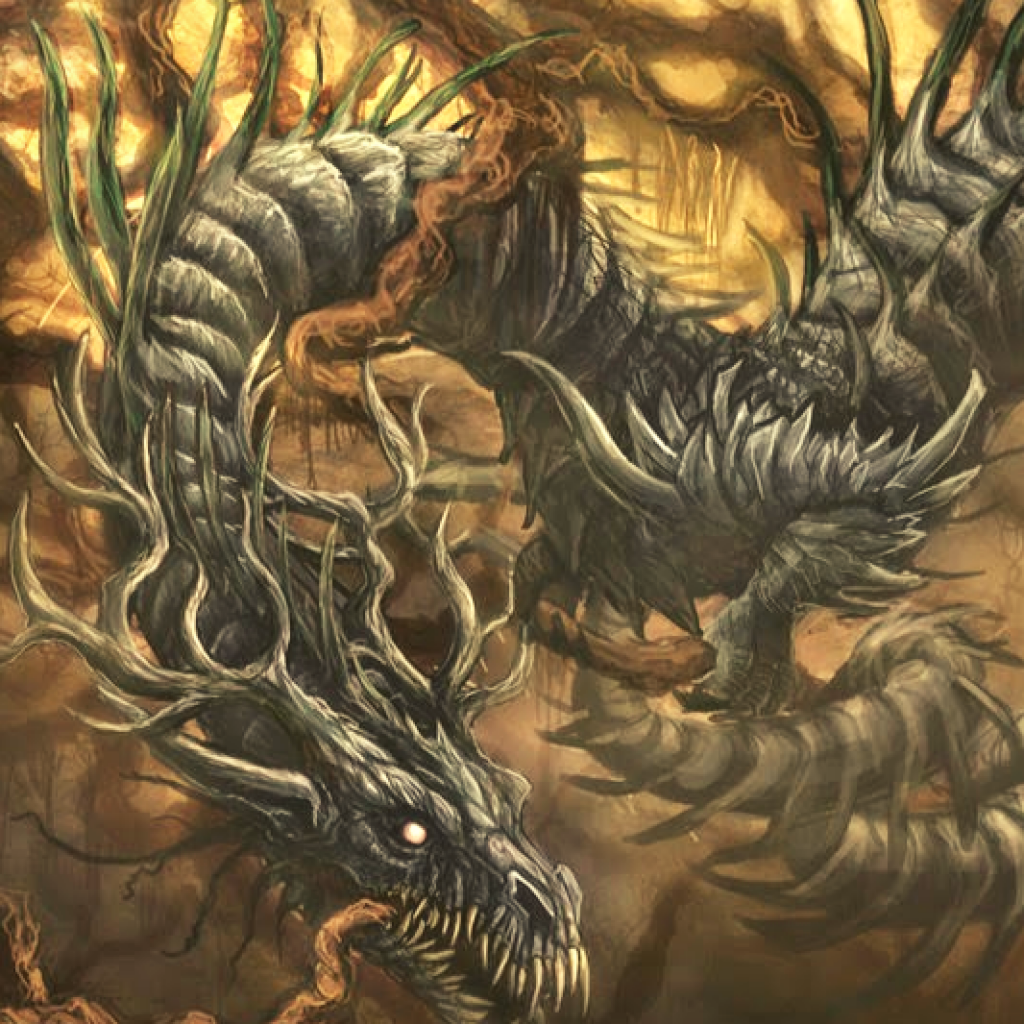
Nidhogg (Norse Níðhöggr) is a ferocious dragon who gnaws at the roots of Yggdrasil, the tree which supports the nine worlds of Norse mythology. This power-hungry monster is sometimes referred to as “the Malice Striker,” an appropriate name given that he rules over dark criminals and is bent on destroying peace and virtue.
Nidhogg is a tremendous dragon. His body is covered in bright scales, and horns erupt from his head. A pair of forelegs, complete with massive claws, help him to rip at the roots of Yggdrasil, but he has no back legs, only a serpentine tail. Beneath his bat-like wings, he carries the corpses of criminals.
His mammoth body can be found twisting through the roots of Yggdrasil, especially around Niflheimr, the cold world from which all the rivers of Midgard spring. Occasionally, he might slither into Hel to visit the dark goddess who some people consider his master.
Balance is extremely important in Norse mythology, and while Nidhogg does represent a ghastly force, he is still important to supporting the balance of Yggdrasil. A great eagle, who represents wisdom and virtue, perches in the uppermost branches of the tree, while Nidhogg, representing chaos and evil, lurks in its roots. The constant tension between the eagle and the dragon is fueled by Ratatoskr, a squirrel who runs up and down the tree ferrying insults between the two enemies. This tension may seem undesirable, but it actually promotes a cycle of growth in the tree of life. After the eagle and the dragon spend the day destroying Yggdrasil in their frenzy to attack each other, the tree is bathed in water from the wells of Urd, which promotes healing and new growth.
In addition to bringing balance to Yggdrasil, the monster also figures in the punishment of criminals. He rules over the dark shores of Nadastrond, to which the corpses of murderers, adulterers, and oath-breakers are banished. A terrifying hall, with walls woven from serpents and a ceiling that drips venom, waits for these criminals, and inside the hall, the dragon chews on their bodies.
Finally, the dreaded dragon has a role to play in Ragnarok, the day when the giants will attack the gods and destroy most of their world. Ragnarok will begin when the dragon finally manages to chew through the roots of Yggdrasil, causing the tree to yellow and the worlds it supports to plunge into a three-year winter. At the end of this frigid and chaotic period, he will fly up from the underworld, carrying dead criminals and leading the giants on an attack against the gods. Ultimately, the he will survive this battle and become the force of evil which balances good in the post-Ragnarok world.
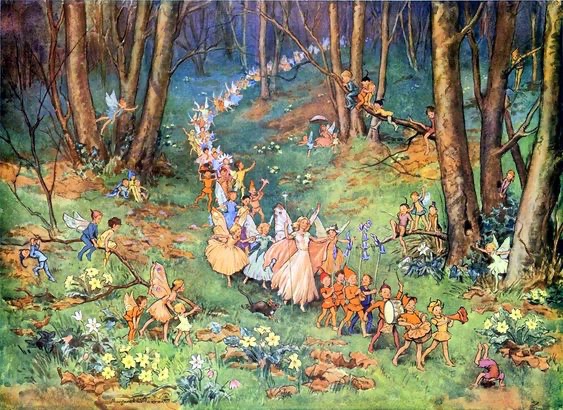
A Fairy Path or Fairy Road is the route by which the fairies regularly travel between any two locations. These paths can be found in many places and are invisible to anyone without the Second Sight, unless they happen to catch the Fairy folk unaware. Fairy Paths are often said to stretch between known fairy hills or locations but may also be found in more obscure locations.
It is considered very bad luck to build on a fairy path and those who do so always suffer for it one way or another. In the most benign cases the building will suffer from disturbances, often at night, as the fairies pass through the building following their accustomed route. As one source says:
When the house happens to have been built in a fairy track, the doors on the front and back, or the windows if they are in the line of the track, cannot be kept closed at night, for the fairies must march through.
In other instances attempts at building would be destroyed as soon as they were begun by being knocked down and a noted method of testing for a fairy path by those who “could not see them was to put up posts where the building was meant to go and see if they remained standing the next day. In extreme cases the person attempting to build might be killed or suffer extreme misfortune.
The Welsh Tylwyth Teg (“Fair Family”) have fairy paths as the Irish and Scottish fairies do, although their reputation is more dangerous. As one anecdotal source says:
“…the Tylwyth Teg have paths (precisely like those reserved for the Irish good people or for the Breton dead), and that it is death to a mortal while walking in one of these paths to meet the Tylwyth Teg.”
The fairies were known to move their homes at certain times of year, notably on the quarter days, and when they did so they would travel along these fairy paths to get from one hill to another. At any time of year, however, a Fairy Path could be perilous.
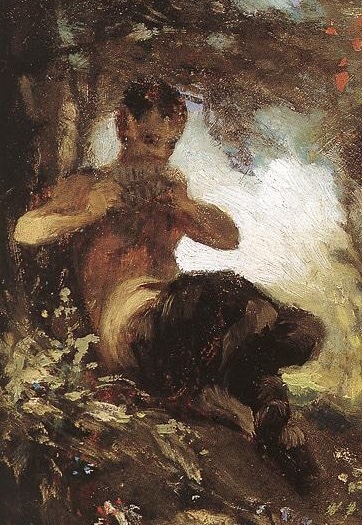
Fauns are mythical creatures with both human and goat features. They are notorious for their love of the forest, music, and beautiful women, and they are generally charming to the people they encounter as they trot along their happy, woodland paths.
Fauns are a peculiar, chimeric race: half goat, half human. With horns, hairy legs, hooves, and a twitchy tail, they might not sound like the loveliest characters, but they have their own undeniable charm. You can’t help but love their faces, which combine pointy ears and a head full of woolly curls with youthful features, sparkling eyes, and a roguish smile.
Above the waist, these woodland creatures have handsome male bodies with lithe limbs. Below the waist, they have two goat legs, which make them extremely nimble dancers. While they’re not especially fond of clothing, they like to adorn themselves with crowns of leaves and berries from their woodland home, especially before one of their legendary parties.
Fauns are merry creatures, and they have a talent for brightening the hearts of others. If you are waylaid by a group of them, you can be sure that you’re not going to get away any time soon. The little creatures will lure you into their festivities with their dancing, jokes, and delicious food.
Of course, they are best known for their flute playing. With just a small, wooden flute, they can hypnotize you with fantastic melodies. Hardly anyone can resist a Faun with a flute, and in truth, the power of their flutes has led some of them to act up, luring travelers into the forest, where they get lost, or stealing the hearts of beautiful maidens away from the rest of the world.
In Greek culture, Fauns are associated with Pan, the god of shepherds, mountain wilds, meadowlands, wooded groves, fertility, and rustic music. They join Pan in his merrymaking and act as his servants when he needs aid. In return, Pan has gifted them with his trademark musical instrument, the pan-flute. Like many Greek gods, Pan was eventually handed down into Roman culture under a new name, Faunus. His troop of Fauns made this transition with him.
Fauns and satyrs are commonly confused because they have some striking similarities in appearance and personality. However, they are separate creatures. Satyrs are followers of Dionysus, the god of harvest, wine-making, and ecstasy. Like Fauns, they love music, women, and parties, but they are far less innocent than their light-hearted cousins. Satyrs are crafty creatures, and they can be downright destructive when they are bent on enjoying themselves, no matter the cost. They are also less physically charming than their woodland cousins. Their faces are less human, and their lower bodies are mightier, more like a horse or a donkey than a harmless, furry goat.
Fauns were popular characters in both Greek and Roman mythology. They are mentioned in ancient texts that describe the gods’ grandest parties, and they are frequently written into the entourage of lovers who pursue nymphs. For example, they follow in the march of Bacchus, a half-god who wandered the earth teaching men how to cultivate vineyards before making a glorious march home to Greece, and in the myth of Vertumnus and Pomona, they are competitors against Vertumnus for the beautiful Pomona’s heart.
During the Hellenistic period, the mythical revelers became popular models for statues. In some of these statues, they were portrayed without any goat-like features, appearing as soft, romantic young men with flutes or beautiful women. The most famous of these statues is the Barberini Faun, which shows a young, handsome man exhausted after a long party.
Fauns were revitalized during the Romantic period, when fairytales gained wild popularity. They were separated from the old Gods of Greek and Roman mythology and became independent, magical creatures of the forest.
One of the Romantic period’s most famous authors, Nathaniel Hawthorne, nodded to the mythical creatures with his acclaimed novel The Marble Faun, while poet Stephane Mallarme composed a masterpiece around the charming chimera with “L’apres-midi d’un Faune.” This poem later inspired both a symphony composition and a ballet.
Remarkably, Fauns have changed very little from their early Greek play-days to their appearances in modern literature. Although they seem to have gotten out from under Pan’s thumb, they still have the same rustically charming appearance, fun-loving temper, and musical talent.
Today’s most famous Faun is Mr. Tumnus, a flute-playing creature who welcomes Lucy Pevensie to the world of Narnia. Mr. Tumnus captures an age-old personality, acting both as an agent of mischief and as a kind-hearted guide for Lucy, the human girl who has captured his fancy.
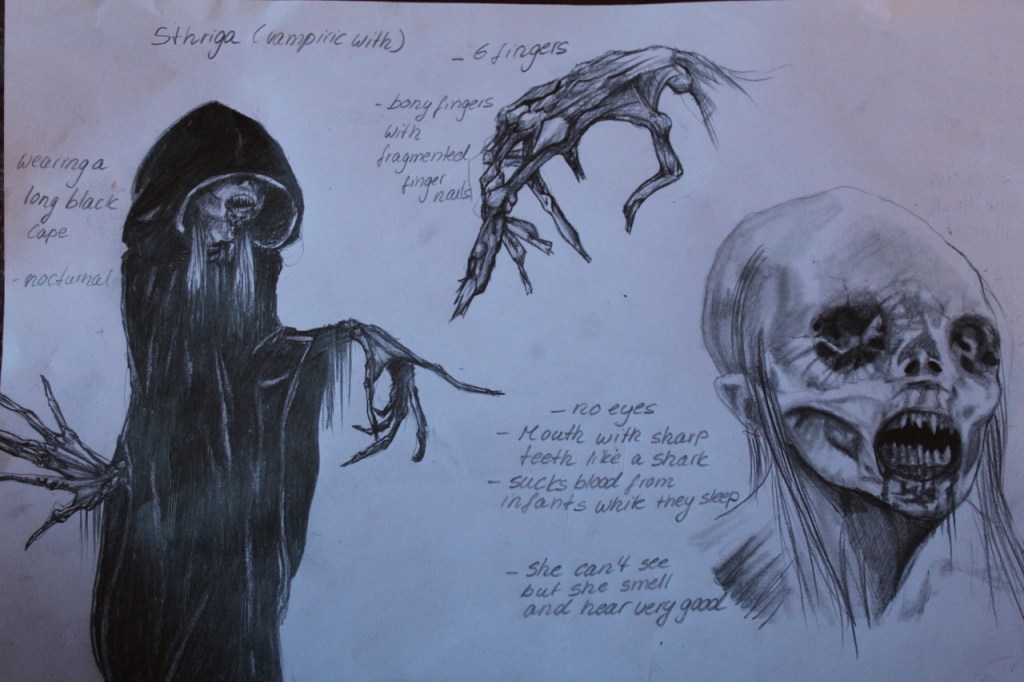
The Shtriga was a vampire-like witch that was found in Albania. The creature was similar to the Strigon, which was a witch found among the southern Slavs, the strigoi of Romania, and the vjeshtitza of Montenegro.
The Shtriga usually took the form of a woman who lived undetected in the community. She was difficult to identify, although a sure sign was a young girl’s hair turning white.
The vampire witch attacked her prey at night, usually in the form of an animal, such as a moth, fly, or bee.
In order to catch a Shtriga, two methods can be attempted:
~ On a day when the community gathered in the church, a cross made of pig bones could be fastened to the doors. Any Shtriga inside would be trapped and unable to pass the barrier.
~ If one followed a suspected Shtriga at night, one could see her vomit blood at some point after she sucked the blood of her victims. The vomited blood could be bottled and turned into an amulet to ward against witches.
Legend of the Shtriga:
According to legend, only the shtriga herself could cure those she had drained (often by spitting in their mouths), and those who were not cured inevitably sickened and died.
The name can be used to express that a person is evil. According to Northern Albanian folklore, a woman is not born a witch; she becomes one, often because she is childless or made evil by envy. A strong belief in God could make people immune to a witch as He would protect them.
Usually, shtriga were described as old or middle-aged women with grey, pale green, or pale blue eyes (called white eyes or pale eyes) and a crooked nose. Their stare would make people uncomfortable, and people were supposed to avoid looking them directly in the eyes because they have the evil eye. To ward off a witch, people could take a pinch of salt in their fingers and touch their (closed) eyes, mouth, heart and the opposite part of the heart and the pit of the stomach and then throw the salt in direct flames saying “syt i dalçin syt i plaçin” or just whisper 3–6 times “syt i dalçin syt i plaçin” or “plast syri keq.”
In some regions of Albania, people have used garlic to send away the evil eye or they have placed a puppet in a house being built to catch the evil. Newborns, children or beautiful girls have been said to catch the evil eye more easily, so in some Albanian regions when meeting such a person, especially a newborn, for the first time, people might say “masha’allah” and touch the child’s nose to show their benevolence and so that the evil eye would not catch the child.
Edith Durham recorded several methods traditionally considered effective for defending oneself from shtriga. A cross made of pig bone could be placed at the entrance of a church on Easter Sunday, rendering any shtriga inside unable to leave. They could then be captured and killed at the threshold as they vainly attempted to pass. She further recorded the story that after draining blood from a victim, the shtriga would generally go off into the woods and regurgitate it. If a silver coin were to be soaked in that blood and wrapped in cloth, it would become an amulet offering permanent protection from any shtriga.
In Catholic legend, it is said that shtriga can be destroyed using holy water with a cross in it, and in Islamic myth it is said that shtriga can be sent away or killed by reciting verses from the Qur’an, specifically Ayatul Kursi 225 sura Al-Baqara, and spitting water on the shtriga.














 Mark Bere Peterson’s Counterculture, Urban Legends, Paganism & Witchcraft