Dr. William Price

Today in weird history —> On January 18, 1884 Dr. William Price attempts to cremate the body of his infant son, Jesus Christ Price, setting a legal precedent for cremation in the United Kingdom. Price, a Welshman, was an interesting character in many ways. He adopted the Druid “religion” for many years; here he is onstage in 1884 wearing Druidic attire. At the time he cremated his infant son, cremation was illegal in England, but his action helped change the law…

#WeirdHistory #WilliamPrice #Cremation #Druid

The Euphronios Krater

Today in Museum History —> On this day in 2008 – The Euphronios Krater is unveiled in Rome after being returned to Italy by the Metropolitan Museum of Art.

Here’s a picture of that beautiful Greek vase, created by Euphronios about 515 B.C.

The Euphronios Krater (or Sarpedon Krater) is an ancient Greek terra cotta calyx-krater, a bowl used for mixing wine with water. Created around the year 515 BC, it is the only complete example of the surviving 27 vases painted by the renowned Euphronios and is considered one of the finest Greek vase artifacts in existence. Part of the collection of the Metropolitan Museum of Art from 1972 to 2008, the vase was repatriated to Italy under an agreement negotiated in February 2006, and it is now in the collection of the Archaeological Museum of Cerveteri as part of a strategy of returning stolen works of art to their place of origin

Most Nobel Prize for Literature Winners

Q: What country has produced the most Nobel Prize for Literature winners?

A: France (15 received, 1 declined)

1. Patrick Modiano, Literature, 2014

2. J. M. G. Le Clézio, Literature, 2008

3. Gao Xingjian, born in China, Literature, 2000

4. Claude Simon, Literature, 1985

5. Jean-Paul Sartre, (declined the prize), Literature, 1964

6. Saint-John Perse, Literature, 1960

7. Albert Camus, born in French Algeria, Literature, 1957

8. François Mauriac, Literature, 1952

9. André Gide, Literature, 1947

10. Roger Martin du Gard, Literature, 1937

11. Ivan Bunin, born in Russia, Literature, 1933

12. Henri Bergson, Literature, 1927

13. Anatole France, Literature, 1921

14. Romain Rolland, Literature, 1915

15. Frédéric Mistral, Literature, 1904

16. Sully Prudhomme, Literature, 1901

Who Were The Norse?

“The term ‘Norse’ is used to describe the various peoples of Scandinavia who spoke the Old Norse language between the eighth and thirteenth centuries AD. While it had eastern and western dialects it would have been generally mutually understood across the range of areas within which it was spoken. A third recognisable form was spoken on the island of Gotland.

The Old Norse language later developed into modern Danish, Faroese, Icelandic, Norwegian and Swedish. In addition, there once existed the so-called Norn languages of Orkney and Shetland that are now extinct. It was, essentially, the language of the Vikings.”

~ Martyn Whittock, from Tales of Valhalla

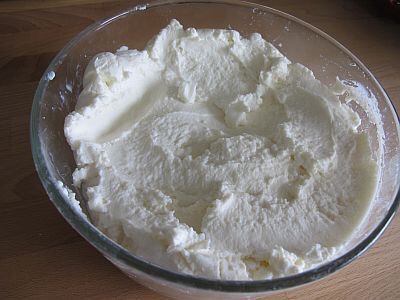
Skyr

  • 1 gallon non-fat milk, pasteurized (not ultra-pasteurized)but not homogenized
  • 1 (5 1/2-ounce) container Siggi’s plain or vanilla skyr*
  • 7 drops liquid animal rennet, or 4 drops liquid vegetable rennet
  • 1/4 cup warm, non-chlorinated water
  • A reliable digital thermometer
  • A fine-mesh nylon vegetable bag or cheesecloth for draining the curds

* Available at Whole Foods, Fresh Market, Haggen’s and specialty food stores. Skyr was introduced to America in 2005 by enterprising Icelandic expatriate Siggi Hlmarsson under the brand name of “Siggi’s Icelandic Style Skyr.”

Skyr—pronounced “skeer”—is a traditional Icelandic “yogurt” that has been made since the 9th century Viking era. It is technically classified as a cheese because it contains rennet, a substance used in curdling milk when making cheese, but is considered a yogurt because of its structure and texture.

Bring the milk to the scalding point.  Pour the milk in a heavy-bottomed pot and bring the milk to a slow and steady simmer over a medium-high burner, heating it until it reaches the scalding point, which is between 185 and 190 F; this should take about 15 to 20 minutes. Stir frequently to prevent scalding.

If toward the very end of the heating process you notice that the milk at the bottom of the pot has begun to scald (seems like it is starting to stick), reduce the heat to medium-low, and stop stirring. A small bit of scalding is okay, but you don’t want to release the scalded bits into the mixture.

Turn the burner off immediately when the milk reaches the scalding point. Remove the pot from the burner and allow it to cool to 110 F.

Scoop out the container of skyr into a bowl. Once the milk has cooled down, combine 1 cup of the cooled milk with the skyr, then return the mixture to the pot, stirring to incorporate.

Next, whisk the liquid rennet into the warm water, then stir this mixture immediately into the milk (the rennet will lose its effectiveness if prepared more than 30 minutes before using).

Cover the pot with a thick towel and place in a warm, draft-free spot, such as the oven (not turned on) or an insulated cooler, for 12 hours.

The curds should have separated from the whey overnight—what you need to create the skyr are just the curds. Spoon the curds into a fine-meshed bag or a double-layer of cheesecloth. Suspend the bag over a dripping tray in a cool room, or place the bag over a colander set over a bowl in the refrigerator, and allow the remaining whey to drain until the skyr is thick.

Your skyr will keep for three or four weeks, covered, in the refrigerator. To serve as breakfast or a snack, top with milk, fresh berries, and sugar or honey to taste.

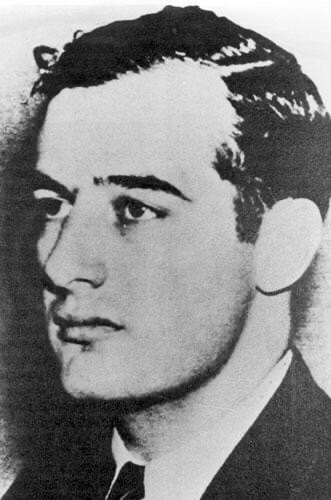
Raoul Wallenberg

Today in Holocaust History –> On this day 17 January 1945, Righteous Among the Nations, Raoul Wallenberg was taken away by Russian soldiers. He was never seen again.

Just prior to the Soviet army entering Budapest, Wallenberg said to his colleague in the Swedish embassy:

“I’ve taken on this assignment, and I will never be able to go back to Stockholm without knowing … that I’d done all a man could do to save as many Jews as possible”.

~ Raoul Wallenberg, Righteous Among the Nations

Raoul Wallenberg was sent to Budapest in 1944 to rescue Jews with connections to Sweden. He arrived with a list of Jews whom he was to help and 650 protective passports. However, he quickly widened the scope of his efforts by issuing 1000’s of “protective letters” and setting up a network of protective houses for Jews .

As the situation in Hungary deteriorated, Wallenberg abandoned all diplomatic protocol and attempted to rescue as many Jews as he could at great risk to himself.

Wallenberg used unconventional methods, including bribery and blackmail, to finance and run his huge rescue operation, successfully saving thousands of Jews. When Adolf Eichmann ordered a “death march” of tens of thousands of persons to the Austrian border, Wallenberg followed the marchers in their vehicles, and distributed food, clothing, and medications. He was able to free Jews from the death march by claiming that they were his “protected” Jews.

In 1956, 11 years after his disappearance, the Soviets finally stated that Raoul Wallenberg had died in prison in 1947.

In 1963 Yad Vashem recognized Raoul Wallenberg as Righteous Among the Nations.

Source: Yad Vashem

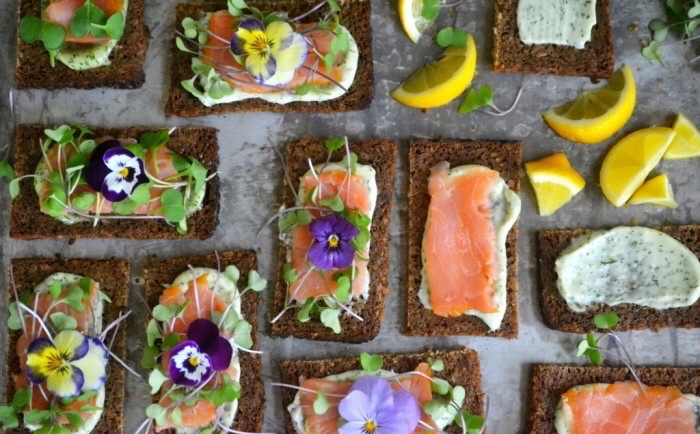
Smoked Salmon With Pickled Red Onion, Lemon And Dill Butter Open Sandwich

2 lemons, 1 zested and juiced, 1 halved

pinch each of sugar and sea salt

½ red onion, finely sliced

1 tsp caraway seeds

small handful of dill, finely chopped

1 Ounce butter, softened

3 ½ ounces smoked salmon

2 slices of rye bread

micro herbs [such as dill, amaranth, rocket (arugula)]

Mix the lemon juice with a pinch of sugar and salt. Add the red onion slices and set aside for 30 minutes.

Dry toast the caraway seeds until fragrant, be careful not to burn them. Allow to cool, then lightly bash using a mortar and pestle. Tip into a bowl along with the dill, lemon zest, a little juice from the halved lemon and the softened butter. Season with salt and white pepper and mix together.

Thinly slice the remaining half lemon. Spread the butter over the bread and top with the smoked salmon, pickled red onion, lemon slices and some of the micro herbs.

A Morning at Wagshal’s Market – Washington D.C.

wag2

Originally published in 2013:

I recently interviewed and then “shadowed” the head butcher at an exclusive butcher shop in Washington DC. I didn’t get the job by-the-way. I’m not at all sore about it, just a bit disappointed. Was I ready to make the move away from the South I have grown to love, maybe not but I had to check it out for the opportunity?

I shadowed the head butcher, Pam. She was impressive in her intimate knowledge and skill and as she said to me, “this isn’t a job it is my life.” It was immediately obvious that she deeply cared about what she was doing, her snide comments about the rest of the staff aside I felt there was a lot I could learn from her if given the chance. Which of course you know I didn’t get – but no sour grapes here. After a quick interview of my interest and knowledge of meat cuts, butcher experience, etc. (Ahem that would be none really, but I had bluntly told them I had never been professionally trained. They are the ones that told me they were interested in me due to my passion for the subject. Maybe I should mention writing a good cover letter is really a plus when applying for a job.) she quickly moved on to preparing the morning orders to be picked up.

wag3

I shadowed, which means I observed while I asked a few questions. I’m not sure if these were a nuisance in retrospect, but she appeared more than happy to answer any of my questions. One thing was obvious, she loved to talk, to talk about meat and maybe most of all how good she was as a butcher and salesperson. The first order of business that morning was to trim and tie a beef tenderloin and cut beef short ribs. It was riveting watching her work with such ease and grace. It was obvious she deeply cared about what she was doing as she told me with pride of her 103 day dry aged porterhouse steaks she had for sale. She did sell one while I was there, an inch and a half thick for a little over $80. The price seemed a little stiff to me, but what did I know about 103 day dry aged prime porterhouses. Better be a damn good piece of meat for that price and still needing to be cooked. I wondered how good of a cook the man buying the steak was, did he do the cooking? His wife? Did he have a private chef?

After the man left she turns, “I told you I’d sell all those steaks this morning,” she grins and she had told me so. I’ve never minded someone with a big ego as long as they have the talent to back it up which Pam clearly did. “I could sell ice to an Eskimo or sand to an Arab.” Okay I have to admit that comment was a little over the top, but what the hell she was proud of the sale and why not that is a damn expensive steak. I wonder how much the man is willing to pay for a steak at a fancy steakhouse. I wonder if that day was special or does he not even blink twice about paying that much for a steak.

wag1

“I’m the best butcher you’ll ever know. I won a butcher competition where there were 57 men and myself. I cut down a whole side of pork in twenty-five minutes. The guy next to me only had two trays done.” Ah, Pam I’ll miss your stories even if they are a bit self-absorbed. I highly recommend Wagshal’s Market for your meat procuring, so long as you have the unlimited budget to afford it. I hope to be back someday when I can afford a 103 day aged porterhouse, maybe then I can tempt my vegan relatives to try at least a bite.

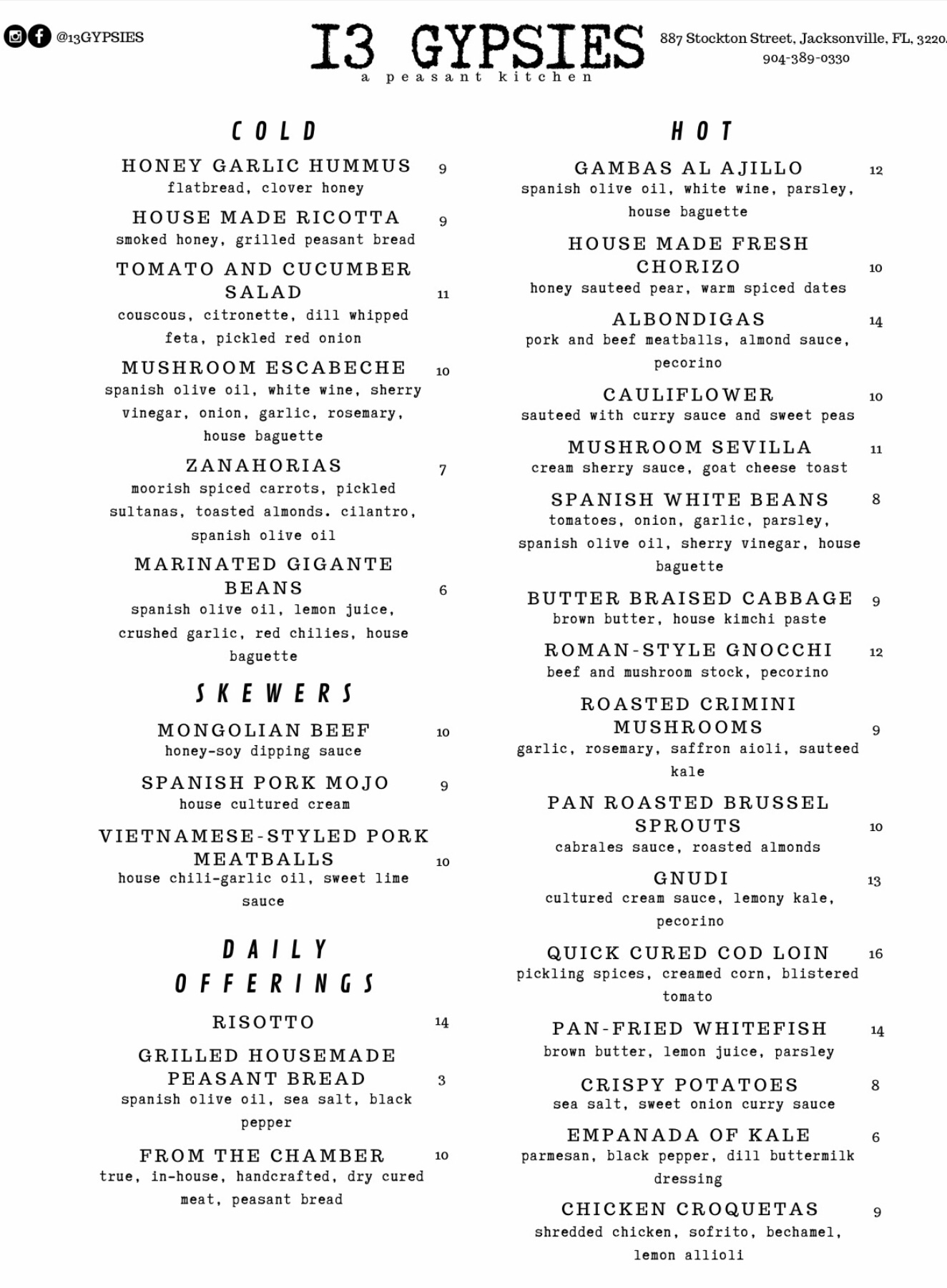
13 Gypsies – Jacksonville, Florida

5B90080F-531A-4465-9F10-E7E4E2CF2B51.jpeg

With a heritage firmly rooted in Spain and dating back more than 35 years, 13 Gypsies strives to bring you a taste of true mediterranean flavors. As many restaurants push food innovation, 13 Gypsies proudly work and strive to preserve traditional recipes and flavors before they are lost. Staying true to his roots, Chef Howard runs his kitchen with a passion for the simple and elegant food of the old world – passing on his love and passion to young new cooks.

887 Stockton Street

Jacksonville, Florida 32204

Land – 904.389.0330

Fax – 904.389.0220

13g@13gypsies.com

EEE1A780-17B6-4E91-8ADA-1D4AD83F3641.jpeg