The Valknut, also known as Hrungnir’s heart, heart of the slain, Heart of Vala, and borromean triangles is a mysterious Norse symbol. its true meaning is still debated, but it is often associated with a warrior’s death in a battle.
The symbol has been found on old Norse stone carvings and funerary steles. It is sometimes called “Hrungnir’s heart,” after the legendary giant of the Eddas. It’s also possible to find a depiction of the Valknut on stone carvings as a funerary motif, where it probably signified the afterlife. In art, the Valknut is a representation of God Odin, and it demonstrates gods’ power over death. A Valknut is also believed to offer protection against spirits which is the reason why it is often carried as a talisman.
A Valknut is made of three parts, and the number three is a very common magic symbol in many cultures. In this case, the symbolism in Norse mythology showing three multiplied by three might designate the nine worlds, which are united by the Yggdrasil tree. In modern times Valknut, like Triquetra and Horn Triskelion, is often interpreted as a symbol pointing to heathen convictions.
In Norse mythology, the Yggdrasil is a giant mythological tree that holds together the Nine Worlds or realms of existence.
At the very top of Yggdrasil, an eagle lived and at the bottom of the tree lived a dragon named Nidhug. Both hated each other and were bitter enemies. The Nine Worlds are guarded by the serpent Jormungandr. Yggdrasil is one of many variations of the Cosmic Axis or Universal World Tree known to all human cultures and home to many fascinating creatures.
The image of Yggdrasil appears on the famous Överhogdal Tapestry, which dates to the year 1066 and depicts the events of Ragnarok, the doom of the Gods and apocalyptic record of the coming comet.
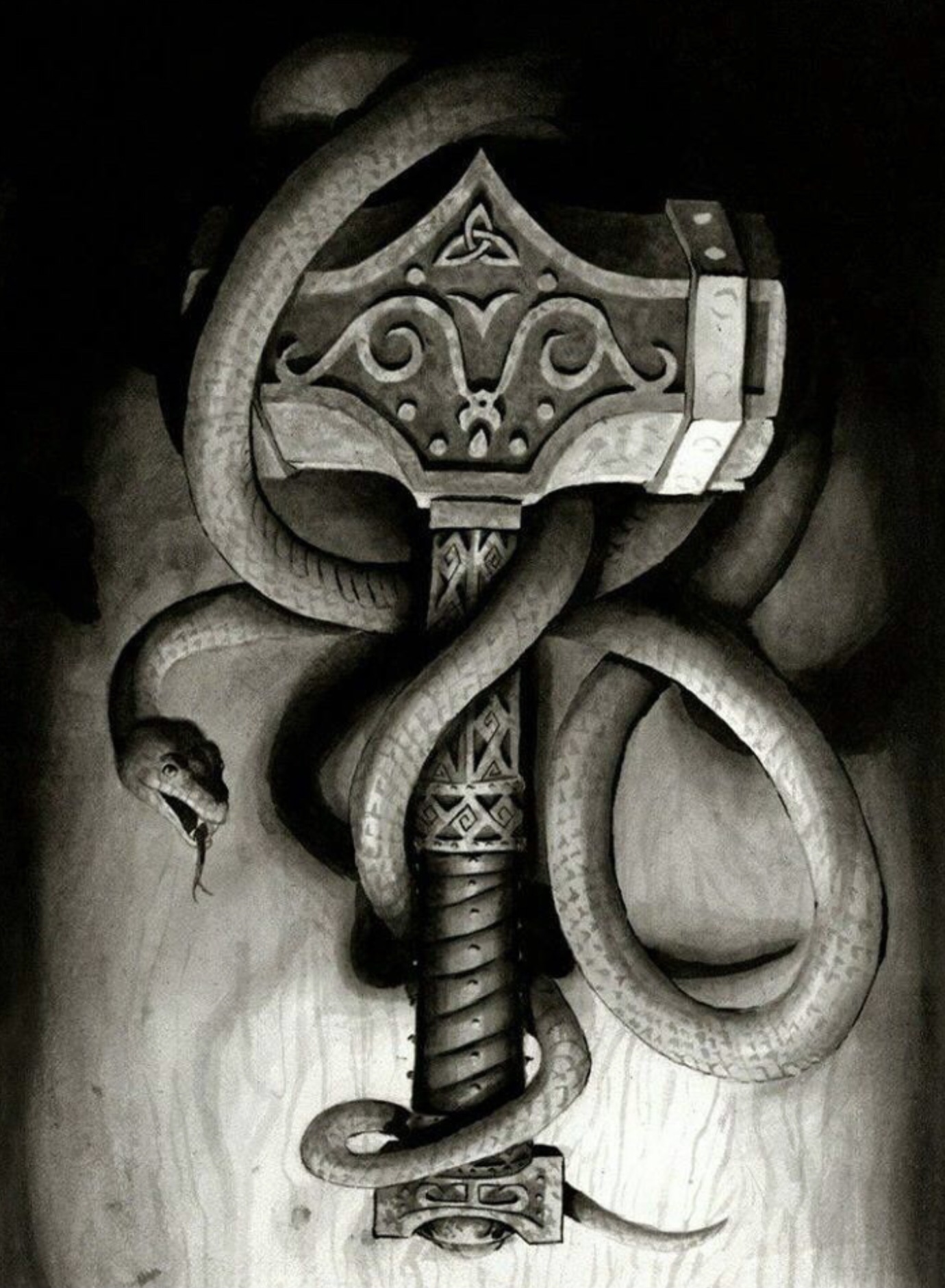
Mjölnir means lightning, and Thor’s hammer indicates the god’s power over thunder and lightning. Thor, ancient god of war is one of the most prominent figures in Norse mythology. Thor who was the storm-weather god of sky and thunder and also a fertility god, was the son of Odin and Fyorgyn, the earth goddess.
Thor’s hammer, Mjölnir is depicted in Norse mythology as one of the most fearsome weapons, capable of leveling mountains. Mjölnir, was a magical weapon that always came back to Thor when he threw it. Wearing Thor’s hammer as an amulet of protection was quite common as this was probably the most popular of all the pagan Viking symbols. Even during Christian times, from A.D. 1000 on, Vikings wore Thor’s Mjölnir as well as a cross on a chain or thong around their necks.
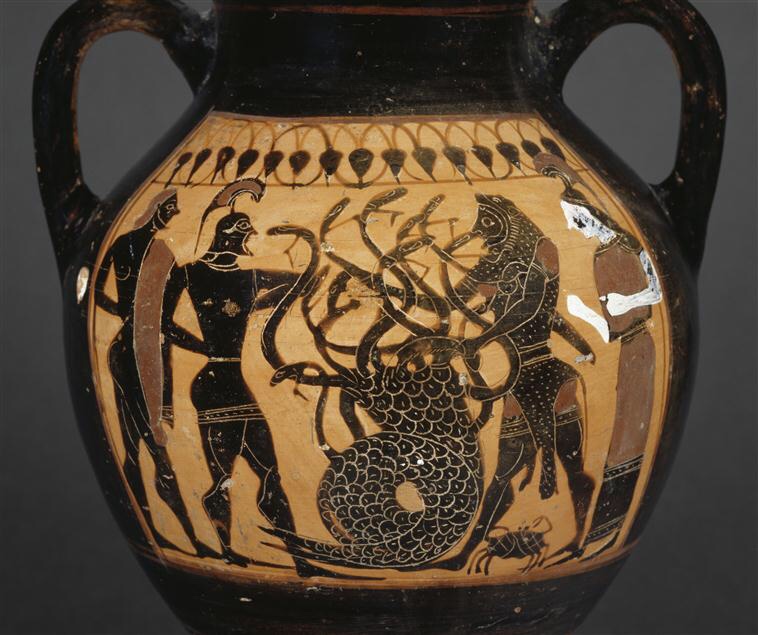
The Hydra was an enormous serpent with nine heads—or as many as fifty or one hundred—one of which was immortal. Its parents were the giant Typhon and Echidna, half maiden and half serpent, the so-called “mother of all monsters.” The Hydra’s haunts were the marshes of Lerna, near the city of Argos.
The second of Hercules’s Labors was the slaying of the Hydra. But each time that Hercules would cut off one of its heads, two would grow in its place. Not only this, but a giant crab that kept the Hydra company appeared and joined the fray. Hercules’s clever nephew and companion Iolaus proposed a remedy: the moment Hercules severed a head, Iolaus would cauterize the stump with a firebrand. This the two did until only the Hydra’s immortal head remained. Hercules then cut off this head, and after burying it beneath a boulder, dipped his arrows in the Hydra’s lethal venom. Both the Hydra and the crab, which Hercules had also slain, were placed in the heavens by the goddess Hera as constellations.
Zhang Heng was born in 78 CE in the town of Xi’e, in what is now Henan Province, in Han Dynasty China. At 17, he left home to study literature and train to be a writer. By his late 20s, Zhang had become a skilled mathematician and was called to the court of Emperor An-ti, who, in 115 CE, made him Chief Astrologer.
Zhang lived at a time of rapid advances in science. In addition to his astronomical work, he devised a water-powered armillary sphere (a model of the celestial objects) and invented the world’s first seismometer, which was ridiculed until, in 138 CE, it successfully recorded an earthquake 250 miles (400 km) away. He also invented the first odometer to measure distances traveled in vehicles, and a nonmagnetic, south-pointing compass in the form of a chariot. Zhang was a distinguished poet, whose works give us vivid insights into the cultural life of his day.
In Norse mythology, the Valkyries were a group of warrior maidens who had served the God Odin and were sent to the battlefields to choose pass judgments upon the slain.
They were not only associated with bloodshed and battle but also with fairness. They were a force to be reckoned with. The Old Norse Poems provide a list of Valkyrie names who were known as the fiercest warriors in battles:
1. Brynhildr(pronounced as “Brin-hil-duur”), meaning”battle armor” or “bright battle,” was known as the leader of the Valkyries.
2. Eir(pronounced as “Ee-rh”), meaning”peace” or “mercy.” In Old Norse mythology, she is a Valkyrie associated with medical proficiency.
3. Geirahöð (pronounced as “Gee-ey-ra-hut”), meaning”battle spear,” is mentioned in some of the manuscripts of Grímnismál.
4. Geiravör (pronounced as “Gee-ey-ra-vurr”), meaning “spear-vör,” is a Valkyrie mentioned in the long list amongst the two Nafnaþulur lists found in the Prose Edda.
5. Geirdrifu(pronounced as “Gee-ey-dra-fu”), meaning”spear-flinger.”
6. Geirönu(pronounced as “Gee-ey-ro-nu”), meaning”the one charging forth with the spear.”
7. Geirskögu(pronounced as “Gee-aer-sko-gu”), meaning”spear-bearer,” a fierce Valkyrie name.
8. Göl(pronounced as “Gawl”), meaning”tumult” or “noise, battle,” is a Valkyrie who served Odin in battle.
9. Göndu(pronounced as “Gawn-du”), meaning”wand-wielder” is one of the most fierce Old Norse Valkyries and the chooser of the slain.
10. Gunnr(pronounced as “Gunner”), meaning”war” or “battle” is a great Valkyrie name with a dual meaning.
11. Herfjötur(pronounced as “Her-fyo-tur”), meaning “fetter of the army” or “host fetter” is well-known in Norse mythology as a powerful Valkyrie with her ability to place fetters.
12. Herja(pronounced as “Herja”), meaning”one who devastates” who was both a Valkyrie and a Germanic goddess and chooser of the slain.
13. Hlaðguðr svanhvít(pronounced as “Hluh-goor-svan-vit”), meaning”swan-white” is King Hlödvér’s daughter, and the sister of Hervör alvit.
14. Hildr (pronounced as “Hill-dur”), meaning”battle” is the daughter of Högni and Hedin’s wife.
15. Hjalmþrimul(pronounced as “Jam-pree-mul”), meaning”helmet clatterer” is amongst the Valkyries in Norse Legend who chooses who will die in battle.
16. Hervör alvitr (pronounced as “Her-vor-aal-vee-tur”), meaning”all-wise strange creature” is a Valkyrie who is the sister of the sister of Hlaðguðr in Nordic mythology.
17. Hjörþrimul(pronounced as “Jor-pree-mul”), meaning”the female sword warrior,” is a legendary Valkyrie.
18. Hlökk(pronounced as “Lowk”), meaning”noise, battle”. She is mentioned in the Poetic Edda poemGrímnismál.
19. Hrist(pronounced as “Rist”), meaning”the quaking one” is a legendary Norse Valkyrie who also appears intheValkyrie Profile series.
20. Hrund(pronounced as “Rund”), meaning“pricker”.
21. Kára(pronounced as “Kaara”), meaning”the curly one” is a Valkyrie mentioned in the Poetic Edda poem Helgakviða Hundingsbana II.
22. Mist(pronounced as “Mist”), meaning”cloud” or “mist”. She appears in the list in the Poetic Edda poem Grímnismál.
23. Ölrún(pronounced as “Awl-run”), meaning”ale-rune” is a powerful Valkyrie.
24. Randgrid(pronounced as “Rand-grid”), meaning”shield-destroyer” is a powerful Valkyrie.
25. Ráðgríðr(pronounced as “Rad-gri-dur”), meaning”council-truce” is a well-known Valkyrie in Norse legend who judges who will die in battle.
26. Reginleif(pronounced as “Rain-leaf”), meaning”daughter of the gods” is a Valkyrie who became Volund for Adam when Ragnarök took place.
27. Róta(pronounced as “Row-tah”), meaning”sleet and storm” is a Valkyrie who is attested in the 36th chapter of the Prose Edda book Gylfaginning, mentioned alongside the other valkyries.
28. Sanngriðr(pronounced as “San-grid-ur”), meaning”very violent and very cruel” is a Valkyrie who is mentioned in the skaldic poem Darraðarljóðand a powerful female figure.
29. Sigrdrífa(pronounced as “Sig-ur-dri-fa”), meaning”inciter to victory” is a well-known Valkyrie in Norse literature who is known as the chooser of the slain.
30. Sigrún(pronounced as “Sig-run”), meaning”victory rune” is a famous Nordic Valkyrie in Norse mythology.
31. Skalmöld(pronounced as “Skal-mold”), meaning”sword-time” is amongst the Valkyries is one of the female figures who decide who will die in battle.
32. Skeggöld(pronounced as “Ske-gold”), meaning”axe-age” who appears in at two poems as a Valkyrie and was one of the powerful female figures.
33. Skögul(pronounced as “Sko-guul”), meaning”shaker” or “high-towering” is one of the Valkyries who appear in Heimskringla.
34. Skuld(pronounced as “Skuld”), meaning“debt” or “future” is a Valkyrie who held the Norn position as the goddess of fate.
35. Sveið(pronounced as “Sveyud”), meaning”vibration” or “noise” is a powerful Valkyrie.
36. Svipu(pronounced as “Svi-poo”), meaning”changeable” is one of the Valkyries about whom much information isn’t provided.
37. Þögn(pronounced as “Pawn”), meaning”silence” is a Valkyrie, found in the Nafnaþulur section attached to the Prose Edda.
38. Þrima(pronounced as “Prima”), meaning “fight” is a Valkyrie, found in the Nafnaþulursection of Skáldskaparmál.
39. Þrúðr (pronounced as “Pruder”), meaning”strength” or “power” is an old Norse Valkyrie who serves ale to the Einherjar in Valhalla.
Holiday Traditions: Holly, Ivy and Evergreens —> Romans loved wreaths and decorated everything with Laurel. Holly, ivy and evergreen are the more popular modern options today, and each one holds significance. Egyptians didn’t have evergreens, so they used palm fronds to celebrate Winter Solstice. Christians love holly because the red berries symbolize the blood of Christ and the pointy leaves symbolize the crown of thorns. However, the advent of holly decor was around long before Christianity. Pre-Christian pagan groups believed that the Holly King did battle with the Oak King. They also thought holly could drive off evil spirits. Romans, of course, were into laurel wreaths, but laurel was not easily procured throughout the northern reaches of the empire. Instead of laurel, they used evergreens.
Holiday Traditions: Mistletoe —> Mistletoe was considered a magical plant in Europe, especially among the Druids and Vikings, and holds significance in Native American cultures. Mistletoe is no modern quirk of Christmas, even Romans partook in fertility rituals beneath the mistletoe. Mistletoe stood as a neutral ground for feuding Norse tribes, who laid down their weapons in order to negotiate beneath the peace plant. The Druids thought it could protect them from thunder and lightning, as well. Whether you’ve got the urge to make out, hide from a storm or talk it out, beware as mistletoe is super poisonous.
Holiday Traditions: Fruitcakes —> While people rarely show any excitement around the fruit-laden cakes these days, they were a real treat in times of yore. The cakes actually have origins in Egypt and were later disseminated by the Romans as they conquered parts of Europe. Those cakes of Egypt were just about as dense and long-lasting as the brandied, fruit-studded cakes of today. Egyptians placed cakes of fermented fruit and honey on the tombs of their deceased loved ones so that they’d have something to munch on in the afterlife. Romans took similar cakes into battle made of mashed pomegranates and barley. Christians went into the crusades with honeycakes. Fruitcakes are everywhere, no matter how hard you try to avoid them.
December 6th, 1912 – The Nefertiti Bust is discovered.
Here’s the Nefertiti bust, now residing in Berlin’s Neues Museum. The limestone and painted stucco bust, which the Egyptians have been demanding back (and they have a case for its repatriation), was found in a sculptor’s workshop in the ancient city of Akhetaten,. The bust of Nefertiti is believed to have been crafted about 1345 BC by the sculptor Thutmose. The bust does not have any inscriptions, but can be certainly identified as Nefertiti by the characteristic crown, which she wears in other surviving (and clearly labelled) depictions, for example the “house altar”.




 Mark Bere Peterson’s Counterculture, Urban Legends, Paganism & Witchcraft