Treblinka Extermination Camp

Treblinka was one of the three death camps that were part of “Operation Reinhard”. It was built as the place of execution for the Jews of the Warsaw Ghetto and its surroundings. It was located near Malkinia, about 80 kilometers north-east of Warsaw. Malkinia was a station on the main Warsaw-Bialystok railroad line in a densely populated area and hidden among deep woods. Jewish and Polish prisoners worked in a punishment camp called Treblinka 1 built as early as 1941. When the extermination camp was built in 1942, the railroad line was extended into it.

“Operation Reinhard” was the code name for “the final solution to the Jewish question” (the extermination of all the Jews) in the areas in Poland under the jurisdiction of the General Gouvernment in the Belzec, Sobibor and Treblinka camps. Several months after work began, the name was suggested in memory of Reinhard Heydrich, head of the SD (The Security Police of the SS) and one of the architects of the “final solution to the Jewish question”, who was shot to death by Czech Underground fighters in May of 1942.

The camp was built in the shape of a polygon, 400 x 600 meters. It had a double barbed wire fence. The inner fence was entwined with branches designed to hide the camp and what was happening there. There were 8 meter high guard towers in each corner and all along the fences.

The living quarters, which included those of the staff (Germans and Ukrainians), offices, the infirmary, storage buildings and workshops. A separate fenced-in area housed the Jewish prisoners’ barracks, sewing shops, a shoemaker and a carpentry shop.

The reception area included the train platform and tracks for shipments, two huts in a fenced-in area where the victims were ordered to undress, and two buildings where the victims’ possessions were kept and sorted. The extermination area was small, only 200 x 250 meters, with a white building which held three gas chambers. There was a diesel motor housed in a building nearby. The victims were executed by carbon monoxide gas that was forced into the chambers through a pipe connected to the roof and into regular shower heads, in order to sustain the illusion of a real shower. One hundred and fifty yards away to the east, were large pits for burying the victims. Between the “reception area” and the “extermination area” there was a narrow path surrounded by wire and intertwined with branches, called “the Pipe,” or “The Way to Heaven”, used by the staff and prisoners (“Himmelfahrtstrasse”). The naked victims were led along here from the undressing huts into the gas chambers.

There were 20-30 SS guards in positions of command and organization and about 90-120 Ukrainians. These were Soviet prisoners of war who volunteered to serve the Germans. They acted as guards and assisted in operating the gas chambers. The 700-1,000 Jewish prisoners did all the work in the camp. They were divided into work groups or “Kommandos”. The uniforms of each Kommando unit had a stripe of a designated color which distinguished them from one another. The exterminations began on July 23, 1942 and continued until April 1943.

From the spring of 1943 only a few transports arrived and then began the burning of the bodies that had been buried in mass graves. Hundreds tried to escape from the trains, most of whom were murdered by the guards. In the early years, before stringent guarding arrangements were established, a few Jews managed to escape from the camp. From time to time there were incidents of Jewish uprisings and from early 1943, an underground existed comprised of prisoners from all parts of the camp.

Uprising:

There was an uprising on August 2,1943, when the last of the bodies had been burned and the camp destroyed, indicating that soon the remaining prisoners would be executed. During the uprising most of the camp burned. The remaining prisoners were ordered to take the buildings and fences apart and try to erase signs of the crimes committed there. When the work was done, everyone was shot. The camp was plowed over, and trees were planted. A farm was established and Ukrainians settled there. About 70 of those who managed to escape from the camp during the uprising survived until the end of the war. 800,000 people were murdered at Treblinka; 2000 of them were Gypsies and most of the rest were Jews. The Jews came from Warsaw, Bialystok, Grodno, Radom, Czenstochowa and even Lublin. Jews from Theresienstadt were also executed there. As the Red Army approached, even the farm that had been established on the camp site was plowed over.

Memorial:

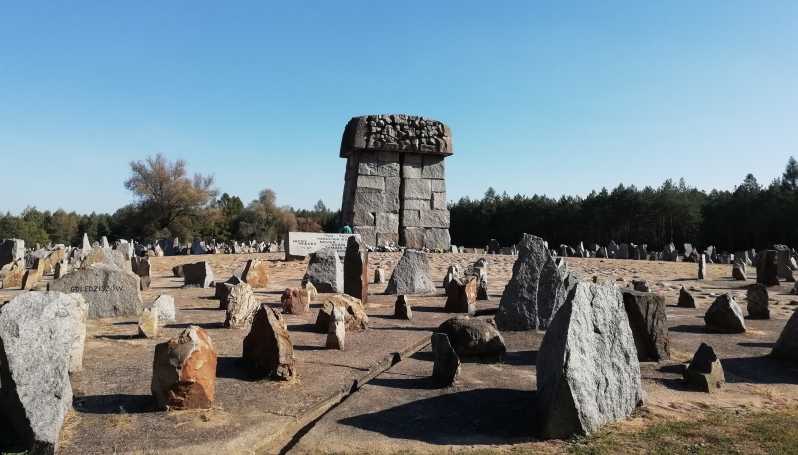
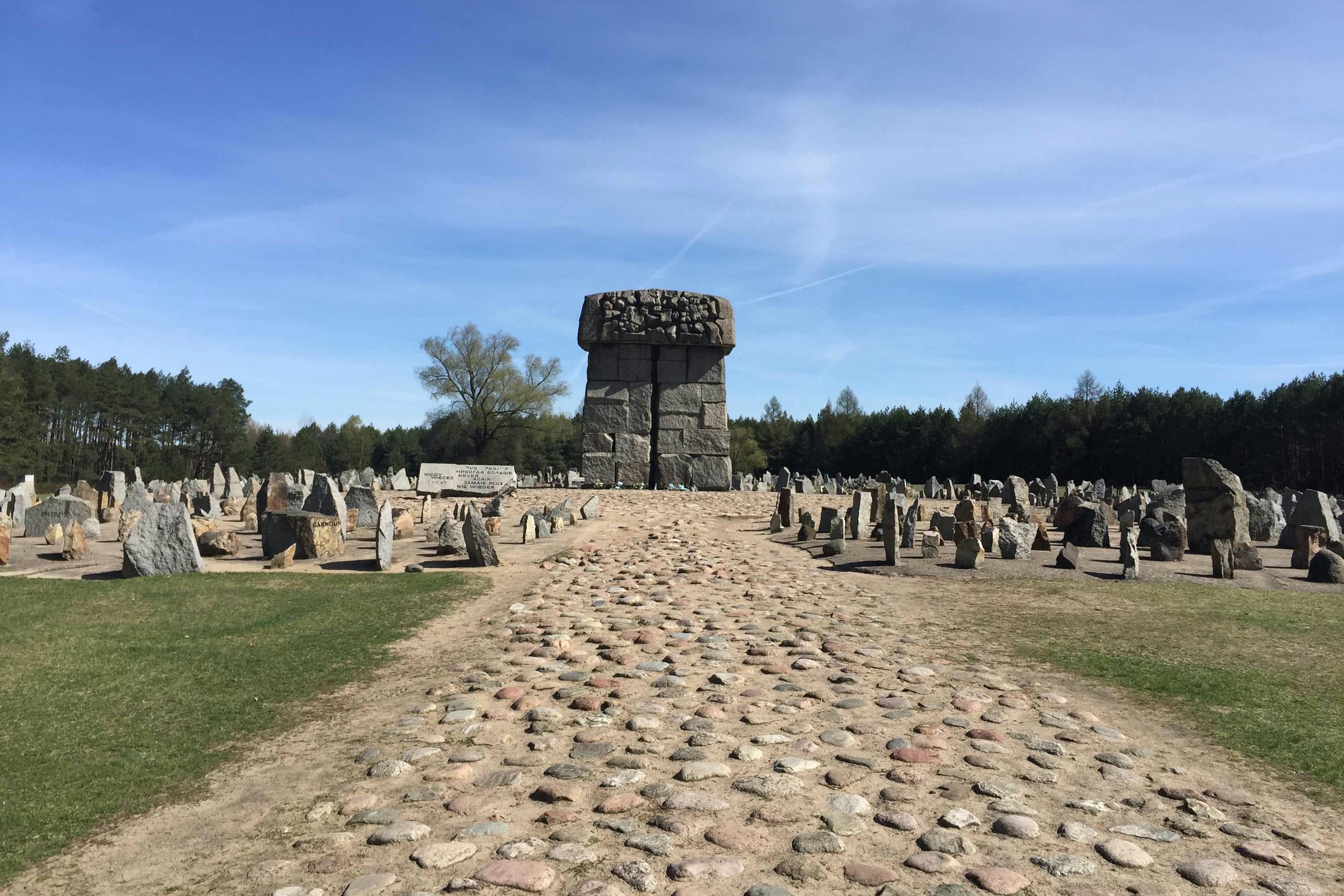
In 1964 the Polish authorities established a stone memorial site, built on the camp ground. A stone pathway leads up to a stone gate on the spot where it is believed that the entrance to the camp stood. The story of the camp is told in several languages on stone plaques. A series of flat stones indicate the railway line that led into the camp and stone pillars mark the camp boundaries. A stone monument at the left of the path which leads to the center of the monument shows the victims last walk – “the Pipe”, the “Shlauch” – of the Jews to the gas chambers. To the right of the path, memorialized in stone, are the names of the places from which the Jews arrived in the transports.

At the heart of the memorial site stands an enormous stone gate that resembles a raised sarcophagus. On one side, the martyrs’ story is told and on the other side there is a menorah, symbol of the Jewish people. Black granite stones symbolize the pits where the victims’ bodies were burned. Six million Jews died in the Holocaust, obliterating the Jewish way of life that had existed for hundreds of years in Europe. Seventeen thousand stones are strewn around the area to symbolize the final resting place of the Jewish world that perished.
Nazi “Death Valley” Prelude to the Holocaust

In the opening months of the Second World War, Nazi forces executed over 30-35,000 civilians in the Pomeranian region of Poland – the first large scale atrocity in the country. Despite efforts to hide these crimes, research is shedding light on these massacres over 80 years later.

Archaeologists working in ‘Death Valley,’ one of at least 400 locations these massacres took place, have uncovered a mass grave and hundreds of artifacts such as victims’ possessions.

Lead author Dr Dawid Kobiałka, from the Polish Academy of Sciences, and the other researchers also explored archival material worked with the local community to gain more insight into these events.

“As a kid living near Death Valley, I used to play with my friends there,” said Dr Kobiałka, “Three decades later, I discovered a mass grave of approximately 500 Poles there.”

These war crimes, which gave Death Valley its name, were part of a coordinated campaign in which the Nazis executed 12,000 civilians in the area around the village of Piasńica from late 1939 to early 1940. Many historians consider this a prelude to the later Nazi genocides.

The Nazis returned to Death Valley, which is located near Chojnice, in 1945 to hide their crimes. Shortly after the war, the remains of 168 of the victims were uncovered at the site. However, it was commonly known that not all mass graves from 1939 were found and exhumed, and the grave of those killed in 1945 was not exhumed either.

Sources: Antiquity Journal

Hammurabi

In around 2000 bce, the Amorites (Westerners), a semi-nomadic people from Syria, swept across Mesopotamia, replacing local rulers with Amorite sheikh dynasties in many of the city-states. By the early 18th century bce, the three most powerful Amorite kings were pre-eminent Shamshi-Adad in the north, Rim-Sin in Larsa in the south, and Hammurabi in Babylon in the center. Over the course of his long reign, Hammurabi consolidated all of southern Mesopotamia into his kingdom and eventually extended his power as far up the Tigris as Nineveh, and as far up the Euphrates as Tuttul, on the junction with the river Balikh. He personally supervised the construction of many temples and other buildings.

The prelude to his code, a tribute to Hammurabi, and a long historical record of his conquests, boasts that his leadership was divinely sanctioned by the gods who passed control of humanity to Marduk (deity of Babylon), and so to its king. It also reveals he saw his role as the guarantor of a just and orderly society.

Angela Davis

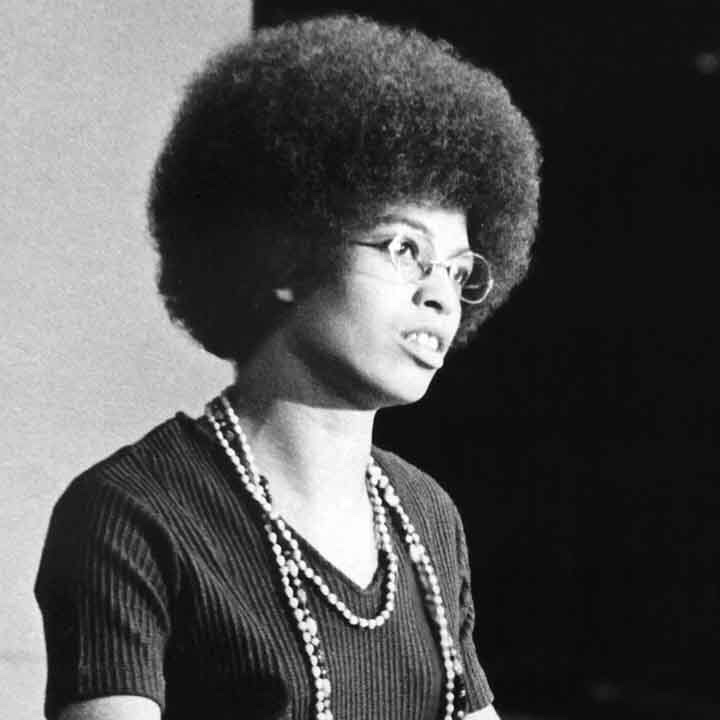
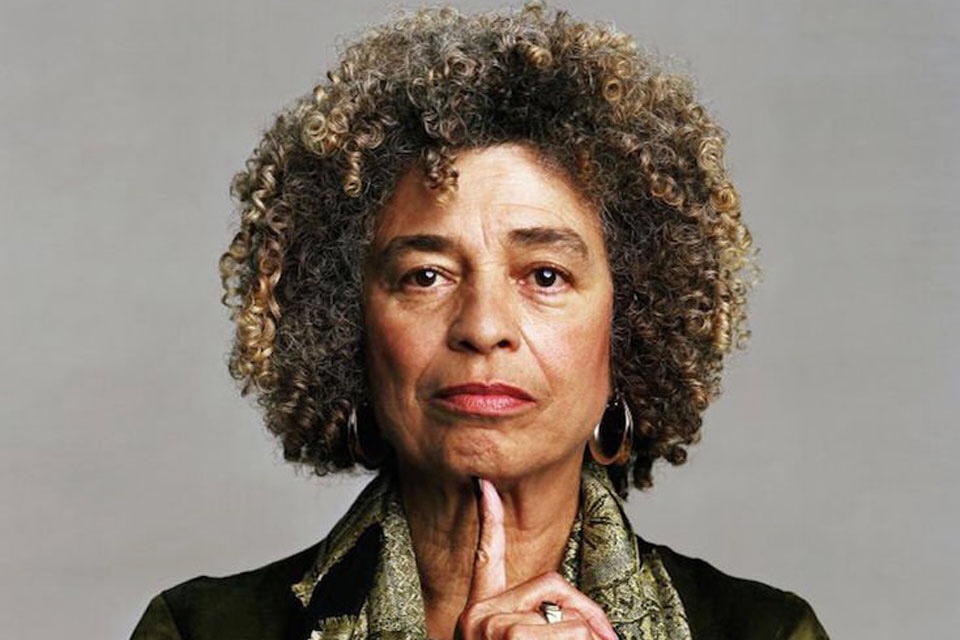
As an activist, scholar, and professor, Angela Davis rose to prominence in the 1960s for her work in the black civil rights movement, especially in the Black Panther Party and the black communist group Che-Lumumba Club. Davis’s activism was driven by her background. She was born in Birmingham, Alabama, in 1944, grew up in an area exposed to anti-black bombings during the 1950s, and attended a segregated elementary school.

Davis was fired from her teaching post at University of California, Los Angeles (UCLA) in 1970 for her links to communism, but won her job back. That same year, she was implicated in the supply of guns to a black prisoner who died trying to escape. She was released from prison in 1972, and continues to lecture on women’s rights, race, and criminal justice.

Key works
1974 Angela Davis: An Autobiography
1983 Women, Race, & Class
1989 Women, Culture, & Politics

Sources: The Feminism Book (DK)

The Match Girls’ Strike

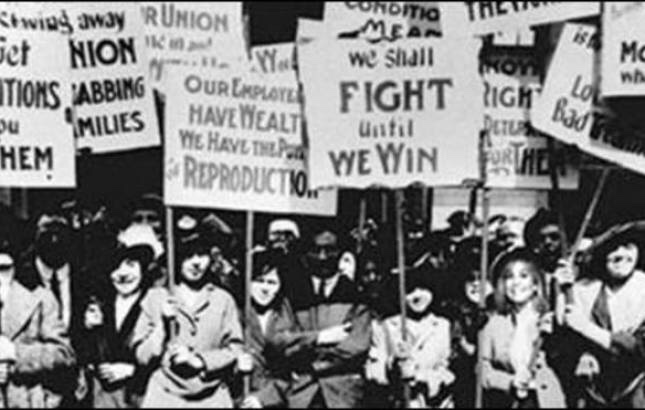
In July 1888, 1,400 women and girls walked out of the Bryant & May match factory in London, in what came to be known as the Match Girls’ Strike. British socialist Annie Besant used her newspaper, The Link, to publicize the 14-hour workday, toxic materials, and the unfair difference between shareholder profits and the poverty wages paid to employees.

Workers complained of fines that cut into their wages, and of unfair dismissals. They also suffered breathing difficulties and other health problems because of the phosphorus fumes in the factory.

Bryant & May attempted to crack down on public criticism by making their workers sign a written denial of any ill-treatment. This, combined with another unfair dismissal, set off the strike. The public sided with the workers, and Bryant & May relented. The success of the match girls inspired a wave of similar strikes in the UK and boosted the rise of trade unionism.”

Sources : The Feminism Book (DK)

La Voisin

In a darkened room stands a 40-year-old woman named Catherine Monvoisin. Her figure is lit only by torches held by the faceless men standing in front of her, men who are sentencing her to death by fire. It is the 17th century, where such a death sentence is an unusual ending to someone’s life. But Catherine is an unusual woman.

Catherine was the wife of a silk merchant and jeweler and lived a life of comfort in Parisian Society. She was a philanthropist, entrepreneur, fortune teller, mother, and art lover. But she was also a professional poisoner, alleged provider of sorceries, and an alleged witch who plunged the French aristocracy into turmoil, and even tried to kill a king.

She was more famously known as “La Voisin” and was a central figure in “L’affaire des Poisons” or the “Affair of the Poisons”. Catherine controlled a wide network of fortune-tellers from her position in Paris society. She provided poison, abortion, aphrodisiacs, arranged black masses, and even claimed to offer magical services.

She was so famous that she even drew clients from the aristocracy, who could afford to pay her high prices which funded her lavish lifestyle. Her organization, in performing commissioned black magic and murder by poison, took thousands of lives.

The claimed alchemist Adam Lesage, one of the lovers of Catherine, told of her murdering her own husband, an accusation she denied. It is believed that throughout her life, she might have been responsible for the deaths of around 2,500 infants due to her poisoning. However, throughout this time she remained a high-profile socialite, and her sheer charm made no one suspect her.

Sources: Bipin Dimri

Margaret Sanger

Birth control activist Margaret Sanger was born in New York in 1879, the sixth of 11 children in an Irish Catholic family. Her mother’s death at the age of 49, after 18 pregnancies, had a profound influence on Sanger. She qualified as an obstetrics nurse, which confirmed her views on the impact multiple pregnancies had on women, especially the poor. Involved in radical politics, she joined the New York Socialist Party.

In 1916, Sanger opened a short-lived birth control clinic, and in 1921, she established the American Birth Control League. She went on to organize the first World Population Conference in Geneva, Switzerland, and in 1953 became president of the International Planned Parenthood Federation. Sanger died of heart failure in Tucson, Arizona, in 1966.

Key works:
1914 Family Limitation
1916 What Every Girl Should Know
1931 My Fight for Birth Control

International Women’s Day Origins

Celebrated annually on March 8, International Women’s Day is traced back to the US in 1907, when more than 15,000 female textile workers marched through New York City, demanding better working conditions and voting rights. In 1909, the Socialist Party of America declared a National Women’s Day, celebrated until 1913 on the last Sunday of February.

In 1910, about 100 women from 17 countries attended the Second International Conference of Women in Copenhagen, Denmark, at which Clara Zetkin proposed the establishment of International Women’s Day, on which women would highlight women’s issues. The following year, more than one million women and men attended International Women’s Day rallies worldwide. In Russia in 1917, women marked the day with a four-day strike for “peace and bread” that was a key event in the lead up to Russia’s October Revolution that year.

Sources: The Feminism Book (DK)