
This is an excellent short video exploring what psychosis is like and the different stages. I highly recommend watching it if you have a psychotic disorder such as Schizophrenia and Schizoaffective disorder or if you have a friend, family member or in a relationship with someone susceptible. Sometimes or often times you might recognize the signs before the person slipping into psychosis. Catching it early may prevent hospitalization being needed.
Category: My Schiz Life
Shadows

Shadows
I’ve lived my life in the margins, a life in the shadows,
Never have I looked up bathed in the sunlight,
It hasn’t been that bad it’s where I always belonged.
From the shadows the voices scream inside my head,
Voices nobody else can hear, voices tormenting me,
Cries of anguish, cries taunting me, echoing in my mind.
The shadow people cloaked in darkness, eyeless, faceless,
Pursuing me through my dreams, through my fractured reality,
They are sent to torment me, through the void to this moment.
Project Semicolon


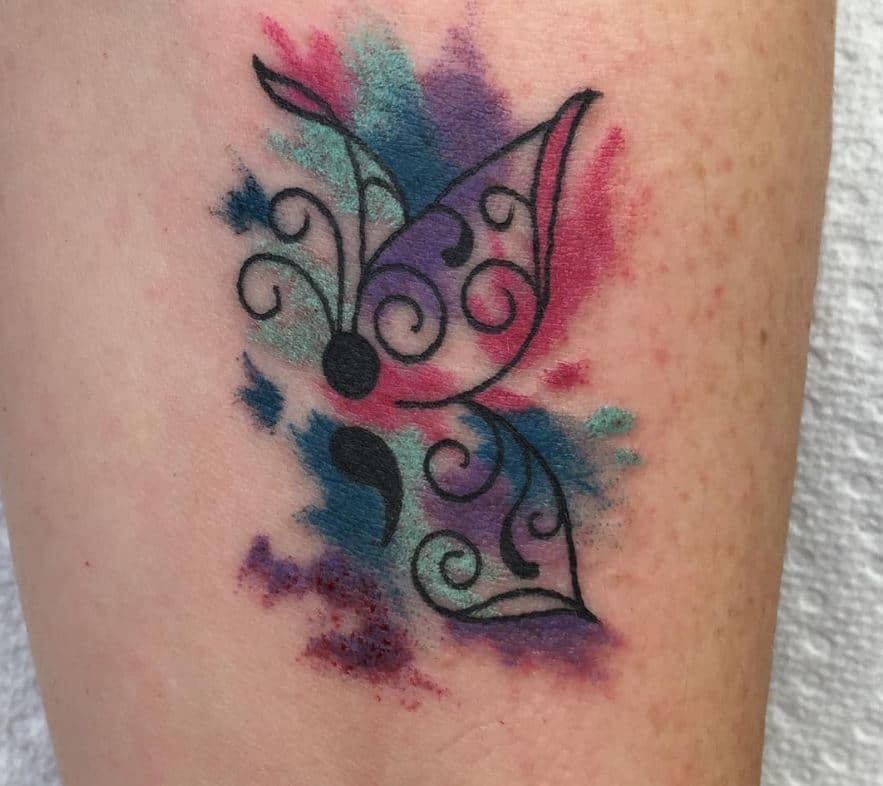

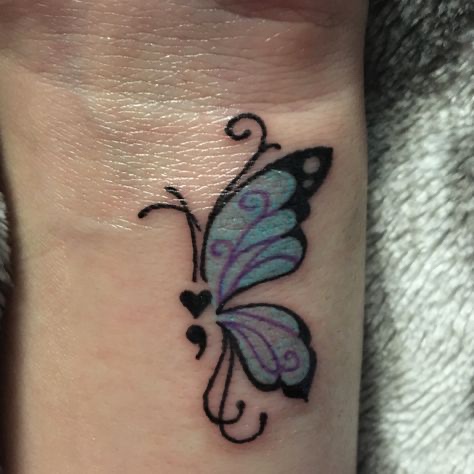
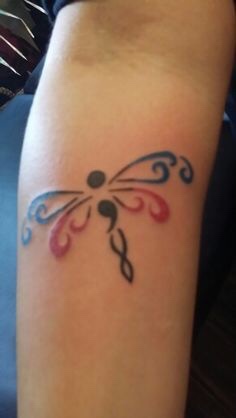


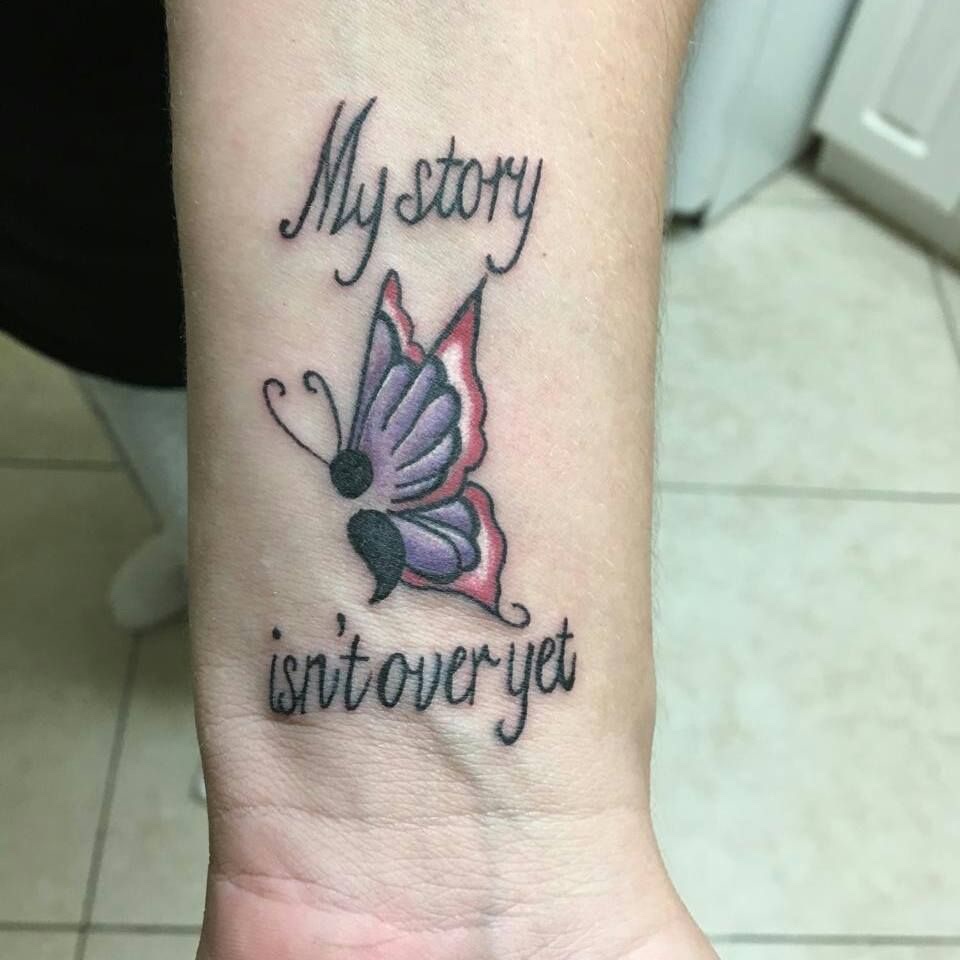


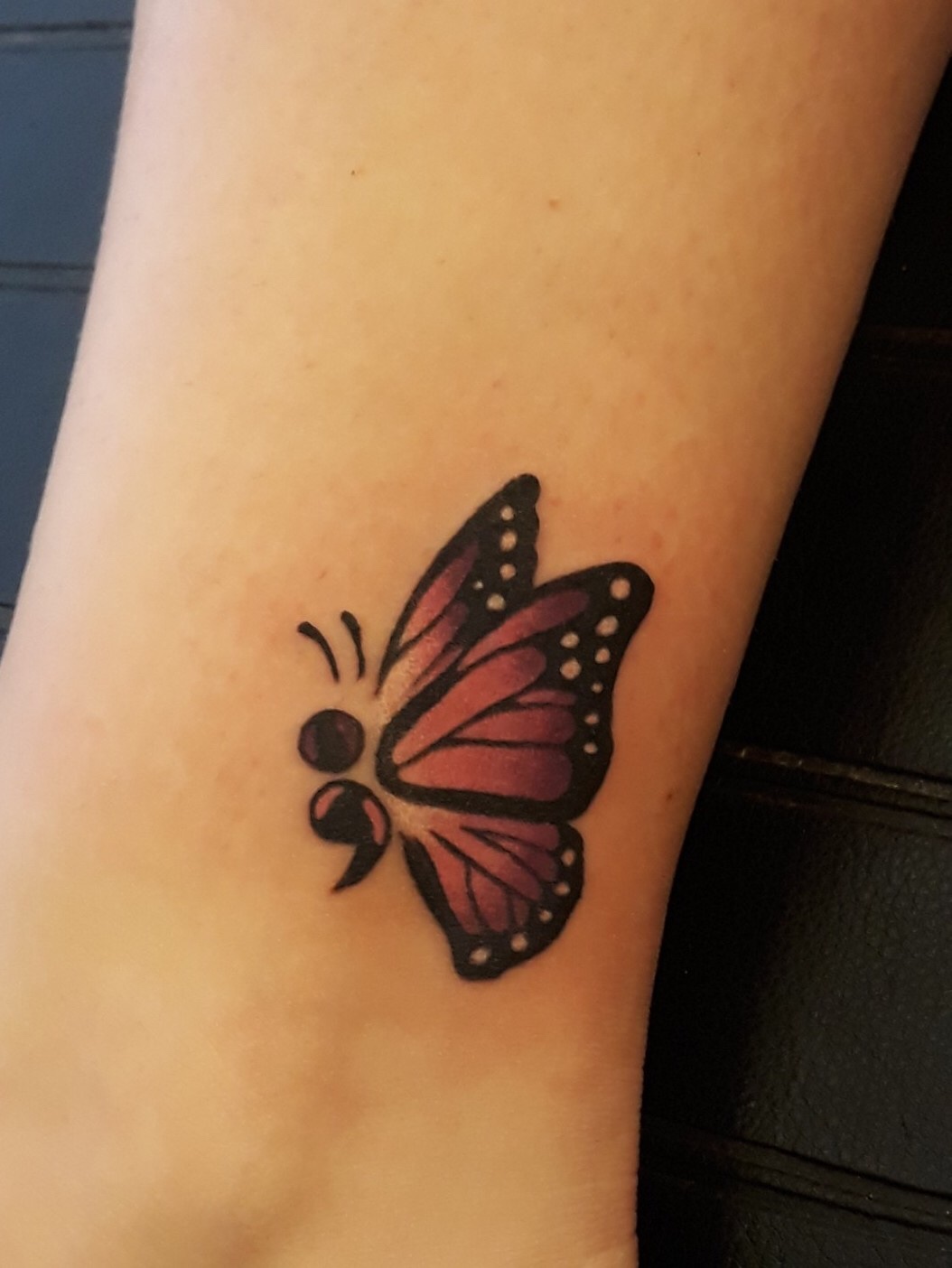
I love Project Semicolon and these Semicolon Butterfly tattoos are amazingly beautiful:
A growing movement is using the semicolon, and in particular a semicolon tattoo, as a symbol of hope for people with mental illness. The Project Semicolon describes the meaning behind the symbol:
“A semicolon represents a sentence the author could have ended, but chose not to. The sentence is your life and the author is you.”
It represents a choice to live on especially for those who may have considered ending their lives.
The project has inspired many people to tattoo or draw the symbol in creative ways to symbolize their own struggles or to honor or support loved ones who have struggled. The project encourages people to use social media to promote the message and continue the conversation, sharing pictures and stories of hope and strength to help end the stigma of mental illness and encourage those who are struggling feel safe and comfortable enough to reach out for help.
(Mis)Representations of Mental Illness in the Media (Film & TV)

When mentally ill people are constantly villainized, stigmatized, and stereotyped in the media, then society inevitably buys into that false image that has been painted. The media has irrefutably contributed to society’s negative attitude towards people with mental illnesses. This negative attitude has significantly built up the stigma around mentally ill people today that makes it so hard to discuss our experiences and feelings.
“The worst stereotypes come out in such depictions: mentally ill individuals as incompetent, dangerous, slovenly, undeserving,” says Stephen Hinshaw, a professor of psychology at the University of California–Berkeley. “The portrayals serve to distance ‘them’ from the rest of ‘us.’”
~ “Mental illness” is used as a catch-all phrase to describe someone’s condition, as opposed to specific medical terminologies such as “schizophrenia” or “anxiety disorder.” And even then, little variation is shown from patient to patient; one movie portrayal of bipolar disorder tends to resemble another. There’s no discussion that each disease is different in each person, because each person is unique. In real life, mental illness shows up differently in everybody. The media does not represent the complexity of mental illness in general. There’s this sense that it’s just a one-name-fits-everybody, or one-title-fits-everybody.
~ People with mental illnesses are childish and silly. Many movies and TV shows – for example, “Me, Myself and Irene,” starring Jim Carrey as a patient with dissociative identity disorder, or “Monk,” the show about a detective with obsessive-compulsive disorder – make light of mental illnesses. They portray otherwise serious psychological conditions as mere quirks, or those who have them as silly, funny and childlike. These portrayals don’t convey the way most people with serious mental illnesses are in pain. In reality, they hurt. They’re struggling.
~ The idea that love, particularly in a romantic sense, can easily “cure” mental illnesses. Mental illness is portrayed as something that can be easily resolved by simply finding the right person. (Silver Linings Playbook, It’s Kind of a Funny Story)
~ The idea that psychotic people are inherently evil. While it is a fact that some violent crimes are carried out by people with psychotic illness, this is a completely inaccurate generalization. In fact, people with mental illnesses are more likely to be the victims of violent crimes than the perpetrators. Characters on TV who were identified through behavior or label as having a mental illness were 10 times more likely than other TV characters to commit a violent crime – and between 10 to 20 times more likely to commit a violent crime than someone with a mental illness would be in real life. (Split, Silence of the Lambs)
~ The general romanticization of mental illnesses. Bringing attention to mental illnesses is one thing, but glamorizing them and using them to spice up a story is another.
~ People with mental illnesses can’t recover. “Recovery is seldom shown” in the media. When people [are shown seeking] therapy, when they go to psychiatric hospitals – rarely do they get better. If they do get better it’s enough that they’re stabilized, but not enough so that they’re integrated with the world, and have friends and jobs. The resulting message is that individuals with mental illnesses have no hope for a “normal” life. The reality is that this isn’t true: Experts say not only do patients often recover from psychiatric illnesses, but they can live healthy lives with the help of medications, therapy and support networks.
~ Psychiatric hospitals cause more harm than good. Many films and television shows continue to portray psychiatric hospitals as bereft of comfort or care – empty corridors, bare walls and intimidating wings filled with manipulative doctors whose treatments cause more harm than good. Patients are often shown as committed against their will, or psychotic and out-of-control. While all medical facilities differ in quality and care, today’s psychiatric wards and treatments are different – even if the public’s perception of them isn’t. Despite the common television or movie theme of a patient being sent to a psychiatric hospital against his or her will, that’s often not the case. In reality, a great number of people elect to go to psychiatric wards dispelling the notion that most patients are involuntarily committed. Laws differ from state to state, but on average it’s difficult to send patients to a psychiatric ward against their will.
Self-Imprisoned Into This Cell of Orchestrated Ignorance

Self-imprisoned into this cell of orchestrated ignorance,
I eternally stare into the mirror upon the wall,
At the chance to see a reflection,
Of an isolated world from our preconceived notions.
All that forms the images before my eyes,
Is the deep, dark, backward memories of my life,
Carrying me back to the present moment,
Enabling me to analyze what I have evolved into.
My back braced cold against the table,
They place the ether mask across my face,
The fog carries itself into the corners of my mind,
Allowing me to be propelled among the world.
I follow the dark sky, by the slight moonlight,
Placing each foot in the trail I’ve created,
Careful not to touch too much emotion,
Careful not to experience too much.
Let us go past the deserted streets,
Fading memories long since fallen into dust,
Let us cross the fields of distant thoughts,
Releasing the manacles of time to manipulation.
Into our world’s forgotten souls I search,
Waiting cautiously for each moment of experience,
Tearing off the blindfolds of our innocence,
Tearing down the walls of our ignorance.
Night Terrors

Struggling to sleep – the night is an all too familiar refrain,
The ceaseless conversations overwhelming my mind,
His voice always piercing, always breaking through the din,
The laugh always mocking who I was, who I’ve become,
That face ever taunting, ever gloating, always judging,
I blink imploring for some release, some distraction,
Alas the eternal vision persists, mocking my sanity,
The eyes glaring, judging, satisfied at what I’ve become,
“Shut up!” The laugh, never allowing me a moment of solitude,
Clenching my eyes the eternal vision persists,
Failure, pathetic, weak – the labels swirl in my unquiet mind.
Lurching my body upright I stare through the blackness,
My breathing is short, shallow and tight in my chest,
My hands trembling, my eyes consumed with horror,
Swallowing hard I sense the ever present knife,
This time not a razor-edge between life and death,
But a choice between life and his domination of my sanity,
Why do I let him control my decisions, make me so weak,
How is it I make choices simply to defy the bastard,
Why am I overwhelmed with guilt and shame,
Every time I ask for help, set foot in the therapist’s office,
How is it that I believe he has won over me.
Mindfulness And Mental Health: Introducing DBT

Mindfulness is no longer just for practitioners of Zen and Buddhism but has moved into the mainstream Mental Health counseling. It has become one of the primary techniques employed among many therapists and coupled with meditation has shown tremendous amounts of improvements in otherwise non-responsive patients. As science furthers more and more we are seeing them recognize the benefits of Zen in daily practice. As NAMI (National Alliance on Mental Illness) describes it, “While the combination of therapy and medication is crucial to recovery, the addition of self-awareness tools and skills can also be beneficial. Whether you are just beginning your recovery or are further along on your journey, the holistic practices can be an excellent complement to therapy and medication.”
While many treatment programs employ the use of mindfulness, I will focus on DBT (Dialectical Behavioral Therapy) in my analysis. So what is DBT? “Dialectical Behavior Therapy (DBT), is a comprehensive cognitive-behavioral treatment that was originally developed to treat chronically suicidal individuals suffering from borderline personality disorder (BPD). DBT has been found especially effective for those with suicidal and other multiply occurring severely dysfunctional behaviors. Research has shown DBT to be effective in reducing suicidal behavior, psychiatric hospitalization, treatment dropout, substance abuse, anger, and interpersonal difficulties,” (behavioraltech.org). So what exactly does all that mean? It is a non-judgmental way of the patient accepting that they have a problem with how they think, and rather than judge it, they can make changes to make their thinking more balanced using mindfulness as one of the primary techniques.
What is mindfulness within this context? The best and simplest definition I have come across is, “doing one thing at a time, in the present moment, with your full attention, and with acceptance,” (DBT Made Simple). This can be further broken down into two parts for the patient. First, awareness and focusing on the present moment. The second part is acceptance, and this is the part that seems to be overlooked. This requires not judging what you are doing mindfully. A large percentage of patients respond well to this primarily, in my opinion, because they are taking control of their mind. Most patients, as is the case with most people in general spend far too much time in the past reliving negative things and mindfulness is a way to put a stop sign up to this harmful cycle.
How is mindfulness employed? There are a multitude of ways this is employed in your everyday life, but I will briefly cover seven of them:
1. Counting breaths. Count your breaths up to ten. One on the inhale and two on the exhale and so on. When you find your mind has wandered, simply return to counting your breath without judgment.
2. Observing sounds. Sitting silently focus your mind on any sounds which you hear: the sound of your breath, the traffic outside, the air-conditioner, etc. When you catch your mind wandering, take note of it without judgment and return to observing sounds.
3. Observing an object. Pick an object, any object. Examine the object with all of your five senses. Touch it. Smell it. Take note of any sound it makes when you move it. When you mind wanders, simply bring your attention back to the object.
4. Observing your thoughts in a cloud. Also could be called labeling your thoughts. You imagine yourself lying in a field of grass looking up at the sky. In each cloud is a thought and as it floats by you label what kind of thought it is without judging yourself for having that thought. For instance if you think this is a stupid exercise, that would be an anger thought. If you think how will I pay my house payment next month, that would be a worry thought.
5. Focusing on a thought. Pick a meaningful thought or short sentence and focus on the thought as you breathe. For instance if you think wise as you breathe in and think mind as you breathe out. When your mind wanders return to your thought without judging yourself.
6. Being the gatekeeper to your mind. This is more simply observing your thoughts. As a gatekeeper would watch people coming through a gate, you will simply experience and observe each thought as it passes over you without judging it. Experience thoughts and emotions as they come to you, do not try to block them. When your mind wanders or you feel yourself trying to stop thoughts simply return to the practice of observing them without judging the thoughts or yourself.
7. Being in your body. Quietly sitting, focus on the different sensations you experience in your body. For example, the feel of your bottom on the chair or your arms against the armrests. Take notice of any emotions you might be feeling, such as worry over a presentation you have at work next week. When your mind wanders simply return your thoughts to your body without judgment.
Sexual Assault in the United States

A few United States sexual assault statistics:
*** Forms of sexual violence include: Rape or sexual assault, Child sexual assault and incest, Sexual assault by a person’s spouse or partner, Unwanted sexual contact/touching, Sexual harassment, Sexual exploitation and trafficking, Exposing one’s genitals or naked body to other(s) without consent, Masturbating in public, Watching someone engage in private acts without their knowledge or permission, Nonconsensual image sharing ***
~ Rape is the most under-reported crime; 63% of sexual assaults are not reported to police.
~ The prevalence of false reporting is low between 2% and 10%. For example, a study of eight U.S. communities, which included 2,059 cases of sexual assault, found a 7.1% rate of false reports. A study of 136 sexual assault cases in Boston found a 5.9% rate of false reports. Researchers studied 812 reports of sexual assault from 2000-2003 and found a 2.1% rate of false reports.
~ One in five women and one in 71 men will be raped at some point in their lives.
~ In the U.S., one in three women and one in six men experienced some form of contact sexual violence in their lifetime.
~ One in four girls and one in six boys will be sexually abused before they turn 18 years old.
~ 20% – 25% of college women and 15% of college men are victims of forced sex during their time in college.
~ More than 90% of sexual assault victims on college campuses do not report the assault.
~ 27% of college women have experienced some form of unwanted sexual contact.
~ Nearly two thirds of college students experience sexual harassment.
#SexualAssault #Rape #SexualHarassment #NoMeanaNo
I Stare Into the Darkness

I stare into the darkness of my room,
of my mind.
Thoughts and images penetrate my consciousness,
moments, images, memories of the night I just lived.
My skin burns,
as my heart races buried within my chest.
What is this sensation, this feeling,
which consumes me?
Sleep, I must sleep,
things will make sense in the morning.
A scent, a whisper, a touch,
attempt to devour me.
My mind has become flooded,
drowning in moments from the past,
the present,
the possibilities that lie before me.
I hear the vehicles pass my house,
why are they so loud tonight?
The cat cries in the next room,
why can’t silence be mine, peace be mine.
I awake in a cold sweat,
my mind hasn’t been quieted.
I scratch for a semblance of sanity,
as I futilely attempt to sleep.
Enough, I cry out,
my eyes clenched shut.
The visions of his hands around my throat,
permeate my mind.
The tender touch of her cheek brushing mine,
supersedes my immortal nightmare.
A sigh in the darkness of my room,
and I am back.
Poetic Forms I Employ

There are a multitude of poetic forms that gave been used through the ages from a Shakespearian Sonnet to a Haiku to my favorite a Sestina. Definitions provided here adapted from poetryfoundation.org website. Here are a few of the ones I employ on a regular basis:
Ballad – A popular narrative song passed down orally. In the English tradition, it usually follows a form of rhymed (abcb) quatrains alternating four-stress and three-stress lines. Folk (or traditional) ballads are anonymous and recount tragic, comic, or heroic stories with emphasis on a central dramatic event; examples include “Barbara Allen” and “John Henry.” Beginning in the Renaissance, poets have adapted the conventions of the folk ballad for their own original compositions. Examples of this “literary” ballad form include John Keats’s “La Belle Dame sans Merci,” Thomas Hardy’s “During Wind and Rain,” and Edgar Allan Poe’s “Annabel Lee.”
Ballade – An Old French verse form that usually consists of three eight-line stanzas and a four-line envoy, with a rhyme scheme of ababbcbc bcbc. The last line of the first stanza is repeated at the end of subsequent stanzas and the envoy. An example is Hilaire Belloc’s “Ballade of Modest Confession”.
Free Verse – Nonmetrical, nonrhyming lines that closely follow the natural rhythms of speech. A regular pattern of sound or rhythm may emerge in free-verse lines, but the poet does not adhere to a metrical plan in their composition. Matthew Arnold and Walt Whitman explored the possibilities of nonmetrical poetry in the 19th century. Since the early 20th century, the majority of published lyric poetry has been written in free verse. Examples include the work of William Carlos Williams, T.S. Eliot, Ezra Pound, and H.D.
Haiku – A Japanese verse form of three unrhyming lines in five, seven, and five syllables. It creates a single, memorable image. The Imagist poets of the early 20th century, including Ezra Pound and H.D., showed appreciation for the form’s linguistic and sensory economy; Pound’s “In a Station of the Metro” embodies the spirit of haiku.
Limerick – A fixed light-verse form of five generally anapestic lines rhyming AABBA. Edward Lear, who popularized the form, fused the third and fourth lines into a single line with internal rhyme. Limericks are traditionally bawdy or just irreveren. Examples include “A Young Lady of Lynn” or Lear’s “There was an Old Man with a Beard.”
Sestina – A complex French verse form, usually unrhymed, consisting of six stanzas of six lines each and a three-line envoy. The end words of the first stanza are repeated in a different order as end words in each of the subsequent five stanzas; the closing envoy contains all six words, two per line, placed in the middle and at the end of the three lines. The patterns of word repetition are as follows, with each number representing the final word of a line, and each row of numbers representing a stanza:
1 2 3 4 5 6
6 1 5 2 4 3
3 6 4 1 2 5
5 3 2 6 1 4
4 5 1 3 6 2
2 4 6 5 3 1
(6 2) (1 4) (5 3)
Sonnet – A 14-line poem with a variable rhyme scheme originating in Italy and brought to England by Sir Thomas Wyatt and Henry Howard, earl of Surrey in the 16th century. Literally a “little song,” the sonnet traditionally reflects upon a single sentiment, with a clarification or “turn” of thought in its concluding lines.
Petrarchan sonnet, perfected by the Italian poet Petrarch, divides the 14 lines into two sections: an eight-line stanza (octave) rhyming ABBAABBA, and a six-line stanza (sestet) rhyming CDCDCD or CDEEDE. John Milton’s “When I Consider How my Light Is Spent” and Elizabeth Barrett Browning’s “How Do I Love Thee” employ this form.
Italian sonnet is an English variation on the traditional Petrarchan version. The octave’s rhyme scheme is preserved, but the sestet rhymes CDDCEE. Thomas Wyatt’s “Whoso List to Hunt, I Know Where Is an Hind” and John Donne’s “If Poisonous Minerals, and If That Tree.”
English (or Shakespearean) sonnet, which condenses the 14 lines into one stanza of three quatrains and a concluding couplet, with a rhyme scheme of ABABCDCDEFEFGG (though poets have frequently varied this scheme) George Herbert’s “Love (II),” Claude McKay’s “America,” and Molly Peacock’s “Altruism” are English sonnets.
Spenserian sonnet is a 14-line poem developed by Edmund Spenser in his Amoretti, that varies the English form by interlocking the three quatrains (ABAB BCBC CDCD EE).
Villanelle – A French verse form consisting of five three-line stanzas and a final quatrain, with the first and third lines of the first stanza repeating alternately in the following stanzas. These two refrain lines form the final couplet in the quatrain. Example “Do Not Go Gentle into That Good Night” by Dylan Thomas, Elizabeth Bishop’s “One Art,” and Edwin Arlington Robinson’s “The House on the Hill.”
 Mark Bere Peterson’s Counterculture, Urban Legends, Paganism & Witchcraft