Human Driven Climate Change

6899765F-42EE-4EF4-9ABD-1ED5493C308E.jpeg

There is quite possibly not a more contentious debate going on in America than global warming and its causes. The science is clear with 97% (based on 11,944 abstracts of research papers) of climate scientists worldwide declaring that human influence is the dominant force driving global warming. The consensus position is articulated by the Intergovernmental Panel on Climate Change (IPCC) statement that “human influence has been the dominant cause of the observed warming since the mid-20th century”. The National Academies of Science from 80 countries have issued statements endorsing the consensus position. Nevertheless, the existence of the consensus continues to be questioned.

A dumbed down (i.e. No math) summary of the theory of the Greenhouse effect:

DCCE7B9C-37BB-426C-8A80-A4B67F3FEE18

Energy from the Sun that makes its way to Earth can have trouble finding its way back out to space. The greenhouse effect causes some of this energy to be waylaid in the atmosphere, absorbed and released by greenhouse gases.

8824F1A4-EFE2-44D4-92B2-82EEF2377A0E

Without the greenhouse effect, Earth’s temperature would be below freezing. It is, in part, a natural process. However, Earth’s greenhouse effect is getting stronger as we add greenhouse gases to the atmosphere. That’s is warming the climate of our planet.

Solar energy absorbed at Earth’s surface is radiated back into the atmosphere as heat. As the heat makes its way through the atmosphere and back out to space, greenhouse gases absorb much of it. Why do greenhouse gases absorb heat? Greenhouse gases are more complex than other gas molecules in the atmosphere, with a structure that can absorb heat. They radiate the heat back to the Earth’s surface, to another greenhouse gas molecule, or out to space.

Even though only a tiny amount of the gases in Earth’s atmosphere are greenhouse gases, they have a huge effect on climate. Sometime during this century, the amount of the greenhouse gas carbon dioxide in the atmosphere is expected to double. Other greenhouse gases like methane and nitrous oxide are increasing as well. The quantity of greenhouse gases is increasing as fossil fuels are burned, releasing the gases and other air pollutants into the atmosphere. Greenhouse gases also make their way to the atmosphere from other sources. Farm animals, for example, release methane gas as they digest food. As cement is made from limestone, it releases carbon dioxide.

With more greenhouse gases in the air, heat passing through on its way out of the atmosphere is more likely to be stopped. The added greenhouse gases absorb the heat. They then radiate this heat. Some of the heat will head away from the Earth, some of it will be absorbed by another greenhouse gas molecule, and some of it will wind up back at the planet’s surface again. With more greenhouse gases, heat will stick around, warming the planet.

What can be done?

“Humans have caused major climate changes to happen already, and we have set in motion more changes still. Even if we stopped emitting greenhouse gases today, global warming would continue to happen for at least several more decades if not centuries. That’s because it takes a while for the planet (for example, the oceans) to respond, and because carbon dioxide – the predominant heat-trapping gas – lingers in the atmosphere for hundreds of years. There is a time lag between what we do and when we feel it.

In the absence of major action to reduce emissions, global temperature is on track to rise by an average of 6 °C (10.8 °F), according to the latest estimates. Some scientists argue a “global disaster” is already unfolding at the poles of the planet; the Arctic, for example, may be ice-free in the summer within just a few years. Yet other experts are concerned about Earth passing one or more “tipping points” – abrupt, perhaps irreversible changes that tip our climate into a new state.

But it may not be too late to avoid or limit some of the worst effects of climate change. Responding to climate change will involve a two-tier approach: 1) “mitigation” – reducing the flow of greenhouse gases into the atmosphere; and 2) “adaptation” – learning to live with, and adapt to, the climate change that has already been set in motion. The key question is: what will our emissions of carbon dioxide and other pollutants be in the years to come? Recycling and driving more fuel-efficient cars are examples of important behavioral change that will help, but they will not be enough. Because climate change is a truly global, complex problem with economic, social, political and moral ramifications, the solution will require both a globally-coordinated response (such as international policies and agreements between countries, a push to cleaner forms of energy) and local efforts on the city- and regional-level (for example, public transport upgrades, energy efficiency improvements, sustainable city planning, etc.). It’s up to us what happens next.”

“Global Climate Change: Evidence.” NASA Global Climate Change and Global Warming: Vital Signs of the Planet. Jet Propulsion Laboratory / National Aeronautics and Space Administration, 15 June 2008. Web. 14 Jan. 2015. .

Nobel Prize in Chemistry 2020

The Nobel Prize—in Chemistry—went to Jennifer Doudna of UC Berekeley and Emmanuelle Charpentier at the Max Planck Institute for Infection Biology in Berlin.

The prize went for the CRISPR/Cas9 system of gene editing and was a tremendous accomplishment in biology and chemistry. It promises a lot, including curing human genetic disease.

Remember, Nobel Prizes in science are designed to reward those who made discoveries potentially helping humanity, not those who just made general scientific advances.

In the 120 years of Nobel prizes in medicine, physics and chemistry, prizes were awarded 599 times to men and 23 times to women.

“For too long, many many discoveries made by women have been underplayed and they have simply not been recognized. The under representation of women in science has been too clear.”

~ American Chemistry Society President Luis Echegoyen, a chemistry professor at the University of Texas El Paso.

Btw this is the first time two women have shared a science Nobel Prize. Go women in STEM!

#NobelPrize #Chemistry #WomenInSTEM #JenniferDoudna #EmmanuelleCharpentier

Scopes Trial Evolution Speech

“If today you can take a thing like evolution and make it a crime to teach it in the public school, tomorrow you can make it a crime to teach it in the private schools, and the next year you can make it a crime to teach it to the hustings or in the church. At the next session you may ban books and the newspapers. Soon you may set Catholic against Protestant and Protestant against Protestant, and try to foist your own religion upon the minds of men. If you can do one you can do the other. Ignorance and fanaticism is ever busy and needs feeding. Always it is feeding and gloating for more. Today it is the public school teachers, tomorrow the private. The next day the preachers and the lectures, the magazines, the books, the newspapers. After a while, your honor, it is the setting of man against man and creed against creed until with flying banners and beating drums we are marching backward to the glorious ages of the sixteenth century when bigots lighted fagots to burn the men who dared to bring any intelligence and enlightenment and culture to the human mind.”
~ Clarence Darrow, “Scopes Trial” courtroom speech, July 13, 1925

Mammal Extinction

Something to think about:

A few years ago, a team of researchers in Europe wanted to figure out the answer to a simple question: How long would it take for evolution to replace all the mammal species that have gone extinct in the time humans have walked the earth?

Some 300 mammal species have died off since the last ice age 130,000 years ago. Their answer: It would take 3 to 7 million years for evolution to generate 300 new species. Humans have been around for about 200,000 years. That’s a blink of an eye in terms of the age of the planet. Nevertheless, in that time, we have caused damage that may well last longer than our species itself.

#Evolution #Extinction

Skylab (1973-1979)

Skylab (1973-1979)

Skylab was the United States’ first space station that orbited the Earth from 1973 to 1979. The station was equipped with a solar observatory (Apollo Telescope Mount), workshop and scientific equipment for conducting experiments in space.

Launched on the retiring Saturn V rocket, the station saw three manned expeditions between 1973 and 1974. Thousands of photographs of Earth were taken, and the Earth Resources Experiment Package (EREP) viewed Earth with sensors that recorded data in the visible, infrared, and microwave spectral regions.

Plans to reuse Skylab for further space missions were delayed and eventually scrapped due to the development of the Space Shuttle Program.

On July 11th 1979, Skylab was de-orbited and fell back to Earth amid huge worldwide media attention.

#WorldSpaceWeek #Skylab

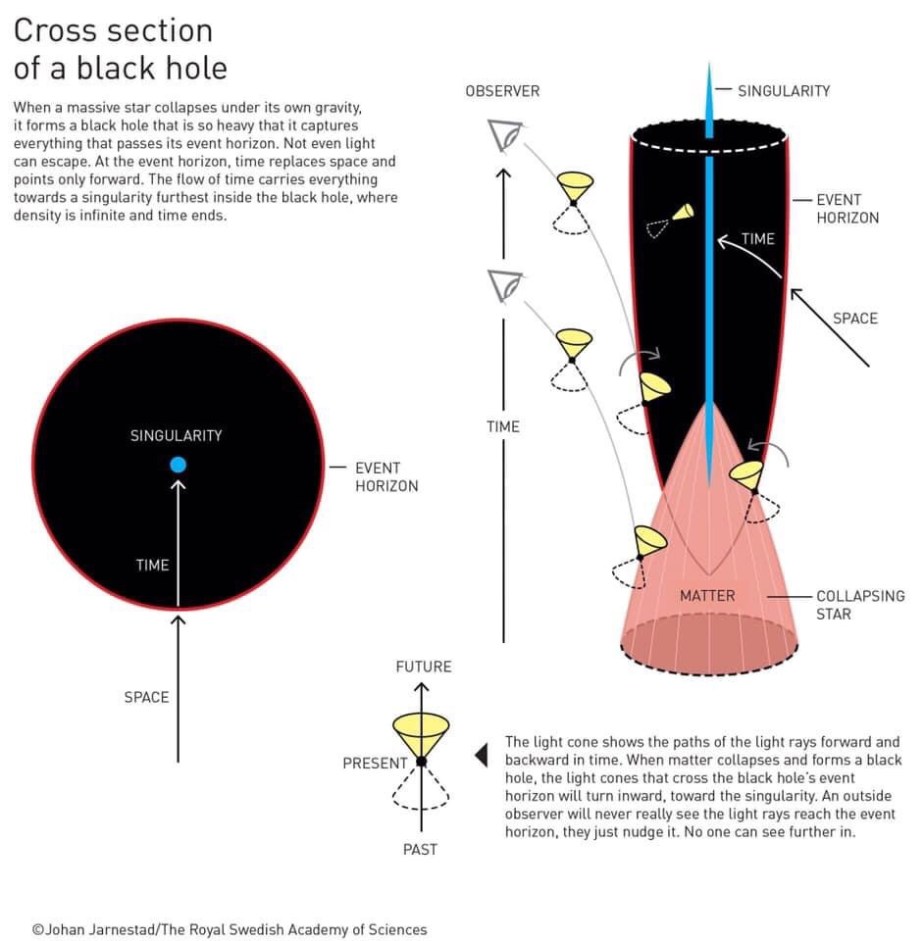
Nobel Prize in Physics 2020: Black Holes

Three Laureates share this year’s Nobel Prize in Physics for their discoveries about one of the most exotic phenomena in the universe, the black hole. Roger Penrose showed that the general theory of relativity leads to the formation of black holes. Reinhard Genzel and Andrea Ghez discovered that an invisible and extremely heavy object governs the orbits of stars at the centre of our galaxy. A supermassive black hole is the only currently known explanation.

Penrose got half the prize, with Genzel and Ghez sharing the other 50%.

#NobelPrize #BlackHoles #Physics

Einstein-Rosen Bridge

79E525DF-60AB-456F-993B-6E4F1CD2852809F05893-8974-46C9-8908-61E9726DA7B2

In 1935, Einstein and physicist Nathan Rosen used the theory of general relativity to elaborate on the idea, proposing the existence of “bridges” through space-time. These bridges connect two different points in space-time, theoretically creating a shortcut that could reduce travel time and distance. The shortcuts came to be called Einstein-Rosen bridges, or wormholes.

“The whole thing is very hypothetical at this point.  No one thinks we’re going to find a wormhole anytime soon.”

~ Stephen Hsu, Professor of theoretical physics at the University of Oregon

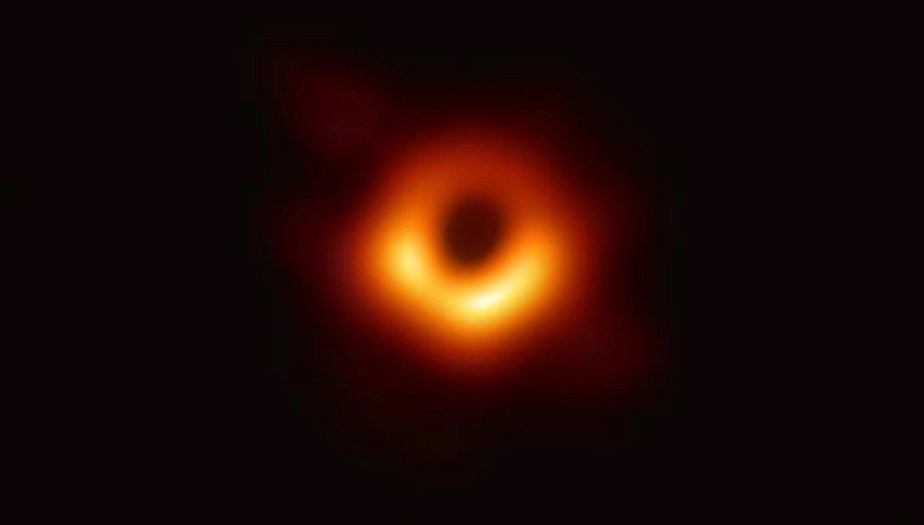
First Image of A Black Hole

We have seen what we thought was unseeable.  We have seen and taken a picture of a black hole.”

~ Sheperd Doeleman, director of the Event Horizon Telescope Collaboration.

What are black holes? 

Black holes are made up of huge amounts of matter squeezed into a small area, according to NASA, creating a massive gravitational field which draws in everything around it, including light. They also have a way of super-heating the material around them and warping spacetime. Material accumulates around black holes, is heated to billions of degrees and reaches nearly the speed of light. Light bends around the gravity of the black hole, which creates the photon ring seen in the image.

In April 2017, scientists used a global network of telescopes to see and capture the first-ever picture of a black hole, according to an announcement by researchers at the National Science Foundation Wednesday morning. They captured an image of the supermassive black hole and its shadow at the center of a galaxy known as M87.

The Event Horizon Telescope Collaboration, called EHT, is a global network of telescopes that captured the first-ever photograph of a black hole. More than 200 researchers were involved in the project. They have worked for more than a decade to capture this. The project is named for the event horizon, the proposed boundary around a black hole that represents the point of no return where no light or radiation can escape.

A lot of people have heard the term “event horizon” That isn’t what we’re  seeing in this image. The bright ring is light bending around the intense gravity of the black hole. The event horizon is actually a long way inside the black circular shadow. 

The visual confirmation of black holes acts as confirmation of Albert Einstein’s theory of general relativity. In the theory, Einstein predicted that dense, compact regions of space would have such intense gravity that nothing could escape them. But if heated materials in the form of plasma surround the black hole and emit light, the event horizon could be visible.

Black holes have sparked imaginations for decades.  They have exotic properties and are mysterious to us. Yet with more observations like this one they are yielding their secrets. This is why NSF exists. We enable scientists and engineers to illuminate the unknown, to reveal the subtle and complex majesty of our universe.” 

~ France Córdova, National Science Foundation Director 

Source: CNN

Veil Nebula

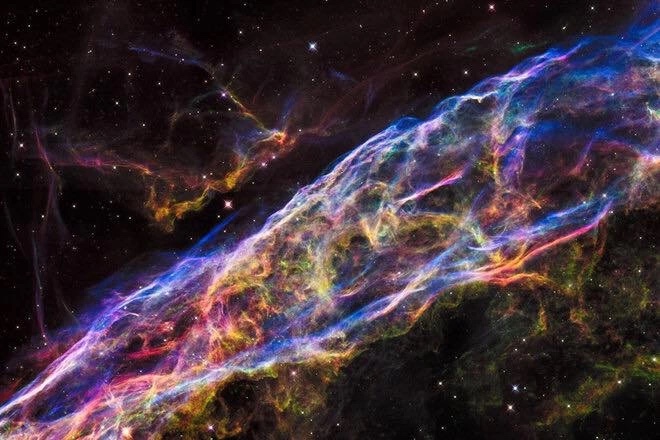
The Veil Nebula is a cloud of heated and ionized gas and dust in the constellation Cygnus. It constitutes the visible portions of the Cygnus Loop (radio source W78, or Sharpless 103), a large but relatively faint supernova remnant. The source supernova exploded circa 3,000 BC to 6,000 BC, and the remnants have since expanded to cover an area roughly 3 degrees in diameter (about 6 times the diameter, or 36 times the area, of the full moon). The distance to the nebula is not precisely known, but Far Ultraviolet Spectroscopic Explorer (FUSE) data supports a distance of about 1,470 light-years.

The Hubble Space Telescope captured several images of the nebula. The analysis of the emissions from the nebula indicate the presence of oxygen, sulfur, and hydrogen. This is also one of the largest, brightest features in the x-ray sky.

#VeilNebula #Astrophysics

Spaghetti Nebula

The Spaghetti Nebula is a Supernova Remnant (SNR) in the Milky Way. 3,000 light-years away from us straddling the border between the constellations Auriga and Taurus. Discovered in 1952 at the Crimean Astrophysical Observatory using a 25-inch Schmidt-Cassegrain telescope, it is difficult to observe due to its extremely low brightness.

The nebulous area is fairly large with an almost spherical shell and filamentary structure.  The remnant has an apparent diameter of approximately 3 degrees, an estimated distance of approximately 3000 (±350) light-years, and an age of approximately 40,000 years.

It is believed that after its stellar explosion a rapidly spinning neutron star known as pulsar PSR J0538+2817 was left behind in the nebula core, emitting a strong radio signal