Zedekiah’s Cave / Solomon’s Quarries (Jerusalem, Israel)

Zedekiah’s Cave/Solomon’s Quarries (Jerusalem, Israel)

Beneath the Muslim Quarter in Jerusalem’s Old City is an underground quarry that goes by two names: Zedekiah’s Cave and Solomon’s Quarries. The names reflect the two main legends that surround this 750-foot-long (228.6 m) collection of caverns.

The first story is that King Zedekiah fled through the cave to escape from attacking Babylonians around 587 BCE. At the time, the legend goes, the cave extended all the way to Jericho—a distance of about 13 miles (21 km). The Babylonians chased Zedekiah to Jericho, capturing and blinding him. The dripping water in the cave is thus known as Zedekiah’s Tears. The second story involves King Solomon, who is fabled to have used stones from the cave to build the First Temple in the 10th century BCE.

There is no archaeological evidence to support either premise. However, chisel markings on the walls suggest Zedekiah’s Cave was one of the quarries that supplied limestone for King Herod’s Second Temple and Temple Mount expansion. The stones of the Western Wall (also called the Wailing Wall)—Judaism’s most sacred prayer site—may indeed have come from this cave.

Source: Atlas Obscura
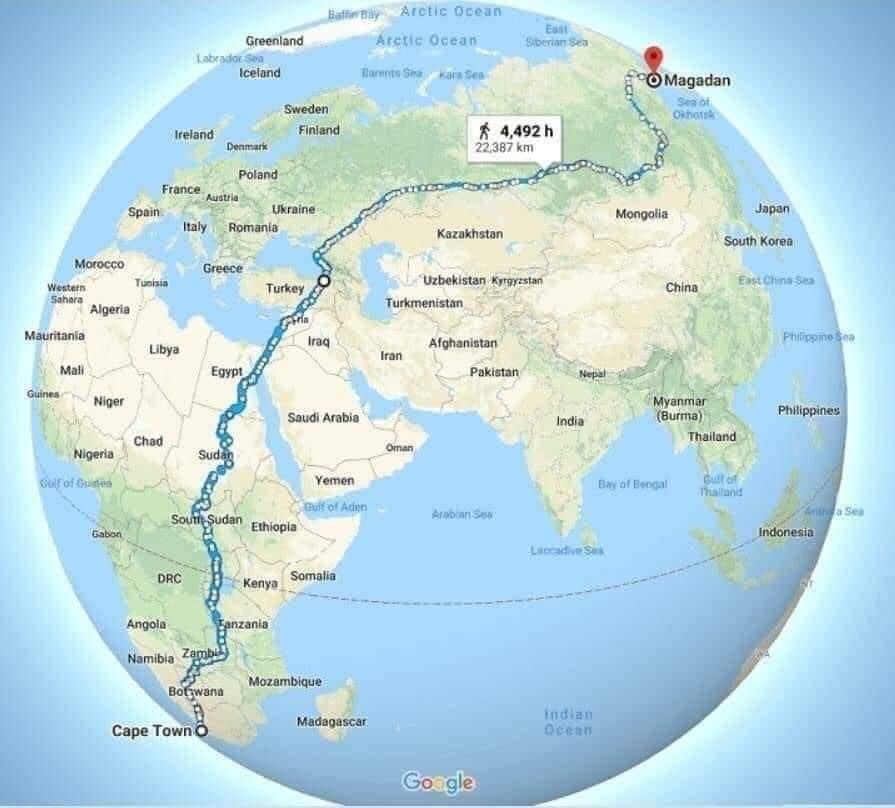
World’s Longest Road

The longest road in the world to walk, is from Cape Town (South Africa) to Magadan (Russia).

No need for planes or boats, there are bridges.

It’s a 22,387 Kilometers and it takes 4,492 hours to walk.

It would be 187 days walking nonstop, or 561 days walking 8 hours a day.

Along the route, you pass through 17 countries, six time zones and all seasons of the year.

Svanslös Crosswalk

Svanslös Crosswalk, showing an unusual “cat crossing” sign in the town of Uppsala, Sweden:

The road signs in front of Carolina Rediviva Library in Uppsala have something unusual: cats. On closer look, you might notice the adult cat leading kittens has no tail. He isn’t just an ordinary bobtail cat. He’s Pelle Svanslös (“Peter No-Tail” in English), a popular character from a children’s book series with the same name.

The Pelle Svanslös series—there are 12 books in total—was written by Gösta Knutsson between 1939 and 1972. As his name suggests, Pelle has no tail. A rat bit his tail off when he was a kitten. But despite this mean mishap, Pelle grows into a kind-hearted young cat. He has been loved by many Swedish children for decades.

Pelle and his feline friends live in Uppsala, Sweden, where the author also lived for many years of his life. To mark the cat’s popularity, Uppsala added some features related to the children’s literature star around the city, such as a statue, a peep-hole (his residence), and these crossing signs.

French School Lunches

In Absolutely Predictable in France Department:

The mayor of Lyon, France, a city where I’ve spent some time feeding on the city’s meaty and copious cuisine, announced that school lunches for 29,000 elementary-school students would no longer include meat. Well, the reaction was guaranteed:

Not so, thundered Gérald Darmanin, the interior minister. He tweeted that dropping meat was an “unacceptable insult to French farmers and butchers” that betrays “an elitist and moralist” attitude. Julien Denormandie, the agriculture minister, called the mayor’s embrace of the meatless lunch “shameful from a social point of view” and “aberrational from a nutritional point of view.”

I’m not that upset, as the kids will get plenty of meat elsewhere. But the fracas is funny.

#FrenchFood #SchoolLunch

Wieliczka Salt Mine (Wieliczka, Poland)

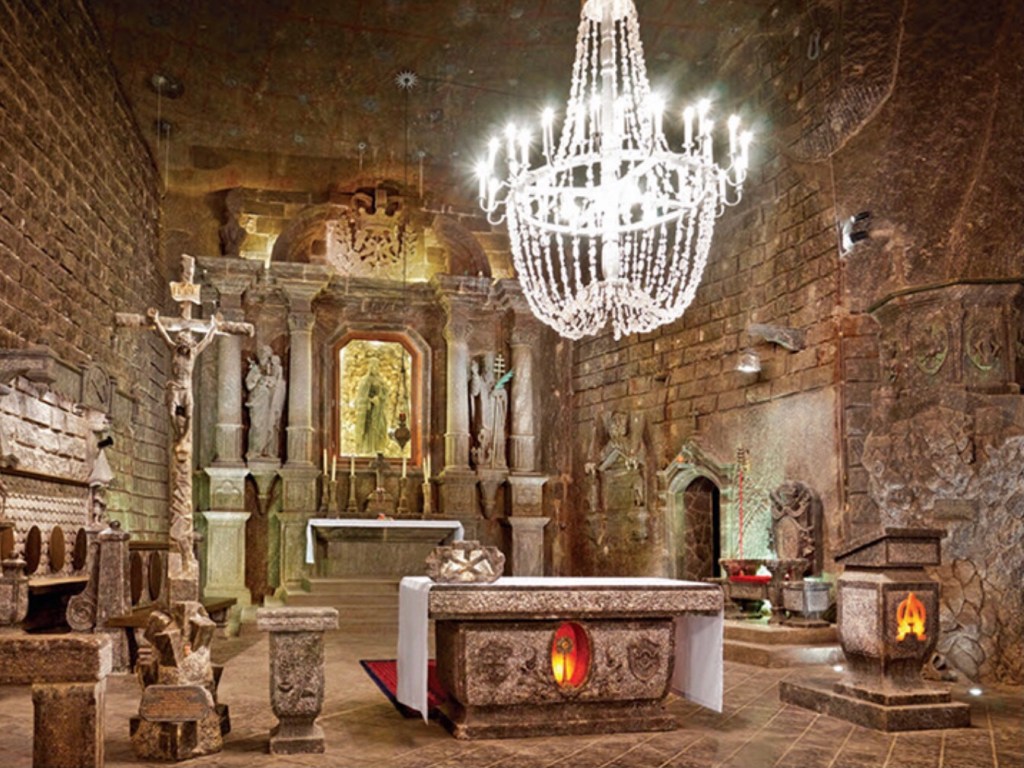
The salt mine’s Chapel of St. Kinga features chandeliers made of salt.

Wieliczka Salt Mine (Wieliczka, Poland)

Miners at Wieliczka carved its rock salt deposits without interruption from the 13th century until the 1990s. Over the centuries, workers slowly turned the seven-level subterranean mine into a majestic salt city replete with life-size rock salt sculptures of saints, biblical wall reliefs, and tableaus depicting their daily lives.

In the early 1900s, the workers undertook their most ambitious project: an underground church named after Kinga, the patron saint of salt miners. The 331-foot-deep (101 m) St. Kinga’s Chapel features a sculpture of Christ on the cross, depictions of scenes from the New Testament, a wall relief of Da Vinci’s The Last Supper, and two altars. All are carved from salt. Hanging from the ceiling are five chandeliers that miners crafted by dissolving salt, removing its impurities, and reconstituting it into crystals as clear as glass.

Another memorable sight on the tour is the placid subterranean lake in the Józef Piłsudski Chamber, softly lit and overseen by a statue of Saint John Nepomucene—the patron saint of drowning. Take a moment of reflection before you bundle into a small, dark miners’ cage with five other people for the long ascent back to the surface.

Source: Atlas Obscura

Temple of All Religions (Kazan, Russia)

Temple of All Religions (Kazan, Russia)

The colorful Temple of All Religions, or Universal Temple, is a mishmash of architectural flourishes culled from most of the major world religions.

Established by philanthropist Ildar Khanov in 1992, the site is not a chapel in the traditional sense, but a center meant to stand as a symbol of religious unity. Khanov, an advocate for rehabilitation services for substance abusers, built the center with the help of patients he met through his work.

The exterior of the temple looks almost like something out of Disneyland’s It’s a Small World ride, with a Greek Orthodox dome here and a Russian minaret there. There are design influences from Jewish synagogues and Islamic mosques, along with a number of spires and bells. All in all, the temple incorporates architectural influences from 12 religions in a bright cacophony of devotion.

Source: Atlas Obscura

The Merry Cemetery (Săpânţa, Maramureş, Romania)

The Merry Cemetery (Săpânţa, Maramureş, Romania)

At the Cimitirul Vesel, or “Merry Cemetery,” over 600 colorful wooden crosses bear the life stories, dirty details, and final moments of the bodies that lie below. Displayed in bright, cheery pictures and annotated with limericks are the stories of almost everyone who has died in the town of Săpânţa. Illustrated crosses depict soldiers being beheaded and a townsperson being hit by a truck. The epigraphs are surprisingly frank and often funny: “Underneath this heavy cross lies my mother-in-law . . . Try not to wake her up. For if she comes back home, she’ll bite my head off.”

The cemetery’s unique style was created by a local named Stan Ioan Pătraş, who at the age of 14 had already begun carving crosses for the graveyard. By 1935, Pătraş was carving clever and ironic poems—done in a rough local dialect—about the deceased, as well as painting their portraits on the crosses, often depicting the way in which they died.

Pătraş died in 1977, having carved his own cross and leaving his house and business to his most talented apprentice, Dumitru Pop. Pop has spent the last three decades continuing the carving work, and has also turned the house into the Merry Cemetery’s workshop-museum. Despite the occasionally darkly comic—or merely dark—tones of the crosses, Pop says no one has ever complained about the work:

“It’s the real life of a person. If he likes to drink, you say that; if he likes to work, you say that . . . There’s no hiding in a small town . . . The families actually want the true life of the person to be represented on the cross.”

Source: Atlas Obscura

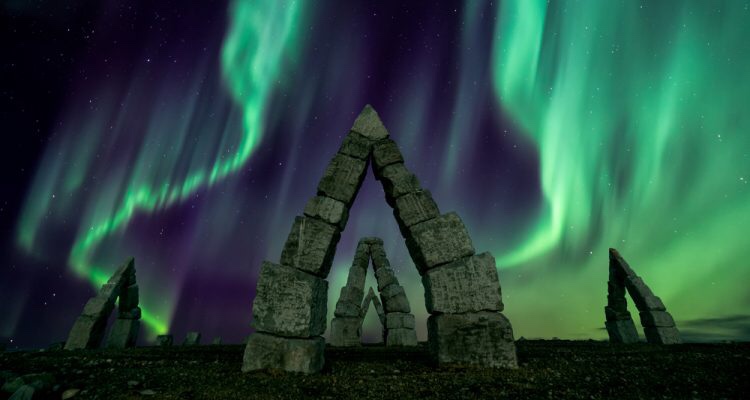
The Arctic Henge (Raufarhöfn, Iceland)

The Arctic Henge (Raufarhöfn, Iceland)

Located in one of Iceland’s most remote northern villages, the Arctic Henge is a colossal piece of stone construction that, when finished, will make Stonehenge look like amateur hour.

Started in 1996, the Arctic Henge project is a monument not only to the country’s nordic roots, but also to some of the neo-pagan beliefs that have arisen in certain areas. The piece was inspired directly from the eddic poem Völuspá (Prophecy of the Seeress), taking from it the concept of 72 dwarves who represent the seasons in the world of the poem, among other symbolic queues. In the Arctic Henge, 72 small blocks, each inscribed with a specific dwarven name will eventually circle four larger stone monuments, which in turn will surround a central balanced column of massive basalt blocks. Each aspect of the deliberate layout corresponds to some aspect of ancient Norse belief and when each piece of the monument is installed, visitors will be able to “capture the midnight sun” by viewing it through the various formations at different vantage points depending on the season.

At current, only the imposing central tri-column and one of the four larger gates have been constructed, along with a smattering of the smaller stones, but it is still a work in progress. When it is complete, the Arctic Henge could easily become the premiere site for Paganism in the entire world and millennia from now it might seem as mysterious as Stonehenge seems to us today.

Source: Atlas Obscura

The Astronomical Clock of Besançon Cathedral (Besançon, Franche-Comté, France)

Besançon Cathedral, located in the center of France’s 19th-century clock-making capital, is home to a 19-foot-tall (5.8 m) clock with 30,000 pieces. It is one of the most complicated horological devices ever made. Installed in 1860, the clock shows the local time in 17 places around the world, as well as the time and height of the tides in eight French ports, a perpetual calendar with leap-year cycles, and the times of sunrise and sunset.

The many dials of what may be the most complicated horological device ever constructed.

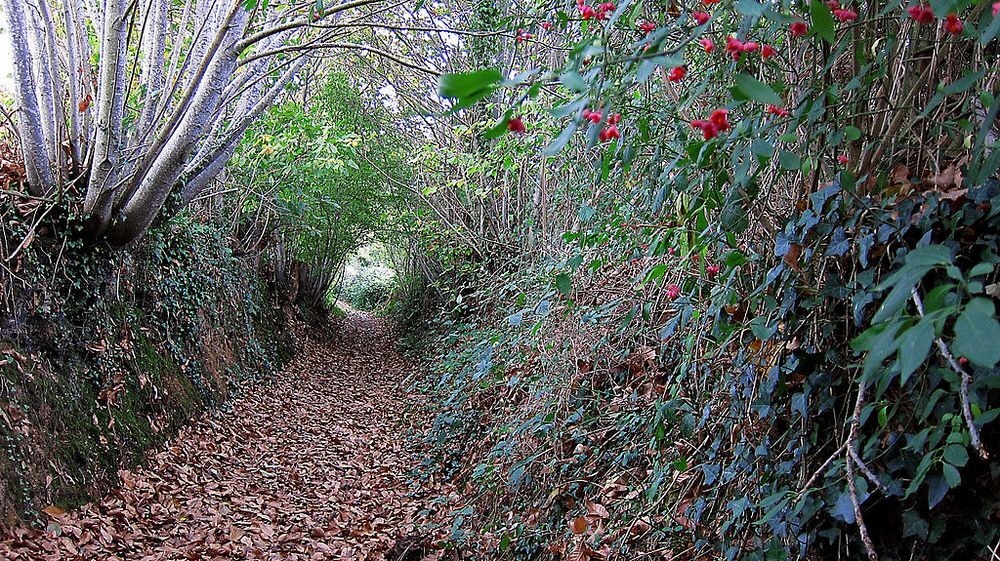
Hollow at La Meauffe (La Meauffe, Normandy, France)

Hollow at La Meauffe (La Meauffe, Normandy, France)

Holloways, which appear like deep trenches dragged into the earth, are centuries-old thoroughfares worn down by the traffic of time. In Europe, most of these sunken lanes go back to Roman times, or as early as the Iron Age.

These deep-recessed roads were naturally tunneled into the soft ground by years of footsteps, cart wheels, and animal hooves. Water flowing through the embankments like a gully further molded the paths into rounded ditches that have sunk as much as 20 feet lower than the land on either side. In some cases, trees rise up from the banks flanking the narrow path and reach toward each other to form a canopy over the road, making the holloway look like a tunnel running through the thick greenery.

Holloways are especially common in the bocage, or “hedgerow,” landscape around Normandy, where the countryside is divided into small fields enclosed by sunken lanes and high hedges. Like many sunken roads, the trench-like holloway in La Meauffe was used as a shelter during times of war. During World War II, the La Meauffe hollow was a defensive strongpoint for the German army, providing perfect cover from the advancing American troops. The limited visibility of the terrain caused the Americans to suffer heavy losses during the attack, leading US soldiers to call the road in La Meauffe “Death Valley Road.”

Many who walk through holloways don’t realize they are retracing ancient steps.