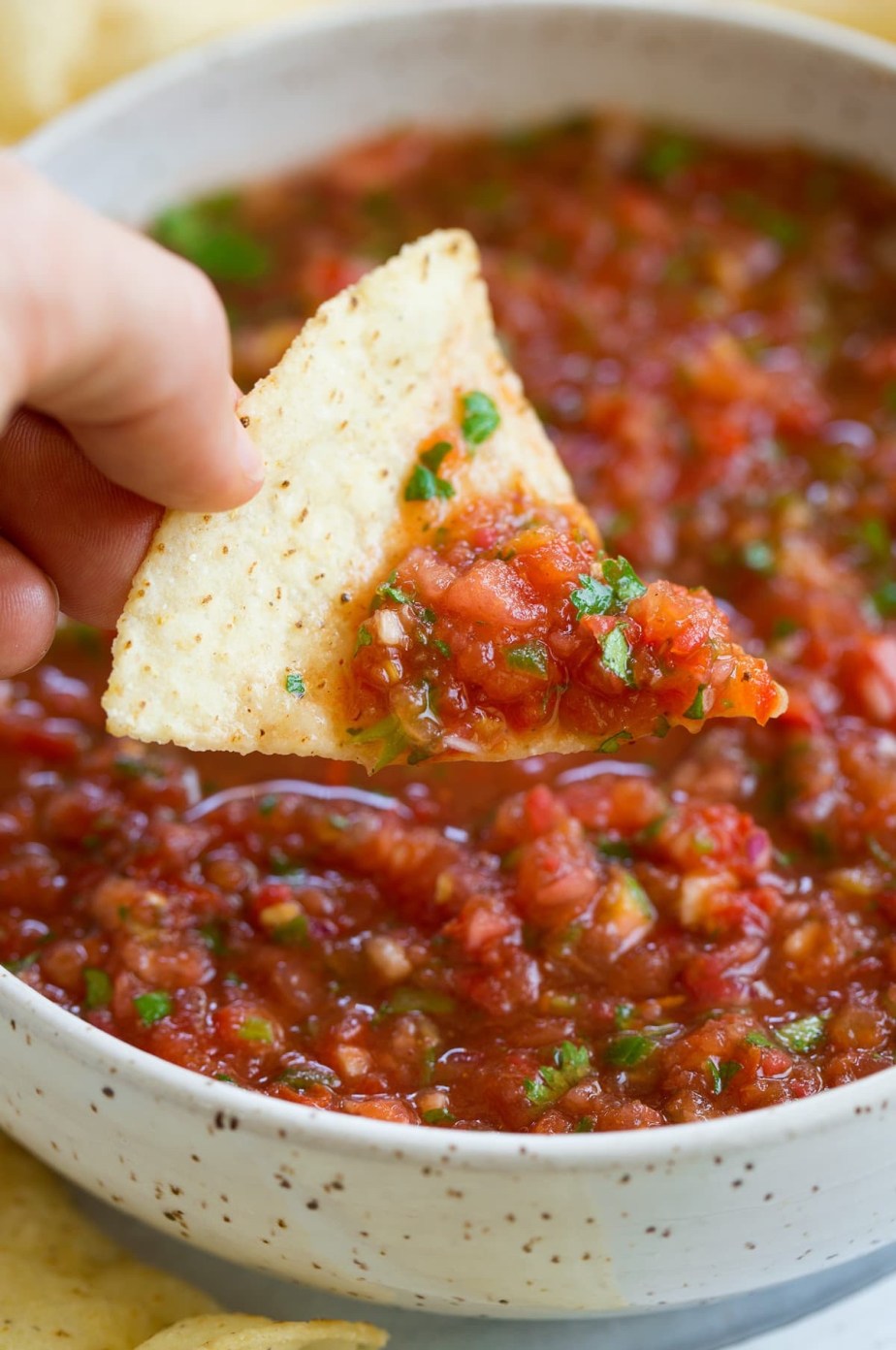
Salsa Mexicana

2 Tbsp olive oil

1 white onion, chopped

2 serrano chiles, stemmed, seeded, veins removed (for a spicier salsa don’t devein chilies), and chopped

2 garlic cloves, chopped

5 Roma tomatoes chopped

¼ cup cilantro leaves, minced

1 tsp sea salt, plus more as needed

Warm the oil in a small saucepan over medium heat until it’s hot. Add the onion and chiles and sauté until the onion is translucent. Add the garlic and tomatoes and cook for about 10 minutes.

Transfer the vegetables to a blender and blend until completely pureed or desired thickness. Return the mixture to the pan and simmer over low heat until the sauce has reduced by about one-third. Add the cilantro and salt. Taste and add more salt if needed.

This salsa is traditionally served hot, but can be served cool as well. It can be stored in a sealed container in the refrigerator for up to 5 days.


Salsa Verde

10 small tomatillos, husks removed and discarded, rinsed, and cut in half

2 to 4 serrano chiles, stemmed, seeded, and veins removed

1 small white onion, half left intact and the other half minced

1 large garlic clove

1 Tbsp sea salt, plus more as needed

½ cup / 10g cilantro leaves, finely chopped

Combine the tomatillos, chiles, intact onion half, garlic, and salt in a medium saucepan. Add water just to cover and bring to a boil and then decrease the heat to maintain a simmer and cook until the tomatillos become more translucent and the chiles have faded from bright green.

Pour everything into a blender, including the liquid, and puree. Return the puree to the saucepan and simmer gently until reduced by about one-third. Add the minced onion and cilantro to the cooked salsa and stir to combine. Taste and add more salt if needed.

This salsa is excellent served hot or cold.

It can be stored in a sealed container in the refrigerator for up to 1 week.

Postal Service to issue NASA sun science forever stamps

“I have been a stamp collector all my life and I can’t wait to see NASA science highlighted in this way,” said Thomas Zurbuchen, associate administrator for NASA’s Science Mission Directorate (SMD) in Washington. “I feel that the natural world around us is as beautiful as art, and it’s inspiring to be able to share the import and excitement of studying the sun with people around the country.”

The 20-stamp set features ten images that celebrate the science behind NASA’s ongoing exploration of our nearest star. The images display common events on the sun, such as solar flares, sunspots and coronal loops. SDO has kept a constant eye on the sun for over a decade. Outfitted with equipment to capture images of the sun in multiple wavelengths of visible, ultraviolet, and extreme ultraviolet light, SDO has gathered hundreds of millions of images during its tenure to help scientists learn about how our star works and how its constantly churning magnetic fields create the solar activity we see.

Source: phys.org

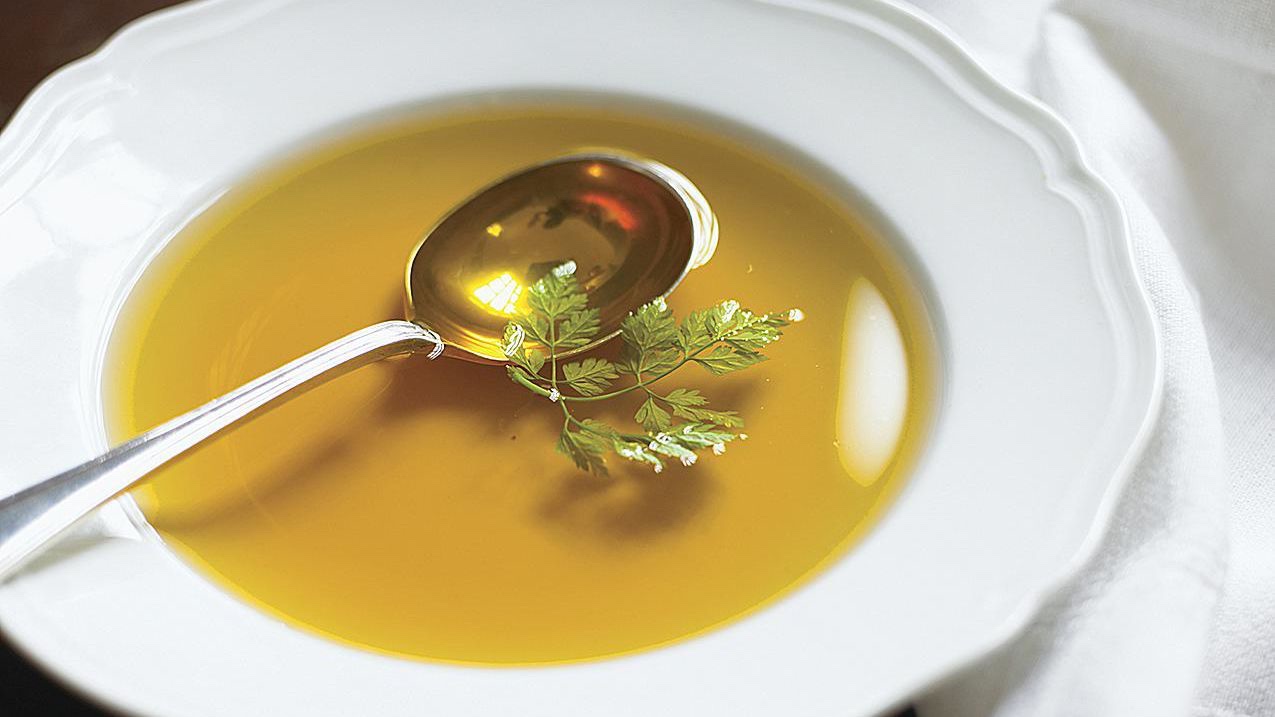
Porcini Consommé

6 cups vegetable stock
1 pound porcini, cleaned, trimmed, and cut into ½-inch slices *
5 black peppercorns
2 to 3 bay leaves
½ cinnamon stick
Fine sea salt
¼ cup heavy (whipping) cream, whipped to soft peaks (optional)
½ teaspoon ground cinnamon

In a medium pot, bring the stock to a boil. Add the mushrooms, peppercorns, bay leaves, and cinnamon stick, reduce the heat, and simmer for 20 minutes. Skim off any foam that forms on the surface.

Line a colander or large metal sieve with cheesecloth and strain the consommé into another pot, pressing gently on the mushrooms with a spoon to release as much liquid as possible. Discard the mushrooms and spices.

Reheat the consommé and season with salt. Pour into bowls. Add a couple tablespoons of cream if desired to each portion, sprinkle with cinnamon, and serve

* Fresh porcini, also called cèpes, are sometimes available in gourmet markets. If you cannot get them, you can make the soup with 1 pound button mushrooms, trimmed, cleaned, and sliced, plus 2 ounces dried porcini.

Galloway Hoard

“National Museums Scotland acquired the Galloway Hoard, as it came to be known, in 2017. Since then, conservators have been working to clean and restore the items, all of which spent more than 1,000 years buried in the Scottish field. This week, the National Museum of Scotland (NMS) released new images of the latest object to undergo conservation: an intricately decorated Anglo-Saxon cross.

After a millennium underground, the cross was encrusted with dirt. Wrapped in a coiled silver cord made out of wire bundled around an animal-gut core, it proved difficult to clean. Improvising, conservators turned to a carved porcupine quill—a tool “sharp enough to remove the dirt yet soft enough not to damage the metalwork,” according to a statement.”

Source: Smithsonian Magazine Online

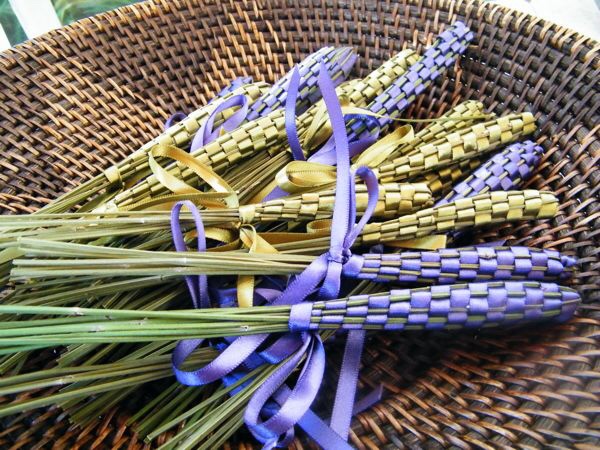
Lavender Wands

The wand is made by weaving a ribbon over and under adjacent stalks, so you must use an odd number of stalks. (I suggest using 13). Harvest only the most robust and straight flower stalks.

• 6 feet 1/4-inch satin ribbon
• 13 stalks fresh, straight, long-stemmed lavender
• Heavy thread
• Clippers
• Scissors

1. Align the flower heads and wrap the thread tightly below the flowers, including one end of the ribbon. Knot the thread and trim the ends; leave 1/4 inch tail of the ribbon.

2. Turn the wand so the flowers point downward. One at a time, bend the stalks over the thread. (Pressing your thumbnail into the stalk above the thread as you bend it prevents breakage if the stalks have dried out a little.) Space stalks evenly like the spines of an umbrella.

3. Bring the ribbon to the outside of the umbrella and begin to weave over and under adjacent stalks. As you weave, pull on the ribbon fairly hard and make sure the flowers inside are covered. As the pulling causes the stalks to twist, realign them after weaving three rounds so they are once again straight and evenly spaced. Repeat this step if necessary after the sixth round.

4. After weaving beyond the flower heads, form a handle by weaving the ribbon tightly for 4 to 5 inches. Tie it off in a bow. After the wand dries, reweave the ribbon on the now shrunken handle and retie the bow.

Source: Mother Earth Living

Viking Runes Introduction

By the beginning of the Viking Age, the Scandinavian rune-masters had developed an alphabet, or “futhark” (from the value of the first six characters), of sixteen characters that was quite distinct from the rest of the Germanic peoples. This alphabet was known as the “younger futhark”.

However, even within Scandinavia, there was no standard form for the characters and there are variations from inscription to inscription, but basically there were two main forms of futhark: the Common or Danish futhark (although it occurs outside of Denmark), and the Swedo-Norwegian futhark (although this also occurs outside of Sweden and Norway.

One can see that there are shortcomings with these alphabets. For example, there are characters for b, k and t, but there are none for p, g and d (this is because the futhark does not distinguish between these voiced and voiceless pairs. Therefore the rune-master had to use b for p, k for g and t for d.

There were other peculiarities: although there were two characters for the two different types of a, there were no symbols for e and o. This meant that the name “Svein” appears as in runes “suin” and the name “Gormr” appears as “kurmR”.

It becomes even more complicated, as the spelling practice allowed n to be omitted when it occurred before a consonant. Therefore the name Thormundr appears as thurmutR.

This of course means that many runic inscriptions can be very difficult to read and there can be a great deal of dispute about their true meaning.

Despite the difficulties in reading runic inscriptions, they can provide a good deal of useful information.

Source: Swedish National Museum Heritage Board’s website, but that page no longer exists.

Herring, Potato, Red Onion, and Egg Open Sandwich

4–5 new potatoes

2 eggs

3 tbsp mayonnaise

1 tsp Dijon mustard

2 tbsp chopped herbs (such as dill, parsley, chives)

2 slices of sourdough bread

½ jar pickled herring, drained (approx. 4oz)

½ red onion, very finely diced

small handful of chives, roughly chopped, to garnish

Boil the potatoes until just tender, about 20 minutes. Leave until cool enough to handle, then slice thickly.

Boil the eggs for about 8 minutes, until relatively hard boiled. Leave to cool, then peel and slice.

Mix the mayonnaise with the mustard, chopped herbs and a little seasoning. Spread over the sourdough bread slices, then arrange a layer of potato over the top. Add the egg, herring and finely chopped onion and garnish with a sprinkle of fresh chives.