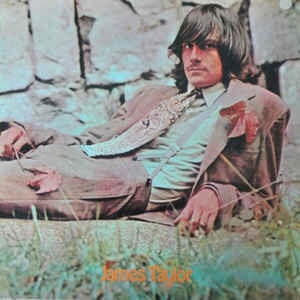
Knocking Round the Zoo – by James Taylor

This is an autobiographical song describing Taylor’s stay at McLean, a psychiatric hospital near Boston where he stayed while finishing high school. Taylor was attending a strict boarding school called Milton Academy when he suffered a bout of depression that led his family to pull him from the school and send him to McLean, where he took classes at their affiliated school.

In this song, he explains how it felt like a zoo, with bars on the windows and people coming to look at you – his sister Kate broke down in tears during one visit.

While Taylor was at McLean, he spotted Ray Charles, who was sent there for his heroin addiction. Taylor’s siblings Livingston and Kate also ended up spending time there. Over the next 15 years or so, James ended up in various other rehab centers and hospitals to treat his addictions.

Just knocking around the zoo
On a Thursday afternoon,
There’s bars on all the windows
And they’re counting up the spoons, yeah.
And if I’m feeling edgy,
There’s a chick who’s paid
To be my slave, yeah, watch out James.
But she’ll hit me with a needle
If she thinks I’m trying to misbehave.

Now the keeper’s trying to cool me
Says I’m bound to be all right,
But I know that he can’t fool me
‘Cause I’m putting him uptight, yeah.
And I can feel him getting edgy
Every time I make a sudden move,
Whoa, yes it’s true.
And I can hear them celebrating
Every time I up and leave the room.

Now my friends all come to see me,
They just point at me and stare.
Said, he’s just like the rest of us
So what’s he doing there?
They hide in their movie theaters
Drinking juice, keeping tight,
Watch that bright light.
‘Cause they’re certain about one thing, babe,
That zoo’s no place to spend the night, no.

Just knocking around the zoo
On a Thursday afternoon,
There’s bars on all the windows
And they’re counting up the spoons, yeah.
And if I’m feeling edgy,
There’s a chick who’s paid to be my slave,
Watch out Kootch.
But she’ll hit me with a needle
If she thinks I’m trying to misbehave.

Counterculture – by Timothy Leary

Counterculture blooms wherever and whenever a few members of a society choose lifestyles, artistic expressions, and ways of thinking and being that wholeheartedly embrace the ancient axiom that the only true constant is change itself. The mark of counterculture is not a particular social form or structure, but rather the evanescence of forms and structures, the dazzling rapidity and flexibility with which they appear, mutate, and morph into one another and disappear.

Counterculture is the moving crest of a wave, a zone of uncertainty where culture goes quantum. To borrow the language of Nobel Prize– winning physicist Ilya Prigogine, counterculture is the cultural equivalent of the “third thermodynamic state,” the “nonlinear region” where equilibrium and symmetry have given way to a complexity so intense as to appear to the eye as chaos.

Participants in a counterculture thrive in this zone of turbulence. It is their native medium, the only clay malleable enough to be shaped and reshaped fast enough to keep pace with the flashing of their inner visions. They are adepts of flux, chaos engineers, migrating in step with the ever-traveling wavefront of maximum change.

In counterculture, social structures are spontaneous and transient. Participants in countercultures are constantly clustering into new molecules, fissioning and regrouping into configurations appropriate to the interests of the moment, like particles jostling in a high-energy accelerator, exchanging dynamic charge. In these configurations they reap the benefits of exchanging ideas and innovations through fast feedback in small groups, affording a synergy that allows their thoughts and visions to grow and mutate almost the instant they are formulated.

Counterculture lacks formal structure and formal leadership. In one sense it is leaderless; in another sense, it is leader-full, all of its participants constantly innovating, pushing into new territory where others may eventually follow.

Counterculture may be found in (sometimes uneasy) alliances with radical, even revolutionary political groups and insurrectionary forces, and the memberships of countercultures and such groups often overlap.

But the focus of counterculture is the power of ideas, images, and artistic expression, not the acquisition of personal and political power. Thus, minority, alternative, and radical political parties are not themselves countercultures. While many countercultural memes have political implications, the seizure and maintenance of political power requires adherence to structures too inflexible to accommodate the innovation and exploration that are basic to the countercultural raison d’être. Organization and institution are anathema to counterculture.

~ Timothy Leary

Ouroboros

“The snake that gives birth to itself also incestuously makes love to itself, putting its own tail in its mouth; it is the seminal member and womb of creation in one. It represents the source and origin of all life and the place where it comes to renew itself in time. The uroboros is both alpha and omega, an image of death drive and sexuality intertwined; both self-fertilization and rebirth come to be as one. The notion of this life force or “cosmic” sexual energy is always found at the heart of mythology.” ​
~ Norland Tellez

Image: The serpent Ouroboros, from Cyprianus, 18th Century

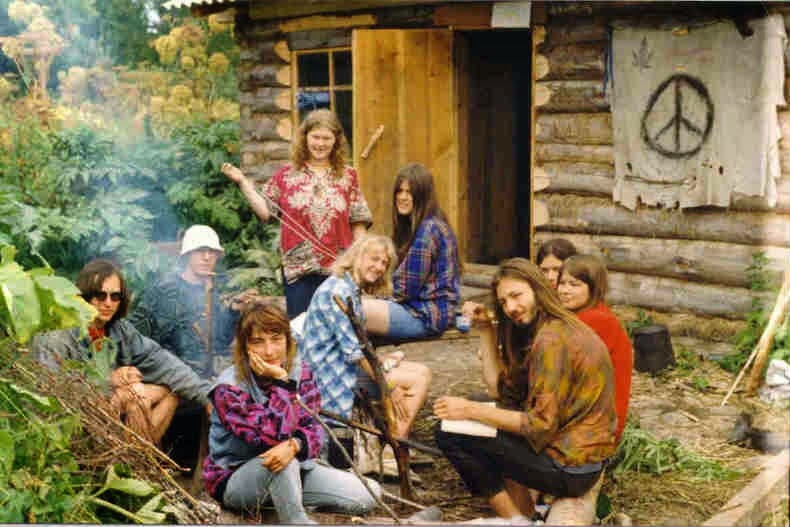
Starting a Commune

What You Need:

  • A house, preferably with several outbuildings
  • A group of open-minded, perfectly matched people with complementary skills, goals, and life philosophies
  • A goat
  • A chore sign-up sheet
  • A casual relationship with the notion of privacy
  • “On Liberty” by John Stuart Mill
  • The collected works of Karl Marx and Friedrich Engels
  • A natural inclination toward egalitarianism
  • A belief in the inherent benefits of “intentional communities”
  1. Move into house.
  2. Get along.
  3. Garden.

Rules:

Rules are naturally a touchy subject.  If you are starting a commune, you’ll need some guidelines in order to prevent complete chaos, but it is best to keep them to a few, if only to avoid the several day-long house meetings required to decide which rules to make and how to follow them. The first you might consider “Everyone gives something, and everyone gets something back.” If you didn’t do your part (e.g., you refuse to help paint the porch) you’re asked to leave.

Television is generally discouraged in communes, mostly because the number of people makes it hard to decide what to watch. 

Once you accept that everyone has an equal responsibility to share in the commune chores, you can immediately begin trying to get out of them.

Gardening:

There is nothing better for a commune than a good-sized vegetable patch. A few tomato plants, some basil, and some rhubarb will keep you busy for the better part of a summer. Everyone can participate in the garden’s care and harvest. Because all residents are participating, the garden is truly a product of the community and a central element of commune life. Also, a bountiful garden can feed a bevy for several months—longer if produce is jarred or frozen.

Venus Figurines

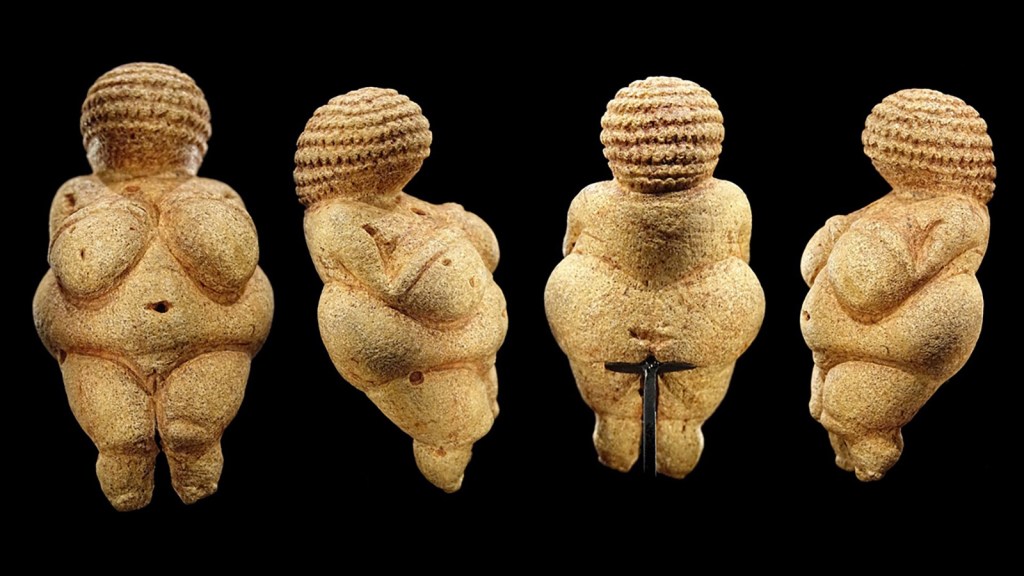
Figurines of women carved or sculpted from stone, ivory, or clay are a type of Paleolithic art found widely across Europe. These figurines share many striking similarities. While details such as facial features and feet are largely ignored, feminine sexual characteristics (breasts, belly, hips, thighs, and vulva) are often exaggerated. The focus on features related to sexuality and fertility, and the round body shapes depicted (during the Ice Age fat would have been a precious commodity) suggest that the figurines may have played a symbolic role as a charm relating to childbirth or, more generally, fertility.

Some researchers believe that the figures represent a “mother goddess,” but there is no real evidence for such an interpretation. Others have focused instead on the fact that the figurines demonstrate widely shared cultural ideas and symbols. These would have been crucial to social interactions and exchanges of resources, information, and potential marriage partners in the Ice Age world.

Blowin’ In The Wind – Bob Dylan

Blowin’ In The Wind

Bob Dylan / 2:46

Musician: Bob Dylan: vocals, guitar, harmonica

Recording Studio: Columbia Recording Studios / Studio A, New York: July 9, 1962

As surprising as it may seem, Dylan wrote “Blowin’ in the Wind” in just ten minutes on April 16, 1962. He was in a coffee shop, the Commons, opposite the Gaslight, the mythical center of the folk scene in the heart of Greenwich Village, where not only Dylan but also Richie Havens, Jose Feliciano, and Bruce Springsteen, among others, got their start. In 2004, when CBS newsman Ed Bradley asked Dylan about the speed with which he wrote, Dylan replied honestly: “It came from… that wellspring of creativity.”  To Scorsese, he also said that regardless of where he was—in the subway, a coffee shop, “sometimes talking to someone”—he could be hit by inspiration. It was an exceptional period, and many years later he tried in vain to re-create it.

During the months following its release, “Blowin’ in the Wind” was at the heart of a controversy that had nothing to do with music. A high school student from Millburn, New Jersey, named Lorre Wyatt claimed to be the real composer of the song, which he said he sold for a thousand dollars. Several students even stated they heard Wyatt singing “Blowin’ in the Wind” before the singles by Peter, Paul and Mary and Dylan came out. This claim was taken very seriously, and Newsweek magazine repeated it in November 1963. It was only in 1974 that Lorre Wyatt admitted having lied to impress the other members of his group, the Millburnaires.

Starting with the New World Singers and Peter, Paul and Mary, hundreds of artists inserted “Blowin’ in the Wind” into their repertoire. These include Marlene Dietrich (1963), Joan Baez (1963), Marianne Faithfull (1964), Sam Cooke (1964), and Stevie Wonder (who reached tenth place on the charts), as well as Judy Collins, Elvis Presley, Neil Young, and Ziggy Marley.

How many roads must a man walk down
Before you call him a man?
How many seas must a white dove sail
Before she sleeps in the sand?
Yes, and how many times must the cannonballs fly
Before they’re forever banned?

The answer, my friend, is blowin’ in the wind
The answer is blowin’ in the wind

Yes, and how many years must a mountain exist
Before it is washed to the sea?
And how many years can some people exist
Before they’re allowed to be free?
Yes, and how many times can a man turn his head
And pretend that he just doesn’t see?

The answer, my friend, is blowin’ in the wind
The answer is blowin’ in the wind

Yes, and how many times must a man look up
Before he can see the sky?
And how many ears must one man have
Before he can hear people cry?
Yes, and how many deaths will it take ’til he knows
That too many people have died?

The answer, my friend, is blowin’ in the wind
The answer is blowin’ in the wind

SourceBob Dylan: All The Songs

Leonardo da Vinci

The original Renaissance man died 502 years ago (1452–1519), but the nature of his genius continues to fascinate us:

Leonardo’s science was grounded in the Aristotelian world as shaped by 18 centuries of interpreters. He developed a system of what he called the four powers of nature: movement, weight, force and percussion. Although he struggled to define these concepts, and many of the ideas are archaic, it is telling that he developed a coherent model for all natural phenomena ranging from the macrocosm (e.g., geological forces that lead to the formation of rivers and oceans) to the microcosm (e.g., human anatomy).

Harpokrates Stelae

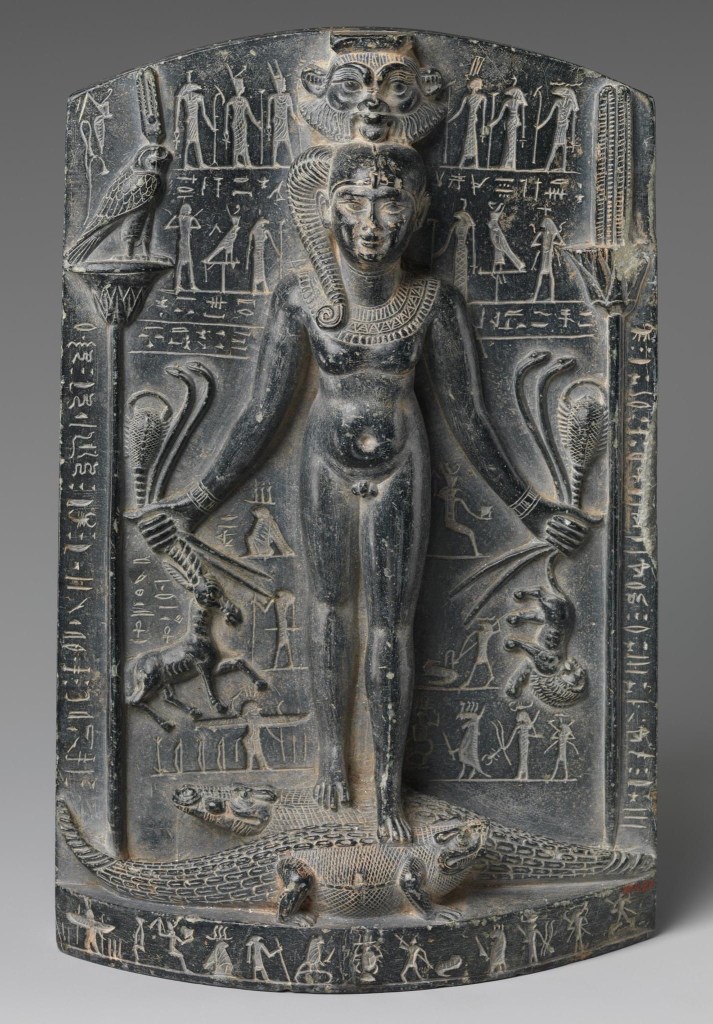
An amuletic plaque of the god Harpokrates (Horus the Child) standing in the center on the heads of two crocodiles and beneath a mask of Bes, a god especially associated with the protection of children and of pregnant women and those giving birth. In each hand Harpokrates clutches a scorpion by the stinger as well as two serpents. He also grasps a quadruped by the horns with his right while his left grips a lion by the tail. In addition, he is flanked by standards in the form of lotus and papyrus columns.

The plaque is extensively inscribed with magical spells to protect against scorpions, snakes, and the other noxious forces subdued by the god, and to heal the stings and bites of wild creatures.

The object is made of chlorite schist and is dated to the Ptolemaic Period (304-30 BCE). This type of stelae was often set up in homes, but examples have also been found in burials. This suggests that they were believed to extend their protective powers to the deceased.

This piece is now in the Metropolitan Museum of Art, New York, USA.

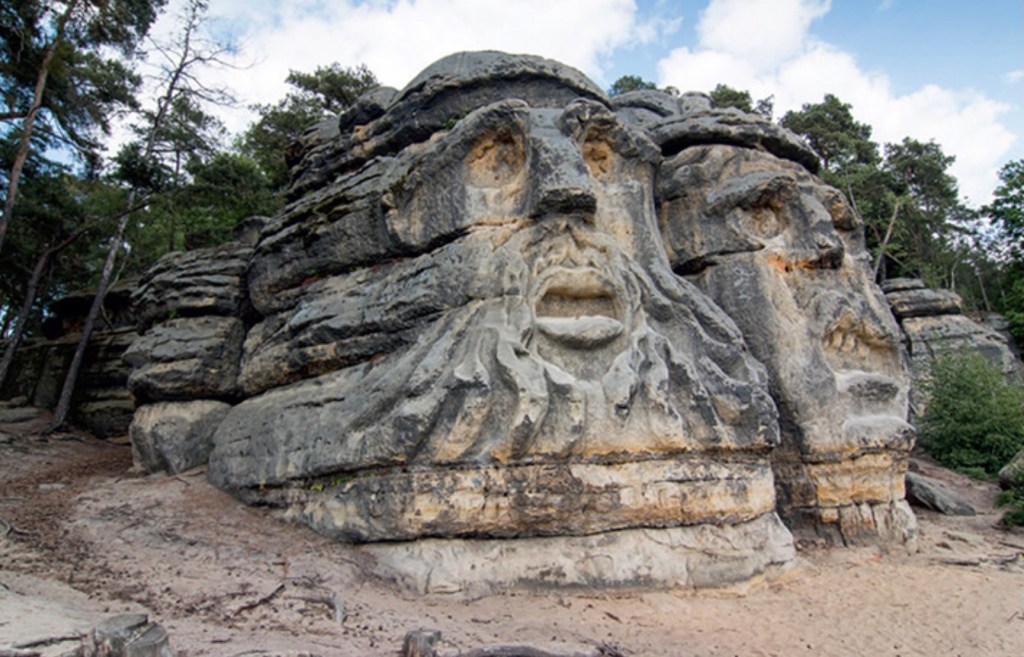
The Devil Heads (Želízy, Czech Republic)

The Devil Heads (Želízy, Czech Republic)

A disturbing sight awaits hikers exploring the forest above the village of Želízy in Czechia. Looking out over the Kokořínsko nature reserve, two enormous demonic faces carved from the native stone stare back with empty eyes.

Created by the renowned Czech sculptor Václav Levý in the mid-19th century, the nearly 30-foot-tall sandstone heads are known as Certovy Hlavy, or “the Devil Heads,” and they have been a local attraction for generations. Now suffering slightly from the ravages of time and weather, the monstrous faces have grown less distinct over time—but no less creepy.