Samuel Barclay Beckett (13 April 1906 – 22 December 1989) was born, an Irish avant-garde novelist, playwright, theatre director, and poet, who lived in Paris for most of his adult life and wrote in both English and French. He is widely regarded as among the most influential writers of the 20th century.
Beckett’s work offers a bleak, tragicomic outlook on human existence, often coupled with black comedy and gallows humour, and became increasingly minimalist in his later career. He is considered one of the last modernist writers, and one of the key figures in what Martin Esslin called the “Theatre of the Absurd”.
Beckett was awarded the 1969 Nobel Prize in Literature “for his writing, which—in new forms for the novel and drama—in the destitution of modern man acquires its elevation.”
Richard Phillips Feynman (May 11, 1918 – February 15, 1988) was an American theoretical physicist known for his work in the path integral formulation of quantum mechanics, the theory of quantum electrodynamics, and the physics of the superfluidity of supercooled liquid helium, as well as in particle physics for which he proposed the parton model. For his contributions to the development of quantum electrodynamics, Feynman, jointly with Julian Schwinger and Sin’ichirō Tomonaga, received the Nobel Prize in Physics in 1965.
Feynman developed a widely used pictorial representation scheme for the mathematical expressions governing the behavior of subatomic particles, which later became known as Feynman diagrams. During his lifetime, Feynman became one of the best-known scientists in the world. In a 1999 poll of 130 leading physicists worldwide by the British journal Physics World he was ranked as one of the ten greatest physicists of all time.
He assisted in the development of the atomic bomb during World War II and became known to a wide public in the 1980s as a member of the Rogers Commission, the panel that investigated the Space Shuttle Challenger disaster. Along with his work in theoretical physics, Feynman has been credited with pioneering the field of quantum computing and introducing the concept of nanotechnology. He held the Richard C. Tolman professorship in theoretical physics at the California Institute of Technology.
Feynman was a keen popularizer of physics through both books and lectures, including a 1959 talk on top-down nanotechnology called There’s Plenty of Room at the Bottom, and the three-volume publication of his undergraduate lectures, The Feynman Lectures on Physics. Feynman also became known through his semi-autobiographical books Surely You’re Joking, Mr. Feynman! and What Do You Care What Other People Think? and books written about him, such as Tuva or Bust! and Genius: The Life and Science of Richard Feynman by James Gleick…
In Tibetan Buddhism, the 108 bead Mala is a powerful meditation tool, bringing positive forces of self realization & contentment to it’s user. This Mala represents the 5 elements: Earth, Fire, Water, Metal, Wood…
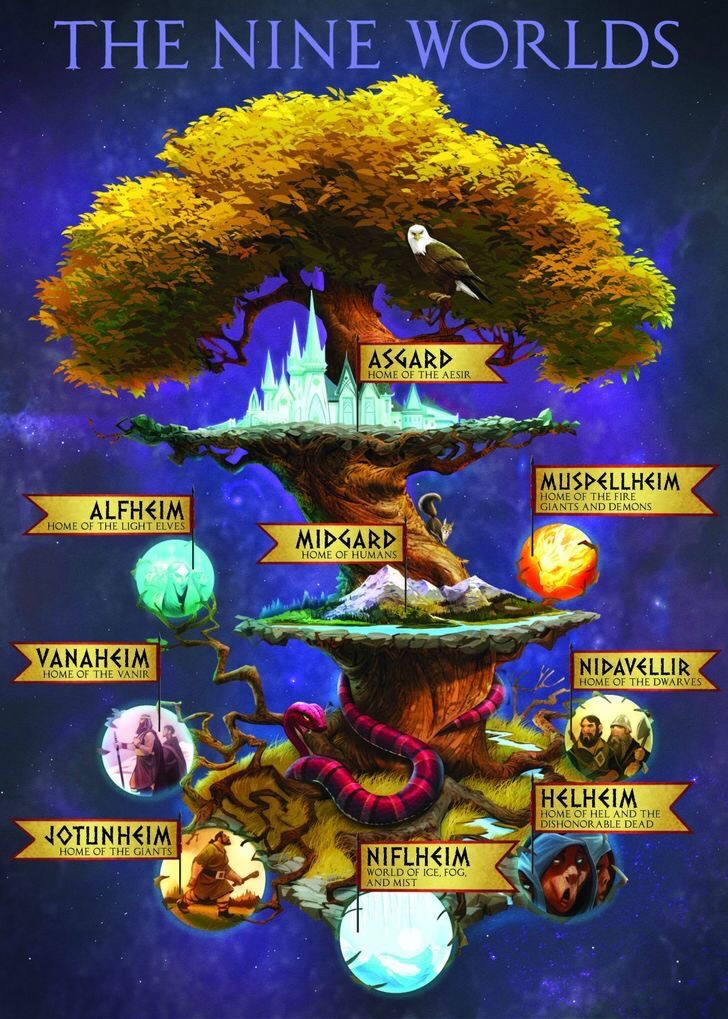
Vanaheim (Old Norse Vanaheimr, “Homeland of the Vanir“) is one of the Nine Worlds that are situated around the world-tree Yggdrasil. As the name implies, it’s the home of the Vanir tribe of deities, who tend to be somewhat more associated with fertility and what we today would call “nature” than the other tribe of Norse deities, the Aesir, who have their home in Asgard.
The surviving sources for our information on Norse mythology and religion, as fragmentary as they are, don’t contain any explicit mention of where exactly Vanaheim is located. The sole clue we have comes from the Lokasenna (“The Taunting of Loki“), one of the poems in the Poetic Edda, which states that the Vanir god Njord went eastward when he went to Asgard as a hostage at the conclusion of the Aesir-Vanir War. Presumably, then, Vanaheim lies somewhere to the west of Asgard.
Some scholars have gone so far as to claim that Vanaheim was invented by the thirteenth-century Icelandic Christian historian and poet Snorri Sturluson. However, there is one authentic and reliable Old Norse poem that mentions Vanaheim by name,so we can be reasonably certain that it was a genuine element of pre-Christian Norse religion.
It should come as no surprise, then, that the sources are completely silent as to what kind of world Vanaheim is. However, its name may contain an indication of the place’s character. One of the primary ways the pre-Christian Norse and other Germanic peoples classified geographical spaces (as well as psychological states) was with reference to their concept of the distinction between the innangard and utangard. That which is innangard (“inside the fence”) is orderly, law-abiding, and civilized, while that which is utangard (“beyond the fence”) is chaotic, anarchic, and wild. This psychogeography found its natural expression in agrarian land-use patterns, where the fence separated pastures and fields of crops from the wilderness beyond them. Of the Nine Worlds, two are innangard spaces: Asgard and Midgard, the world of human civilization. Both of these contain -gard in their names and are depicted as having a fence or fortification surrounding them. The rest of the Nine Worlds’ names end in -heim, and there’s no reference to their being enclosed in any way, which seems to indicate that they’re essentially utangard places. Such a designation is certainly in keeping with the way these places are described in Old Norse literature. Thus, we can infer that Vanaheim, like the Vanir themselves, is somewhat more wild or “natural,” and less “cultural,” than the world of the Vanir’s Aesir counterparts, or even that of humanity.
The ALA Office for Intellectual Freedom tracked 156 challenges to library, school, and university materials and services in 2020. Of the 273 books that were targeted, here are the most challenged, along with the reasons cited for censoring the books:
George by Alex Gino. Reasons: Challenged, banned, and restricted for LGBTQIA+ content, conflicting with a religious viewpoint, and not reflecting “the values of our community”
Stamped: Racism, Antiracism, and You by Ibram X. Kendi and Jason Reynolds. Reasons: Banned and challenged because of author’s public statements, and because of claims that the book contains “selective storytelling incidents” and does not encompass racism against all people
All American Boys by Jason Reynolds and Brendan Kiely. Reasons: Banned and challenged for profanity, drug use, and alcoholism, and because it was thought to promote anti-police views, contain divisive topics, and be “too much of a sensitive matter right now”
Speak by Laurie Halse Anderson. Reasons: Banned, challenged, and restricted because it was thought to contain a political viewpoint and it was claimed to be biased against male students, and for the novel’s inclusion of rape and profanity
The Absolutely True Diary of a Part-Time Indian by Sherman Alexie. Reasons: Banned and challenged for profanity, sexual references, and allegations of sexual misconduct by the author
Something Happened in Our Town: A Child’s Story About Racial Injustice by Marianne Celano, Marietta Collins, and Ann Hazzard, illustrated by Jennifer Zivoin. Reasons: Challenged for “divisive language” and because it was thought to promote anti-police views
To Kill a Mockingbird by Harper Lee. Reasons: Banned and challenged for racial slurs and their negative effect on students, featuring a “white savior” character, and its perception of the Black experience
Of Mice and Men by John Steinbeck. Reasons: Banned and challenged for racial slurs and racist stereotypes, and their negative effect on students
The Bluest Eye by Toni Morrison. Reasons: Banned and challenged because it was considered sexually explicit and depicts child sexual abuse
The Hate U Give by Angie Thomas. Reasons: Challenged for profanity, and it was thought to promote an anti-police message
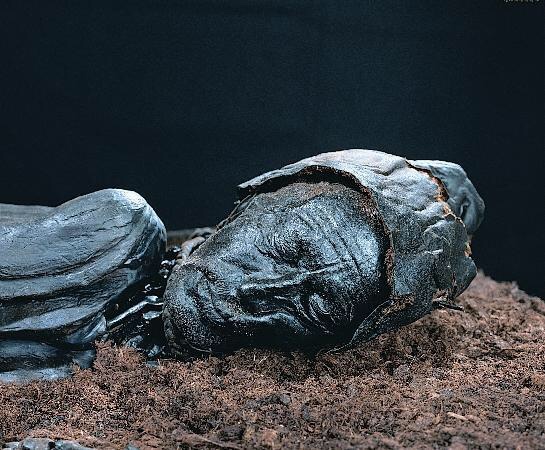
Walking around the Bjældskovdal bog in 1950, brothers Emil and Viggo Højgaard (along with Grethe, Viggo’s wife) stumbled upon a body. Believing the man to be the victim of a recent killing, they called the police. Further investigations revealed that he had indeed been murdered—some 2,300 years earlier.
The Tollund Man was found curled in the fetal position with his eyes closed and a serene expression frozen on his face. The cold, acidic, oxygen-starved conditions of the peat bog had kept him remarkably well preserved. His hair, beard stubble, eyelashes, and toenails were all intact, and he was nude, but for a sheepskin cap and wide belt around his waist. A rope was wound tightly around his neck. The Iron Age man had been hanged, likely during a ritual sacrifice.
In 1950, it was not yet known how best to preserve discoveries like Tollund Man. Accordingly, only the head of the original specimen was kept intact. The rest of the body was subjected to various tests to determine his probable age (probably around 40, due to the presence of wisdom teeth and wrinkles) and the conditions surrounding his life and death. Among the details found: Tollund Man was 5 feet 3 inches (1.6 m) tall, his final meal was a gruel made from barley and flaxseed, and his “sacrificers” (read: killers) took the time to close his mouth and eyes after death.
Thousands of “bog bodies” have been discovered in sphagnum swamps across Northern Europe, but the Tollund Man remains the best preserved. His original head and reconstructed body now reside at the Silkeborg Museum. The rope used to end his life is still wrapped around his throat.
In Norse mythology, gods and goddesses usually belong to one of two tribes: the Aesir and the Vanir. Throughout most of the Norse tales, deities from the two tribes get along fairly easily, and it’s hard to pin down firm distinctions between the two groups. But there was a time when that wasn’t the case.
The Vanir goddess Freya was always the foremost practitioner of the art of seidr, the most terribly powerful kind of magic. Like historical seidr practitioners, she wandered from town to town plying her craft for hire.
Under the name Heiðr (“Bright”), she eventually came to Asgard, the home of the Aesir. The Aesir were quite taken by her powers and zealously sought her services. But soon they realized that their values of honor, kin loyalty, and obedience to the law were being pushed aside by the selfish desires they sought to fulfill with the witch’s magic. Blaming Freya for their own shortcomings, the Aesir called her “Gullveig” (“Gold-greed”) and attempted to murder her. Three times they tried to burn her, and three times she was reborn from the ashes.
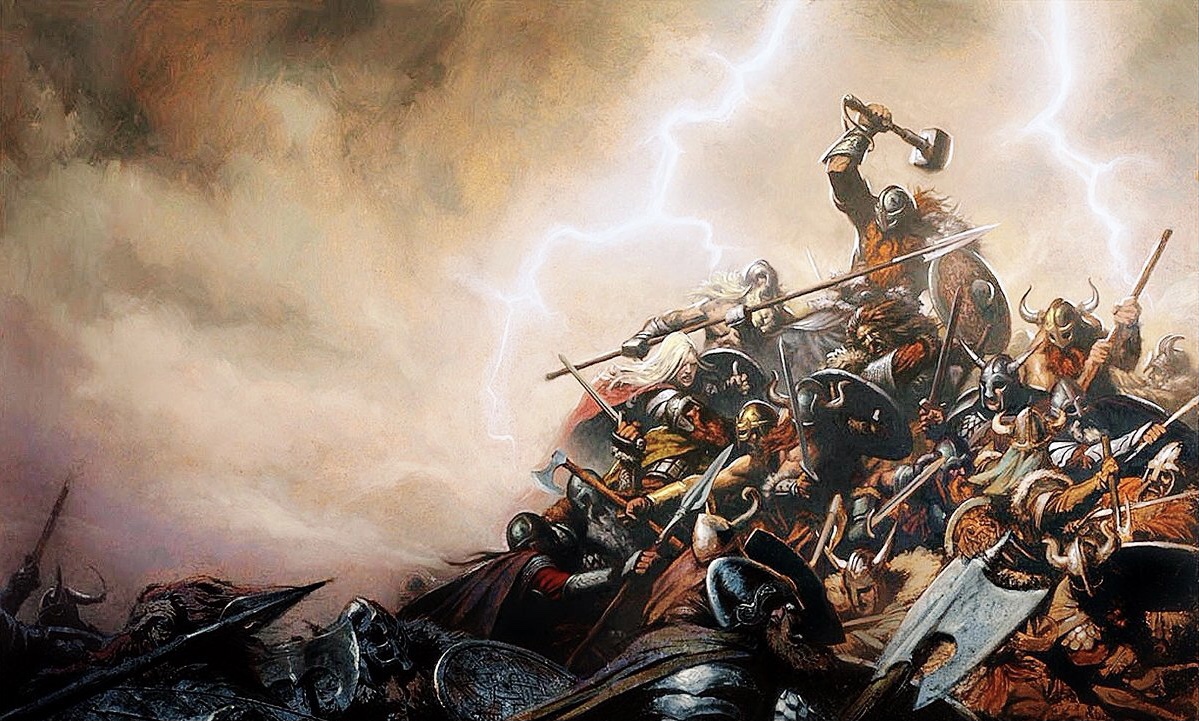
Because of this, the Aesir and Vanir came to hate and fear one another, and these hostilities erupted into war. The Aesir fought by the rules of plain combat, with weapons and brute force, while the Vanir used the subtler means of magic. The war went on for some time, with both sides gaining the upper hand by turns.
Eventually the two tribes of divinities became weary of fighting and decided to call a truce. As was customary among the ancient Norse and other Germanic peoples, the two sides agreed to pay tribute to each other by sending hostages to live among the other tribe. Freya, Freyr, and Njord of the Vanir went to the Aesir, and Hoenir (pronounced roughly “HIGH-neer”) and Mimir went to the Vanir.
Njord and his children seem to have lived more or less in peace in Asgard. Unfortunately, the same can’t be said of Hoenir and Mimir in Vanaheim. The Vanir immediately saw that Hoenir was seemingly able to deliver incomparably wise advice on any problem, but they failed to notice that this was only when he had Mimir in his company. Hoenir was actually a rather slow-witted simpleton who was at a loss for words when Mimir wasn’t available to counsel him. After Hoenir responded to the Vanir’s entreaties with the unhelpful “Let others decide” one too many times, the Vanir thought they had been cheated in the hostage exchange. They beheaded Mimir and sent the severed head back to Asgard, where the distraught Odin chanted magic poems over the head and embalmed it in herbs. Thus preserved, Mimir’s head continued to give indispensable advice to Odin in times of need.
The two tribes were still weary of fighting a war that was so evenly-matched, however. Rather than renewing their hostilities over this tragic misunderstanding, each of the Aesir and Vanir came together and spat into a cauldron. From their saliva they created Kvasir, the wisest of all beings, as a way of pledging sustained harmony.
Sources: norse-mythology.org, Sons of Vikings, Children of Ash and Elm
“I want to write because I have the urge to excel in one medium of translation and expression of life. I can’t be satisfied with the colossal job of merely living. Oh, no, I must order life in sonnets and sestinas and provide a verbal reflector for my 60-watt lighted head.” ~ Sylvia Plath, The Journals of Sylvia Plath
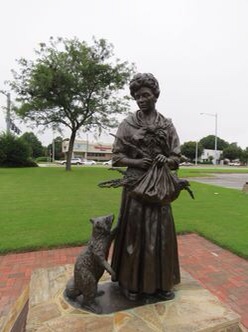
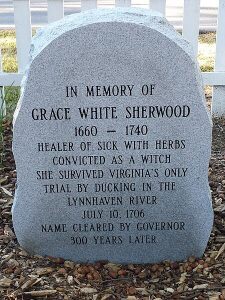
One of the most famous witches in Virginia’s history is Grace Sherwood, whose neighbors alleged she killed their pigs and hexed their cotton. A farmer, healer, and midwife, she was accused by her neighbors of transforming herself into a cat, damaging crops, and causing the death of livestock. She was charged with witchcraft several times. Sherwood was accused of bewitching her neighbor, Elizabeth Hill, causing Hill to miscarry. Other accusations followed and Sherwood was brought to trial in 1706.
The court decided to use a controversial water test to determine her guilt or innocence. Sherwood’s arms and legs were bound and she was thrown into a body of water. It was thought if she sank, she was innocent; if she floated, she was guilty. Sherwood didn’t sink and was convicted of being a witch. She wasn’t killed but put in prison and for eight years.
A satirical article (supposedly written by Benjamin Franklin) about a witch trial in New Jersey was published in 1730 in the Pennsylvania Gazette. It brought to light the ridiculousness of some witchcraft accusations. It wasn’t long before witch mania died down in the New World and laws were passed to help protect people from being wrongly accused and convicted.
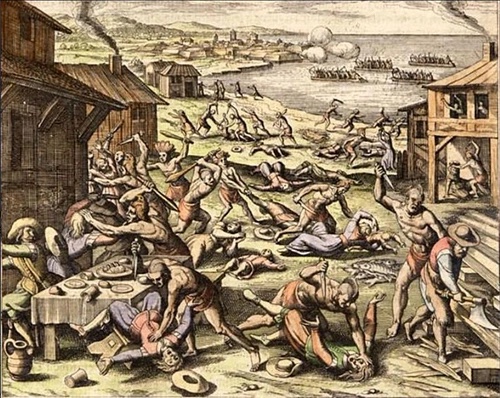
The power of the “Indian Curse” – whether in New England or in Virginia, as in the case of the equally famous Curse of Chief Cornstalk – was considered an irrefutable truth by the colonists because of their belief in the Native Americans as diabolical servants of Satan. This belief was strengthened early on by the Indian Massacre of 1622 in Virginia when, on the morning of 22 March 1622, the chief of the Powhatan Confederacy, Opchanacanough (l. 1554-1646) launched a surprise attack on the settlements, killing 347 people. Prior to the attack, the natives had appeared friendly (purposefully so, on Opchanacanough’s orders, to lower the colonists’ defenses), and this, to the colonists, was proof that no native could be trusted and all posed a potential threat.
The belief in natives wielding supernatural powers continued, however, as they became more marginalized, and it was understood that they had grounds for holding a grudge. Other minorities were equally apt to be suspect though, whether African slaves – who were thought to be able to cast spells through their own associations with Satan – or Catholics whose religious beliefs were considered diabolic by the majority of Protestants.
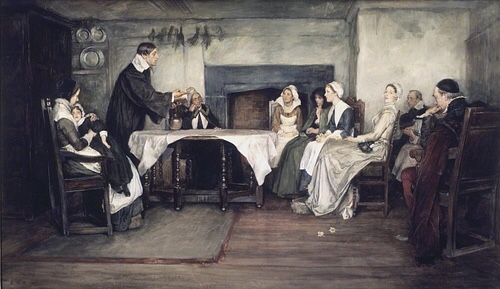
Witchcraft, thought to be practiced by all three of these groups, was understood as an intimate relationship between a person or people with Satan himself, God’s adversary, who continually plotted against those whom the Bible claimed God had made in his own image. Although the Salem Witch Trials are easily the most famous expression of the fear and hysteria generated by a belief in witchcraft, marginalized people – most often women – were charged, convicted, and hanged or otherwise dispatched in colonies from Massachusetts down to Florida.
Source: World History Encyclopedia Online, ancient.eu









 Mark Bere Peterson’s Counterculture, Urban Legends, Paganism & Witchcraft