The Zmeu is from Moldavia. It is a vampire that can take the form of a flame and enter the room of a young woman or widow. Once it enters the room of the sleeping woman, the flame becomes a man and seduces them.
The Zmeu can have legs, arms, and appear completely normal. It’s main goal is to seduce and marry women. This vampiric creature has magical and destructive powers; he can fly and shapeshift. He also has supernatural strength.
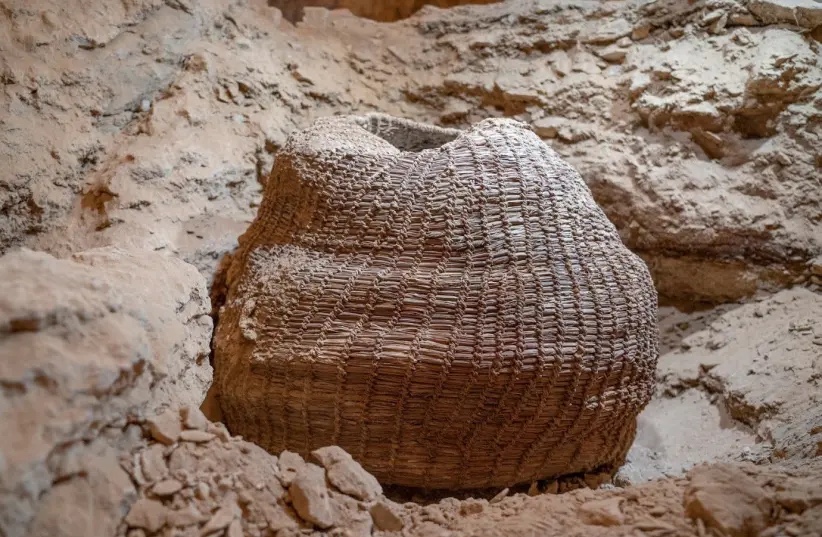
Oldest woven basket in the world found in Israel, dates back 10,000 years!
The basket was found empty and closed with a lid. Only a small amount of soil was retrieved in it and the researchers hope it will help identify what the vessel contained.
Beneath the Muslim Quarter in Jerusalem’s Old City is an underground quarry that goes by two names: Zedekiah’s Cave and Solomon’s Quarries. The names reflect the two main legends that surround this 750-foot-long (228.6 m) collection of caverns.
The first story is that King Zedekiah fled through the cave to escape from attacking Babylonians around 587 BCE. At the time, the legend goes, the cave extended all the way to Jericho—a distance of about 13 miles (21 km). The Babylonians chased Zedekiah to Jericho, capturing and blinding him. The dripping water in the cave is thus known as Zedekiah’s Tears. The second story involves King Solomon, who is fabled to have used stones from the cave to build the First Temple in the 10th century BCE.
There is no archaeological evidence to support either premise. However, chisel markings on the walls suggest Zedekiah’s Cave was one of the quarries that supplied limestone for King Herod’s Second Temple and Temple Mount expansion. The stones of the Western Wall (also called the Wailing Wall)—Judaism’s most sacred prayer site—may indeed have come from this cave.
It is the first prayer a Jewish child learns; the last thing an observant Jew says before sleep each night; the last prayer a Jew says before death; and, in a religion noticeably devoid of statements of creed, a religion that has no catechism, it is as close as you can come to a Jewish statement of essential faith.
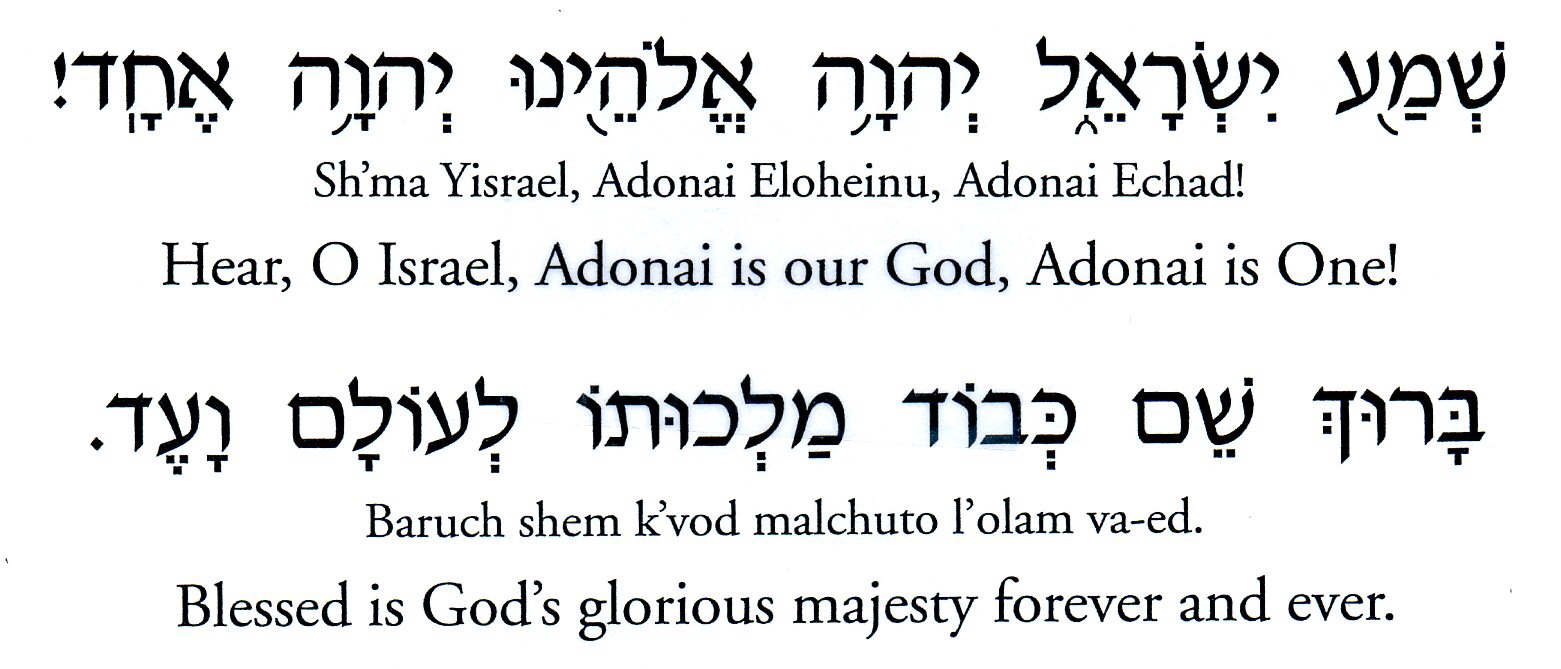
Sh’ma yisrael Adonai Eloheinu Adonai ekhad.
Hear, O Israel, our God Adonai is one.
This is the part of the prayer that almost every Jew knows but, in fact, there is considerably more to it than that one sentence, important though that sentence is. In fact, the Sh’ma is three paragraphs long, including not only this essential statement of God’s uniqueness but also sections of Deuteronomy (6:4–9, 11:13–21) and Numbers (15:37–41) that prescribe some of the most important elements of Jewish ritual, including instructions on when to recite the Sh’ma.
The full text of the prayer instructs us to recite these words “when we lie down and when we rise up,” and to wear them upon our heart and as a sign between our eyes, to inscribe them “upon doorposts of your house and upon your gates.” On the basis of these instructions, the rabbis devised the schedule of reciting the Sh’ma congregationally twice daily, at the morning and evening services, and in bed just before sleep, the idea of wearing tefillin at the morning service and placing a mezuzah on the doorways to Jewish homes (See sidebar “Mezuzah,” p. 53). In addition, the final paragraph prescribes the wearing of tzitzit, the ceremonial fringes on four-cornered garments, although Reform siddurim frequently omit that section.
The other element of the Sh’ma that amplifies its importance in Jewish theology is that the middle section, drawn from Deuteronomy 11:31–21, adds the concept of reward and punishment, a concept that is one of the cornerstones of ethical monotheism: there’s more to this than just believing in one Supreme Being; you also have to behave properly.
Given the prayer’s importance, it should come as no surprise that the rabbis ask for the utmost in concentration when it is said. Many Jews cover their eyes with their right hand while saying the opening two lines of the prayer, the better to concentrate on God’s oneness, as one prayer book has it. Maimonides writes, “One who reads the Sh’ma and does not concentrate his mind while reciting the verse ‘Hear, O Israel, our God Adonai is One,’ has not fulfilled his liturgical duty.”
The second line of the prayer,
Barukh shem k’vod malkhuto l’olam va’ed.
Blessed be the name of God’s glorious kingdom forever.
is said in an undertone except on Yom Kippur (although some Reform and Reconstructionist congregations say it aloud all year). There are several explanations for this in the rabbinic literature. Perhaps the most poetic is the notion that Moses heard the angels singing this line to God when he reached the peak of Mount Sinai; since he “stole” it from the angels, we can only recite it sotto voce until we atone for our sins on Yom Kippur and are, briefly, as pure as the angels.
Although it is usually thought of as a statement of monotheism, the Sh’ma is convincingly read as an affirmation of God’s uniqueness and unity, that the Creator is not only one and not many, but wholly Other, different from anything in the Creation. Some Hasidic thinkers go even further, suggesting that there is nothing but God, that the whole universe exists only within God.
“The time will come when diligent research over long periods will bring to light things which now lie hidden. A single lifetime, even though entirely devoted to the sky, would not be enough for the investigation of so vast a subject…And so this knowledge will be unfolded only through long successive ages. There will come a time when our descendants will be amazed that we did not know things that are so plain to them…Many discoveries are reserved for ages still to come, when memory of us will have been effaced. Our universe is a sorry little affair unless it has in it something for every age to investigate…Nature does not reveal her mysteries once and for all.”
“Fanaticism dates back much earlier than Islam. Earlier than Christianity and Judaism. Earlier than all the ideologies in the world. It is an elemental fixture of human nature, a “bad gene.” People who bomb abortion clinics, murder immigrants in Europe, murder Jewish women and children in Israel, burn down a house in the Israeli-occupied territories with an entire Palestinian family inside, desecrate synagogues and churches and mosques and cemeteries—they are all distinct from al-Qaeda and ISIS in the scope and severity of their acts, but not in their nature. Today we speak of “hate crimes,” but perhaps a more accurate term would be “zealotry crimes,” and such crimes are carried out almost daily, including against Muslims.
Genocide and jihad and the Crusades, the Inquisition and the gulags, extermination camps and gas chambers, torture dungeons and indiscriminate terrorist attacks: none of these are new, and almost all of them preceded the rise of radical Islam by centuries.
As the questions grow harder and more complicated, people yearn for simpler answers, one-sentence answers, answers that point unhesitatingly to a culprit who can be blamed for all our suffering, answers that promise that if we only eradicate the villains, all our troubles will vanish.
“It’s all because of globalization!” “It’s all because of the Muslims!” “It’s all because of permissiveness!” or “because of the West!” or “because of Zionism!” or “because of immigrants!” or “because of secularism!” or “because of the left wing!” All one needs to do is cross out the incorrect entries, circle the right Satan, then kill that Satan (along with his neighbors and anyone who happens to be in the area), thereby opening the gates of heaven once and for all.
More and more commonly, the strongest public sentiment is one of profound loathing—subversive loathing of “the hegemonic discourse,” Western loathing of the East, Eastern loathing of the West, secular loathing of believers, religious loathing of the secular. Sweeping, unmitigated loathing surges like vomit from the depths of this or that misery. Such extreme loathing is a component of fanaticism in all its guises.
For example, concepts that only half a century ago seemed innovative and exciting—multiculturalism and identity politics—quickly morphed, in many places, into the politics of identity hatred. What began with an expansion of cultural and emotional horizons is increasingly deteriorating into narrower horizons, isolationism, and hatred of the other. In short, a new wave of loathing and extremism assails us from all sides.”
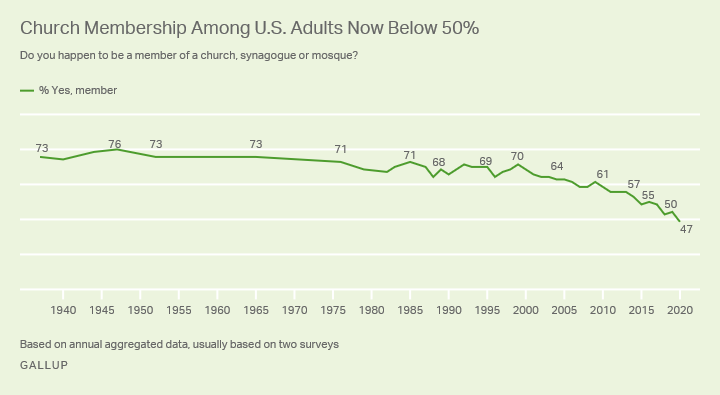
Americans’ membership in houses of worship continued to decline last year, dropping below 50% for the first time in Gallup’s eight-decade trend. In 2020, 47% of Americans said they belonged to a church, synagogue or mosque, down from 50% in 2018 and 70% in 1999.
U.S. church membership was 73% when Gallup first measured it in 1937 and remained near 70% for the next six decades, before beginning a steady decline around the turn of the 21st century.
Today in 1974 – Terracotta Army was discovered in Shaanxi province, China.
There are more than 8,000 life-sized figures in this army, which were made and buried with Qin Shi Huang, the first Emperor of China, in the third century BC. Pictured one of the three pits containing the figures.
Virginia Woolf died 80 years ago on this day in 1941:
“Dearest, I feel certain that I am going mad again. I feel we can’t go through another of those terrible times. And I shan’t recover this time. I begin to hear voices, and I can’t concentrate. So I am doing what seems the best thing to do. You have given me the greatest possible happiness. You have been in every way all that anyone could be. I don’t think two people could have been happier till this terrible disease came. I can’t fight any longer. I know that I am spoiling your life, that without me you could work. And you will I know. You see I can’t even write this properly. I can’t read. What I want to say is I owe all the happiness of my life to you. You have been entirely patient with me and incredibly good. I want to say that—everybody knows it. If anybody could have saved me it would have been you. Everything has gone from me but the certainty of your goodness. I can’t go on spoiling your life any longer. I don’t think two people could have been happier than we have been. V.”









 Mark Bere Peterson’s Counterculture, Urban Legends, Paganism & Witchcraft