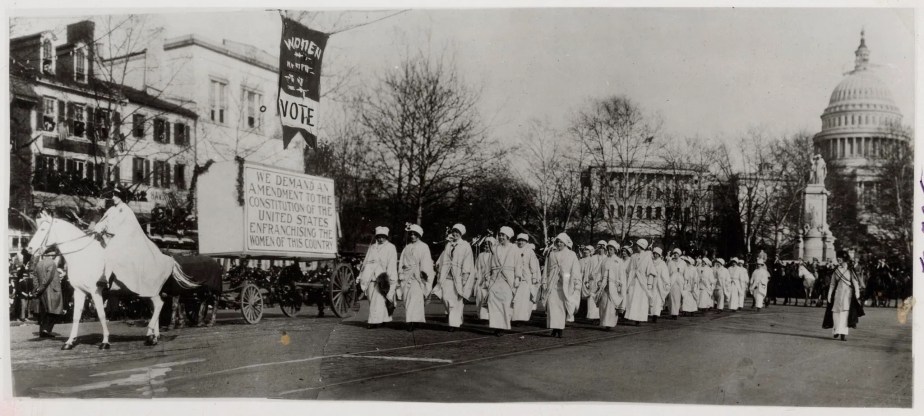
Today in Women’s Rights —-> 1913 – Thousands of women march in the Woman Suffrage Procession in Washington, D.C.
Here’s a photo of the procession, with the women all in white. They finally won the right to vote in 1920 when Tennessee became the last state needed to ratify the Nineteenth Amendment to the Constitution.
For many, this is the star of the poison plants; named for Atropos, one of the Three Fates, who held the shears with which she could cut the thread of life. It grows in scrub, woods, woodland margins and thickets with the dark purple flowers appearing in June to August and the black, shiny berries from August to November. Most people have heard of deadly nightshade even if they have never seen it growing in the wild; its combination of providing deadly poison and its use to beautify give it a romantic attraction that is hard to beat. Add to that the hallucinations it may also cause and its fascination is complete. The plant’s very name, ‘belladonna’, comes from its use by Venetian women to make themselves ‘beautiful ladies’ by causing their pupils to dilate. Before the advent of modern anaesthetics, belladonna was applied to the skin as ‘sorcerer’s pomade’ to make the patient unconscious before surgery.
Belladonna contains tropane alkaloids, notably hyoscine (also called scopolamine), hyoscyamine and atropine, with at least five other toxic components having been isolated.
The enticing berries are slightly sweet and symptoms may be slow to appear, but last for several days. They include dryness in the mouth, thirst, difficulty in swallowing and speaking, blurred vision from the dilated pupils, vomiting, excessive stimulation of the heart, drowsiness, slurred speech, hallucinations, confusion, disorientation, delirium, and agitation. Coma and convulsions often precede death. There is disagreement over what constitutes a fatal amount with cases cited of a small child eating half a berry and dying alongside a nine-year-old Danish boy who ate between 20 and 25 berries yet survived. [Poisonous Plants, John Robertson] Though the root is believed to have the highest concentration of the toxins, the berries are usually the cause of accidental poisoning because they look so tempting.
Magical propensities for inducing visions and aiding astral projection.
In a bowl cream together with an electric or hand beater the cream cheese, lemon zest, juice, sea salt and pepper to a whipped cream consistency. Fold in the capers, onion and chives.
Spread each slice of bread with a generous amount of the cream cheese mixture, distributing evenly, then the smoked salmon and rocket. Sandwich bread together, cut off the crusts and then cut into triangles.
Tip: I like to use dark rye for this recipe, but sourdough is a good alternative.
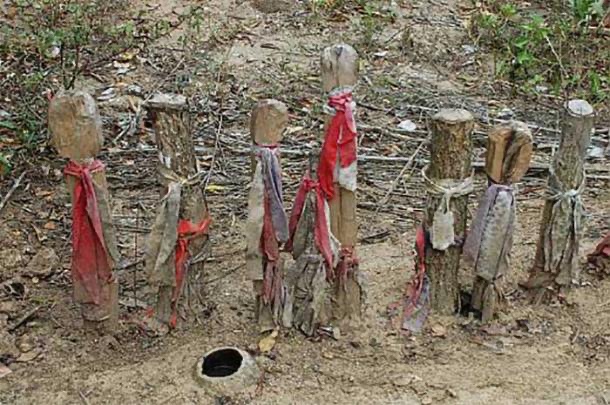
During the 1980s, Coastal Kenya experienced the largest heist of ancestral artifacts in history. Over 300 wooden Vigango statues were taken from the sacred grounds of several Mijikenda tribes. These 4-foot wooden statues were stolen and sold to western tourists and international art collectors. Since then, the Vigango statues have been discovered in private art collections and museums throughout Europe and the United States.
A majority of those Vigango pieces in circulation were sold by art dealer Ernie Wolfe III, who was accused by the New York Times in 2006 of being a prime suspect to the sale of stolen Vigango statues. Although hundreds of the statues which he sold remained in circulation, Wolfe III mentioned making efforts to stop further sales of newer Vigango statues. Much work has been made by American anthropologists Linda Giles, Monica Udvardy, and John B. Mitsanze to repatriate the looted statues back to Kenya.
The Mijikenda culture consists of nine tribes related to the Bantu ethnic groups of Kenya. Other Kenyans have derogatorily referred to the Mijikenda people either as the ‘Nyika’ or ‘Nika,’ meaning ‘bush people.’ This prejudice may be why their sacred statues may have been targets for looting, along with the pressures of crushing poverty. There are over 30 sacred Kaya forests that are used for prayer by the Mijikenda.
Vigango statues are created from the wood these sacred forests provide. The wood is resistant to termites and very dense. The statues stand 4 feet (1.22 meters) tall and have unique carved triangle etchings that symbolize abstract forms of identity that once bestowed the deceased Mijikenda elder they represent.
The purpose of the Vigango’s creation is to incarnate the spirits of dead male Gohu elders who held significant respect and immense responsibility within the Mijikenda tribal community. It is the secretive Gohu society of men who are responsible for the construction of Vigango statues.
It is customary for a family to commission a member of the Gohu to create a Vigango statue of their respected male elder a week after death. The sculptures appear two dimensional in their depiction of revered elders of significance, but in their simplicity, a plethora of complex identities are shaped with each individual Vigango statue. This ritual is often followed by a festive meal and a family gathering.
These statues also act as liaisons of communication for living community members to ask advice from wise elder spirit ancestors. The Vigango statues were said to aid in advice regarding plague, famine, and drought. Because of their essential role in the Mijikenda tribal community, Gohu are usually placed in the center of their town or near the current chief’s homestead. However, it is believed that Vigango’s advice can only be heard by those related to the people who have passed.
Ernie Wolfe III mentioned that the statues are sometimes left behind when a village relocates to another fertile region. Once the village has settled, it is up to the tribe to erect smaller statues carrying no carvings, known as Vibaos, to take the place, power, and spiritual connectivity that make the abandoned Vigango statues powerless. If this ritual is not performed, the spirits of the elders, along with their enchanted magic, remain alone and isolated in the region no longer inhabited by their people.
But the belief of deactivated Vigango statues being replaced by Vibao may be subject to scrutiny due to the controversy of Wolfe III’s own collection. In another account mentioned by the New York Times, the anthropologist Udvardy believes that Wolfe III had misinterpreted the situation and that Vigango are to forever remain in the land they were erected.
Whichever is the truth, the fact remains that the theft and displacement of these powerful spirit vessels result in their wrath towards whoever steals, purchases, and acquires them. To carry a Vigango statue is both a blessing and a curse. And those who are cursed suffer the most.
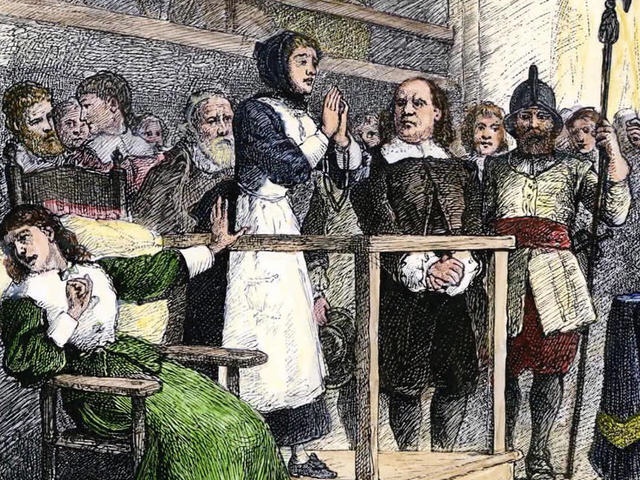
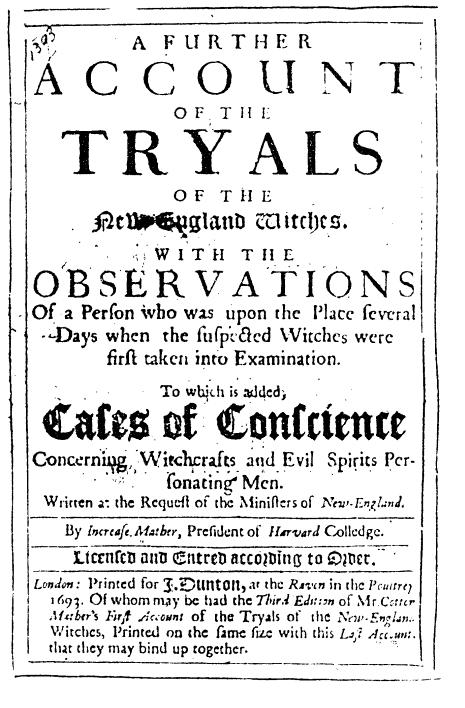
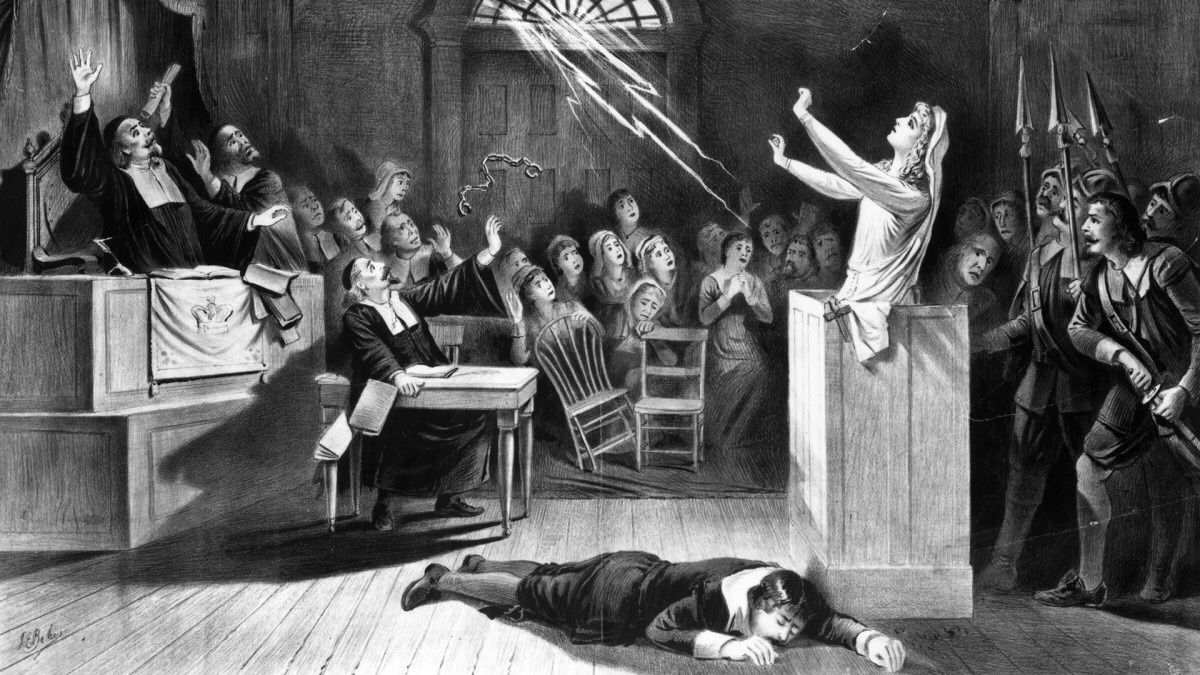
1692 – Sarah Good, Sarah Osborne and Tituba are brought before local magistrates in Salem Village, Massachusetts, beginning what would become known as the Salem witch trials.
Good was hanged, Osborne died in jail, and Tituba, thought to be a slave from South America, and then was “freed” before being sold to someone else.
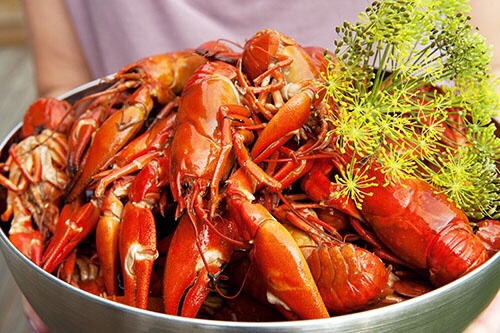
The annual ‘kräftskiva’, or crayfish party, in Sweden is not something to take lightly. It’s a celebrated with plenty of crayfish, salads and silly hats. Because the summers are so short in Scandinavia it feels right to mark the arrival of locally caught crayfish with a big party.
Dill crowns, the flowering part of the fully grown plant, are commonly found on farmers’ markets in Sweden but less readily available elsewhere. You can grow them at home, or source them from specialist suppliers who stock edible flowers and pollen varieties. Fennel fronds or dill fronds would make good alternatives.
about 50 crayfish
7oz sea salt
4 tsp caster sugar
1 pint beer
large bunch of dill crowns, stalks removed
Bring about 10½ pints (6 liters) water to the boil in a large pan and add the salt, sugar and beer. Add most of the dill crowns, reserving a few for serving, and simmer for about 5 minutes.
Add the crayfish and cook for 5–7 minutes before removing from the heat. Cool the pan quickly by placing in a tub or bath with cold water, iced if possible. The crayfish can be kept in their brine for up to 2 days.
To serve, drain and decorate with the remaining dill crowns. Serve with lemon aioli.
Timothy Leary was an American psychologist who became an iconic figure of the 1960s counterculture, coining possibly the most widely used catchphrase linked with that era: “Turn On, Tune In, Drop Out.”
However, the order in which Leary wished us to do these three things is slightly different. He felt that society was polluted by politics, and made up of sterile, generic communities that do not allow the depth of meaning needed by true individuals. The first thing he thought we should do is “Drop Out,” by which he meant that we should detach ourselves from artificial attachments and become self-reliant in thought and deed. Unfortunately, “Drop Out” has been misinterpreted as urging people to halt productivity, which was never his intention.
Next, Leary tells us to “Turn On,” or delve into our unconscious, and “find a sacrament which returns you to the temple of God, your own body.” This is a command to explore deeper layers of reality, as well as the many levels of experience and consciousness. Drugs were one way to do this, and Leary, a Harvard professor, began experimenting with the hallucinogenic drug LSD.
To “Tune In,” Leary asks us to return to society with a new vision, seeking fresh patterns of behavior that reflect our transformation, and to teach others our newfound ways.”
Born in the city of Weil der Stadt near Stuttgart, southern Germany, in 1571, Johannes Kepler witnessed the Great Comet of 1577 as a small child, marking the start of his fascination with the heavens. While studying at the University of Tübingen, he developed a reputation as a brilliant mathematician and astrologer. He corresponded with various leading astronomers of the time, including Tycho Brahe, ultimately moving to Prague in 1600 to become Brahe’s student and academic heir.
Following Brahe’s death in 1601, Kepler took on the post of Imperial Mathematician, with a royal commission to complete Brahe’s work on the so-called Rudolphine Tables for predicting the movements of the planets. He completed this work in Linz, Austria, where he worked from 1612 until his death in 1630.
Apparently oats were originally a weed found in wheat and barley crops that eventually became a crop on its own. The Greeks and Romans of classical times regarded oats as coarse and used them mostly as animal fodder. The Romans called it avena, and considered them only fit to feed barbarians.
Their neighbors, the Celtic and Germanic peoples, took an entirely different view and used oats extensively. In the northern and upland regions of Europe, oats are the only cereal which will ripen in the cold wet climate. Oats were first cultivated around 1000 B.C.E. in Central Europe. The first record of the cultivation of oats in England is a location called athyll (“on oat hill”) in Anglo Saxon records from 779 CE. There is a record of the bishop of Worcester’s oat lands mentioned in a boundary charter dated 984 CE. Ground oats mixed with milk, cream or water was a very common meal for working people. It was not until the fifteenth century that flour made from oats was first referred to as oatmeal.
1 1/2 cups oatmeal
3 cups all purpose flour
1 cup brown sugar
1/2 cup molasses
1/2 cup golden syrup
3 teaspoons ground ginger
1/2 cup (1 stick) butter or lard
1 teaspoon allspice
1/8 teaspoon mace
1/8 teaspoon nutmeg
3 teaspoons cinnamon
2 teaspoon baking powder
1/2 teaspoon salt
1 egg
1 cup milk
Preheat oven to 350 F (180 C).
Soak the oats in the milk in a small bowl for a half hour.
Whisk together the rest of the dry ingredients in a larger bowl. Stir the brown sugar and the egg together in another large bowl. In a small saucepan over low heat, melt the butter and stir in the molasses and golden syrup. Mix the butter/syrup mixture to the brown sugar mixture. Stir in the dry ingredients until just blended. Place in a greased 9 X 11 inch pan. Bake for about 45 minutes, or until the cake starts to come away from the sides of the pan. A toothpick inserted into the middle should come out clean and the cake should spring back when touched.
Alternatively you can roll the batter into small balls, roll them in oatmeal, and bake them on a cookie sheet until brown.









 Mark Bere Peterson’s Counterculture, Urban Legends, Paganism & Witchcraft