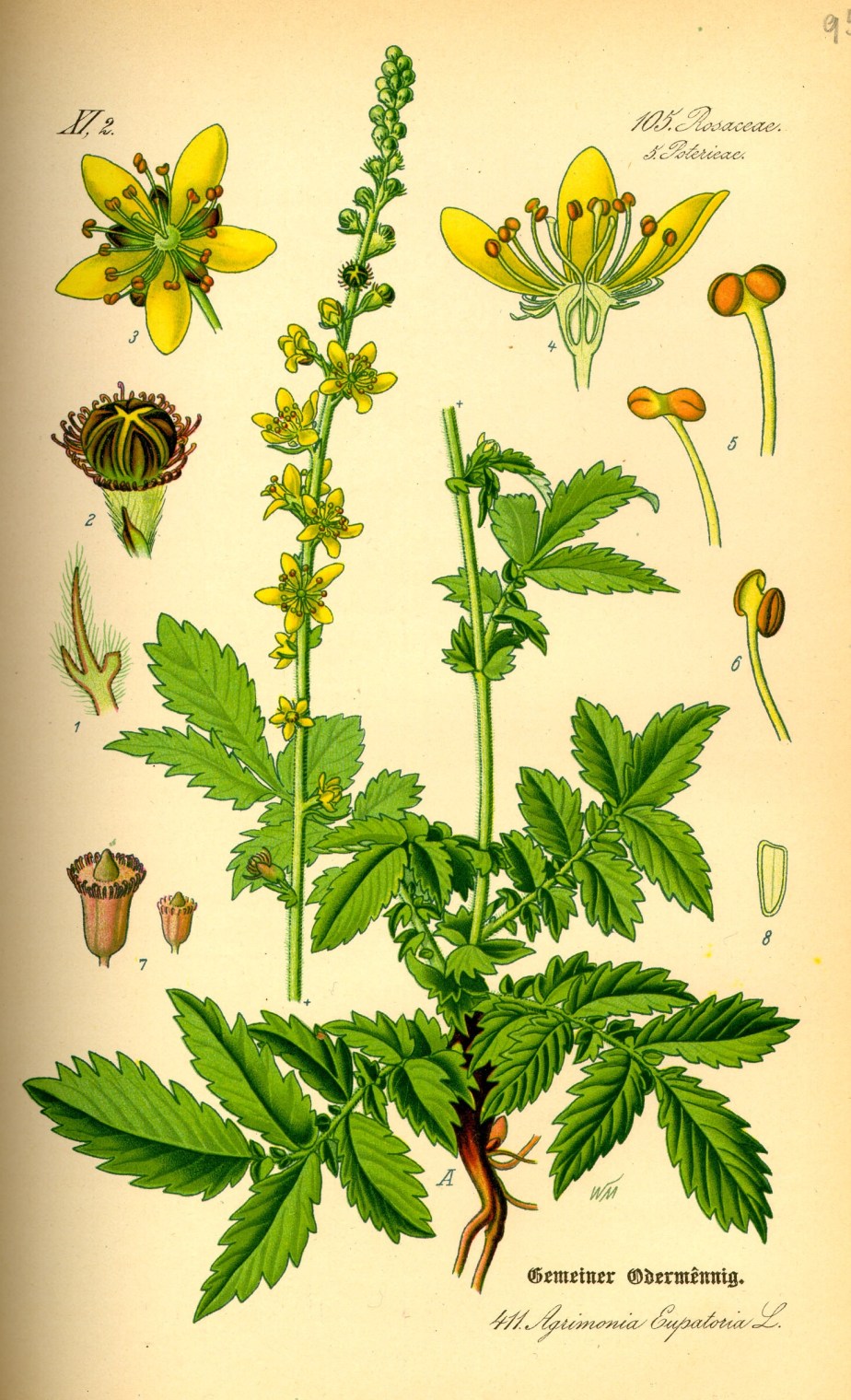
Agrimony

Diagnosis:

One of the most frequent health problems, especially when traveling is “diarrhea,” which affects up to 80 percent of people who go to high-risk countries (Africa, Asia, and Central and South America) where the sanitary conditions of water purification, and food preparation and preservation, are not very safe. In many cases, it is limited to mild cases of diarrhea lasting two or three days, but it can make traveling difficult. In other cases, diarrhea is accompanied by fever, nausea, vomiting, and even dehydration. Diarrhea is mostly due to drinking polluted water and consuming food with toxins.

Dosage:

For its tannin content, agrimony is considered an astringent that can be used to treat diarrhea. To stop serious persistent diarrhea, drink an infusion of agrimony that you prepare by mixing a teaspoon of the plant per cup of water. Boil it for two minutes, let it steep for fifteen minutes, and strain it. Drink three cups a day for three days to notice its effect.

Other Uses:

Precisely because of its richness in tannins it is also effective for gargling as a treatment for pharyngitis or tonsillitis. Externally, it is an excellent remedy against dermatitis because it relieves intense itching.

Source: Medicinal Plants at Home

Tokyo Ghoul

Tokyo Ghoul is set in an alternate reality where ghouls, creatures that look like normal people but can only survive by eating human flesh, live among the human population in secrecy, hiding their true nature in order to evade pursuit from the authorities. Ghouls have powers including enhanced strength and regenerative abilities – a regular ghoul produces 4–7 times more kinetic energy in their muscles than a normal human; they also have several times the RC cells, a cell that flows like blood and can become solid instantly. A ghoul’s skin is resistant to ordinary piercing weapons, and it has at least one special predatory organ called a kagune, which it can manifest and use as a weapon during combat. Another distinctive trait of ghouls is that when they are excited or hungry, the color of their sclera in both eyes turns black and their irises red. This mutation is known as kakugan (“red eye”).

The story follows Ken Kaneki, a student who barely survives a deadly encounter with Rize Kamishiro, his date who reveals herself as a ghoul and tries to eat him. He is taken to the hospital in critical condition. After recovering, Kaneki discovers that he underwent a surgery that transformed him into a half-ghoul. This was accomplished because some of Rize’s organs were transferred into his body, and now, like normal ghouls, he must consume human flesh to survive. Ghouls who run a coffee shop called “Anteiku” take him in and teach him to deal with his new life as a half-ghoul. Some of his daily struggles include fitting into the ghoul society, as well as keeping his identity hidden from his human companions, especially from his best friend, Hideyoshi Nagachika.

Sources: Tokyo Ghoul Manga, Wikipedia

Hunter S. Thompson Funeral

Thompson killed himself with a gun, and his funeral was a gala event:

On August 20, 2005, in a private funeral, Thompson’s ashes were fired from a cannon. This was accompanied by red, white, blue, and green fireworks—all to the tune of Norman Greenbaum’s “Spirit in the Sky” and Bob Dylan’s “Mr. Tambourine Man”. The cannon was placed atop a 153-foot (47 m) tower which had the shape of a double-thumbed fist clutching a peyote button, a symbol originally used in his 1970 campaign for sheriff of Pitkin County, Colorado. The plans for the monument were initially drawn by Thompson and Steadman, and were shown as part of an Omnibus program on the BBC titled Fear and Loathing in Gonzovision (1978). It is included as a special feature on the second disc of the 2004 Criterion Collection DVD release of Fear and Loathing in Las Vegas, and labeled as Fear and Loathing on the Road to Hollywood. According to his widow, Anita, the $3 million funeral was funded by actor Johnny Depp, who was a close friend of Thompson’s. Depp told the Associated Press, “All I’m doing is trying to make sure his last wish comes true. I just want to send my pal out the way he wants to go out.” An estimated 280 people attended, including U.S. Senators John Kerry and George McGovern; 60 Minutes correspondents Ed Bradley and Charlie Rose; actors Jack Nicholson, John Cusack, Bill Murray, Benicio del Toro, Sean Penn, and Josh Hartnett; musicians Lyle Lovett, John Oates and David Amram, and artist and long-time friend Ralph Steadman.

The tower holding the cannon was torn down later in 2005 (photo by Paul Conrad, the Aspen Times):

Ezra Pound

Today in 1949 – Ezra Pound is awarded the first Bollingen Prize in poetry by the Bollingen Foundation and Yale University.

At the time Pound, an American, was locked in St. Elizabeths mental hospital in Washington, D.C., where he stayed for 12 years. He had been charged with treason but was never tried. His fellow artists helped secure his release in 1958, and he went to Italy, where he died in 1972. Here’s his mug shot when he was arrested.

Garlic Fresh Cheese

Garlic Fresh Cheese

Foraging is integral to the rural Scandinavian way of life and each season offers some delicious ingredient from nature’s bounty. Scandinavians actively seek out wild garlic when it’s in season so if you’re out in the woods in spring, collect a few leaves.  This garlic fresh cheese is delicious with sourdough.

2 lbs. 4oz Greek yogurt *

1 tbsp sea salt

2 tbsp extra virgin olive oil

small bunch of garlic leaves (preferably wild), finely chopped

½  lemon, zest and juice (optional)

Stir the yogurt in a large bowl with the sea salt. Transfer to a sieve lined with a double layer of muslin and set over a large bowl. Wrap up the ends of the muslin tightly, twisting and securing with an elastic band. Leave in a cool place to drain for 24 hours.

The following day, heat 1 tablespoon of the oil in a small pan and add the wild garlic. Sauté for a minute or so until wilted. Allow to cool.

Unwrap the drained yogurt and place in a bowl, discarding the liquid. Stir in the wild garlic and season with pepper and a little lemon juice and zest, if desired, for a tangier version. Adjust the salt to taste, then drizzle over the remaining oil before serving.

*Real Greek yogurt is best as the original kind from Greece is properly strained and has the right consistency for this recipe. Do not use ‘Greek-style’ yogurt as this description can mean anything, and won’t necessarily have as good a texture or as delicious a flavour.

Foundation for Individual Rights in Education (FIRE) “Worst Colleges for Free Speech”

Foundation for Individual Rights in Education (FIRE) awards its yearly “Worst Colleges for Free Speech”

University of Tennessee, UT Health Science Center, Memphis, TN. A doctoral student in pharmacy was investigated for her excessive “sexuality” in her social-media posts, even though she didn’t identify herself as a student in the program. She’s sued the university.

St. John’s University, Queens, NY. A professor was removed from the classroom indefinitely for asking students whether the transatlantic slave trade had any positive effects on biodiversity. He didn’t try to justify slavery; this was part of a course on the effects of transatlantic ship traffic on biodiversity. He’s sued the University.

Collin College, McKinney, TX. A history professor criticized Mike Pence on Twitter during the Vice-Presidential debate, saying that the moderator “needs to talk over Mike Pence until he shuts his little demon mouth up.”  The college issued a statement condemning her tweets and gave her a written warning despite the fact that her tweets were protected by the First amendment. Collin College then refused to renew her contract. Collin College did several other questionable things that are detailed in the piece.

Haskell Indian Nations University, Lawrence, KS. This is a publicly-funded school. It kicked out a student during the pandemic, forcing him to sleep in his car, for criticizing a university official. It also tried to order the student newspaper not to criticize the University.

New York University, New York, NY. NYU’s school of medicine tried to prevent its doctors from making any public comments about the coronavirus without consulting the University. This constitutes “prior restraint”. (NYU is a private school but swears to uphold free speech.)

Duquesne University, Pittsburgh, PA. A professor gave a student permission to say the n-word during a class discussion about why it’s inappropriate to use the word. The prof didn’t say the word, but allowed a student to do so pedagogically. The professor was removed from the class and then suspended for seven months without pay, including mandatory training.  The prof has hired an attorney.

Frostburg State University, Frostburg, MD. Like NYU, this school told its employees not to speak to the media about how the school was handling the pandemic. (That’s illegal, as this is a public school.) It then investigated and harassed a reporter for the student newspaper who criticized the school’s pandemic response.

Northwestern University in Qatar, Doha, Qatar. This Qatari branch of the Chicago school canceled a rock band concert because the lead singer was openly gay, citing “safety concerns.” They had the event on the U.S. campus, but violated freedom of expression overseas.

University of Illinois at Chicago. A law professor asked a hypothetical question on a law-school exam using redacted words. The question included an assertion that a person said they were called “a ‘n______’ and ‘b_______’. (profane expressions for African Americans and women”  Yes, the words were censored on the exam. And how could he have posed a hypothetical any more sensitively? After all, to judge the case you need some idea how the words were used. Nevertheless, UIC opened an investigation into the professor’s exam. This is chilling of speech, pure and simple.

Fordham University, New York, NY. Fordham has repeatedly refused to recognize a chapter of Students for Justice in Palestine because “its sole purpose is advocating political goals of a specific group.” This has been going on for four years. As I’ve said, I consider SJP an Islamist organization, but it’s both illegal and unethical to not recognize it when it recognizes other organizations with political agendas. The school also suspended a student for legal postings on his Instagram account.

And. . . . a school gets a Lifetime Censorship Award for repeated violations of its free-speech code! Voilà:

There’s too much to recount, but here’s one paragraph:

Even inaugurating a new chancellor in 2014 did not stem the tide of student rights abuses — Kent Syverud oversaw the dismantling of an entire engineering fraternity and the expulsion of several members in 2018 over their private satirical “roast.” Syracuse claims that the voluntary skit constituted “conduct that threatens the mental health” of others once it was leaked to the public — an assertion so preposterous that it led to lawsuits in state and federal court, where university attorneys attested, under oath, that the school’s speech promises are, in fact, worthless. Syracuse concluded the decade by rejecting a Young Americans for Freedom chapter over its conservative viewpoints, banning all fraternity social activity despite no evidence of misconduct by any of the students, and, most recently, placing a professor on leave for writing “Wuhan Flu or Chinese Communist Party Virus” on his course syllabus.

It’s sadly ironic that the university itself argues that its promises of free expression are worthless. Parents, don’t let your children grow up to be Syracuse students!

As a palliative, here are FIRE’s top five for free speech:

  1. The University of Chicago
  2. Kansas State University
  3. Texas A&M University
  4. University of California, Los Angeles
  5. Arizona State University

Buckwheat Pancakes

1 cup buckwheat flour

2 tablespoons potato flour or ground yellow maize flour

2 tablespoons coconut flour

2 teaspoons gluten-free baking powder

1/8 teaspoon Himalayan salt

1½ cups coconut milk

1 tablespoon melted coconut oil

1–2 teaspoons grapeseed oil

To make the pancakes, combine the buckwheat flour, potato flour, coconut flour, baking powder and salt in a large bowl.

Add the coconut milk, coconut oil and ½ cup water and whisk well. The amount of water you need depends on how thick you prefer your batter; add a bit more for thinner batter.

Heat a non-stick frying pan over medium heat. Brush the pan with some of the grapeseed oil.

Pour ¼ cup of the batter into the pan and cook for 2–3 minutes, or until bubbles appear on the surface. Turn and cook the other side for 2 minutes, or until cooked through. Transfer to a plate and keep warm.

Cook the remaining batter in the same way, adding more grapeseed oil to the pan as needed. You should have enough batter to make eight pancakes.

Sam the Trinity Fox

As the Irish Times reports:

Sam, the fox living on the grounds of Trinity College in Dublin, and who was seen wandering the streets of Dublin during the first lockdown, has found love and is pregnant.

Last year the health of the vixen was of concern as she appeared emaciated. With all restaurants and bars closed and the city centre all but deserted during the first lockdown she was deprived of scraps. She also developed mange on her tail.

In response, staff at Trinity College Dublin left out meat infused with an antibiotic for her and she has not looked back.

The latest development involving Sam the fox happened last month, when she was in heat.

She attracted two suitors, who have been named Prince and Scar by college staff, who fought for her affections.

The festival of Lupercalia

The festival of Lupercalia

The ancient Roman festival of Lupercalia (celebrated to avert evil spirits and purify the city, releasing health and fertility) has been one of the earliest records of the term Valentine’s Day. But the holiday isn’t what you would imagine.

The event, which was held February 13 to February 15, began with the traditional sacrifice of an unlucky goat and dog.

A group of priests called the Luperci then cut off a piece of the skin of the two animals, touched it to their foreheads and then struck it against every woman nearby. The thinking, it was said, is that the women hoped it would help make them more fertile.

By the end of the 5th century, Pope Gelasius I had seen enough — he replaced Lupercalia with St. Valentine’s Day.